
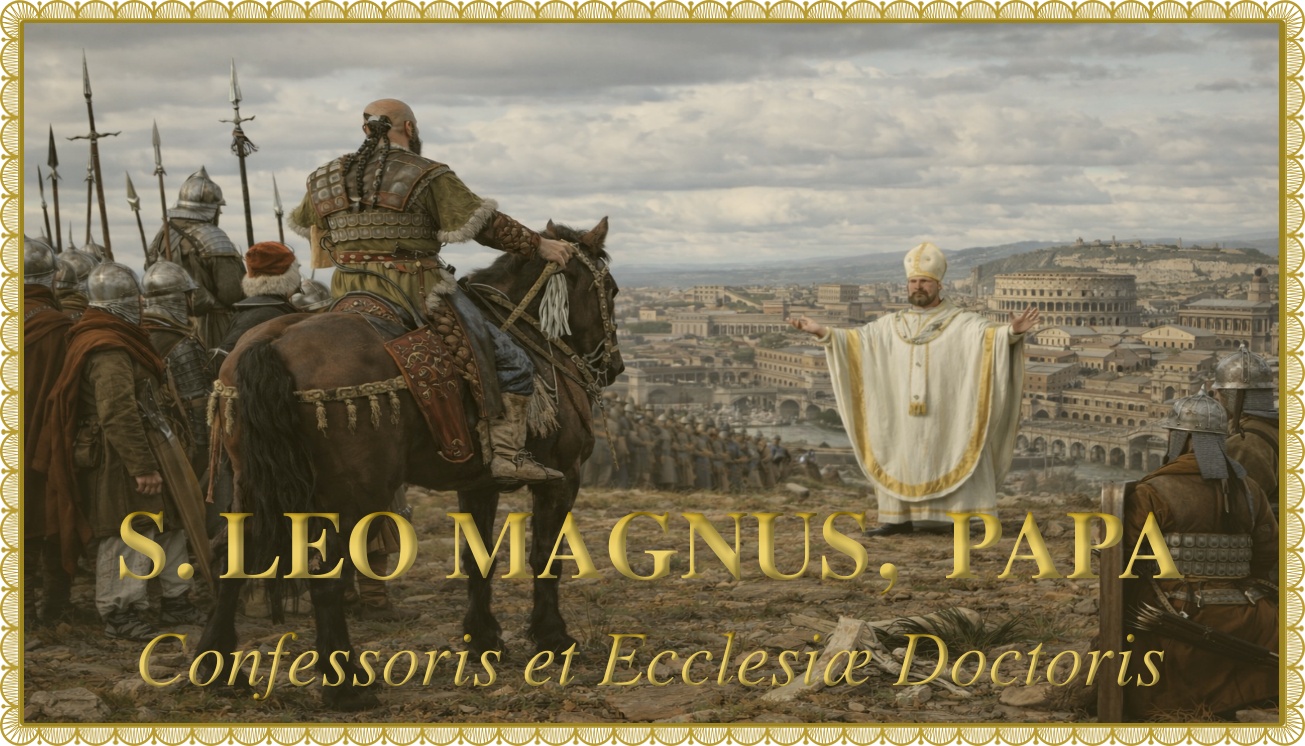
St. Leo the Great
by the Revd Dr Robert Wilson PhD (Cantab), Old Roman Apostolate UK
Today we celebrate the feast of St. Leo the Great. His family was probably Tuscan, but he seems to have grown up in Rome. Little is known about his early life, but he discerned his vocation at an early age, rising to a prominent role among the Roman clergy under Celestine I and Sixtus III. He had been sent to mediate in a dispute in Gaul in 440 when Sixtus died and he was the natural choice to be his successor as Bishop of Rome. He soon displayed the great gifts as a pastor and ruler for which he later became famous. Many of his sermons and letters have survived. He seems to have been so identified with his role as the successor of St. Peter that there is little sense of his own personality. His sermons clearly expound the central doctrines of the faith and are powerful exhortations to the faithful to follow the life of holiness.
He lived in an age of great controversy, in which these gifts were much needed. In 448 he received a letter from Eutychus, an abbot in Constantinople, complaining about a revival of the Nestorian heresy. The following year Eutychus wrote again complaining about his excommunication by Flavian, the Patriarch of Constantinople. It became clear that Eutychus had fallen into the Monophysite heresy, the opposite error from Nestorianism. The Emperor Theodosius II summoned a council at Ephesus to deal with the matter. It was packed with supporters of Eutychus and presided over by Dioscorus, Patriarch of Alexandria, an unscrupulous character and strong supporter of Eutychus. St. Leo called it the “Robber Synod” because it acquitted Eutychus and condemned Flavian, who died soon afterwards from his violent mistreatment. It seemed that the orthodox cause was lost and that Monophysitism was now firmly entrenched.
History took another course due to Theodosius’ death after a fall from his horse. His successor Marcian summoned a council at Chalcedon in 451 which condemned Eutychus and excommunicated and deposed Dioscorus. The Tome which St. Leo had written to Flavian in 449 was now confirmed as the standard of orthodoxy and it has remained the basis of the Church’s teaching ever since.
St. Leo now had to turn his attention to protecting his native Italy from an invasion in 452 by Attila the Hun. He had already caused much destruction and was moving towards sacking Rome, but St. Leo went out to meet him and he was induced to withdraw, being content with an annual tribute. Three years later he was unable to prevent the Vandal general Gaiseric from sacking the city, but he did manage to persuade him to be content with pillaging the city instead of massacring the inhabitants. St. Leo had to devote the remainder of his life to dealing with the aftermath of this damage, but he remained stedfast in the face of great adversity. He died on November 10th 461.
What was the central issue at stake in the Christological controversy that St. Leo faced? At the time there were two great schools of theological thought in the Church, associated with the patriarchates of Antioch and Alexandria. The latter strongly emphasised the unity of the person of Christ and his divinity as the Word made flesh. This was vital to safeguard the doctrine of the incarnation, as St. Cyril of Alexandria had shown, but it tended in consequence to place less emphasis on the humanity of the Saviour. Eutychus and his patron Dioscorus (St. Cyril’s successor as Patriarch of Alexandria) were extreme partisans of this school of thought who fell into the error of Monophysitism, in which the divine nature was seen to replace the human in the person of the Saviour. By contrast, the school of Antioch placed greater emphasis on the distinction between the divine and human natures, but found it more difficult in consequence to maintain the unity his person. Nestorius was an extreme exponent of this school of thought. He drew such a sharp contrast between the two natures that he denied to Mary the title Theotokos (bearer of God). He had been condemned at the Council of Ephesus in 431, but the situation had subsequently moved to the opposite extreme and it was necessary for the Council of Chalcedon in 451 to condemn Eutychus as well as Nestorius.
How did St. Leo provide a solution to this dispute? He was not an original thinker like the leading exponents of the rival schools of Antioch and Alexandria. He followed the Latin tradition which had first been expounded by Tertullian and viewed the Saviour as one person in two natures. This enabled him to incorporate the strengths of both sides, without falling into the errors of their more extreme partisans. In agreement with the school of Antioch, St. Leo affirmed the reality of both the divine and human natures in the person of the Saviour and clearly repudiated the Monophysite errors of Eutychus and Dioscorus, for whom the divine had displaced the human in Christ. In agreement with the school of Alexandria St. Leo affirmed the unity of the person of Christ and that Mary was rightly called Theotokos, because she conceived in her womb the Word made flesh. Hence, he also repudiated Nestorius, who had denied this. This teaching was affirmed at Chalcedon, which emphasised both the unity of the person of the Word made flesh and the reality of both the divine and human natures, without change, division or separation.
It has often been noted that the Roman Church did not produce an original thinker to rival the great schools of thought in Antioch and Alexandria. John Henry Newman wisely responded to this charge (that it had originated nothing in the early ages of the Church) that herein lay the greatest strength of the Church of Rome. It was content to guard the deposit of faith that had been entrusted to it and address practical matters, rather than indulging in excessive theological speculation.
Concerning the lasting achievements and legacy of St. Leo it has been well said: “At the very moment in which the whole fabric of the Western Empire was threatened with dissolution, the Roman Church arose in her might, and with her splendid tradition and the record of an almost blameless past, undertook the guidance of mankind. In Leo she possessed a commanding personality who did not shrink from the responsibility of his position. In his faults and in his virtues he was the incarnation of ancient Rome. If he was lacking in sympathy, and perhaps also in generosity, he was full of courage, uprightness and consciousness of a great mission.. An iron man in an iron age, Leo was well fitted to prepare the Church to survive the crash of a falling world.”
Let us pray that we will follow the example of St. Leo in upholding in our own time and place that same faith once delivered to the saints.



Leave a Reply