
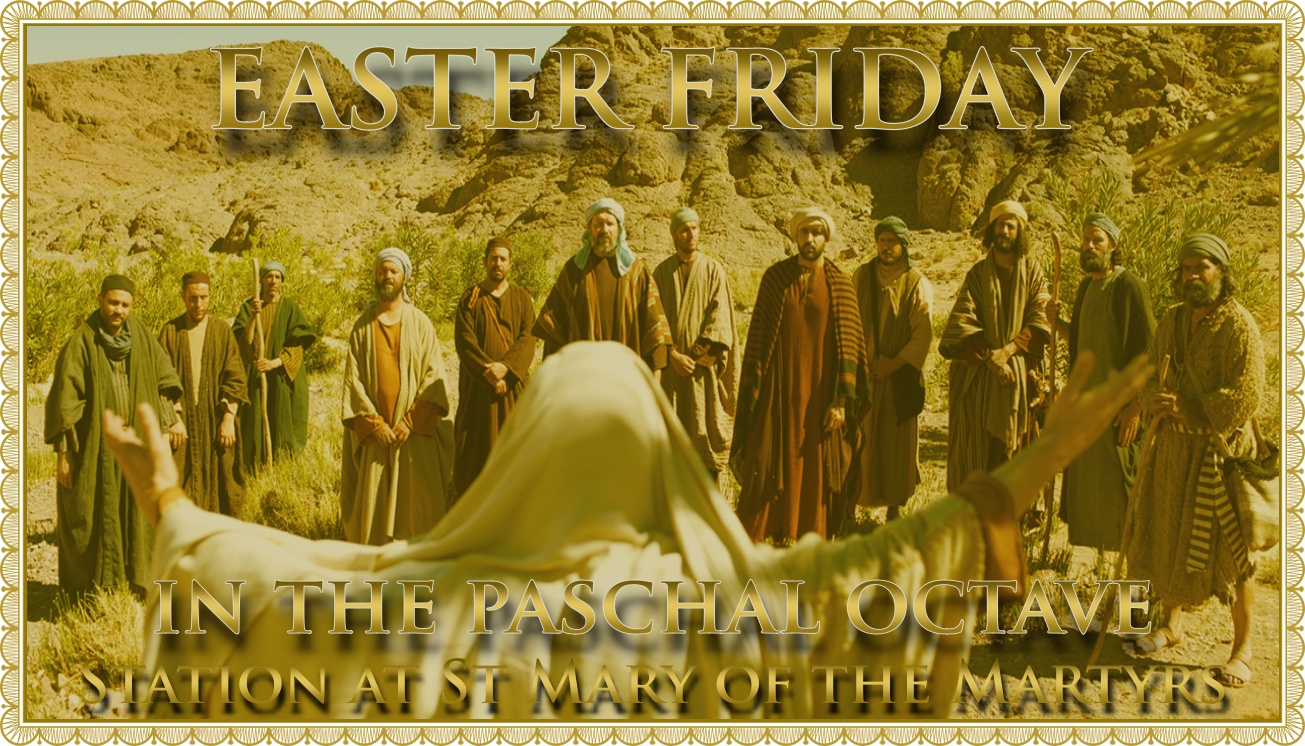
Easter Friday
by the Revd Dr Robert Wilson PhD (Cantab), Old Roman Apostolate UK
Today’s Gospel from St. Matthew records that the eleven disciples went to Galilee to a mountain where Jesus had appointed them. He said to them: “All power is given to me in heaven and earth. Going, therefore, teach ye all nations, baptising them in the name of the Father, and of the Son, and of the Holy Ghost; teaching them to observe all things whatsoever I have commanded you. And behold I am with you all days, even to the consummation of the world.”
The Gospel has recorded how the women who came to the tomb on the first Easter morning had found it empty. They had seen an angel who had told them that Jesus had risen from the dead and that the disciples should go to Galilee where they would see him. It was there (as we heard today) that he made his great commission to them to summon the nations to turn from their idols and repent and be baptised and live in accordance with his teachings. This scene forms the climax and conclusion of the Gospel.
The Book of Daniel recorded a vision of a future time when the power of the beasts would overthrown and be given instead to the son of man, who would be enthroned alongside the Ancient of Days. The beasts symbolised the pagan nations who were oppressing Israel, but their power which rested on force and violence would not last forever, for it would be transferred to the son of man, the representative of the saints of the most high, the faithful remnant of Israel, who would inherit the kingdom and possess it for ever. The forces of evil that seem so all pervasive in this present world would eventually self destruct and God’s kingdom would finally come on earth as it is in heaven.
Jesus had proclaimed that the Kingdom of God, future in its fullness, was now breaking into history in his own person and ministry. Though he clearly saw himself as the agent of God’s final deliverance he preferred to refer to himself as the Son of Man rather than the Davidic Messiah. This is not because (as has sometimes been supposed) the Son of Man was a more modest title than the claim to be the Davidic Messiah. It was because the latter suggested a warrior and a conqueror, whereas the Son of Man pointed to his future enthronement and rule. Hence, when Peter made his great confession of faith at Caesarea Philippi Jesus acclaimed him as the rock on which his Church (the faithful remnant of Israel) would be built, but moved on to speak of himself as the Son of Man, whose messianic destiny, enthronement and rule could only come about through reversal, repudiation, suffering and death. Likewise, at his trial before the Sanhedrin Jesus was asked whether he was the Christ. He did not deny this, but immediately went on to speak of the Son of Man from now on being seated at the right hand of the power and coming with the clouds of heaven, a clear reference to himself as the one in whom Daniel’s vision would be fulfilled. It is not surprising that the authorities found his claims blasphemous.
Hence, when the resurrected Jesus commissioned his disciples by declaring that all power in heaven and earth had been given to him he was saying that he had now been enthroned as the Son of Man as the book of Daniel had said. But instead of establishing an independent Jewish nation by defeating the Romans and rebuilding the temple, he had won the decisive victory over the forces of evil as the Suffering Servant of Isaiah, who was wounded for our transgressions and chastised for our iniquities. He had established his kingdom not by force and violence but by taking evil upon himself and somehow subsuming it to good. He had taught and embodied the power of love, rather than the love of power.
It is important also to emphasise that this does not mean that the Kingdom of Christ is a purely private and personal matter that has no impact on how human societies are governed. Jesus did indeed tell Pilate that his kingdom was not of this world, meaning that it was not based on force and violence. But when he made his great commission to his disciples he said that all power in heaven and earth had been given to him. His sovereignty was not simply in heaven but on earth as well. The existing powers that be in this world (whatever delusions of grandeur they may have had and still have about themselves) are not the ultimate authority. That is why so many of the early Christians became martyrs, for they were witnesses (and the word martyr means witness) to a higher lordship than that of the Emperor. Hence, they could not participate in the idolatrous deification of the civil power. They gave allegiance to another king, one called Jesus. His kingdom may not have been based on force and violence, but that emphatically did not mean that it was a purely private and personal matter that did not threaten the status quo in this world. Though the final coming of the kingdom was still in the future, it had already been inaugurated in Jesus’ life, death and resurrection.
St. Peter spoke in his epistle (which we heard today) of how “Christ died once for our sins, the just for the unjust, that he might offer us to God.” In the days of Noah, the faithful had been saved by water. “Whereunto baptism being of the like form, now saveth you also, not in putting away the filth of the flesh, but by the pledge of a good conscience towards God, by the resurrection of our Lord Jesus Christ, who is on the right hand of God.”
St. Peter wrote his epistle to the Christians of Asia Minor, warning them of coming persecution, shortly before his own martyrdom under Nero. Despite the trials and tribulations which they were facing they should persevere and always be willing to give an explanation for their hope. In their baptism they had died to their sins and pledged to live a new life according to the teachings of the Saviour, who had triumphed over the powers of evil by his glorious resurrection from the dead.
Let us pray for grace to be faithful to that same great commission to go and teach all nations, baptising them in the name of the Father, and of the Son, and of the Holy Spirit. Let us give thanks for his promise always to be with us until the final consummation of his kingdom at the end of the age, in that new heaven and new earth, wherein dwelleth righteousness.






Leave a Reply