
Power and Truth: Why Fidelity Stands Outside and Ultimately Triumphs
The Asymmetry of Modern Institutions
Progressives want power; conservatives want truth. This simple contrast explains one of the most persistent realities of modern institutional life: those who seek to change an institution from within rarely leave it, and those who seek to preserve its foundational identity are the ones driven out. Across politics, academia, culture, and the Church, the same asymmetry appears again and again. Progressives remain inside institutions they denounce, clinging to the machinery they wish to reshape, while conservatives—faithful to the original mission—stand outside because they refuse to collaborate in its dismantling. The paradox is that the most loyal are expelled, and the most hostile are enthroned.
This dynamic arises from radically different understandings of what an institution is. For the progressive, an institution is an instrument: a mechanism through which society, doctrine, or culture can be reconstructed. Truth is seen as evolving, authority as constructive, and tradition as negotiable. For the conservative, truth is received rather than invented, tradition is inheritance rather than hindrance, and institutions exist to guard rather than reinvent. When these two visions collide, the institution almost always aligns with those who still desire to wield its authority, rather than those who remind it of the constraints of its identity.
The Paradox of Progressive Rage
The most striking contradiction, however, is that progressives rage most loudly against the very institutions they refuse to leave. Their denunciations are constant: the institution is corrupt, unjust, oppressive, outdated, rigid, or structurally compromised. Yet leaving is inconceivable. They must remain, for the institution—by its prestige, its authority, its structures, its global platform—provides the power they seek. Their criticism is not an act of renunciation but a method of conquest. They attack in order to rule. And because their influence grows by sustaining crisis, the institution must never be permitted peace. A satisfied institution is a useless tool for revolution. Perpetual complaint becomes the engine of internal capture.
Meanwhile, those who defend the institution’s identity—those who honour its founding purpose, its doctrinal or constitutional roots, its inherited moral framework—find themselves pushed aside. Their fidelity becomes an inconvenience. Their refusal to bend becomes a scandal. Their continuity becomes a threat to those who insist that change is the highest virtue. Paradoxically, defending the institution becomes the quickest way to be removed from it.
Truth on the Margins of History
This cycle is not new. It is woven into the story of civilisation. Again and again, those who preserve truth are exiled, while those who assail truth are enthroned. Yet, over the long arc of history, the exiles are the ones vindicated.
Athanasius was exiled repeatedly for defending the divinity of Christ when most bishops had submitted to Arian ambiguity¹. Maximus the Confessor had his tongue and hand cut off for refusing to compromise with Monothelitism, yet his Christology was later affirmed as orthodox². John Fisher and Thomas More were executed for remaining faithful to papal authority, while reformers who raged against Rome occupied the bishoprics³. Cardinal József Mindszenty was silenced and sidelined, first by totalitarian regimes and then by ecclesiastical diplomacy, yet he stands today as the embodiment of Catholic courage⁶.
Vindication in the Secular Sphere
The same pattern unfolds in secular history. Socrates exposed the hypocrisies of Athenian power; the city raged and executed him, yet Western philosophy begins with him. Ignaz Semmelweis insisted on handwashing to prevent maternal deaths; the medical establishment erupted in scorn and fired him, yet modern medicine regards him as a pioneer⁸. Alfred Wegener, mocked and dismissed for proposing continental drift, died before plate tectonics vindicated him⁹. Václav Havel was imprisoned as a danger to the state; he later became president of a free nation⁷. Alan Turing, who broke the Enigma code and helped save millions, was destroyed by the state he served, yet he is now honoured as the father of modern computing.
These witnesses—sacred and secular—tell the same story: those cast out for truth ultimately triumph because truth outlasts power. Institutions that abandon their identity eventually decay; those who keep the truth become the seed of renewal when collapse comes.
The Ecclesial Crisis of Our Time
This is the key to understanding the contemporary ecclesial crisis. Those who rage against doctrine, tradition, and the Church’s moral teaching remain firmly embedded within its structures. They do not leave; they cannot leave. They need the Church’s machinery to advance the very changes they demand. Yet those who hold fast to the Church’s perennial magisterium—whether in diocesan parishes, traditional communities, the SSPX, the Old Roman Apostolate, or faithful missions such as the Servants of the Holy Family—are characterised as obstacles, as rigid, as divisive, as schismatic. They are pushed to the margins not because they reject the Church, but because they refuse to reject what the Church has always taught.
Their situation mirrors that of Athanasius contra mundum, of Fisher standing alone in the English hierarchy, of Newman misunderstood by both Anglicans and Catholics, of Mindszenty standing against political coercion and ecclesiastical timidity. It is fidelity in exile. But exile for truth has always been the birthplace of restoration. The Church’s history shows that renewal seldom comes from the bureaucratic centre; it comes from the margins where the deposit of faith has been kept intact.
The Primacy of Truth Over Power
The fundamental question before the Church and the West is whether truth will be subordinated to power, or whether power will once again be judged by truth. History makes the answer clear. The institutions that choose power lose themselves. Those who guard the truth preserve civilisation.
This is why the guardians of doctrinal continuity today—whether in the SSPX, the Old Roman Apostolate, the Servants of the Holy Family, or faithful diocesan communities—find themselves at the edge of ecclesial structures. It is not because they have departed from the faith, but because they refuse to depart from what the faith has always been. Their fidelity, like that of the great witnesses before them, stands in quiet judgment over the institutions that have compromised. And as the testimony of history shows, it is from such faithful outposts—small, steadfast, often hidden—that renewal finally emerges.
- St Athanasius, Apologia ad Constantium, 356.
- Third Council of Constantinople, Definition of Faith, 681.
- Calendar of State Papers, Henry VIII, 1535–1536, trial records of Fisher and More.
- John Henry Newman, Apologia pro Vita Sua, 1864.
- Aleksandr Solzhenitsyn, The Gulag Archipelago, 1973.
- József Mindszenty, Memoirs, 1974.
- Václav Havel, “The Power of the Powerless,” 1978.
- Ignaz Semmelweis, The Etiology, Concept, and Prophylaxis of Childbed Fever, 1861.
- Alfred Wegener, Die Entstehung der Kontinente und Ozeane, 1915.


Latest
- Today’s Mass: September 09 Day II in the Octave of The Nativity of the Blessed Virgin MaryThe feast of Our Lady’s Nativity, of ancient Eastern origin and established at Rome by the time of Pope St Sergius I, celebrates Mary as the immaculate New Eve and the dawn of salvation, the chosen tabernacle from whom the Redeemer would take His flesh. Today the Church also commemorates St Gorgonius, an officer of the imperial household at Nicomedia who, with his companion Dorotheus, embraced the Faith and suffered martyrdom under Diocletian in A.D. 303; his relics were later translated to Rome.
- NOMEN MANET, RES DEEST ~ The Name Remains; the Reality Is Lacking: Spiritual Conference for Nuntiatoria CXXIIThe content emphasises the disconnect between the names associated with Catholicism and the actual practices of faith. It highlights the importance of embodying belief through genuine actions, urging self-examination rather than mere external observance. Ultimately, it advocates for a restoration of sincerity in faith, calling individuals to authentically reflect their beliefs through their lives and worship.
- Mary Is Co-Redemptrix: Cardinal Burke Reopens Rome’s Marian ControversyCardinal Raymond Leo Burke has declared the Virgin Mary as “Co-Redemptrix” amidst controversy over the Vatican’s restriction on this title. The debate revolves around the appropriateness of certain theological language and whether terminology historically used can still accurately express Marian cooperation in Redemption without compromising Christ’s unique role.
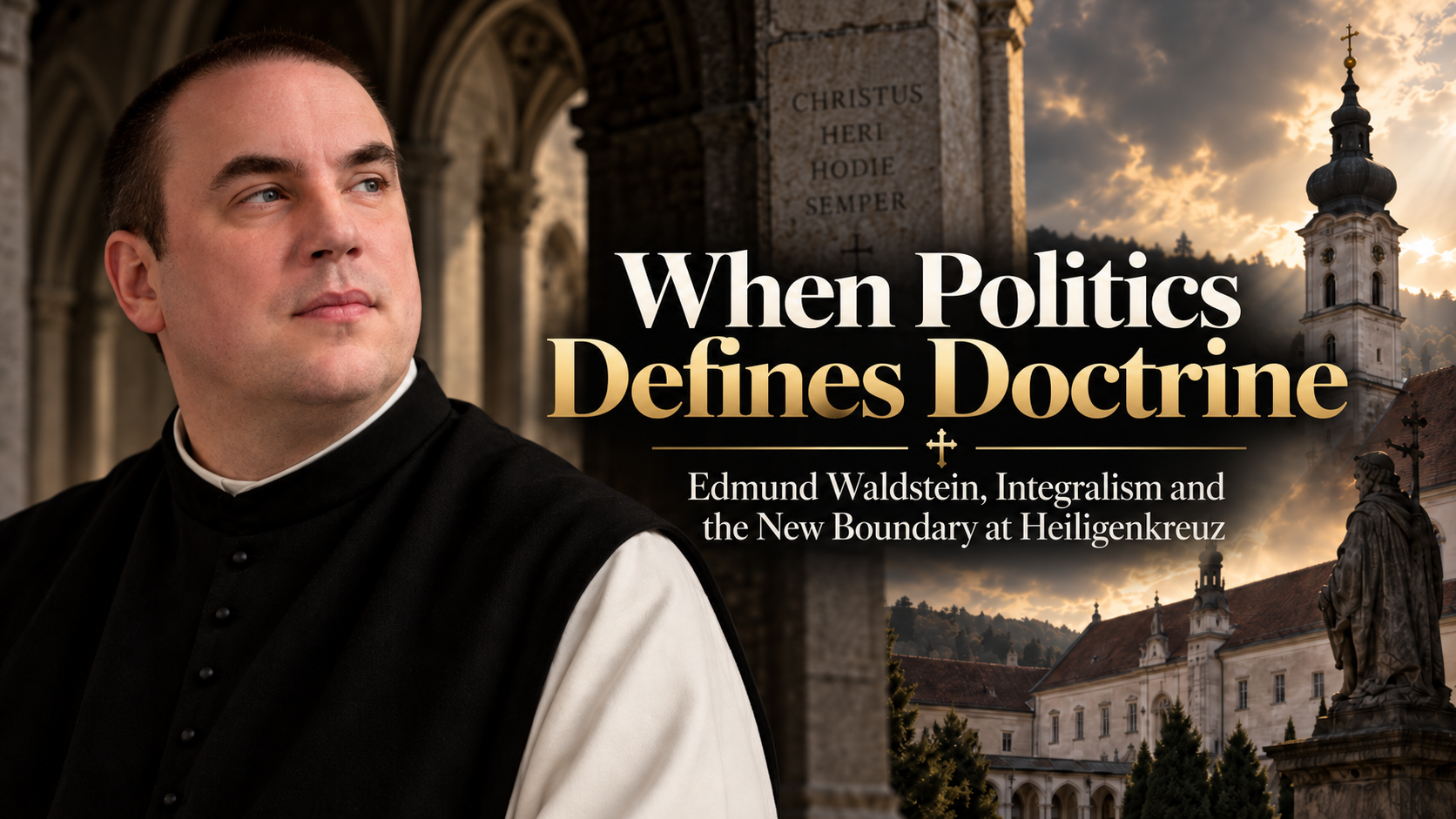
- When Politics Defines Doctrine: Edmund Waldstein, Integralism and the New Boundary at HeiligenkreuzThe ongoing exclusion of Father Edmund Waldstein from teaching at Heiligenkreuz has sparked debate on the limits of acceptable Catholic thought, particularly regarding integralism and its relationship to Church doctrine. Critics argue that Waldstein and similar positions challenge both Catholic teachings and democratic values, raising questions about the intersection of faith and politics.
- Christianity Is Right ~ Not Right WingThe article discusses the distinction between Catholic orthodoxy and modern political ideologies, particularly the Right and Christian nationalism. It argues that Catholic beliefs about family, morality, and authority predate contemporary political classifications and should not be conflated with right-wing politics. The ordo amoris framework is presented as a guiding principle for evaluating political alliances while maintaining a focus on the common good and the Social Kingship of Christ.



Leave a Reply