
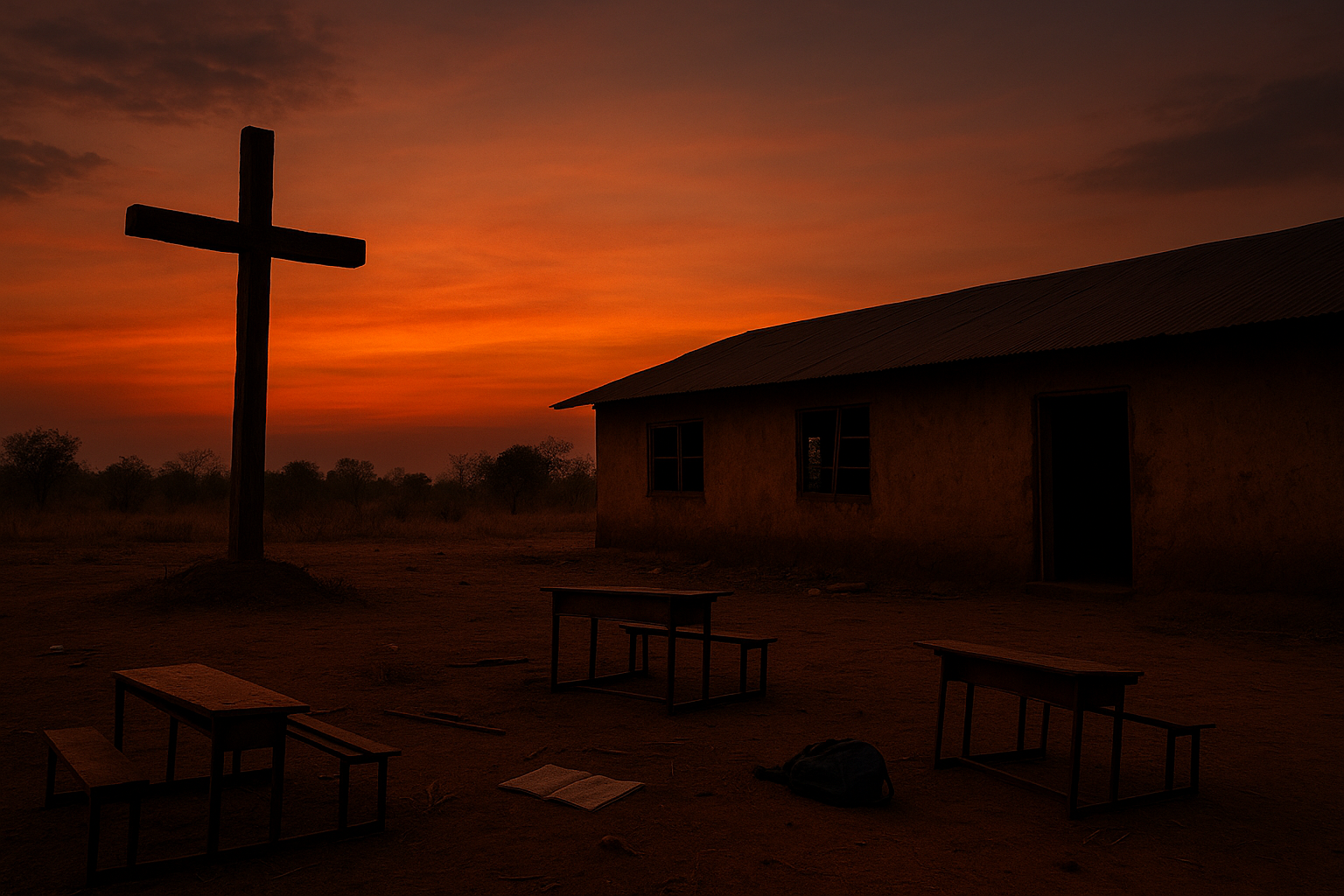
Christmas Under Threat: Nigerian Christians Mark the Nativity in Fear
As Christmas approaches, Christian communities across northern Nigeria are once again compelled to mark the Nativity under conditions of fear, displacement, and persistent violence. In regions long afflicted by Islamist insurgency and militia attacks, public celebrations have been curtailed or abandoned altogether, as pastors and faithful alike brace for renewed attacks timed deliberately to coincide with the Christian feast.¹
In Chibok, a predominantly Christian town within Nigeria’s Muslim-majority Borno State, Pastor Paul Maina of the Church of Christ in Nations (COCIN) has cancelled traditional Christmas festivities entirely. Once characterised by public carolling, shared meals, and midnight services attended even by non-Christian neighbours, Christmas is now observed quietly and often in secrecy. “These were happy times,” Maina recalls. “But that is no more.”¹
A Community Living Under Threat
Chibok has long been a focal point of Boko Haram’s campaign of terror. Since the Islamist insurgency began in 2009, Nigeria has seen waves of violence from Boko Haram and its break-away affiliate Islamic State West Africa Province (ISWAP), as well as armed militias, especially in central and northern regions.² Data collected by multiple monitoring organisations shows that Nigeria ranks among the world’s most violent contexts for Christians, accounting for a disproportionate share of global faith-related killings and abductions.³
In the weeks leading up to Christmas this year, jihadist militants and ethnic militia factions have reportedly been sighted moving between villages, often on motorbikes—a tactic designed to spread panic and uncertainty. Residents now sleep in surrounding bushes rather than in their homes, fearing night-time raids. Churches, being obvious targets, are avoided; even open-air gatherings carry serious risk.¹
Pastor Maina, who shepherds a congregation of approximately 300, gathers his flock sporadically and without fixed location. Christmas Eve services have been cancelled following military warnings against outdoor events between 7 p.m. and 6 a.m. “We are not free to celebrate,” he says.¹
Strategic Targeting of Christian Holidays
Across Nigeria’s north and Middle Belt, pastors and observers report that Islamist and militia actors have shown a marked tendency to target Christian communities around religious holidays. Recent reports note that jihadist attacks on Christmas Eve and Christmas Day in previous years resulted in dozens or hundreds of deaths across remote villages, reflecting a pattern in which extremists exploit the predictability of holiday gatherings and travel to inflict maximum physical and psychological damage.⁴
On Christmas Day 2023, coordinated attacks across Plateau State left scores of Christians dead and hundreds wounded during a week-long assault on several communities in the Middle Belt. Similar violence again marked the end of 2024 in Benue State, with dozens reported killed.⁴ As one Nigerian clergyman observed, the objective is not merely territorial control but the demoralisation of Christian communities: “They don’t want Christians to enjoy Christmas.”¹
Displacement, Hunger, and Silent Camps
Violence has also devastated food security. Christmas falls during the dry season when farmers harvest and store crops, yet many now harvest early or abandon fields altogether. Armed Fulani herders, often operating as irregular militias and not formally aligned with Boko Haram, have clashed with predominantly Christian farming communities, contributing to displacement and the destruction of property.²
Many Christians now spend Christmas in camps for internally displaced persons. In Chibok, such camps reportedly have no Christmas services. While aid organisations provide food and clothing, the absence of communal worship underscores the depth of displacement—not only from homes but from ordinary religious life.¹
Pastor Maina has presided over more than a dozen funerals of Christians killed this year alone. His overriding hope is simply to avoid burying more of his flock during the Christmas season. “The local government cannot do a thing,” he notes, adding that even soldiers often retreat when militants appear.¹
International Political Response and Indigenous Advocacy
The plight of Nigerian Christians has drawn attention beyond Africa. In late 2025, the President of the United States designated Nigeria a “Country of Particular Concern” under the International Religious Freedom Act, asserting that Christianity faces an existential threat and accusing radical Islamist groups of mass killings.⁵ This designation underscores concern among some Western policymakers that violence against Christians has reached crisis levels, prompting legislative resolutions in the U.S. Congress condemning the persecution of Christians and urging decisive action.⁶
However, Nigerian government officials have pushed back against characterisations of systematic religious persecution, urging that violence in the country — which affects communities of all faiths — reflects broader security challenges that include ethnicity, organised crime, and weak governance.⁷ The Christian Association of Nigeria (CAN) has responded by affirming the severity of attacks on Christian communities, calling for transparent and equitable action from the Nigerian government to protect all citizens and secure churches and villages targeted by extremist violence.⁸
The Nativity Under the Cross
Amid these realities, the theological meaning of Christmas comes into sharp focus. The muted and threatened celebration of the Nativity among persecuted Christians is not an aberration from the Christian story but a stark return to its origins. Christ is born not into comfort, but into danger; not into universal welcome, but into a world marked by hostility. From the flight into Egypt to the slaughter of the Innocents, the Incarnation bears the shadow of suffering from its first hour.⁹
St Leo the Great insists that the humility of the Nativity is itself a moment of spiritual combat. Christ enters history clothed in weakness precisely to confront the powers of sin and death on their own ground. “He who is true God is born in the complete and perfect nature of a true man,” Leo writes, so that “the new man might repair the old.”¹⁰ The manger is not a sentimental tableau, but the opening act of the redemptive conflict that culminates on Calvary.
St Augustine sharpens the paradox. The eternal Word comes among men not with visible power but in concealment. “He lay in a manger,” Augustine observes, “yet He held the world together.”¹¹ Where Christ is hidden, He is not absent; where He appears weak, He is already victorious. The Church, forced to celebrate Christmas quietly, precariously, or in fear, lives this same mystery: divine strength veiled beneath apparent vulnerability.
St Gregory Nazianzen insists that the Incarnation demands participation rather than observation. “Christ is born: glorify Him,” he exhorts — but this glorification is inseparable from sharing His abasement.¹² To welcome the Child of Bethlehem is to accept the path He sets before His followers: humility, suffering, and fidelity under trial.
Seen in this light, the improvised and threatened Christmases of northern Nigeria are not aberrations but a conformity to the deepest pattern of Christian life. Emmanuel, God-with-us, is present not in security but in danger; not in triumphal display but in faithful endurance. Here martyrdom is often not sealed by blood alone, but by perseverance — the daily resolve to gather, to worship, and to confess Christ when celebration itself has become an act of defiance.
Such Christmases stand as a judgment on a sentimentalised faith that has forgotten the cost of the Incarnation. They remind the wider Church that the Child born at Bethlehem already bears the shadow of the Cross — and that His glory is revealed most fully where that Cross is most faithfully borne.
¹ Emmanuel Nwachukwu, “Amid Fear of Attacks, Many Nigerians Mute Christmas,” Christianity Today, 19 December 2025.
² Christian Association of Nigeria statement, via CSW, “Christian Association of Nigeria clarifies position on violence against Christian communities,” October 2025. csw.org.uk
³ UK Parliament briefing on freedom of religion in Nigeria; World Watch List ranking and statistics on Christian deaths. House of Commons Library
⁴ “A Tense Christmas for Christians Hunted in Nigeria,” persecution.org, December 2025. persecution.org
⁵ “Trump declares Nigeria ‘Country of Particular Concern’ amid violence targeting Christians,” Crux, November 2025. Crux
⁶ H.Res.866 — Condemning the persecution of Christians in Nigeria (119th U.S. Congress, 2025). Congress.gov
⁷ Reporting on Nigeria’s rejection of mass-persecution claims and government perspective. Al Jazeera
⁸ CAN statement as above. csw.org.uk
⁹ Matthew 2:13–18.
¹⁰ St Leo the Great, Sermon 21, 2–3 (PL 54:192–195).
¹¹ St Augustine, Sermon 184, 3.
¹² St Gregory Nazianzen, Oration 38 (On the Theophany), 1–3.


Latest
- Today’s Mass: October 24 St Raphael the ArchangelThe Feast of Saint Raphael the Archangel highlights his healing powers as depicted in the Book of Tobit, where he aids Tobit and his son, Tobiah. Venerated as a protector of travellers and the blind, Raphael is celebrated for his miraculous interventions. His legacy includes support for nurses, matchmakers, and Catholic studies.
- 25.10.26 Nuntiatoria CXXIX: CHRISTUS REXThe text discusses the relationship between Christ’s kingship and authority within the Church amidst contemporary challenges. It contrasts ecclesiastical power with genuine faith, emphasising that authority must protect divine truth rather than alter it. The witness of imprisoned priests illustrates the enduring significance of fidelity to Christ over institutional conformity.
- THE DOMESTIC CHURCH: 25 October – 2 November 2026 A Home with Room for Heaven: Preparing for All Saints and All SoulsThe content outlines a week’s plan for traditional Catholic families to prepare for the feasts of All Saints and All Souls. Emphasising daily prayers, remembrance of the deceased, and engagement with children’s activities, it aims to integrate Catholic customs into family life, enriching spiritual practices and fostering a shared faith experience.
- ORDO w/c 25.10.26The text outlines the liturgical calendar for the last week of October and the beginning of November, highlighting key celebrations. Notable events include the Feast of Christ the King, St Evaristus, the Vigil of Saints Simon and Jude, and the Feast of All Saints, emphasising themes of holiness, unity in faith, and the Church’s teachings.
- Christ the King: The Sovereignty of the Crucified RedeemerThe Mass of Christ the King articulates core Catholic beliefs about Jesus’ divine authority, redemptive sacrifice, and the essence of His Kingdom. It emphasises Christ as Prophet, Priest, and King, whose sovereignty is inseparable from His mission of reconciliation, calling the faithful to acknowledge His authority and embrace moral duties rooted in divine truth.




Leave a Reply