

The Semiotics of the Papacy: Why “Small Traditions” Matter
In the first eight months of his pontificate, Pope Leo XIV has quietly—but consistently—recovered a series of minor customs and practices associated with the Roman Pontificate that had either fallen into disuse or been deliberately set aside in recent years. None of these changes, taken individually, constitutes a doctrinal intervention. None alters the deposit of faith, the text of the Missal, or the formal structures of canon law. Yet together they represent something more consequential: the reconstitution of the visible language by which the papal office is recognised, interpreted, and understood.
This development has not gone unnoticed. Among the most attentive and methodical observers has been Rorate Caeli, which for years has chronicled the slow erosion—and now the partial recovery—of papal and liturgical forms. Its attention to detail has often been caricatured as aesthetic fixation or nostalgic preoccupation. In reality, its method has been closer to that of an archivist or grammarian: recording shifts in symbolic practice and tracing their cumulative effects on ecclesial self-understanding.
The controversy surrounding these restorations reveals a deeper fault line in contemporary Catholic thought. The disagreement is not ultimately about vestments, candlesticks, or ceremonial furniture. It is about whether authority in the Church is something that can be adequately communicated without form.
The Papacy as a Visible Office
The Catholic understanding of the papacy has never been purely abstract. The Roman Pontiff is not simply a teacher who happens to hold supreme jurisdiction, nor a manager temporarily entrusted with executive authority. He is a visible principle of unity whose office is inherently sacramental in its mode of expression. This visibility has always been communicated through a dense web of signs: ritual, language, posture, dress, architecture, protocol, and rhythm of life.
When Pope Leo XIV celebrates the Mass publicly, sings it in Latin, wears vestments marked by continuity rather than studied austerity, restores the dalmatic beneath the chasuble, reintroduces assisting deacons, or reclaims traditional choir dress, he is not indulging personal taste. He is allowing the office to speak in its own inherited dialect. These are not innovations; they are acts of recollection.
What Rorate Caeli has consistently highlighted is that the papacy possesses a grammar no less than a text. Grammar is rarely noticed when it is intact. It becomes conspicuous only when it is violated or dismantled. The prior pontificate’s systematic minimisation of papal distinctiveness—often justified in the language of humility, simplicity, or pastoral proximity—had the unintended effect of rendering the papal office semiotically unstable. The Pope remained Pope, but increasingly without the visual and ritual cues by which that reality had historically been apprehended.
Accidents, Substance, and Recognition
The common retort—that all of this concerns mere externals—rests on a misunderstanding of how human beings know realities that are not directly accessible to the senses. In classical metaphysics, substance is not perceived in isolation. It is known through accidents. The accidents do not create the substance, but they disclose it.
An elephant deprived of trunk, tusks, ears, and tail does not cease to be an elephant in the abstract. Yet it ceases to be recognisable as such. Likewise, the papacy does not depend ontologically on lace, Latin, or liturgical choreography. But the sustained removal of nearly all of its identifying accidents produces a crisis of recognition. The office remains, but its meaning becomes increasingly opaque.
This is not a theoretical concern. It has pastoral consequences. When authority loses its symbolic articulation, it is either sentimentalised or bureaucratised. Fatherhood becomes informality; governance becomes management; continuity becomes personal style. What is lost is not majesty for its own sake, but intelligibility.
From Symbolic Minimisation to Semantic Confusion
The problem, then, was never that particular customs were set aside. History shows ample variation in papal practice. The difficulty arose when omission became principle, when nearly every inherited marker of hierarchy or distinction was treated as suspect, and when rupture with immediate predecessors was framed as moral virtue.
Over time, this produced what might be called semantic drift. The papacy was increasingly presented as a corrective to its own past, rather than as its organic heir. The visible signs that once anchored the office within a continuum of centuries were replaced by gestures whose meaning depended almost entirely on media interpretation.
It is precisely this drift that Rorate Caeli has documented with unusual clarity. By attending to what others ignored, it exposed how the erosion of form precedes the erosion of meaning. The present restorations are therefore not nostalgic reversals but stabilising acts. They restore reference points.
Why Restoration Is Not Reaction
It would be a mistake to interpret Pope Leo XIV’s actions as a repudiation of his predecessor’s intentions. Intentions are notoriously difficult to judge, and unnecessary to the argument. What matters are effects. Regardless of motive, the prior reduction of papal symbolism contributed to confusion about the nature of the office itself.
Restoration, in this context, is not reactionary. It is diagnostic and reparative. It acknowledges that the Church teaches not only through encyclicals and catechisms, but through habit, repetition, and form. Traditions with a lowercase “t” are often dismissed precisely because they operate beneath conscious argument. Yet it is for that reason that they are so effective. They shape perception before opinion. They instruct without polemic.
Conclusion
To focus on any single recovered custom would indeed be trivial. But to ignore their cumulative significance is to misunderstand how authority is communicated in a sacramental society. Pope Leo XIV’s quiet recovery of papal forms does not settle theological disputes or resolve ecclesial fractures. What it does is restore the visible language by which the Roman Pontificate is recognised as what it is: not a personal platform, not a managerial role, but a divinely instituted office situated within a living tradition.
In an age deeply suspicious of form, this recovery is easily misunderstood. Yet clarity often appears ornamental to those who have grown accustomed to ambiguity. What is being restored is not pageantry, but meaning.
¹ St Thomas Aquinas, Summa Theologiae, I, q.29, a.4; III, q.60, a.2.
² Joseph Ratzinger, The Spirit of the Liturgy (San Francisco: Ignatius Press, 2000), 165–176.
³ Romano Guardini, The Spirit of the Liturgy (London: Sheed & Ward, 1930), chs. 1–3.
RELATED ARTICLES


LATEST ARTICLES
- Today’s Mass: September 19 S. Eustace & Companions, MartyrsSt. Eustachius, formerly General Placidus, experienced a transformative vision of Christ while hunting. After converting with his family, he endured persecution, losing them temporarily. Reuniting after military success, he ultimately refused to worship pagan deities, leading to his martyrdom with his family. They were later honoured with a church.
- Sermon for St. Eustacius/ Seventeenth Sunday after PentecostThe feast of St. Eustacius, celebrated on the Seventeenth Sunday after Pentecost, commemorates early Christian martyrs who refused to renounce their faith. Despite limited historical knowledge of St. Eustacius, his story embodies the courage of many Christians who, facing persecution from the Roman Empire, chose martyrdom over idolatry, ultimately shaping the Church’s foundation.
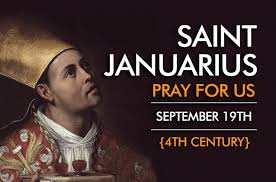
- Today’s Mass: September 19 St. Januarius, Bishop and Companion MartyrsSt. Januarius and companion martyrs were martyred during the persecution under Diocletian. St. Januarius, patron of the city of Naples and bishop of Beneventum, was beheaded with his deacons and some others.
- Sermon for St. Januarius and his CompanionsToday we celebrate the feast of St. Januarius and his companions. About St. Januarius little is known except that he was among the many martyrs during the great persecution under the Emperor Diocletian.
- 20.09.26 Nuntiatoria CXXIV: QUOD ACCEPIMUS, CUSTODIMUS ET TRADIMUSThe editorial emphasises the importance of understanding our inheritance as custodians rather than owners. It highlights the obligation to preserve and transmit the Christian Faith, sacraments, and traditions to future generations. Through gratitude and fidelity, those who receive must ensure that what has been entrusted does not end with them.


Leave a Reply