
Communicatio in Sacris in Public: The Beer–Fabiny Communion Incident in Hungary
A Documented Ecumenical Transgression
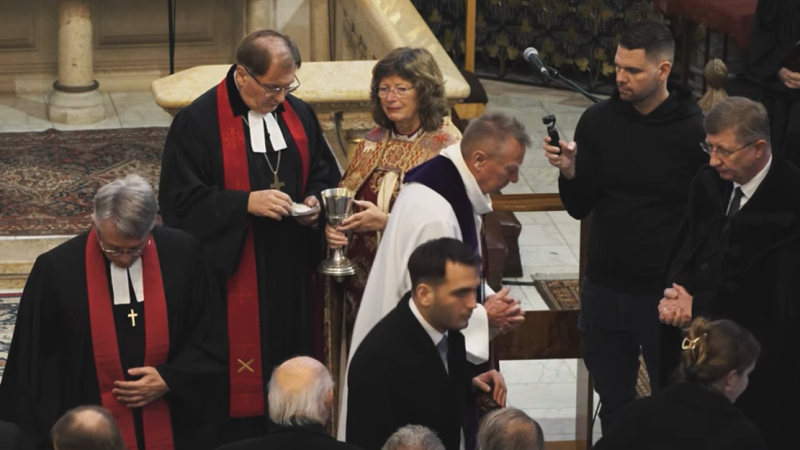
On 28 December 2025, Hungarian Catholic and Lutheran circles were confronted with incontrovertible visual evidence showing Miklós Beer, retired Roman Catholic Bishop of Vác, receiving Lutheran communion during a festive Lutheran worship service marking the 20th anniversary of the episcopal ministry of Lutheran “bishop” Tamás Fabiny.¹
The service was a public and solemn act of Lutheran worship, attended by prominent church figures, including Cardinal Péter Erdő, Archbishop of Esztergom–Budapest and Primate of Hungary. What removes all ambiguity from the matter is the existence of publicly accessible video footage, which clearly documents the event and its circumstances.
The recording shows Bishop Beer vested in an alb and a purple stole, processing from the pews and receiving communion directly from Lutheran ministers. This is not a disputed report, an interpretation, or hearsay; it is a recorded public act, now widely disseminated.
From Rumour to Evidence
Initial discussion of the incident circulated through Hungarian Catholic commentary sites and social media, where it was initially treated by some as exaggerated or unverified. That uncertainty no longer exists.
The video evidence establishes three facts beyond dispute. First, the liturgy was Lutheran, not Catholic. Second, the communion was Lutheran “úrvacsora”, administered by Lutheran pastors. Third, Bishop Beer knowingly participated, visibly vested as a Catholic bishop.
What had been rumour has thus become objective fact, documented and preserved.

Who Is Bishop Miklós Beer?
Miklós Beer, born in 1943, was ordained a Catholic priest in 1966 and served as Bishop of Vác from 2003 until his retirement in 2019. Over the course of his episcopate, he became known within Hungary for his openness to progressive social positions and for a broad interpretation of post-conciliar ecumenical engagement.
Retirement, however, does not alter the sacramental reality of episcopal ordination. Catholic doctrine is unequivocal: the episcopate confers an ontological character, imprinting permanent obligations. A bishop emeritus remains a bishop, bound by the Church’s doctrine and discipline—particularly in public ecclesial acts.²
The Canonical Prohibition: Communicatio in Sacris
The Catholic Church has long prohibited sacramental participation that falsely signifies unity where it does not exist. This prohibition is traditionally expressed by the term communicatio in sacris.
The 1983 Code of Canon Law regulates this with precision. Canon 844 §1 states unambiguously that Catholic ministers may administer the sacraments licitly only to Catholic faithful, and that Catholics may receive the sacraments licitly only from Catholic ministers.³ Limited exceptions exist under canon 844 §§2–4, but these are restricted to cases of grave necessity—such as danger of death—and require a shared faith in the sacrament. None of these conditions apply to a festive Lutheran jubilee service.
Additionally, actions by clerics that undermine ecclesial discipline or create grave confusion among the faithful fall under penal provisions of the Code, including canon 1389 (abuse of ecclesiastical power or function) and related norms governing scandal and public delict.⁴ While such acts do not incur automatic excommunication, they are nonetheless classified as grave canonical offenses.
Publicity and the Reality of Scandal
In Catholic moral theology, scandal does not mean emotional offence or media controversy. It refers to an action that leads others into error, weakens adherence to doctrine or discipline, or conveys the impression that the Church’s sacramental theology is optional.⁵
This incident involved a public liturgical celebration, a bishop acting in clerical vesture, and documented dissemination of the act. In the case of a bishop—even a retired one—the gravity is heightened. Bishops are, by divine institution, guardians of sacramental integrity and ecclesial unity.⁶
Liturgical Vesture as a Sacramental Sign
The wearing of an alb and stole is not a neutral choice. In Catholic theology, the stole is a visible sign of ordained ministry and sacramental authority. Its use in a non-Catholic communion rite inevitably conveys one of two false impressions: either that the Lutheran rite is sacramentally equivalent to the Catholic Eucharist, or that full ecclesial communion already exists between the Catholic Church and Lutheran communities.
Both implications directly contradict Catholic doctrine, including the Church’s definitive teaching on the Eucharist and Holy Orders.⁷
From Praxis to Precedent: Francis-Era Ecumenism and Its Consequences
The Beer–Fabiny incident does not arise in isolation. It must be situated within the ecclesial culture shaped during the pontificate of Pope Francis, in which pastoral gesture was frequently prioritised over juridical clarity, particularly in ecumenical contexts.
Although Pope Francis never formally altered canon 844, his repeated emphasis on discernment and conscience in Eucharistic matters—most notably in his 2015 remarks to a Lutheran congregation in Rome—created the widespread impression that sacramental boundaries were negotiable in practice, even if unchanged in law.⁸ This perception was reinforced during the German episcopal disputes over intercommunion for Protestant spouses, where decisive intervention was withheld.⁹
The cumulative effect was not doctrinal development but disciplinary incoherence: the norms remained intact on paper, while their enforcement became hesitant and uneven. Within such a climate, actions like Bishop Beer’s become intelligible. What was once clearly forbidden begins to appear pastorally tolerable when infractions meet no correction.
Pope Leo XIV and the Question of Reset
Against this background, early signals from the pontificate of Pope Leo XIV suggest a different emphasis, though still cautiously expressed. Leo has thus far spoken of ecumenism in classical theological terms, stressing truth, order, and sacramental integrity rather than symbolic convergence.
His public addresses have avoided the Francis-era language of irreversibility and process, returning instead to a more traditional sequencing: unity presupposes shared faith; communion presupposes unity.¹⁰ Whether this marks a genuine course correction or merely a tonal adjustment remains to be seen. What is clear is that Leo inherits a Church accustomed to gesture without consequence.
A Looming Test Case: Canterbury, Gender, and Symbolic Unity
This tension becomes even more acute when one considers a likely future test case: the relationship between Rome and Canterbury, now complicated by the election of a woman as Archbishop of Canterbury.
Under Pope Francis, precedent was set when he and Justin Welby jointly blessed congregations—acts carefully framed as non-sacramental, yet visually suggestive of ecclesial convergence. Such gestures were already problematic, given the Catholic Church’s definitive judgment on Anglican orders in Apostolicae Curae.¹¹
The situation has now changed qualitatively. A joint blessing involving a woman claiming episcopal authority would introduce a new and more severe theological contradiction. From the Catholic perspective, the impossibility of women’s ordination is not disciplinary but doctrinal, definitively taught.¹²
A repetition of Francis-era symbolic gestures under these new conditions would inevitably suggest one or more false conclusions: that episcopal ministry is interchangeable across confessions; that the question of women’s ordination is secondary or unresolved; or that sacramental ontology yields to relational symbolism. Any of these would contradict settled Catholic teaching.
The Silence of Ecclesiastical Authorities
Perhaps the most striking feature of the Beer incident is the absence of response. To date, there has been no public clarification, correction, or disciplinary statement from competent ecclesiastical authority—neither from the Diocese of Vác, nor from the Hungarian Bishops’ Conference, nor from Esztergom–Budapest.
Such silence is not neutral. In ecclesial life, public acts demand public response, especially when they concern bishops and the sacraments. Silence risks normalising what canon law forbids and teaching the faithful, by omission, that Eucharistic discipline is optional.
If Pope Leo XIV intends to restore coherence after a period of practical looseness, cases such as this cannot simply be allowed to pass. Otherwise, the Church risks perpetuating a two-tier reality: clear doctrine in texts, fluid practice in life.
Conclusion
The Beer–Fabiny incident represents more than a local Hungarian controversy. It is a test case for post-Francis Catholicism. It forces the Church to confront whether ecumenism will continue to be governed by symbolic momentum or re-anchored in sacramental theology.
The act itself is clear. The law is clear. The magisterium is clear. What remains uncertain is whether clarity will once again be matched by episcopal accountability.
What cannot be denied is this: the boundary was crossed in public, and the silence that followed now demands interpretation.
¹ Video recording of the Lutheran jubilee service for Bishop Tamás Fabiny, publicly circulated December 2025.
² Catechism of the Council of Trent, On the Sacrament of Holy Orders.
³ Code of Canon Law (1983), can. 844 §1.
⁴ Code of Canon Law (1983), can. 1389; cf. cann. 1339–1341.
⁵ St Thomas Aquinas, Summa Theologiae, II–II, q. 43, a. 1.
⁶ Second Vatican Council, Lumen Gentium, §23.
⁷ Council of Trent, Session XIII, Decretum de Sanctissimo Eucharistiae Sacramento.
⁸ Pope Francis, remarks at the Evangelical Lutheran Church of Rome, 15 November 2015.
⁹ Congregation for the Doctrine of the Faith, Letter to the German Bishops’ Conference, 25 May 2018.
¹⁰ Pope Leo XIV, Address to the College of Cardinals, May 2025.
¹¹ Leo XIII, Apostolicae Curae (1896).
¹² John Paul II, Ordinatio Sacerdotalis (1994); CDF, Responsum ad dubium (1995).
RELATED ARTICLES


Latest ARTICLES
- Today’s Mass: September 19 St. Januarius, Bishop and Companion MartyrsSt. Januarius and companion martyrs were martyred during the persecution under Diocletian. St. Januarius, patron of the city of Naples and bishop of Beneventum, was beheaded with his deacons and some others.
- Sermon for St. Januarius and his CompanionsToday we celebrate the feast of St. Januarius and his companions. About St. Januarius little is known except that he was among the many martyrs during the great persecution under the Emperor Diocletian.
- 20.09.26 Nuntiatoria CXXIV: QUOD ACCEPIMUS, CUSTODIMUS ET TRADIMUSThe editorial emphasises the importance of understanding our inheritance as custodians rather than owners. It highlights the obligation to preserve and transmit the Christian Faith, sacraments, and traditions to future generations. Through gratitude and fidelity, those who receive must ensure that what has been entrusted does not end with them.
- ONE LORD, ONE FAITH, ONE BAPTISM: The Seventeenth Sunday after PentecostThe Seventeenth Sunday after Pentecost emphasises the love of God and neighbour, rooted in divine justice. The Mass articulates the necessity of one faith and baptism, ensuring charity is not sentimental but deeply theological. The Gospel challenges believers to recognise Christ’s dual nature as both David’s son and Lord, reinforcing true Christian charity.
- AN AWARD IS NOT A MEETINGLambeth Palace has withdrawn the Hubert Walter Award given to Hafiz Tahir Ashrafi for reconciliation, citing previously unknown controversial comments. This raised questions about the vetting process prior to the award. While Ashrafi has defended his record of protecting minority rights, the Palace must clarify why such issues were overlooked initially.





Leave a Reply