
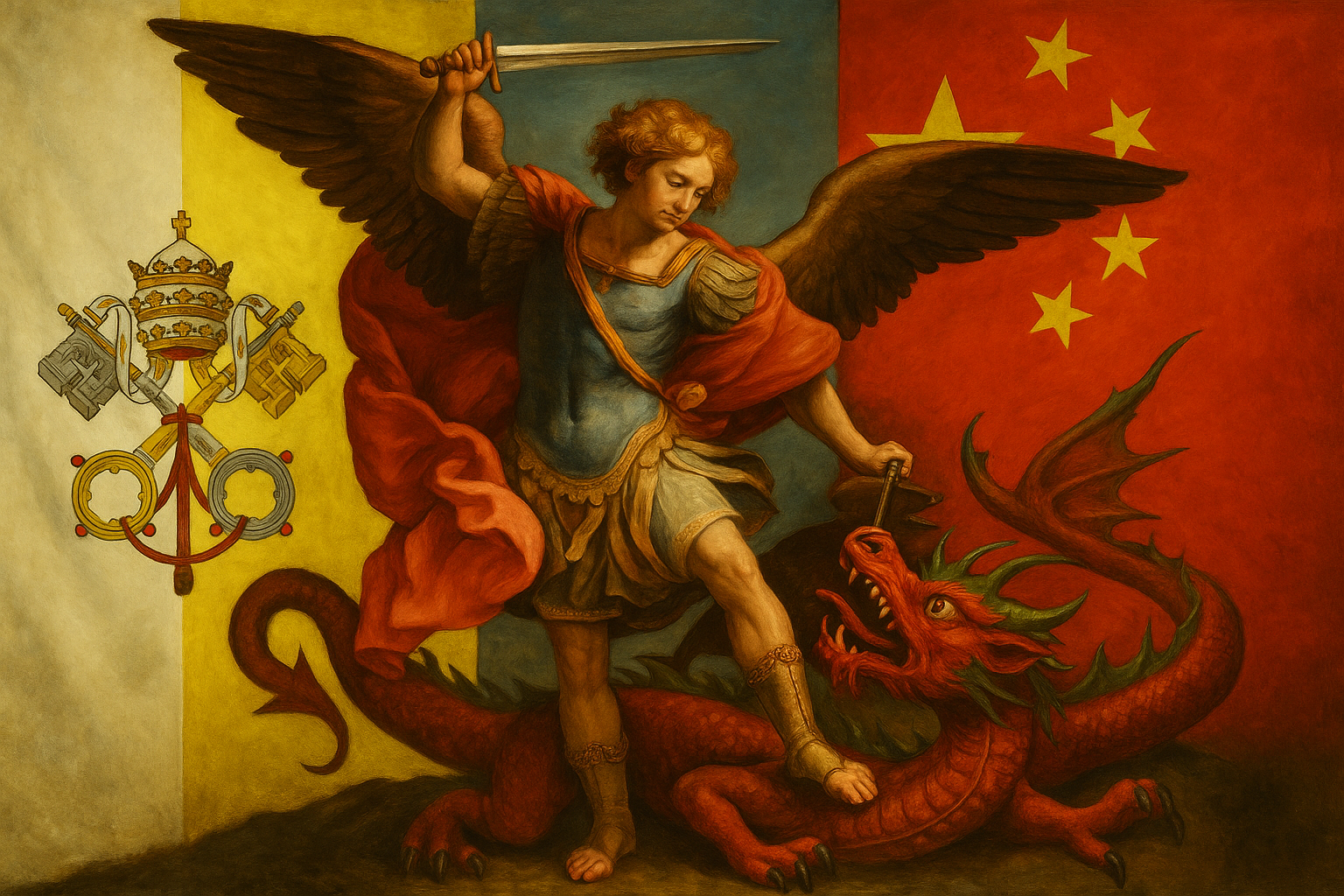
Jimmy Lai, Conscience, and the Limits of Vatican Diplomacy
The imprisonment of Jimmy Lai raises a serious and immediate question concerning the protection of conscience, religious freedom, and the practical limits of Vatican diplomacy under the Sino–Vatican agreement with the People’s Republic of China. In a recent essay for the Catholic Herald, Benedict Rogers poses—carefully and conditionally—the further question of whether Lai’s suffering could, in certain circumstances, engage the Church’s theology of martyrdom.¹ Rogers advances this not as a conclusion, nor as a device for effect, but as a theological lens through which to assess the gravity of punishment imposed for conduct inseparable from faith-formed conscience. Lai remains alive, and the present analysis is therefore concerned not with posthumous recognition, but with the obligations of ecclesial and diplomatic actors toward a Catholic layman imprisoned under conditions that raise acute moral and humanitarian concerns.

From Refugee to Publisher: A Life Shaped by Freedom and Risk.
Jimmy Lai Chee-ying was born in Guangzhou in 1947 and arrived in Hong Kong as a child refugee, entering the territory illegally as a stowaway. His early years were marked by poverty, factory labour, and exposure to both the precariousness and the promise of life in a comparatively free society. This experience would later inform his instinctive suspicion of authoritarian power and his conviction that freedom of expression is not an abstract entitlement but a lived necessity.²
Lai’s rise from factory worker to international entrepreneur culminated in the founding of the Giordano clothing brand, followed by a decisive turn toward media and public discourse. In 1995, he established Apple Daily, a Chinese-language newspaper that rapidly became one of Hong Kong’s most widely read and politically influential publications. The paper combined populist presentation with investigative reporting and an unapologetically pro-democracy editorial line. Its criticism of the Chinese Communist Party and of pro-Beijing authorities was explicit, sustained, and increasingly isolated as Hong Kong’s political climate hardened.³
Lai’s conversion to Catholicism in 1997, shortly before the handover of Hong Kong to China, marked a deepening of the moral framework underlying his public life. His faith reinforced a view of truth-telling, personal responsibility, and resistance to coercion as moral duties rather than strategic options. Over time, this religious conviction became inseparable from his understanding of journalism and civic engagement.⁴
Law as Instrument: Arrest, Prosecution, and Detention.
The immediate context of Lai’s arrest lies in the political upheavals of 2019 and the subsequent imposition of the National Security Law in June 2020. The law criminalised broadly defined acts of secession, subversion, terrorism, and collusion with foreign forces, granting authorities expansive powers and introducing penalties up to life imprisonment. From its inception, legal scholars and international observers warned that the law’s vagueness and retroactive reach would permit its use as an instrument of political control rather than criminal justice.⁵
On 10 August 2020, Hong Kong police raided the headquarters of Next Digital, the parent company of Apple Daily, arresting Lai and senior executives and seizing journalistic materials. Company assets were frozen shortly thereafter. This marked the first major application of the National Security Law against a media organisation and signalled that journalism itself had been reclassified as a national security threat.⁶
Formal charges against Lai were brought in December 2020, including conspiracy to collude with foreign forces. Prosecutors cited public statements, editorials, and meetings with foreign officials as evidence, despite the fact that much of the alleged conduct predated the National Security Law’s enactment. Bail was initially granted, then revoked on appeal, and Lai has remained continuously in custody since late 2020.⁷
The forced closure of Apple Daily in June 2021—following further arrests and asset freezes—marked a symbolic end to mass-circulation independent journalism in Hong Kong. The newspaper’s final edition sold more than a million copies, reflecting both public solidarity and the widespread recognition that an era had closed.⁸
Lai’s National Security Law trial commenced in December 2023 and extended over more than 150 hearing days, culminating in guilty verdicts in December 2025. Legal observers, human-rights organisations, and several governments criticised the proceedings as politically determined and inconsistent with international fair-trial standards, particularly given the law’s retroactive application and the restrictions placed on defence counsel.⁹
The severity of Lai’s punishment is compounded by the conditions of his detention. Now in his late seventies, suffering from diabetes and cardiovascular illness, he has spent prolonged periods in solitary confinement with restricted access to sunlight, exercise, and independent medical care. Submissions to United Nations special procedures and testimony from family members indicate serious physical deterioration and a foreseeable risk to life.¹⁰
Conscience, Faith, and Institutional Silence.
The religious dimension of Lai’s case is central to understanding its moral gravity, though not its legal classification. His public conduct has consistently been informed by Christian conscience, particularly with respect to truth-telling and moral responsibility. During detention, he has been denied access to the Sacraments, including Holy Communion—an act of spiritual deprivation irrespective of the state’s stated rationale.¹¹
It is in this context that Rogers raises the question of martyrdom as a conditional theological inquiry grounded in the doctrine of odium fidei. The relevance of the inquiry lies not in asserting a conclusion, but in clarifying whether punishment directed at faith-formed conscience—rather than discrete criminal acts—may in principle engage categories traditionally associated with religious persecution.¹²
The response to Lai’s imprisonment exposes a marked divergence between individual advocacy and institutional restraint. In the United Kingdom, David Alton has repeatedly raised Lai’s case in the House of Lords, framing it as a matter of British consular responsibility, due process, and freedom of conscience. His interventions demonstrate that sustained representation on Lai’s behalf is both feasible and diplomatically survivable.¹³
Ecclesial advocacy has likewise emerged outside the Vatican Secretariat of State. Joseph Zen, Bishop Emeritus of Hong Kong and the prelate who received Lai into the Church, has spoken publicly and repeatedly in his defence, identifying him as a prisoner of conscience and linking his prosecution to his Catholic faith.¹⁴
By contrast, no comparable public intervention has been documented from the Vatican Secretariat of State. Vatican media have largely avoided substantive coverage of Lai’s conviction and detention, even as the provisional Vatican–China agreement has been renewed without public conditions relating to human rights or religious liberty.¹⁵
Cardinal Pietro Parolin, as Secretary of State and principal architect of the Holy See’s China policy, has not made any recorded public representation on Lai’s behalf. Public statements on China have instead emphasised dialogue and institutional continuity.¹⁶
Nothing in the Sino–Vatican agreement legally prevents the Holy See from speaking or acting on Lai’s behalf. The agreement concerns episcopal appointments and does not bind the Vatican to silence regarding imprisoned Catholics. Any restraint observed must therefore be understood as a prudential or strategic choice rather than a juridical necessity.¹⁷
The case of Jimmy Lai thus presents a concrete and unresolved test of contemporary Catholic witness in a juridical age. It confronts the Church not with overt martyrdom or explicit bans on worship, but with a subtler form of persecution in which legal process is used to criminalise conscience, moral speech, and faith-informed public engagement. This is a form of pressure increasingly characteristic of modern authoritarian systems, where repression is procedural rather than spectacular, and where injustice is administered through courts rather than mobs.¹⁸
For the Holy See, the case raises unavoidable questions about the moral limits of diplomatic prudence. Dialogue, patience, and institutional continuity are legitimate instruments of diplomacy, but they are not absolute goods. When diplomacy consistently coincides with silence in the face of manifest injustice—particularly toward a Catholic layman deprived of liberty, health, and sacramental life—it risks being perceived not as prudence but as acquiescence. The credibility of Vatican diplomacy ultimately depends not only on access to power, but on its willingness to speak when conscience is at stake.¹⁹
The divergence between individual advocacy and institutional restraint is therefore instructive rather than incidental. The sustained interventions of Lord Alton and the public witness of Cardinal Zen demonstrate that moral clarity and public representation are possible without collapsing diplomatic engagement. Their actions underscore that silence is not imposed by necessity or law, but chosen as a matter of policy.²⁰
At the same time, the Church’s concern in Lai’s case is not reducible to geopolitics or press freedom alone. What is at issue is whether a Catholic layman may be punished indefinitely for conduct inseparable from a conscience formed by faith, and whether the Church will defend that conscience in practice as well as in principle. This question lies at the heart of Catholic teaching on religious liberty and the dignity of the human person, articulated most clearly in the Church’s insistence that conscience, rightly formed, stands prior to the claims of the state.²¹
Jimmy Lai remains alive, and that fact gives urgency to the present moment. The question before the Church is not how his suffering might later be classified, but how it is addressed now. Whether through public advocacy, diplomatic intervention, or sustained moral witness, the response—or absence of response—will shape how future generations understand the Church’s fidelity to those who suffer not for crimes committed, but for truths spoken and consciences obeyed.²²
¹ Benedict Rogers, “Jimmy Lai should be recognised as a martyr?”, Catholic Herald.
² Mark Clifford, The Troublemaker: How Jimmy Lai Became China’s Greatest Fear.
³ Ibid.
⁴ Rogers; Clifford.
⁵ National Security Law of Hong Kong SAR (2020); international legal commentary.
⁶ Hong Kong Police press releases; contemporaneous reporting.
⁷ Hong Kong Court of Final Appeal bail judgment.
⁸ Apple Daily, final edition, June 2021.
⁹ Trial judgment and international legal commentary.
¹⁰ UN Special Rapporteur submissions; family testimony.
¹¹ Detention reports; pastoral accounts.
¹² Catechism of the Catholic Church, §§2471–2474; Congregation for the Causes of Saints, Sanctorum Mater.
¹³ UK House of Lords Hansard records.
¹⁴ Cardinal Zen, public statements and interviews.
¹⁵ Review of Vatican News and L’Osservatore Romano.
¹⁶ Public statements of Cardinal Parolin on China policy.
¹⁷ Holy See–PRC Provisional Agreement (2018; renewals).
¹⁸ Václav Havel, The Power of the Powerless.
¹⁹ Pope Benedict XVI, Address to the Roman Curia, 22 December 2005.
²⁰ Hansard; Cardinal Zen public interventions.
²¹ Dignitatis Humanae, §§2–3; Gaudium et Spes, §16.
²² John Paul II, Veritatis Splendor, §§32–34.
RELATED ARTICLES


LATEST ARTICLES
- Today’s Mass: October 27 Vigil of SS Simon & Jude, ApostlesThe vigil of SS Simon and Jude celebrates their apostolic contributions and shared commemoration in the Church. St. Jude, author of a New Testament Epistle, and Simon, with a shared mission in Mesopotamia and Persia, exemplify zealous anticipation of liturgical solemnities. Their legacy is acknowledged through prayers and reflections in early Christian traditions.
- THE KING’S OATH AND THE DEAD OF SAINT GEORGE’SA tragic attack during a Christian funeral in Karak, Jordan, resulted in nine fatalities and numerous injuries. King Abdullah II has pledged severe retaliation, leading to the arrest of three suspects. The Latin Patriarchate supports the monarchy’s role in ensuring religious freedom, while the Orthodox community vows to remain in their homeland amidst ongoing concerns for their safety.
- THE LAW OF A CHURCH THAT HAS NOT YET BEEN REUNITEDAt the Angelicum conference, Orthodox and Anglican scholars discussed the future of ecclesiastical law alongside Vatican cardinals. Cardinal Koch advocated for a new ecumenical juridical order, connecting these discussions to the upcoming Synodal Assembly of 2028. The conference aimed to address how different Christian governance models could influence Catholic law and authority.
- ‘DWARFS TAVISTOCK’: Baroness Cass demands Inquiry into Brighton NHS ScandalBaroness Hilary Cass has called for an independent inquiry into Brighton’s WellBN practice, claiming it overshadowed the Tavistock scandal. An investigation revealed severe clinical failures affecting 78 children, alongside the distressing treatment of safeguarding GP Dr Sarah Redvers, who raised alarms about these practices and faced retaliation. Accountability within the NHS is urgently needed.
- “THAT’S JUST PARANOIA”: Dr Joseph Shaw and the Crisis beyond the Latin MassDr Joseph Shaw’s recent interview highlights his support for the Traditional Latin Mass but inadequately addresses the Society of Saint Pius X’s (SSPX) concerns regarding the Church’s doctrinal crisis. He dismisses SSPX’s fears as paranoia, yet the Society’s extensive theological arguments underscore that preserving the older liturgy is insufficient for restoring Catholic Tradition.





Leave a Reply