
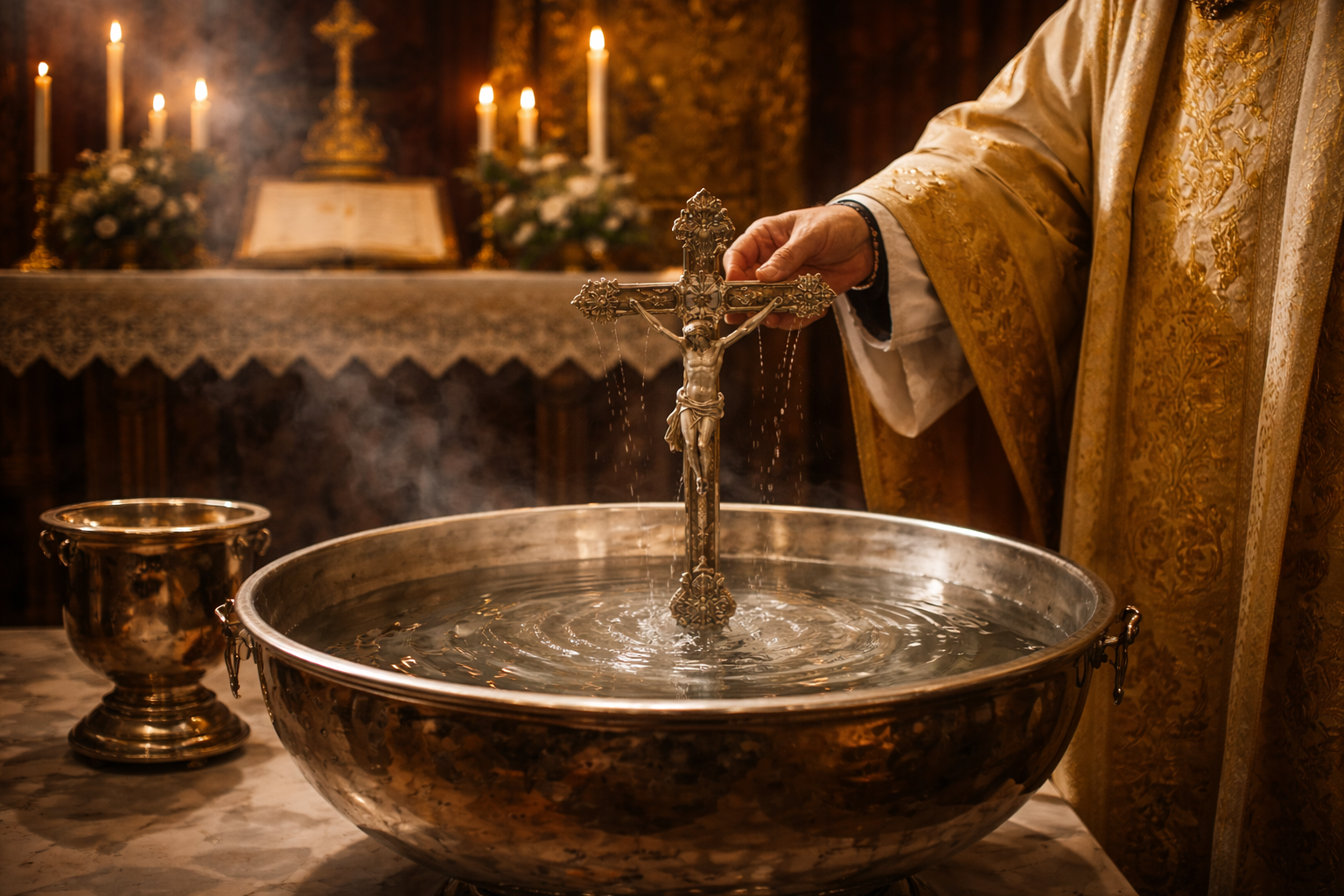
The Blessing of Epiphany Water
The Sanctification of Creation and the Manifestation of Christ
Epiphany as a Feast of Manifestation
Among the rites attached to the Feast of the Epiphany, few express with such theological density the Church’s sacramental vision as the solemn blessing of water. Rooted in the Baptism of Christ in the Jordan, this rite proclaims not merely a historical event but the decisive sanctification of creation itself. In blessing water on Epiphany, the Church confesses that the Incarnate Word has entered the material order and restored it from within, rendering even the most elemental substance a bearer of divine grace.
Epiphany, as the Church has always understood, is not exhausted by the visit of the Magi. It is the feast of manifestation in its fullness: Christ revealed to the nations, Christ revealed in glory at the Jordan, Christ revealed as Lord over the created order. The blessing of water belongs organically to this logic. It is the liturgical echo of the Jordan event, where Christ, though sinless, descended into the waters not to be purified but to purify them, and through them, the world.¹
The Patristic Consensus on the Baptism of Christ
The Fathers of the Church are unanimous on this point. St Gregory of Nazianzus teaches that Christ “comes up from the water, bearing up the world with Him,” declaring that the element itself has been transformed by His descent.² St John Chrysostom insists with equal clarity that the Jordan did not cleanse Christ, but rather “received sanctification from the body of the Lord.”³ The Baptism of Christ, in patristic theology, is therefore not a private act of humility but a cosmic intervention. The waters are reclaimed from disorder and restored to their proper role as instruments of life, blessing, and sanctification.
This theology is not speculative. It is liturgical. The Fathers speak as men immersed in the Church’s prayer, and their language reflects a sacramental worldview in which matter is neither neutral nor profane, but capable of being taken up into the economy of salvation.
Early Liturgical Witness and the Continuity of the Jordan
This conviction shaped the earliest Christian observance of Epiphany, particularly in the East, where Theophany was originally the principal feast celebrating both the Nativity and the Baptism. From at least the fourth century, the Church’s liturgical life bore witness to the belief that water blessed on this day possessed a unique character. It was not merely symbolic, nor interchangeable with ordinary holy water, but stood in deliberate continuity with the Jordan itself.⁴
The faithful did not treat Epiphany water as devotional ornamentation. They received it as something set apart, charged with the memory and power of Christ’s descent into the waters, and ordered toward the sanctification of persons, dwellings, and the wider created order.

The Older Roman Rite and the Enacted Theology of Water
In the Western Church, this theology once found an equally explicit and enacted expression. Before later standardisation and abbreviation, the Latin Rite preserved a longer and more hieratic Epiphany Water blessing, transmitted through medieval Roman sacramentaries, pontificals, and monastic ritual books. This older Roman form did not merely allude to Christ’s Baptism but ritually reenacted it, most notably through the solemn immersion of the crucifix into the water.
This action was not ornamental. It was the theological heart of the rite. The Roman Church confessed visibly what the Fathers taught doctrinally: Christ sanctifies the waters by contact with His Body. As the priest immersed the crucifix—sometimes once, sometimes three times according to local use—the accompanying prayer made the claim explicit:
Descendat in hanc aquam virtus Spiritus Sancti, et totam huius elementi substantiam sanctificet, ut, te, Domine, in Iordane baptizato, omnis aquarum natura benedictionem sumpserit.
May the power of the Holy Spirit descend into this water and sanctify the whole substance of this element, so that, when You, O Lord, were baptised in the Jordan, the entire nature of waters received blessing.
Here the Roman rite does not hesitate to speak of an objective transformation of the element itself. The water is addressed not as neutral matter but as part of a creation wounded by sin and now reclaimed by Christ’s descent.
Exorcism, Restoration, and the Reclaiming of Creation
This theology is reinforced by the multiple solemn exorcisms found in the older Roman form. The water is adjured to become an instrument of divine protection, explicitly set against the lingering effects of disorder and demonic influence:
Exorcizo te, creatura aquae, in nomine Dei Patris omnipotentis, et in nomine Iesu Christi Filii eius Domini nostri, et in virtute Spiritus Sancti: ut fias aqua exorcizata ad effugandum omnem potestatem inimici.
I exorcise you, creature of water, in the name of God the Father almighty, and in the name of Jesus Christ His Son our Lord, and in the power of the Holy Spirit, that you may become exorcised water, to put to flight every power of the enemy.
Although this rite does not confer the sacrament of Baptism, its language is deliberately baptismal in register. The water is treated as a sacramental extension of baptismal grace, ordered toward healing, protection, and the sanctification of persons, homes, and the created order itself. The final prayers make this pastoral intent explicit:
Praesta, quaesumus, Domine, ut quicumque ex hac aqua sumpserint, corporis sanitatem et animae tutelam percipiant.
Grant, we beseech You, O Lord, that whoever makes use of this water may receive health of body and protection of soul.
Abbreviation without Repudiation
The later Rituale Romanum preserved this theology in a more compact form, retaining solemn exorcisms, the blessing of salt, and the Jordan typology, but without the full ritual enactment found in earlier Roman uses. Nothing in the older rite was doctrinally corrected or repudiated; it was simplified for the sake of pastoral uniformity. The theological content remains entirely Roman, orthodox, and continuous.⁵
Seen in this light, the Western tradition appears not restrained or juridical, but once cosmically confident. The immersion of the crucifix in the older Latin rite stands as the Roman analogue to the Eastern immersion of the cross in the Great Blessing of Waters. The resemblance is theological, not derivative. Both arise independently from the same patristic conviction: Christ descends into the waters to reclaim them.
East and West in Doctrinal Unity
The Eastern liturgy gives voice to this truth with its own grammar. In the Great Blessing of Waters at Theophany, the Church declares that Christ has shattered the dominion of chaos, illumined the depths, and renewed the face of the earth. The immersion of the cross signifies the manifestation of the Holy Trinity and the descent of the Holy Spirit upon creation.⁶
What unites East and West is not ritual uniformity but doctrinal unity. Both confess that Christ’s Baptism marks the moment at which the material world is decisively reclaimed. Water, the primordial element of life, becomes a privileged sign of restoration.
Dogmatic Clarification and Catechetical Force
This conviction is later articulated dogmatically in the Church’s teaching on the sacraments, which insists that God communicates grace through material signs precisely because matter itself has been assumed and redeemed by the Word made flesh.⁷ The Catechism of the Catholic Church, drawing directly on this patristic and liturgical inheritance, affirms that Christ’s Baptism “sanctified the waters” and prepared them to become the instrument of new birth in Baptism.⁸
The blessing of Epiphany water therefore functions as a liturgical catechesis. It recalls the faithful to their baptismal identity and resists the modern desacralisation of reality by asserting that no corner of creation lies outside the reach of the Incarnation.
Conclusion: The Jordan Extended through Time
The blessing of Epiphany water is thus neither a folkloric survival nor a devotional curiosity. It is a proclamation of Christ’s cosmic kingship and of the Church’s sacramental vision of the world. In blessing water, the Church announces that the Jordan has been sanctified—and with it, the whole created order. Wherever this water is used, the Church quietly confesses that Christ has entered the depths, and that creation itself bears the mark of His light.
¹ Matthew 3:13–17.
² St Gregory of Nazianzus, Oratio 39 (In Sancta Lumina), §§14–16.
³ St John Chrysostom, Homilia in Baptismum Christi, PG 49.
⁴ Egeria, Itinerarium, ch. 45.
⁵ Rituale Romanum (1614), Tit. VIII, cap. I; comparison with earlier Roman and monastic ritual books.
⁶ Euchologion, Megas Hagiasmos (Great Blessing of Waters).
⁷ Council of Trent, Session VII, De Sacramentis in Genere.
⁸ Catechism of the Catholic Church, §1220.
⁹ Excursus: The longer Roman Epiphany Water blessing with immersion of the crucifix is attested in medieval Roman sacramentaries and pontificals, including the Sacramentarium Gelasianum (Frankish recension), pre-modern Pontificale Romanum manuscripts, and monastic ritual traditions. See A. Franz, Die kirchlichen Benediktionen im Mittelalter, vol. I (Freiburg, 1909).
related articles


Latest articles
- THE KING’S OATH AND THE DEAD OF SAINT GEORGE’SA tragic attack during a Christian funeral in Karak, Jordan, resulted in nine fatalities and numerous injuries. King Abdullah II has pledged severe retaliation, leading to the arrest of three suspects. The Latin Patriarchate supports the monarchy’s role in ensuring religious freedom, while the Orthodox community vows to remain in their homeland amidst ongoing concerns for their safety.
- THE LAW OF A CHURCH THAT HAS NOT YET BEEN REUNITEDAt the Angelicum conference, Orthodox and Anglican scholars discussed the future of ecclesiastical law alongside Vatican cardinals. Cardinal Koch advocated for a new ecumenical juridical order, connecting these discussions to the upcoming Synodal Assembly of 2028. The conference aimed to address how different Christian governance models could influence Catholic law and authority.
- ‘DWARFS TAVISTOCK’: Baroness Cass demands Inquiry into Brighton NHS ScandalBaroness Hilary Cass has called for an independent inquiry into Brighton’s WellBN practice, claiming it overshadowed the Tavistock scandal. An investigation revealed severe clinical failures affecting 78 children, alongside the distressing treatment of safeguarding GP Dr Sarah Redvers, who raised alarms about these practices and faced retaliation. Accountability within the NHS is urgently needed.
- “THAT’S JUST PARANOIA”: Dr Joseph Shaw and the Crisis beyond the Latin MassDr Joseph Shaw’s recent interview highlights his support for the Traditional Latin Mass but inadequately addresses the Society of Saint Pius X’s (SSPX) concerns regarding the Church’s doctrinal crisis. He dismisses SSPX’s fears as paranoia, yet the Society’s extensive theological arguments underscore that preserving the older liturgy is insufficient for restoring Catholic Tradition.
- THE REFUSAL IS NOW IN WRITINGThe Vatican has formally denied the Summorum Pontificum pilgrims permission to enter St Peter’s Basilica together for prayer, a decision communicated through published correspondence. The situation has sparked debate over administrative failures and the Church’s treatment of traditional Catholics. Key questions remain regarding the explanation for this refusal amidst wider pastoral concerns.




Leave a Reply