
The Sunday within the Octave of the Epiphany
(Dominica infra Octavam Epiphaniæ – Tridentine Rite)
In the Tridentine Rite, the Sunday within the Octave of the Epiphany is neither a narrative pause nor a secondary observance. It is a deliberate liturgical hinge, placed by the Roman tradition to interpret Epiphany from within. The Magi have departed, the star has fulfilled its task, yet the Church refuses to move on hastily. Instead, she turns inward, insisting that manifestation must mature into formation. What has been revealed to the nations must now be ordered within the human life the Son of God has assumed.¹
The older Roman calendar treats Epiphany not as a single feast but as a constellation of manifestations: to the Gentiles in the Magi, in wisdom at the Temple, in glory at the Jordan, and in sovereign power at Cana. This Sunday stands at the centre of that arc. It prevents Epiphany from collapsing into spectacle by grounding revelation in obedience, time, and growth.²
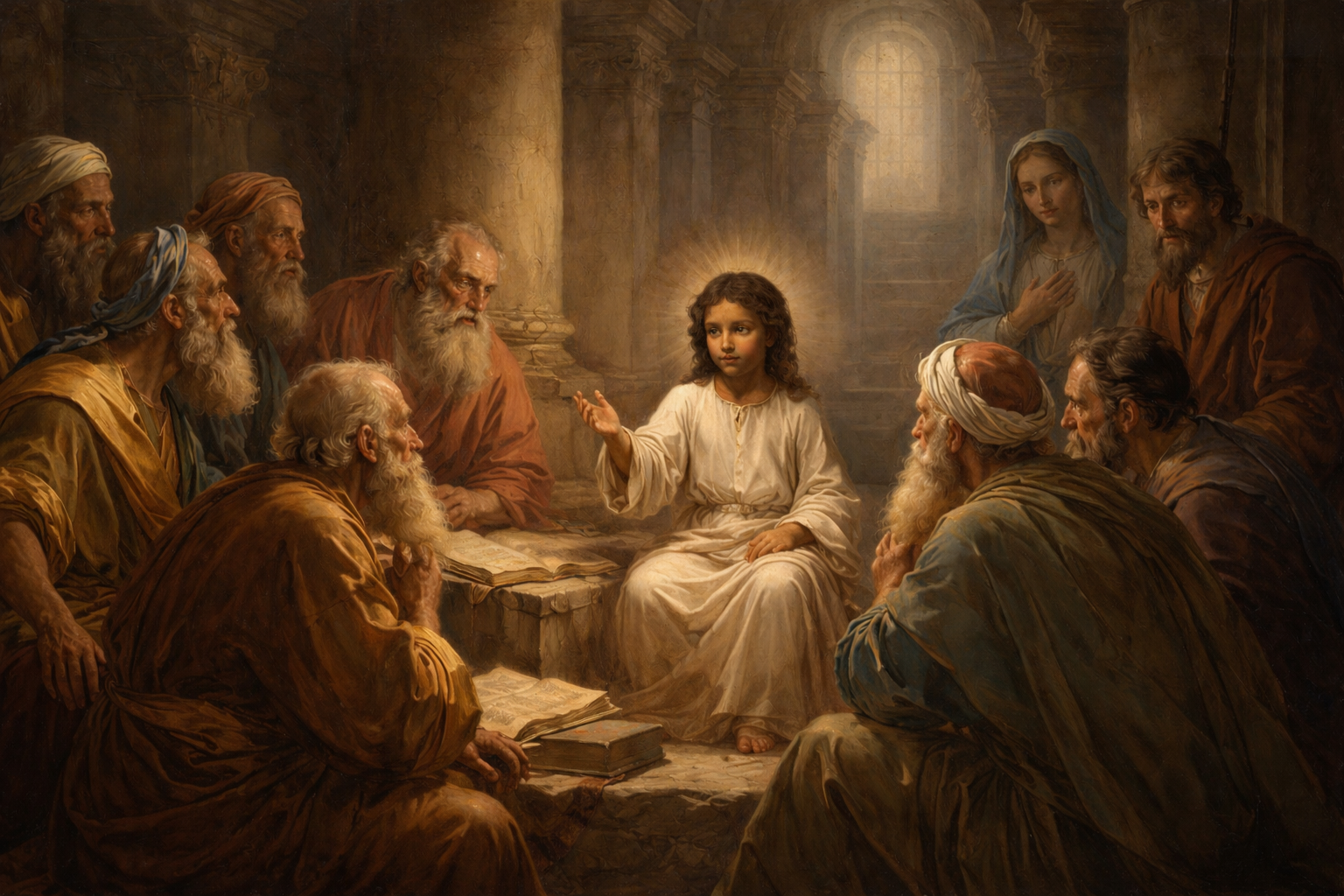
The Gospel (Luke 2:42–52), recounting the Finding of the Child Jesus in the Temple, is therefore profoundly epiphanic. Christ reveals Himself not through miracle but through authority in wisdom. The astonishment of the Doctors is not caused by precocious eloquence but by the source from which He speaks. Saint Augustine explains that Christ questioned the teachers not as one who needed instruction, but as one whose questions themselves instructed, since divine wisdom does not learn but draws others into truth.³ The wonder of the Doctors thus mirrors the wonder of the Magi: in both cases, divine wisdom is encountered where human expectation did not anticipate it.
This manifestation reaches its apex in Christ’s words to Mary: “Did you not know that I must be about My Father’s business?” The Church has always recognised this as a moment of unveiled identity, yet patristic exegesis is careful to guard against any reading that would set divine mission against human obedience. Saint Ambrose observes that Christ neither denies His mother nor disrupts the order of the family; He acknowledges His Father without rejecting filial submission, naming divine necessity without weaponising it against human bonds.⁴ Revelation occurs within obedience, not against it.
The liturgy immediately insists on what follows. Christ returns to Nazareth and is subject to Mary and Joseph. This descent is not an anticlimax but a theological declaration. Saint Bede the Venerable explains that He who is equal to the Father according to His divinity chose subjection according to His humanity in order to teach humility as a divine virtue rather than a mere human concession.⁵ The Incarnation does not suspend order; it sanctifies it. Authority, obedience, and time are not obstacles to redemption but its chosen instruments.
Here scholastic theology brings decisive clarity. Saint Thomas Aquinas distinguishes Christ’s obedience from ours by noting that it was not imposed by necessity or disorder, but freely embraced as the perfection of virtue.⁶ In Christ, obedience is not remedial but revelatory: it shows what authentic human freedom looks like when wholly aligned with the divine will. Nazareth thus emerges as the moral architecture of the Incarnation. Before Christ teaches crowds or commands nature, He lives fidelity, submission, and silence.
The Epistle appointed for the day (Galatians 4:1–7) situates this hidden life within the broader economy of salvation. Saint Paul likens humanity to an heir under guardianship—possessing the promise, yet not ready to exercise it. Saint John Chrysostom explains that Christ submitted Himself to the Law not because He was bound by it, but in order to redeem those who were, entering the condition of immaturity so that humanity might attain mature sonship.⁷ His submission to parents, Law, and time itself is therefore redemptive.
This Pauline theology illuminates the Gospel’s closing detail: that Jesus advanced in wisdom, age, and grace. Aquinas is explicit that this growth is real according to Christ’s human nature. Experiential knowledge truly increased, not because the divine intellect lacked anything, but because human development itself was assumed and sanctified.⁸ The Incarnation redeems not only human nature in the abstract, but the slow, ordinary process of becoming human. Time itself is healed.
The liturgical prayers of the Mass gather these theological strands into a single spiritual demand. The Collect petitions that those who acknowledge Christ outwardly may be inwardly reformed and outwardly conformed, making clear that Epiphany is incomplete without transformation.⁹ The Postcommunion deepens this logic by praying that the mystery received may govern the faithful, not merely console them. Christ does not simply appear; He orders.
The continued use of white vestments throughout the Octave reinforces this unity. The Church has not left Epiphany behind but is contemplating its interior dimension. The same Christ adored by kings is now seen submitting to craftsmen and homemakers. Kingship and humility are not opposed. The Tridentine Rite refuses to fragment the mystery, allowing Nazareth to interpret Bethlehem, and Bethlehem to interpret Jordan and Cana.
The long silence of Nazareth, compressed by the Gospel into a single verse, is thus not an omission but a theological statement. Origen remarks that Christ was hidden for many years in order to teach that the greatest works of God are prepared in silence.¹⁰ By preserving this Sunday within the Octave, the Roman liturgy resists every temptation to confuse revelation with visibility, mission with immediacy, or authority with activity. Formation precedes mission. Obedience precedes authority. Silence precedes speech.
In this way, the Sunday within the Octave of the Epiphany stands as a quiet but uncompromising corrective to every age. Before Christ preaches, He obeys. Before He transforms the world, He sanctifies a home. Epiphany does not culminate in acclaim but in Nazareth. The Light revealed to the nations first orders a family, hallows time, and dignifies fidelity in the ordinary. God is no less revealed when He is hidden; indeed, the liturgy teaches that He is often revealed most truly there.
- Prosper Guéranger, The Liturgical Year: Christmas, trans. Dom Laurence Shepherd (Dublin: James Duffy, 1870), pp. 274–276.
- Missale Romanum (editio typica 1954), Ordo Temporum, Tempus Epiphaniæ.
- Augustine of Hippo, Sermon 51, §16, in Patrologia Latina 38:342.
- Ambrose of Milan, Expositio Evangelii secundum Lucam, II, 51 (PL 15:1640).
- Bede the Venerable, In Lucae Evangelium Expositio, II (PL 92:330).
- Thomas Aquinas, Summa Theologiae, III, q.40, a.3.
- John Chrysostom, Homilies on Galatians, Homily 8 (PG 61:651–654).
- Thomas Aquinas, Summa Theologiae, III, q.12, a.2.
- Missale Romanum (1954), Collect for the Sunday within the Octave of the Epiphany.
- Origen, Homiliae in Lucam, Homily 19 (PG 13:1845–1848).
related articles


Latest articles
- Today’s homily: St Nicholas TolentinoThe reflection celebrates Saint Nicholas of Tolentino, emphasising that holiness is achieved not through personal efforts but through grace. It highlights his life of service, prayer, and self-discipline, suggesting that his true sanctity stems from dependence on God. The message reinforces the importance of a single-hearted focus on God in one’s spiritual journey.
- Today’s Mass: September 10 St Nicholas of TolentinoSaint Nicholas of Tolentino, born around 1246 in Italy, became a devout Augustinian hermit known for his piety and dedication to preaching. He spent his later years in Tolentino, promoting virtue, and maintaining his chastity until his death in 1306. Canonised in 1446, his tomb is revered by the faithful.
- Sermon for St. Nicholas of TolentinoToday we honour St. Nicholas of Tolentino, who lived from 1245 to 1305. Abiding in Tolentino, he dedicated his life to ministry, healing, and reconciliation amidst societal discord. A member of the Augustinian order, he exemplified service without seeking fame, inspiring others to witness their faith in everyday life.
- Today’s Mass: September 09 Day II in the Octave of The Nativity of the Blessed Virgin MaryThe feast of Our Lady’s Nativity, of ancient Eastern origin and established at Rome by the time of Pope St Sergius I, celebrates Mary as the immaculate New Eve and the dawn of salvation, the chosen tabernacle from whom the Redeemer would take His flesh. Today the Church also commemorates St Gorgonius, an officer of the imperial household at Nicomedia who, with his companion Dorotheus, embraced the Faith and suffered martyrdom under Diocletian in A.D. 303; his relics were later translated to Rome.
- NOMEN MANET, RES DEEST ~ The Name Remains; the Reality Is Lacking: Spiritual Conference for Nuntiatoria CXXIIThe content emphasises the disconnect between the names associated with Catholicism and the actual practices of faith. It highlights the importance of embodying belief through genuine actions, urging self-examination rather than mere external observance. Ultimately, it advocates for a restoration of sincerity in faith, calling individuals to authentically reflect their beliefs through their lives and worship.




Leave a Reply