
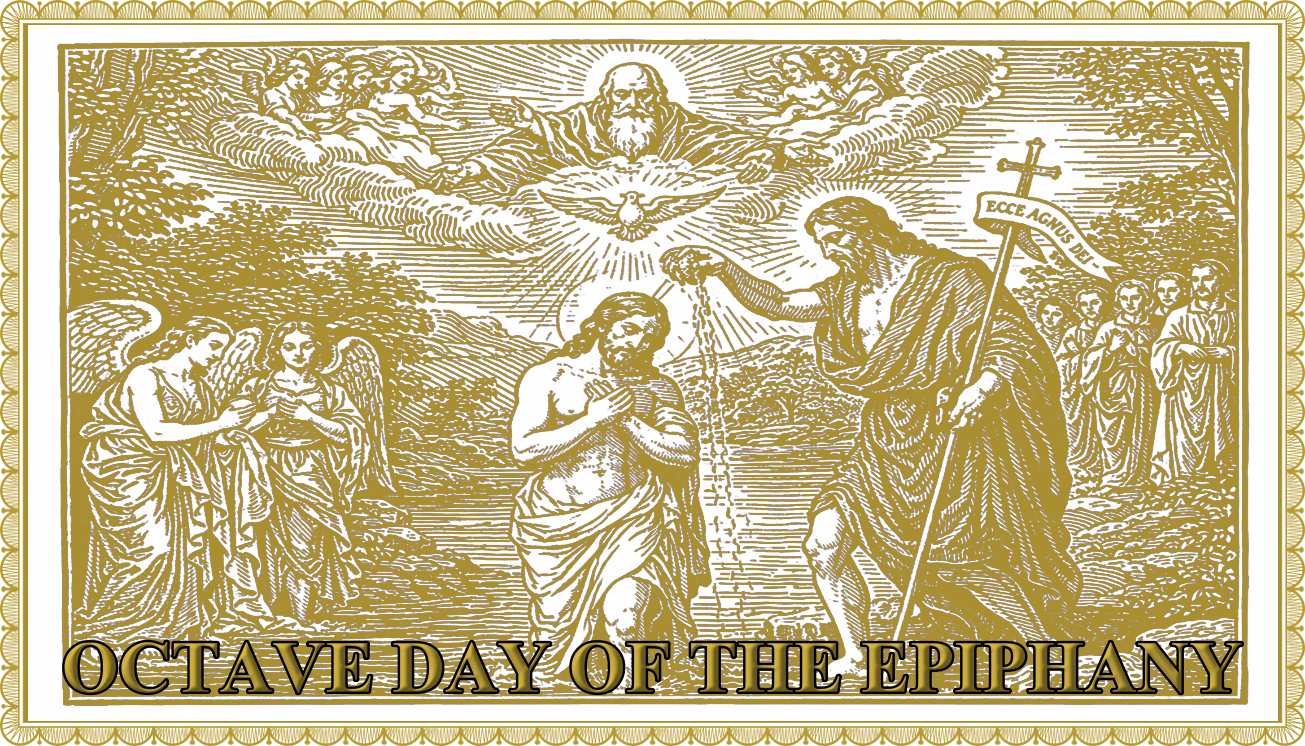
Octave Day of The Epiphany
by the Revd Dr Robert Wilson PhD (Cantab), Old Roman Apostolate UK
And John gave testimony saying: I saw the Spirit coming down as a dove from heaven, and he remained upon him. And I knew him not: but he who sent me to baptise with water said to me: he upon whom thou shalt see the Spirit descending and remaining upon him, he it is that baptiseth with the Holy Ghost. And I saw: and I gave testimony that this is the Son of God.
Today is the Octave of Epiphany. On the feast itself we celebrated the coming of the Magi to Bethlehem to visit the Saviour. Today we commemorate his baptism in the River Jordan. We hear from the account in St. John’s Gospel. St. John the Baptist had told a deputation from Jerusalem that he was not himself the Coming One, but was rather sent ahead of him. He then saw Jesus coming towards him and said, “Behold the Lamb of God, behold him who taketh away the sin of the world. This is he of whom I said: After me there cometh a man who is preferred before me, for he was before me. And I knew him not, but that he may be made manifest in Israel, therefore am I come baptising with water.” He then gave his testimony that at the baptism of Jesus he saw the Spirit coming down from heaven and remaining upon him. He then knew that it would be he who would baptise with the Holy Ghost.
What was the nature of St. John the Baptist’s distinctive ministry? He had been born to elderly parents in Judea and came from a priestly family. He had dwelt in the wilderness until the time of his manifestation to Israel. He then emerged preaching a baptism of repentance in the river Jordan, for he discerned that salvation was even nearer than they had believed. The repeated ritual ablutions practised by devout Jews were not sufficient. Reform was not enough, reconstitution alone would avail. The people were summoned to repent in the face of the coming judgment. John himself baptised with water, but the Coming One for whom he had been sent to prepare the way would baptise with the Holy Spirit and with fire. It was therefore necessary to create a purified faithful remnant of Israel, who had repented of their sins and been baptised by John. This preparation for the pouring out of the Holy Spirit on all flesh was the reason John had been sent baptising with water. The Coming One was already among them, waiting to be revealed.
Why then did Jesus, who we affirm to have been without sin, submit to John’s baptism of repentance? It is important not to view this through what has been called the “introspective conscience of the West”. In being baptised by John in the Jordan Jesus was beginning the path of his vocation of being “numbered among the transgressors”. This was confirmed when the Spirit came down from heaven and remained on him. The one who would baptise with the Holy Spirit and with fire would himself be baptised with the Spirit, marking him out as the Coming One of John’s preaching, the Lamb of God who would take away the sin of the world, the bridegroom in whose presence he was content to stand.
The account in St. John’s Gospel gives the testimony of the Baptist, in the other Gospels Jesus’ baptism is described. The divine voice affirmed that “This is my beloved Son, in whom I am well pleased.” This is generally thought to combine two distinct scriptural passages. The first is Psalm 2, which celebrates the king as the Son of God. This was usually given a messianic interpretation for a coming warrior and conqueror. The second passage is that of Isaiah 42 about the suffering servant who God would uphold, who would be the instrument of redemption by means of self sacrifice on behalf of others. This combination affirms Jesus to indeed be the Coming One of John’s preaching. But his kingship would be different from the rulers of this world. It would not be based on force and violence but on self sacrifice. His messianic destiny, enthronement and rule would come about through reversal, repudiation, suffering and death.
St. John the Baptist had looked forward to the advent of a coming one who would separate the wheat from the chaff and would baptise with the Holy Spirit and with fire. But Jesus modelled his ministry on the Servant-Son of the baptismal voice, who was despised and rejected by men, a man of sorrows and acquainted with grief, who bore the sin of many and made intercession for the transgressors. He had indeed come to set fire to the earth, but it was what he would himself undergo rather than dispense. His baptism in the Jordan would only finally be consummated on Golgotha, on the day when he no longer taught, but acted and suffered.
Jesus had told Nicodemus that it was necessary to be born again of water and the Spirit to enter into the kingdom of God. Now that he is risen, ascended and glorified, he has commissioned his followers to preach the gospel to all nations, baptising them in the name of the Father and of the Son and of the Holy Spirit. Unlike the baptism of John, which was merely preparatory, Christian baptism actually itself confers salvation. Those who are baptised die to sin and are raised to a new life with Christ. For as many as have been baptised into Christ have put on Christ, in whom there is neither Jew nor Greek, slave nor free, male and female, for all have sinned and fallen short of the glory of God and are justified freely by his grace which he has bestowed on us in the Beloved, in whom we have redemption through his blood, the remission of sins.
In the fourth century a great controversy divided the Church in North Africa. The Donatists said that those who had apostasised during the time of persecution had invalidated the sacraments that they celebrated, beginning with baptism. The Catholic position was championed by St. Augustine who said that sacramental grace is not dependent on the worthiness of those who administer them, but on Christ, who is alone without sin. Sacraments are conferred ex opere operato, by means of the rites themselves, rather than ex opere operantis, dependent on the moral status of those who administered them (as the Donatists had claimed).
He put it like this: “Was it not that when the dove descended on Christ, John then for the first time knew him to have that particular attribute, that, whosoever shall baptise with his baptism, whether they were themselves just or unjust, the virtue of the sacrament should proceed, not from them, but from him on whom abode the dove; so that he is the real baptiser in every Christian baptism until the end of time, and it is in this sense that it is said of him: “the same is he which baptiseth with the Holy Ghost”? Whether it be Peter, or Paul, or Judas, that performeth the ceremony, the real baptiser and effectual worker is Christ. For if the holiness of baptism depended on the holiness of the particular officiator, no two baptisms would be exactly alike, and every one would be supposed to be more or less regenerated according as the minister who baptised him was more or less of saint.
Now, my brethren, understand me. The saints themselves, those good men who appertain to the dove, those good men whose portion is in Jerusalem, those good men in the Church, of whom the apostle saith, “The Lord knoweth them that are his”, these good men differ from another by diversities of graces, and are not all of the same worthiness. Some are holier than others, and some are better than others. Supposing then (for the sake of argument) that A is baptised by B, a righteous saint, and C is baptised by D who is less worthy in the sight of God, who hath attained only a lower degree in godliness, who is not so chaste and whose life is not so good as B’s: yet A and C receive just the same thing. And how is this, unless it be that it is Christ himself who is the effectual baptiser?”
Let us take heed to these words today as we affirm our faith in the one baptism for the remission of sins. As we confess our own unworthiness, let us pray for grace to do all such good works as he has prepared for us to walk in that we may become what, through the regenerating waters of baptism, we now are.




Leave a Reply