
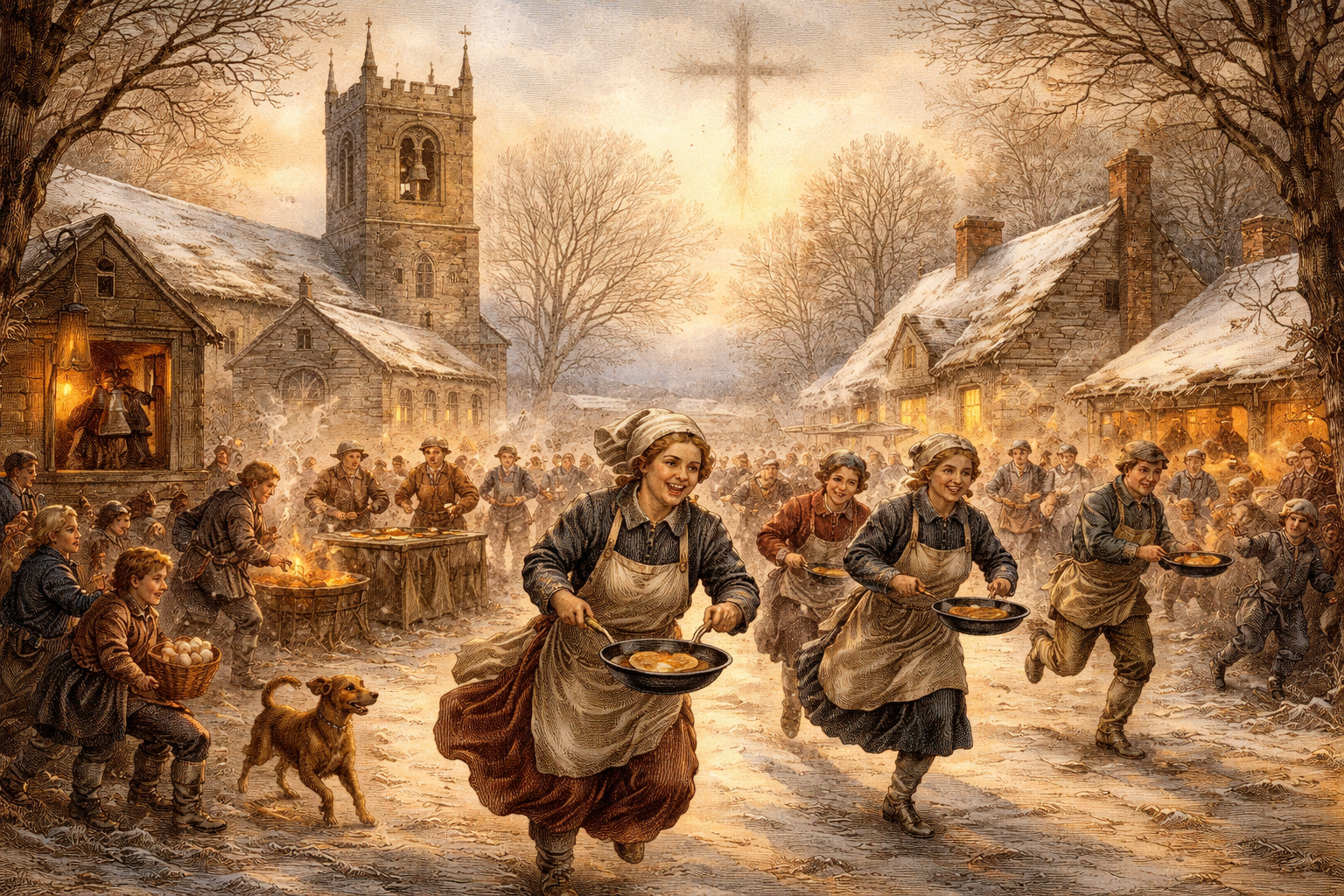
Shrove Tuesday: Confession, Carnival, and the Last Feast Before the Fast
Shrove Tuesday stands at the hinge of the Christian year. It is at once penitential and exuberant, domestic and public, liturgical and folkloric. Observed on the Tuesday before Ash Wednesday, it marks the close of Shrovetide and the threshold of Lent—the forty-day fast in preparation for Easter. Its date moves with Easter, falling forty-seven days before the Resurrection feast.¹
The English name preserves its original spiritual purpose. To be “shriven” was to confess one’s sins and receive absolution. In medieval England, the faithful were exhorted to make confession before Lent began, fulfilling the Church’s precept and entering the fast reconciled with God.² The day was therefore not merely culinary but sacramental. The parish bell would ring for “shriving,” summoning the faithful to examination of conscience and confession before the imposition of ashes the following day.
Yet because Lent traditionally required abstinence from meat and, in many regions, from eggs, milk, butter, and animal fats, Shrove Tuesday also became the last opportunity to consume rich foods. What could not be stored had to be used. Hence pancakes in England, crêpes in France, pączki in Poland, and countless other variations across Christendom. The domestic kitchen thus echoed the theology of the liturgy: the sweetness of feast yields to the discipline of fast.³
England: Pancakes, Bells, and Parish Memory


In England, Shrove Tuesday remains widely known as “Pancake Day.” The custom is not trivial nostalgia but a relic of older Lenten discipline. Pancakes—made of eggs, milk, flour, and butter—represented precisely those ingredients once restricted during the fast.⁴
The famous pancake race in Olney claims origins in 1445, when, according to local tradition, a housewife ran to church clutching her frying pan upon hearing the shriving bell. Whether apocryphal or not, the story captures the essential fusion of kitchen and church, feast and sacrament. The race endures as a communal rite, binding town and parish in memory.
At Westminster School, the ancient custom known as “The Greaze” sees a large pancake tossed over a bar; students scramble for fragments, and the largest piece wins a reward.⁵ Such customs preserve a playful exuberance that historically preceded the sobriety of Ash Wednesday.
France and the Wider Carnival Tradition


In France, Shrove Tuesday is known as Mardi Gras—“Fat Tuesday.” The name itself expresses the logic of pre-Lenten indulgence. Rich foods are consumed; processions and masked festivities fill the streets. Crêpes and beignets are customary, their circular form sometimes interpreted as symbolising the sun’s return at winter’s end, though the Christian rationale remains the impending fast.⁶
Across the Atlantic, Mardi Gras reached particular splendour in New Orleans, where French and Spanish Catholic heritage shaped a festival of parades, elaborate floats, music, and the sharing of king cake.⁷ Though modern celebrations often take on a secular or commercial character, their chronological placement remains determined by the liturgical calendar. Carnival ends when Lent begins.
Theologically, this sequence matters. Carnival is not autonomous excess; it is bounded by Ash Wednesday. The ashes relativise the beads.
Central and Eastern Europe: Fried Dough and Winter’s Farewell


In Poland, Shrove Tuesday coincides with the eating of pączki—deep-fried doughnuts filled with jam or custard. Their richness reflects the same pre-Lenten logic: butter and sugar consumed before abstinence.⁸
In Germany and Austria, the day falls within Fasching or Fastnacht. Costumes, parades, and pastries mark the transition from winter to penitential spring. While some folkloric elements may pre-date Christianisation, the ecclesial calendar ultimately structured and disciplined them.
The Nordic and Slavic World: From Sledges to Blini


In Finland, the observance known as Laskiainen combines pea soup, sweet cream buns (laskiaispulla), and outdoor sledding. The descent of sledges down snowy hills symbolically “slides” into Lent.⁹
In Russia, the week preceding Great Lent in the Orthodox tradition is called Maslenitsa, centred on blini—thin pancakes often topped with sour cream or caviar. The circular blini are sometimes interpreted symbolically, yet the ecclesial rhythm remains decisive: the feast anticipates the Great Fast.
The Spiritual Architecture of Shrove Tuesday
Behind every pancake and parade lies a theological structure. Shrove Tuesday is not a festival in isolation but the final note of a preparatory octave. Its exuberance presupposes Ash Wednesday’s sobriety. The faithful confess before they feast; they feast before they fast; they fast in order to celebrate Easter with purified hearts.
St Gregory the Great described the original Roman Lent of thirty-six fasting days as “a tithe of the year.”¹⁰ The later extension to forty days intensified the symbolism: Christ fasted forty days in the wilderness; so too the Church. Shrove Tuesday thus marks the final ordinary day before the imposition of ashes—in capite jejunii, “at the head of the fast.”¹¹
Modern practice often detaches the celebration from confession and the fast that follows. Yet historically, Shrove Tuesday was inseparable from sacramental reconciliation. To be “shriven” was the point. Pancakes were incidental.
Traditional Recipes
English Shrove Tuesday Pancakes
Ingredients: 100g plain flour, 2 eggs, 300ml milk, 1 tbsp melted butter, pinch of salt.
Method: Whisk flour and salt; add eggs; gradually incorporate milk; rest batter 20 minutes. Fry thinly in butter, flipping once. Serve with lemon juice and caster sugar.
French Crêpes
Ingredients: 125g flour, 2 eggs, 300ml milk, 25g melted butter, 1 tbsp sugar.
Method: Combine ingredients to smooth batter; rest; cook thinly in lightly buttered pan. Serve with jam, honey, or chocolate.
Polish Pączki
Enriched yeast dough with eggs, butter, sugar; deep-fried; filled with rosehip jam; dusted with icing sugar.
Each recipe encodes the same logic: eggs, milk, and fat consumed before abstinence.
Conclusion
Shrove Tuesday is the Church’s last domestic feast before penitence. Around the world it manifests in local colour—pancakes in Buckinghamshire, beads in Louisiana, doughnuts in Warsaw, sledges in Helsinki—but its theological grammar is constant. Confession precedes ashes; feast yields to fast; joy is disciplined by hope.
The truest observance of Shrove Tuesday is not merely culinary but sacramental: to enter Lent shriven, reconciled, and ready.
- Roman Missal, Computation of Easter; Council of Nicaea (325), determination of Paschal dating.
- Fourth Lateran Council (1215), Canon 21, Omnis utriusque sexus.
- Dom Prosper Guéranger, The Liturgical Year, Lent, Vol. I.
- Eamon Duffy, The Stripping of the Altars (Yale University Press, 1992), pp. 16–18.
- Westminster School archives; tradition of “The Greaze.”
- Claude Gaignebet, Le Carnaval (Payot, 1974).
- Henri Schindler, Mardi Gras in New Orleans (Pelican Publishing, 1997).
- Anne Applebaum, Poland: A History (Doubleday, 2001), cultural customs chapter.
- Kustaa Vilkuna, Year of the Peasant (Finnish Literature Society, 1950).
- Gregory the Great, Homiliae in Evangelia, XVI.
- Ordo Romanus; early medieval references to in capite jejunii.
related articles


Latest articles
- WHEN THE BISHOP BECOMES THE MESSAGE: The Cult of Personality, Episcopal Pride and the Betrayal of Apostolic TrustArchbishop Josef Grünwidl of Vienna has openly advocated for women’s ordination, reflecting a troubling trend among bishops who express personal opinions at odds with established Catholic doctrine. This practice undermines their primary role of teaching the faith and raises concerns about episcopal pride and the proper handling of doctrinal authority by the Church.
- SANDIE PEGGIE: WHEN THE UNION FAILS THE WOMEN IT SHOULD DEFENDThe Royal College of Nursing successfully defended its actions in a discrimination case brought by Sandie Peggie, yet the ruling highlights concerns about the union’s failure to acknowledge members’ rights amid ideological conformity. This raises critical questions regarding the adequacy of trade union representation for employees facing complex workplace issues.
- Today’s homily: St Winefride of HolywellSt Winefride’s courage, and the survival of devotion to her through centuries of persecution, reveal the cost and beauty of Christian fidelity. Her feast challenges us to move beyond outward observance, cultivate genuine holiness, resist compromise, and persevere in sanctifying grace, ready to meet Christ, our divine Bridegroom.
- Today’s Mass: November 3 St Winefride of HolywellThe spring attached to her legend has given its name to Holywell (Tre Ffynnon), Clwyd, and down the centuries, and right up to the present day, pilgrims have travelled there in the hope of finding healing for their illnesses. Such pilgrimages even continued throughout the Reformation with 14,000 people and 150 priests gathered there on St Winefride’s feast day in 1629 – a time when Catholics were still dying as martyrs.
- THE GOSPEL IS NOT AN ALIBI FOR BUREAUCRACYBishop Philip North contends that spiritual renewal is paramount for the Church of England, sidelining organisational reform. He defends diocesan administration despite concerns over rising costs and declining clergy and congregations. This editorial emphasises the need for both faithful evangelisation and responsible financial stewardship as interconnected necessities for the Church’s survival.







Leave a Reply