
Above the Tomb: Profanation, Commercialisation, and Governance at St Peter’s Basilica
The heart of Catholicism is not an abstraction. It is a place. It is the basilica raised over the tomb of the Apostle Peter: St Peter’s Basilica. Consecrated on 18 November 1626,¹ the basilica stands not only as an architectural masterpiece of the Renaissance and Baroque, but as a visible confession of Petrine primacy and Eucharistic faith.
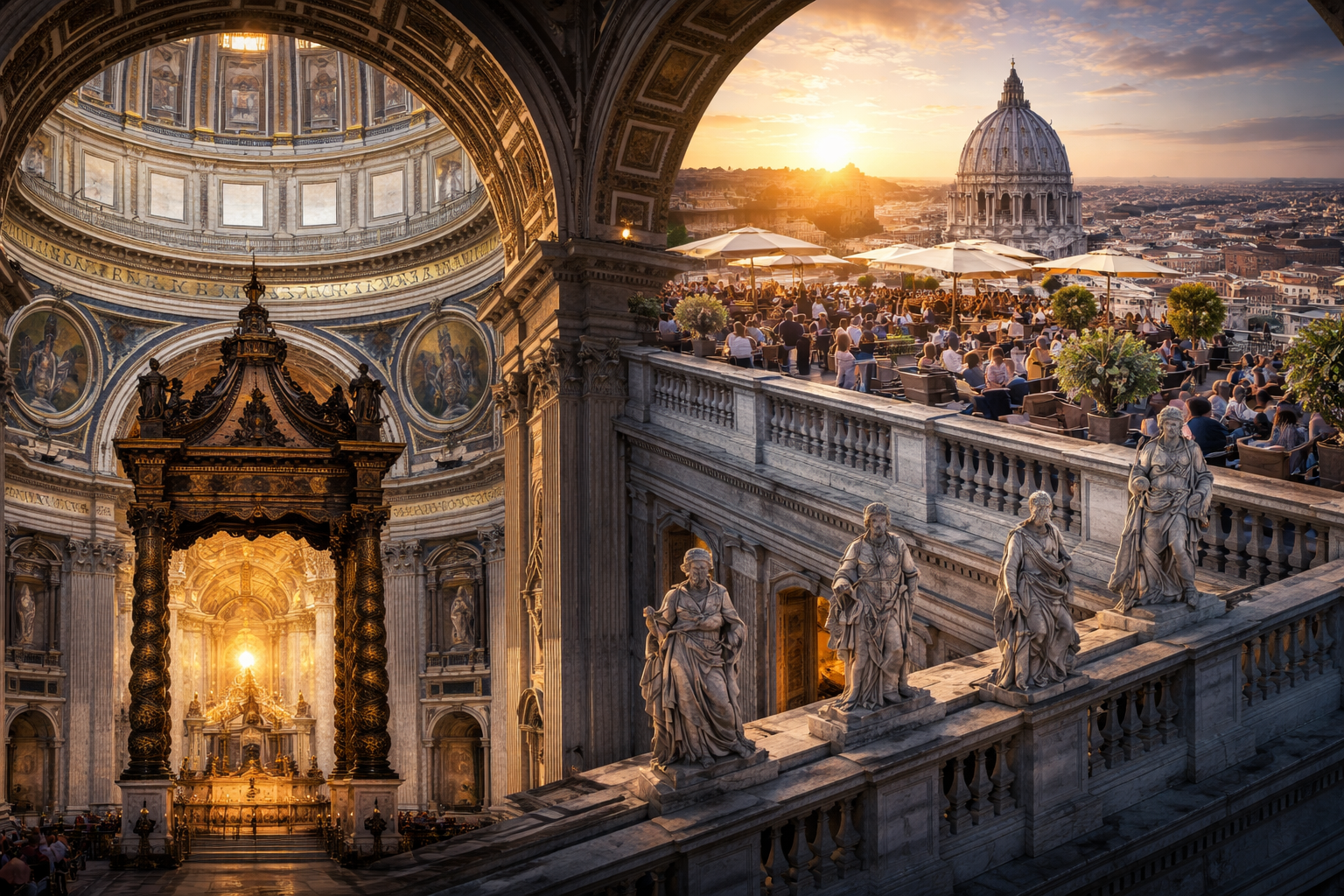
In recent weeks, two developments have converged to provoke grave concern among clergy and faithful alike: the confirmation of plans to expand a terrace refreshment point into a restaurant-style facility above the basilica, and a series of public profanations and Eucharistic irregularities within the sacred space itself. These events cannot be treated in isolation. They form part of a wider crisis of sacral governance.

The Terrace Restaurant Plan
On 11 February 2026, Italian daily Il Messaggero reported the existence of works underway on the main terrace above the nave of St Peter’s Basilica, aimed at expanding an existing refreshment point into a larger bistro-style facility.² The following day, the Holy See Press Office confirmed that such an expansion was under consideration in order to respond to increased visitor flows and ease crowding within the basilica.³
The works are being carried out by the Fabric of St Peter (Fabbrica di San Pietro), the body responsible for the maintenance and administration of the basilica. Authority for the basilica rests with Cardinal Mauro Gambetti, Archpriest of the Papal Basilica, Vicar General for Vatican City State, and President of the Fabric.⁴
The terrace in question forms part of the route to the dome and lies above the nave, directly over the area traditionally associated with the tomb of the Apostle. While the official explanation appeals to visitor management and recollection, internal reports suggest that furnishings have already arrived on site and that construction is advanced.²
Allegedly the canons of St. Peter’s Basilica were not formally informed about the project. “The works had been kept strictly secret by the Fabric of Saint Peter and the archpriest,” Il Messaggero reported.
Several clergy, speaking anonymously to Italian media, expressed reservations about the symbolism of eating and drinking in such proximity to the tomb of St Peter.² Whether or not the comparison with other religious sites is rhetorically apt, the theological question remains: what does spatial hierarchy signify in a sacramental religion?
Catholic tradition has always expressed doctrine architecturally. The tomb of the Apostle lies beneath the Altar of the Confession; above it rises the dome. The vertical axis is catechetical. The introduction of a commercial dining space within that axis inevitably alters its meaning.
A Pattern of Profanation
The terrace controversy unfolds against the backdrop of repeated acts of desecration within the basilica in recent years.
On 1 June 2023, a naked protester mounted the Altar of the Confession and shouted political slogans before being apprehended.⁵ On 7 February 2025, a man climbed onto the same altar and threw candlesticks to the ground.⁶ On 10 October 2025, a drunken individual stripped naked and urinated at the altar of the Chapel of the Blessed Sacrament.⁷ In January 2026, a man reportedly climbed onto the altar of that chapel during Eucharistic adoration and violently overturned sacred vessels, prompting a penitential rite of reparation.⁸
Such acts cannot be dismissed as random pathology alone. The Altar of the Confession stands directly above the Petrine tomb; the Chapel of the Blessed Sacrament houses the Eucharistic Lord exposed for adoration. The recurrence of profanations at precisely these loci of sacramental concentration raises questions about security, oversight, and liturgical seriousness.
Canon law is unambiguous: “Sacred places are violated by gravely injurious actions done in them with scandal to the faithful.”⁹ When violation occurs, rites of reparation are prescribed. The frequency of incidents at the world’s most symbolically guarded sanctuary is itself cause for alarm.
Eucharistic Irregularities During Mass
On 8 February 2026, Italian journalist Andrea Zambrano reported witnessing two alleged Eucharistic profanations during the 10:30 a.m. Mass in the central nave of St Peter’s Basilica, celebrated by Cardinal Gambetti.¹⁰ According to his published account in La Nuova Bussola Quotidiana, one communicant received multiple consecrated Hosts and distributed them to others in the pew; in a separate instance, a consecrated Host was placed into the mouth of a young child by a layperson, creating confusion and near irreverence.¹⁰
The journalist noted that while warnings were announced in multiple languages before Communion—urging proper disposition and consumption before the priest—security personnel were reportedly not stationed near the ministers distributing Holy Communion.¹⁰
The Church’s liturgical discipline exists precisely to prevent such situations. The Congregation for Divine Worship has repeatedly affirmed that “the faithful should not take the consecrated bread… by themselves” and that abuses must be corrected.¹¹ The possibility of communicants retaining or redistributing Hosts is a longstanding concern in large public liturgies, especially when Communion is received in the hand.
It is not the existence of warning announcements that safeguards the Eucharist, but coherent enforcement and disciplined ritual form.
Governance and Symbolism
The five-year term of Cardinal Gambetti as Vicar General for Vatican City State is set to expire on 20 February 2026. Whether or not it is renewed is a matter for Pope Leo XIV. The deeper issue, however, transcends personnel.
St Peter’s Basilica is not merely a cultural monument. It is the liturgical centre of the Latin Church and the architectural embodiment of Petrine succession. When acts of desecration recur, when Eucharistic discipline appears porous, and when commercial development is introduced within the vertical axis of the apostolic tomb, a pattern emerges.
The Church has always insisted that lex orandi, lex credendi—the law of prayer is the law of belief. If the sacred is treated administratively rather than theologically, the faithful will inevitably draw conclusions about what the Church herself believes.
Reverence is not ornamental. It is doctrinal in stone.
If the most symbolically charged sanctuary in Catholicism cannot clearly manifest sacramental hierarchy and disciplined governance, confidence in ecclesial seriousness elsewhere will not long endure.
- Ludwig von Pastor, The History of the Popes, Vol. 28 (London: Kegan Paul, 1938), pp. 347–349; Vatican.va, historical overview of St Peter’s Basilica consecration (18 November 1626).
- Il Messaggero, report on terrace works at St Peter’s Basilica, 11 February 2026.
- Holy See Press Office statement regarding terrace expansion, 12 February 2026.
- Vatican.va, biographical profile of Cardinal Mauro Gambetti, OFM Conv.; Apostolic Letter of appointment as Archpriest (2021).
- Reuters, “Naked man climbs altar in St Peter’s Basilica,” 1 June 2023.
- Italian press reports on altar incident, 7 February 2025 (ANSA coverage).
- Italian media coverage of October 2025 desecration at Blessed Sacrament Chapel.
- LifeSiteNews, report on January 2026 altar desecration and penitential rite.
- Code of Canon Law (1983), can. 1211.
- Andrea Zambrano, “Profanazioni eucaristiche a San Pietro,” La Nuova Bussola Quotidiana, 11 February 2026.
- Congregation for Divine Worship and the Discipline of the Sacraments, Redemptionis Sacramentum (2004), §§92–94.
RELATED ARTICLES


Latest ARTICLES
- Today’s homily: Christ the KingThe homily reflects on Christ’s kingship as seen in the Gospel narrative. It contrasts earthly authority with divine truth, emphasising that true allegiance to God requires genuine obedience and transformation. Believers are called to examine their personal commitments and respond to Christ’s demands in everyday life, ultimately recognising their identity as bearers of God’s image.
- Sermon for Christ the KingToday marks the celebration of Christ the King and the Twenty Second Sunday after Pentecost, a feast asserting Christ’s sovereignty against totalitarianism. St. Paul emphasised Christ’s supremacy over power and principalities, challenging early Gnostic beliefs. The early Church’s victory over evil is affirmed in Christ’s resurrection, offering hope and unity amidst contemporary struggles.
- Today’s Mass: October 25 SOVEREIGNTY OF OUR LORD JESUS CHRIST, SUPREME KINGThe Feast of the Sovereignty of Our Lord Jesus Christ celebrates Christ’s dual kingship by birth and conquest. Established by Pius XI, it aims to deepen faith and counter anti-clericalism. The liturgical observance underscores His authority as King, advocating for societal recognition of His reign to bring peace and harmony.
- TRADITION BEHIND THE FENCEThe Vatican’s prohibition of the traditional Ad Petri Sedem pilgrimage to St Peter’s Basilica has sparked controversy, especially among traditional Catholics. While some cite scheduling conflicts, the broader issue lies in the restrictive policies of Traditionis custodes, which may confine traditional liturgical practices to specific enclaves, risking the transmission and recognition of Catholic Tradition within the wider Church.
- Today’s Mass: October 24 St Raphael the ArchangelThe Feast of Saint Raphael the Archangel highlights his healing powers as depicted in the Book of Tobit, where he aids Tobit and his son, Tobiah. Venerated as a protector of travellers and the blind, Raphael is celebrated for his miraculous interventions. His legacy includes support for nurses, matchmakers, and Catholic studies.





Leave a Reply