
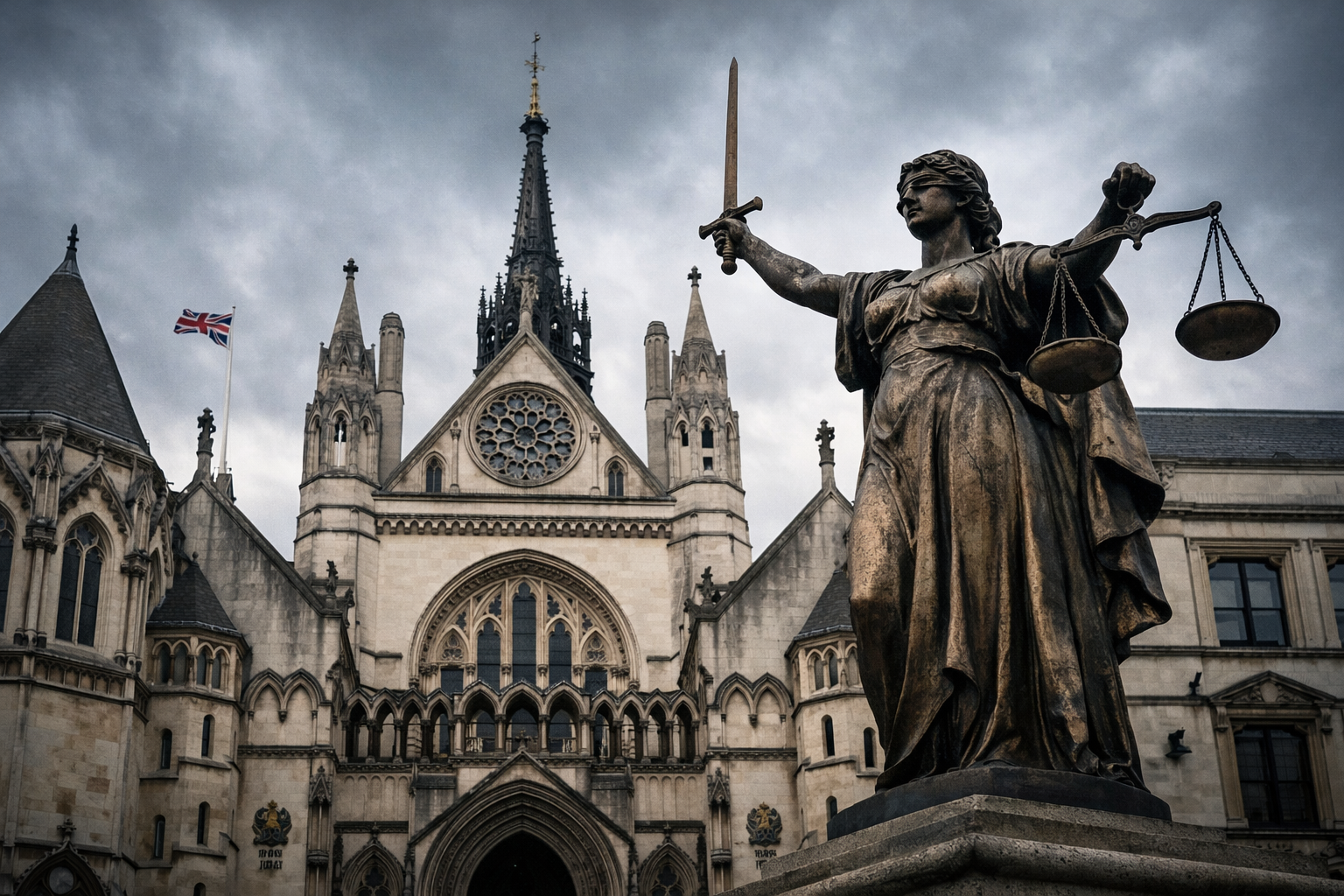
ENGLAND’S FREE SPEECH TEST: THE COSKUN CASE AND THE RETURN OF BLASPHEMY BY PROSECUTORIAL MEANS
In October 2025, the conviction of Hamit Coskun was quashed at Southwark Crown Court, reaffirming a principle embedded in modern English criminal law: there is no offence of blasphemy.¹ Yet the matter has not ended. The Crown Prosecution Service (CPS) has sought to challenge that ruling before the High Court of England and Wales, raising a constitutional question of genuine gravity: may public-order legislation be used to recreate, in substance, what Parliament expressly abolished?
THE INCIDENT AND ITS LEGAL CONSEQUENCES
On 13 February 2025, Coskun burned a copy of the Qur’an outside the Turkish Consulate in London while criticising the policies of President Recep Tayyip Erdoğan.² His protest was overtly political and deliberately provocative.
A bystander, Moussa Kadri, reacted violently, attacking Coskun with a knife and inflicting injuries requiring hospital treatment.³ Kadri later received a suspended sentence. Coskun, however, was charged under section 5 of the Public Order Act 1986, with the offence treated as religiously aggravated under section 31 of the Crime and Disorder Act 1998.⁴
It bears repeating that burning a religious text is not, of itself, a criminal offence in England and Wales. The common law offences of blasphemy and blasphemous libel were abolished by section 79 of the Criminal Justice and Immigration Act 2008.⁵
THE APPEAL JUDGMENT
In R v Coskun (10 October 2025), Mr Justice Bennathan held unequivocally:
“There is no offence of blasphemy in our law.”⁶
He further affirmed that freedom of expression, protected by Article 10 of the European Convention on Human Rights, includes expression that offends, shocks or disturbs.⁷ The Crown Court concluded that Coskun’s conduct did not meet the statutory threshold for disorderly behaviour within section 5.
THE CPS CASE-STATED APPEAL
The CPS has now pursued a case-stated appeal to the High Court, arguing that the Crown Court erred in law in overturning the conviction.⁸ The prosecution contends that the combination of symbolic desecration, hostile language, and proximity to a diplomatic site constituted disorderly behaviour properly aggravated by religious hostility.
If accepted, that reasoning would have far-reaching implications. It would mean that symbolic protest becomes criminal not because it incites violence or directly harasses identifiable individuals, but because it gravely offends adherents of a religion.
FROM OFFENCE TO CRIMINALITY
The constitutional difficulty is clear. Parliament removed blasphemy from English law in 2008.⁵ Public-order legislation was designed to prevent tangible disorder, not to confer special legal protection upon religious doctrines or sacred objects.
The European Court of Human Rights in Handyside v United Kingdom (1976) famously held that freedom of expression protects speech that “offends, shocks or disturbs.”⁷ That principle is not decorative; it is foundational. If offence alone becomes the functional trigger for criminal sanction, the distinction between maintaining public order and enforcing religious orthodoxy collapses.
THE CIVILISATIONAL QUESTION
This case is not a referendum on the wisdom or taste of Qur’an burning. It is a test of whether English law can sustain principled neutrality in a religiously plural society.
In a constitutional democracy, the state may punish violence. It may punish incitement. It may punish direct harassment. What it may not do—without fundamentally altering the settlement reached in 2008—is criminalise symbolic dissent because it affronts the sacred.
The High Court’s judgment will determine whether public-order law remains tethered to objective disorder, or whether it evolves into a vehicle for the indirect reintroduction of blasphemy protections under another name.
The boundary between offence and crime is now before the court.
- R v Coskun (Southwark Crown Court, 10 October 2025).
- Factual summary in R v Coskun, judgment of Bennathan J, paras 3–6.
- Sentencing proceedings in R v Kadri (Inner London Crown Court, 2025); see also National Secular Society, “CPS challenges quashing of Quran-burning conviction,” 2025.
- Public Order Act 1986, s. 5; Crime and Disorder Act 1998, s. 31.
- Criminal Justice and Immigration Act 2008, s. 79.
- R v Coskun (Southwark Crown Court, 10 October 2025), approved judgment.
- Handyside v United Kingdom (1976) 1 EHRR 737.
- CPS confirmation of case-stated appeal, February 2026; national press reporting including The Telegraph, 11 February 2026.
RELATED ARTICLES


Latest ARTICLES
- Today’s homily: Christ the KingThe homily reflects on Christ’s kingship as seen in the Gospel narrative. It contrasts earthly authority with divine truth, emphasising that true allegiance to God requires genuine obedience and transformation. Believers are called to examine their personal commitments and respond to Christ’s demands in everyday life, ultimately recognising their identity as bearers of God’s image.
- Sermon for Christ the KingToday marks the celebration of Christ the King and the Twenty Second Sunday after Pentecost, a feast asserting Christ’s sovereignty against totalitarianism. St. Paul emphasised Christ’s supremacy over power and principalities, challenging early Gnostic beliefs. The early Church’s victory over evil is affirmed in Christ’s resurrection, offering hope and unity amidst contemporary struggles.
- Today’s Mass: October 25 SOVEREIGNTY OF OUR LORD JESUS CHRIST, SUPREME KINGThe Feast of the Sovereignty of Our Lord Jesus Christ celebrates Christ’s dual kingship by birth and conquest. Established by Pius XI, it aims to deepen faith and counter anti-clericalism. The liturgical observance underscores His authority as King, advocating for societal recognition of His reign to bring peace and harmony.
- TRADITION BEHIND THE FENCEThe Vatican’s prohibition of the traditional Ad Petri Sedem pilgrimage to St Peter’s Basilica has sparked controversy, especially among traditional Catholics. While some cite scheduling conflicts, the broader issue lies in the restrictive policies of Traditionis custodes, which may confine traditional liturgical practices to specific enclaves, risking the transmission and recognition of Catholic Tradition within the wider Church.
- Today’s Mass: October 24 St Raphael the ArchangelThe Feast of Saint Raphael the Archangel highlights his healing powers as depicted in the Book of Tobit, where he aids Tobit and his son, Tobiah. Venerated as a protector of travellers and the blind, Raphael is celebrated for his miraculous interventions. His legacy includes support for nurses, matchmakers, and Catholic studies.





Leave a Reply