
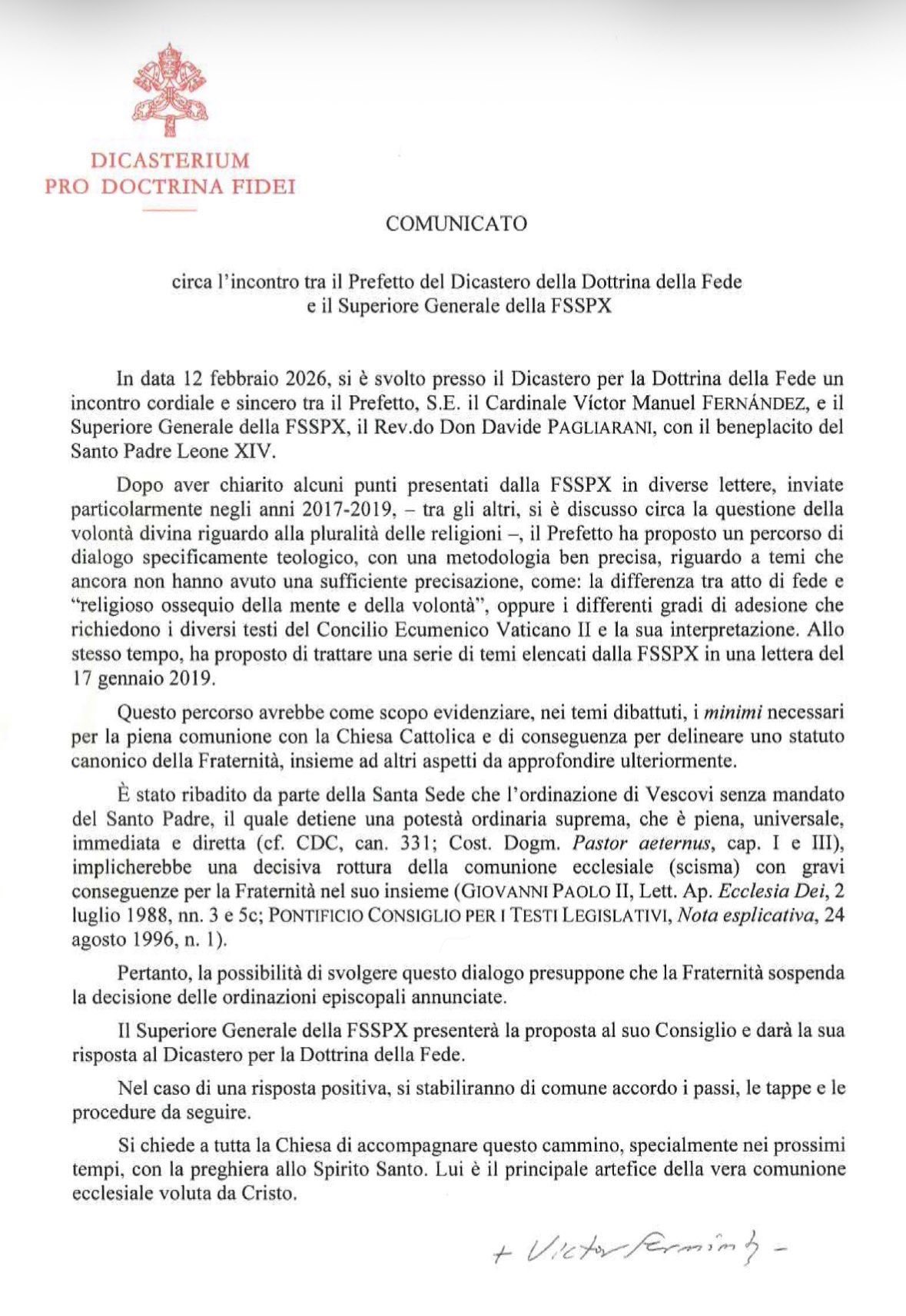
Toward “Minimal Requirements”? The DDF–SSPX Communiqué and the Ecclesiological Moment of 12 February 2026
On 12 February 2026 the Dicastery for the Doctrine of the Faith issued a formal communiqué following a meeting between its Prefect, Cardinal Víctor Manuel Fernández, and the Superior General of the Society of Saint Pius X, Fr Davide Pagliarani, with the approval of Pope Leo XIV.¹ The text is measured, juridically structured, and theologically precise. It neither announces an agreement nor rehearses old condemnations. Instead, it proposes a path of specifically theological dialogue, oriented toward identifying “the minimal requirements necessary for full communion.”²
The phrase is the hinge upon which this entire moment turns.
I. Theological Issues Explicitly Identified
The communiqué acknowledges that, following correspondence from the SSPX (2017–2019), certain doctrinal matters require clarification. Three are of particular importance.
First, the question of the divine will concerning the “plurality of religions.” This is an unmistakable reference to the 2019 Abu Dhabi statement on “Human Fraternity,” which asserted that the diversity of religions is “willed by God.”³ The distinction between positive and permissive divine will is not semantic; it touches the doctrine of the uniqueness and universality of Christ and His Church, solemnly reaffirmed in Dominus Iesus (2000).⁴ The fact that the DDF recognises this as a legitimate theological subject for clarification signals that the issue has not been definitively foreclosed.
Second, the communiqué identifies the distinction between an act of faith (fides divina et catholica) and the “religious submission of mind and will” (obsequium religiosum). This distinction, codified in canon 752 and clarified in the 1998 Doctrinal Commentary on the concluding formula of the Professio fidei,⁵ is foundational to assessing the authority of conciliar texts.
Third, the DDF refers explicitly to “the differing levels of assent required by various texts of the Second Vatican Ecumenical Council and their interpretation.” This is extraordinary language. The Council itself defined its pastoral character and avoided new dogmatic definitions.⁶ Yet, for decades, public discourse often treated the Council as an undifferentiated doctrinal whole. The communiqué reintroduces theological gradation.
II. Ecclesiological Framework: Communion and Authority
The document reiterates the perennial doctrine of papal primacy as articulated in Pastor Aeternus of Pastor Aeternus, which affirms the Roman Pontiff’s supreme, full, immediate, and universal jurisdiction.⁷ It further recalls the canonical norm that episcopal consecration without pontifical mandate constitutes a schismatic act (CIC 1983, can. 1382; cf. can. 751).⁸
The warning is unambiguous: any episcopal ordinations without mandate would “constitute a decisive rupture of ecclesial communion (schism), with grave consequences for the Fraternity as a whole,” citing Ecclesia Dei.⁹
Yet the tone differs markedly from 1988. The emphasis now is not punitive but conditional: dialogue presupposes suspension of announced consecrations. This is leverage, but it is also an opening.
III. “Minimal Requirements” and the Nature of Vatican II
The phrase “minimal requirements necessary for full communion” invites careful analysis. Communion in Catholic theology is not a vague sentiment but a visible, sacramental and juridical reality.ⁱ⁰ The Church requires unity in:
- The profession of the same faith,
- The celebration of the same sacraments,
- Submission to legitimate pastors, especially the Roman Pontiff.ⁱ¹
The communiqué suggests that Rome is prepared to articulate which doctrinal elements are strictly necessary for communion, and which may remain subject to theological debate within the bounds of orthodoxy. This implicitly affirms the classical distinction between dogma and theological opinion, and between irreformable definitions and authoritative but reformable magisterial acts.
Such a clarification would not weaken ecclesial authority; rather, it would restore traditional theological method.
IV. Risks and Opportunities for the SSPX
From the standpoint of ecclesiology and prudence, this moment presents both real opportunity and real danger.
Opportunities
- Doctrinal Clarification at the Highest Level
If Rome formally distinguishes levels of assent within Vatican II, this would vindicate the long-standing SSPX claim that not all conciliar texts are of equal doctrinal weight. - Canonical Regularisation Without Doctrinal Capitulation
A canonical structure—personal prelature or analogous form—could secure juridical stability while preserving liturgical and theological integrity. - Reframing the Debate
The dialogue shifts from accusations of disobedience to structured theological argument, the proper terrain of Catholic tradition.
Risks
- Ambiguity Institutionalised
If “minimal requirements” are formulated in a way that embeds unresolved ambiguities (particularly regarding religious liberty or interreligious theology), the SSPX risks appearing to endorse doctrinal formulations it has publicly criticised. - Gradual Assimilation
A canonical solution without substantial doctrinal clarity could expose the Fraternity to progressive administrative pressures over time. - Internal Fracture
Perceived compromise could provoke internal division, as occurred after the 2012 Doctrinal Preamble discussions. - Episcopal Consecration as Point of No Return
Conversely, proceeding with episcopal consecrations would almost certainly foreclose this opening and solidify juridical rupture.
V. A Theological Position Paper
From a traditional Catholic perspective rooted in the perennial magisterium, several principles must govern discernment.
First, communion with the Roman Pontiff is not optional. The papal office is divinely instituted and essential to the visible unity of the Church.⁷
Second, theological precision is not rebellion. The Church has always permitted disputation within defined doctrinal limits. St Thomas Aquinas himself distinguishes between dogma and theological conclusions.ⁱ²
Third, the nature of an ecumenical council must be assessed according to its own stated intention. Vatican II declared itself pastoral and avoided defining new dogmas.⁶ Therefore, it is legitimate to examine the authority of particular texts according to their doctrinal weight.
Fourth, unity cannot be purchased at the price of truth. But neither can truth be defended by severing communion unnecessarily.
Accordingly, a prudent course for the SSPX would be:
- To suspend episcopal consecrations temporarily,
- To engage the proposed theological process rigorously and publicly,
- To insist upon formal clarification of doctrinal weight and levels of assent,
- To seek canonical regularisation only if such clarifications are secured in writing.
This is not capitulation. It is Catholic method.
VI. The Broader Ecclesial Significance
The communiqué signals a potential maturation in Rome’s approach. It acknowledges that post-conciliar tensions cannot be resolved by slogans or disciplinary measures alone. They require theological method, distinctions, and careful articulation of authority.
Whether this process succeeds will depend not on sentiment but on precision.
The Holy Spirit is invoked in the communiqué as “the principal author of true ecclesial communion willed by Christ.” That communion is neither bureaucratic absorption nor ideological conformity. It is unity in the truth.
If the forthcoming dialogue restores clarity concerning the nature of magisterial authority, the gradation of assent, and the limits of pastoral conciliar teaching, this moment may prove historic.
If not, it will be another missed opportunity in a crisis now more than half a century old.
- Dicastery for the Doctrine of the Faith, Communiqué, 12 February 2026.
- Ibid.
- Document on Human Fraternity for World Peace and Living Together, Abu Dhabi, 4 February 2019.
- Congregation for the Doctrine of the Faith, Dominus Iesus, 6 August 2000.
- Congregation for the Doctrine of the Faith, Doctrinal Commentary on the Concluding Formula of the Professio fidei, 29 June 1998; cf. Code of Canon Law (1983), can. 752.
- Second Vatican Ecumenical Council, Address of Pope Paul VI, 7 December 1965; cf. Lumen Gentium, Preliminary Note.
- First Vatican Council, Pastor Aeternus, 18 July 1870, chs. 1–3.
- Code of Canon Law (1983), can. 751; can. 1382 (prior to 2021 reform).
- John Paul II, Ecclesia Dei, 2 July 1988, nn. 3–5.
- Catechism of the Catholic Church, nn. 815–816.
- Ibid.; cf. St Cyprian, De unitate ecclesiae.
- St Thomas Aquinas, Summa Theologiae, II–II, q.1, a.2.
RELATED ARTICLES


Latest
- Today’s Mass: October 18 St Luke the Evangelist; Commemoration of Sunday XXI Post PentecostSaint Luke was born a Greek and a Gentile in Antioch, Syria. He was a physician and it is believed that he may have also been a slave, as it was not uncommon in his day for slaves to be educated in medicine so the family would have a resident physician.
- “ONLY LUKE IS WITH ME”: THE EVANGELIST OF MERCY AND APOSTOLIC FIDELITYThe feast of St Luke, celebrated on 18 October, honours the beloved physician and Evangelist whose writings convey crucial Christian truths. He emphasises the vital link between divine mercy, repentance, and sacrifice. As St Paul’s companion, Luke’s narrative preserves the essence of the Gospel, reminding the Church to uphold and transmit revelation faithfully.
- Today’s Mass: October 17 St Gall, Confessor;Saint Gall, born in Ireland in the sixth century, became a notable confessor after accompanying Saint Columban to France and later Switzerland, where he preached and converted idolaters. Despite his significant contributions, he humbly declined the position of bishop of Constance. He died in 646, leaving a lasting legacy.
- 18.10.26 Nuntiatoria CXXVIII: NON POTEST VERITAS SUBDI POTESTATIThis editorial asserts that truth should not be subjugated to authority, emphasising that legitimate power derives from truth rather than mandates it. It critiques contemporary tendencies in both ecclesiastical and societal contexts where authority prioritises institutional credibility over accountability. Ultimately, it calls for a return to truth as the foundation of authority, urging faithful adherence to moral principles.
- ORDO w/c 18.10.26The liturgical calendar from 18 to 25 October 2026 includes the feast of St Luke the Evangelist, commemorating essential themes of forgiveness and evangelisation. Subsequent days honour St Peter of Alcantara, St John Cantius, St Ursula and St Raphael, culminating in the celebration of Christ the King, affirming His universal sovereignty over all creation.



Leave a Reply