
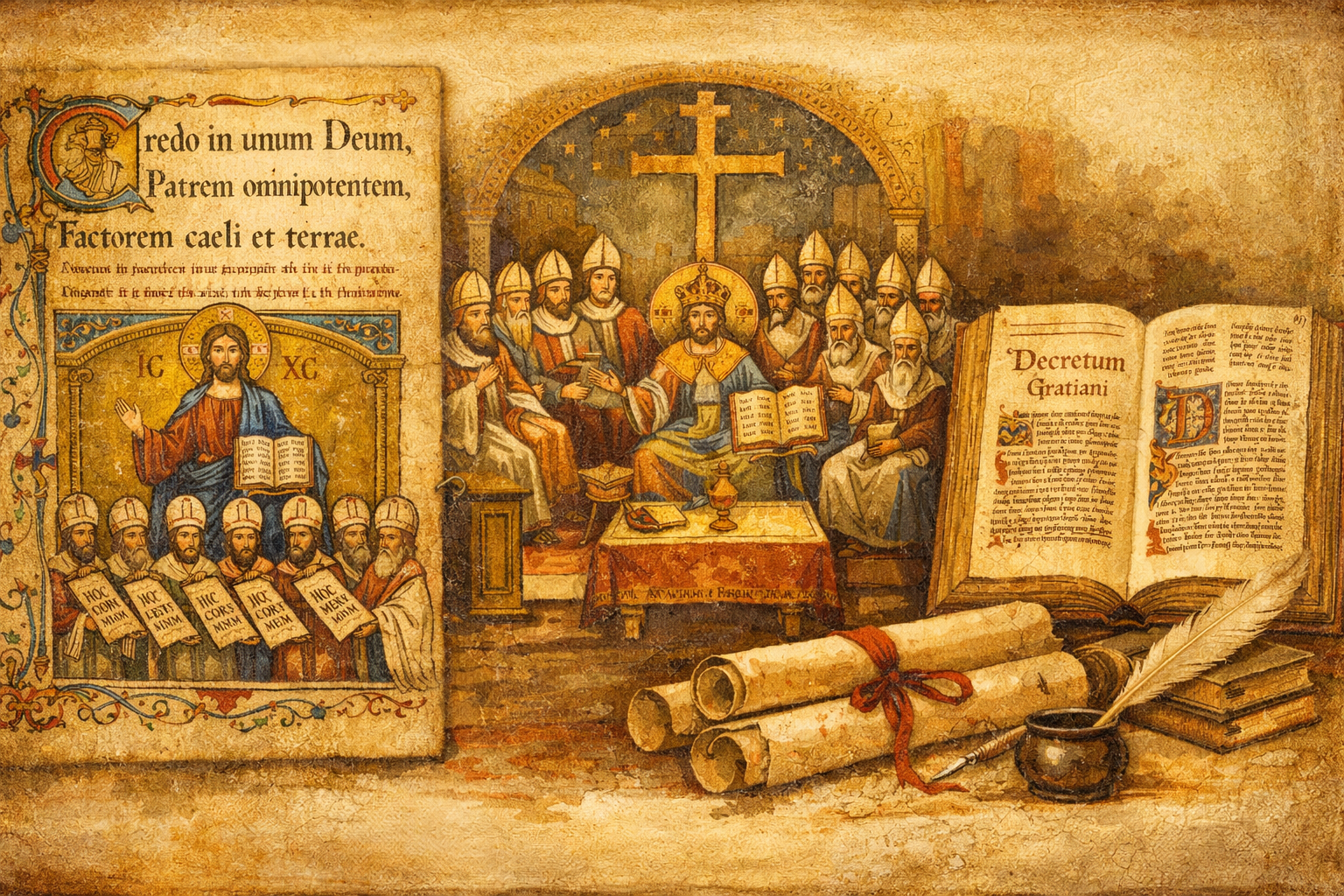
Fidelity Under Necessity: An Athanasian–Bellarminian Defence of the SSPX, the Old Roman Apostolate, and the Servants of the Holy Family
Introduction: Authority, Truth, and Ecclesial Crisis
The Catholic Church has already endured periods in which juridical authority, numerical dominance, and institutional possession diverged sharply from fidelity to apostolic doctrine. The fourth-century Arian crisis remains the paradigmatic example. During that period, episcopal majorities—often supported by imperial power—occupied sees, councils, and basilicas while advancing doctrinal ambiguity or error. Orthodoxy survived not through institutional control, but through fidelity maintained by confessors, monks, and exiled bishops.
The decisive theological witness of this period is Athanasius of Alexandria, whose ecclesiology established a permanent rule for times of doctrinal emergency: the Church is recognised not by possession of structures or titles, but by perseverance in the apostolic faith when ordinary authority fails in its proper end. As Athanasius reassured the faithful when orthodox believers were expelled from their churches, “They have the places, but you have the faith… for the faith, not the place, constitutes the Church.”¹
This Athanasian principle—received by later Fathers and given juridical precision by Robert Bellarmine, Doctor of the Church—provides the proper framework for evaluating the contemporary position of the Priestly Society of Saint Pius X (SSPX), the Old Roman Apostolate (ORA), and the Servants of the Holy Family (SSF), particularly in light of the SSPX’s announced intention to proceed with further episcopal consecrations on grounds of necessity.
The Athanasian Norm: Fidelity as the Measure of Authority
Athanasius never denied the legitimacy of episcopal office as such. Rather, he insisted that authority exists for the faith and loses moral binding force when exercised against it. In Historia Arianorum, he observes that many bishops imposed doctrine “not by persuasion, but by violence,” while truth endured among those without power.² The faithful, he insists, must judge claims of authority by conformity to the faith once delivered and handed down from the beginning.
This principle is already implicit in Scripture. Saint Paul commands the faithful not merely to obey, but to “stand fast and hold the traditions” they have received (2 Thess 2:15). Authority in Catholic theology is therefore ministerial, not creative. Popes and bishops guard the Deposit of Faith; they do not possess authority to permit its erosion through silence, ambiguity, or pastoral experimentation that endangers doctrine.
This logic was echoed in the West by Hilary of Poitiers, who rebuked appeals to institutional possession: “You ask where the Church is; I answer, where the true faith is.”³ Basil of Caesarea diagnosed the deeper pathology when he lamented: “The doctrines of the Fathers are despised, apostolic traditions are set aside, and the Church is filled with men skilled in ambiguity.”⁴
The governing theological rule for such moments was systematised by Vincent of Lérins, who explicitly cited the Arian collapse as precedent. When novelty infects even bishops and councils, Vincent writes, “it is necessary that we cling to antiquity, which at this day cannot be seduced by any fraud of novelty.”⁵
St Robert Bellarmine: Papal Authority, Resistance, and Antiquity
This patristic logic receives precise juridical articulation in St Robert Bellarmine’s De Romano Pontifice. Bellarmine affirms without qualification that the Roman Pontiff has no earthly superior and cannot be judged, punished, or deposed by the faithful. Yet he explicitly rejects any conception of papal authority as arbitrary or absolute.
In Book II, Chapter 29, Bellarmine writes: “Just as it is lawful to resist the Pontiff who attacks the body, so also is it lawful to resist him who attacks souls, or who disturbs the civil order, or, above all, who seeks to destroy the Church. I say that it is lawful to resist him by not doing what he commands and by impeding the execution of his will; it is not lawful, however, to judge, punish, or depose him.”⁶
This resistance is not rebellion, but self-defence in obedience to a higher norm. It is inseparable from Bellarmine’s doctrine of the Notes of the Church, especially Antiquity and Uninterrupted Duration. “The second note is Antiquity… therefore we must follow that which has been handed down from the beginning.”⁷ A command that contradicts constant and ancient teaching lacks this note and therefore loses binding force in conscience.
Canon Law, Moral Theology, and the Principle of Necessity
The Church’s canonical tradition confirms this framework. Canon law has never treated legality as an end in itself. The supreme interpretive principle of the entire legal system is explicit: “The salvation of souls, which must always be the supreme law in the Church, is to be kept before one’s eyes.”¹⁸
Classical canonists consistently taught that penal laws require strict interpretation and full imputability. The authoritative pre-Code manual of Francis Xavier Wernz and Pedro Vidal teaches that acts undertaken to avert grave harm to the Church or to souls may be externally illicit yet non-imputable, such that penalties do not follow where intent is preservative rather than rebellious.⁸
This juridical reasoning is inseparable from Catholic moral theology. Alphonsus Liguori, whose Theologia Moralis undergirds modern canonical penal norms, holds that laws cease to bind when their observance would cause grave harm, and that necessity excuses both from obligation and from penalty.⁹ Dominicus Prümmer likewise insists that penal liability presupposes full advertence and free consent, both of which may be absent under necessity.¹⁰
Canon law also foresees circumstances in which ordinary jurisdiction cannot safely function. Canon 144 provides that the Church supplies jurisdiction in cases of common error or positive and probable doubt.¹⁶ These principles are codified explicitly in Canon 1323, which exempts from penalty those who act by reason of necessity or even under the sincere belief that necessity is present.¹⁷ Since excommunication requires contumacy, a bishop acting to preserve souls and doctrine lacks the intent necessary for the penalty to bind.
Canonists on Schism, Contumacy, and Resistance
Classical canonists are equally precise in defining schism. Felix Cappello defines schism as a formal refusal of submission to the Roman Pontiff as such, not resistance to particular commands.¹¹ Augustine Beste likewise emphasises that schism is determined by intention, not merely by external irregularity.¹²
Authority, Law, and Ministerial Power
The juridical tradition underpinning this framework is reinforced by scholastic theology. Francisco Suárez teaches that ecclesiastical authority is ministerial, not arbitrary; commands destructive of the Church’s essential goods lack binding force.¹³ Modern canonists such as Eugene Corecco and Ladislas Örsy likewise affirm that canon law serves the salus animarum and must be interpreted teleologically.¹⁴ ¹⁵
Distinction from Schism and from Sedevacantism
The SSPX explicitly acknowledges the Roman Pontiff, prays for him in the Mass, and claims no parallel papal authority. This alone separates its position from schism as defined by Canon 751.¹⁹ Equally important is the distinction from sedevacantism, which presumes to judge the Pope himself—an act for which there is no precedent in Catholic theology.
Scripture itself records resistance within hierarchy. Saint Paul “withstood Peter to the face” when the truth of the Gospel was endangered (Gal 2:11). Unity in Catholic theology is unity in truth, not mere administrative alignment (Matt 10:34).²⁰
Conclusion: Preservation, Not Rebellion
If episcopal consecration absolutely required prior Roman mandate regardless of circumstances, this would contradict Canon 1752, Canon 144, Canon 1323, classical moral theology, and historical precedent. If necessity can justify extraordinary action, then the question is not whether the principle is Catholic, but whether the present crisis qualifies as necessity.
The SSPX argues that it does. It does not deny papal authority. It argues that preserving priesthood, sacraments, and traditional doctrine amid a global doctrinal and liturgical crisis constitutes necessity under long-standing Catholic principles.
By the combined witness of Athanasius, Bellarmine, Suárez, Alphonsus, the classical canonists, and the Church’s own law, the SSPX, ORA, and SSF may be understood as custodians under constraint—preserving the Deposit of Faith while awaiting the restoration of ordinary order.
- Athanasius of Alexandria, Epistola ad Monachos, §§2–5, PG 25:565–576.
- Athanasius of Alexandria, Historia Arianorum ad Monachos, §§33–35, PG 25:721–728.
- Hilary of Poitiers, Contra Auxentium, §§6–8, PL 10:609–618.
- Basil of Caesarea, Epistula 92 (90), PG 32:484–489.
- Vincent of Lérins, Commonitorium, chs. 3–5, PL 50:639–642.
- Robert Bellarmine, De Romano Pontifice, lib. II, cap. 29.
- Robert Bellarmine, De Ecclesia Militante, lib. IV, cap. 9.
- Wernz–Vidal, Ius Canonicum, vol. VII, nn. 398–402, 409–412.
- Alphonsus Liguori, Theologia Moralis, lib. I, tract. I, cap. 3, nn. 24–27.
- Dominicus Prümmer, Manuale Theologiae Moralis, vol. I, nn. 169–173.
- Felix Cappello, De Censuris, nn. 25–30.
- Augustine Beste, Introductio in Codicem Iuris Canonici, nn. 612–620.
- Francisco Suárez, De Legibus, lib. III, cap. 10, nn. 6–10.
- Eugene Corecco, “The Theology of Canon Law,” The Jurist 50 (1990): 175–198.
- Ladislas Örsy, The Church: Learning and Teaching, ch. 5.
- Codex Iuris Canonici (1983), c. 144.
- Codex Iuris Canonici (1983), c. 1323 §§4, 7.
- Codex Iuris Canonici (1983), c. 1752.
- Codex Iuris Canonici (1983), c. 751.
- Biblia Sacra Vulgata: 2 Thess 2:15; Gal 2:11; Matt 10:34.
RELATED ARTICLES


Latest
- Today’s Mass: October 17 St Gall, Confessor;Saint Gall, born in Ireland in the sixth century, became a notable confessor after accompanying Saint Columban to France and later Switzerland, where he preached and converted idolaters. Despite his significant contributions, he humbly declined the position of bishop of Constance. He died in 646, leaving a lasting legacy.
- 18.10.26 Nuntiatoria CXXVIII: NON POTEST VERITAS SUBDI POTESTATIThis editorial asserts that truth should not be subjugated to authority, emphasising that legitimate power derives from truth rather than mandates it. It critiques contemporary tendencies in both ecclesiastical and societal contexts where authority prioritises institutional credibility over accountability. Ultimately, it calls for a return to truth as the foundation of authority, urging faithful adherence to moral principles.
- ORDO w/c 18.10.26The liturgical calendar from 18 to 25 October 2026 includes the feast of St Luke the Evangelist, commemorating essential themes of forgiveness and evangelisation. Subsequent days honour St Peter of Alcantara, St John Cantius, St Ursula and St Raphael, culminating in the celebration of Christ the King, affirming His universal sovereignty over all creation.
- THE DEBTOR AT HIS BROTHER’S THROAT: The Twenty-First Sunday after PentecostThe Twenty-First Sunday after Pentecost highlights the danger of receiving divine mercy and failing to extend the same to others, exemplified by the parable of the unforgiving servant. The Church emphasises the need for genuine charity, justice without vengeance, and the importance of faith in guiding interpersonal conduct amidst spiritual struggle.
- The Roman Provenance of MonsignorThe title “Monsignor” is often misunderstood as an ecclesiastical rank or honour, whereas it is merely a style of address linked to specific ecclesiastical offices. The distinction between substantive dignity and its verbal expression is crucial. Various regulations historically defined these roles, ensuring accurate representation of ecclesiastical authority and honour.




Leave a Reply