
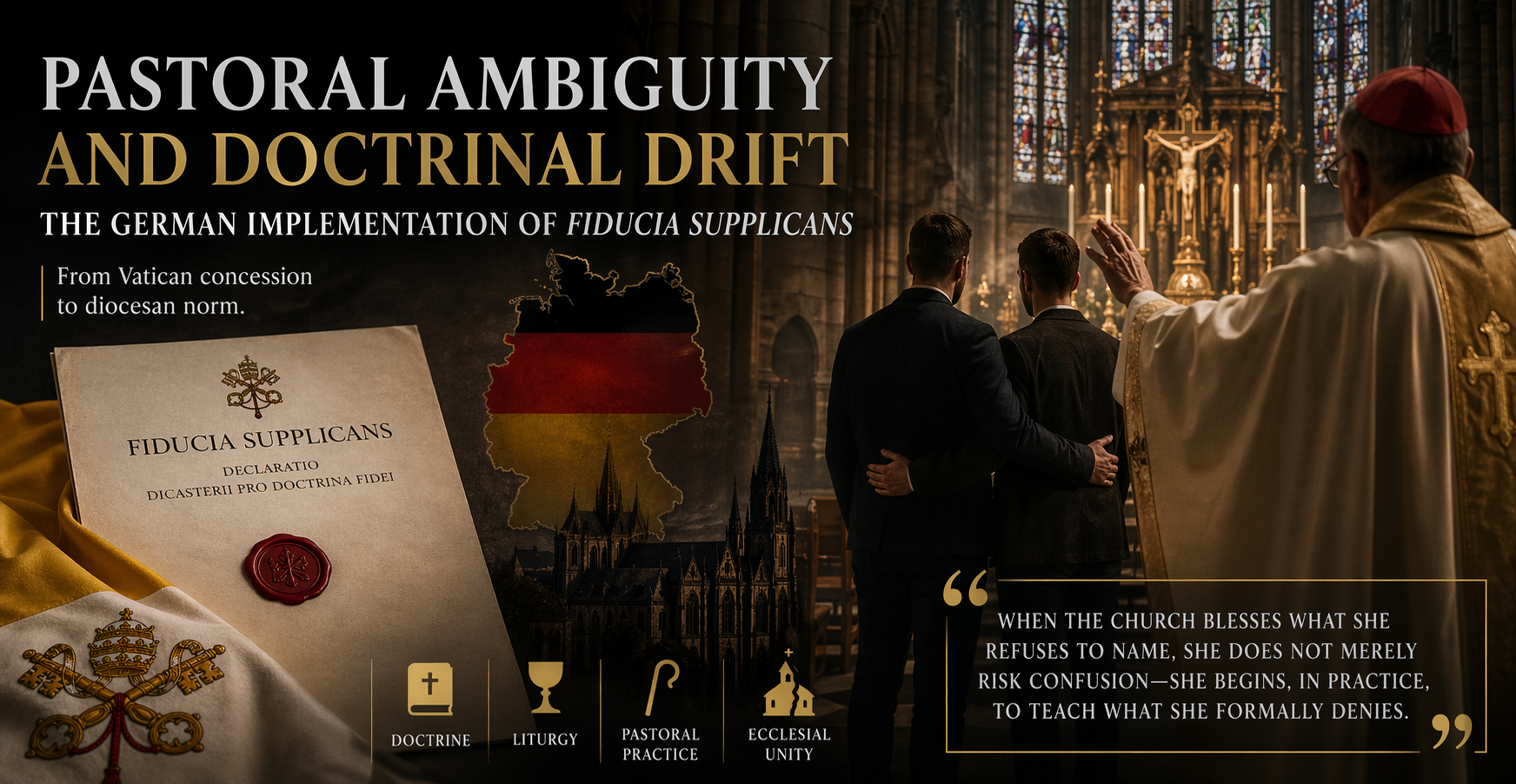
Pastoral Ambiguity and Doctrinal Drift: The German Implementation of Fiducia Supplicans

Munich, April 2026: From Vatican Concession to Diocesan Norm
A development now emerging within the Church in Germany marks not a momentary pastoral adjustment, but the consolidation of a trajectory long in motion. Reports from German Catholic media, corroborated across multiple outlets, indicate that Reinhard Marx has authorised and encouraged clergy within the Archdiocese of Munich and Freising to offer blessings to couples in so-called “irregular situations,” with accompanying language extending to “couples of all gender identities.”¹ The significance of this development lies not merely in the act itself, but in its institutionalisation within diocesan life—a movement from isolated pastoral gesture to habitual pastoral norm.
This development must be situated within the framework of Fiducia Supplicans, the 2023 declaration issued by the Dicastery for the Doctrine of the Faith under Cardinal Víctor Manuel Fernández and approved by Pope Francis. The document was presented as a carefully delimited intervention, permitting spontaneous, non-liturgical blessings while insisting that such acts must not “create confusion with the sacrament of marriage.”² It was, in effect, an attempt to navigate a pastoral impasse without altering doctrinal formulation. Yet what is now unfolding in Germany demonstrates the inherent difficulty—if not impossibility—of maintaining that distinction once the practice is absorbed into the ordinary life of the Church.
From Permission to Prescription: The Quiet Rewriting of Practice
At the level of formal text, Fiducia Supplicans remains juridically permissive. It allows certain pastoral gestures under tightly constrained conditions, explicitly avoiding any suggestion that such blessings constitute recognition of a union.³ Yet law, in the life of the Church, is not interpreted solely through its wording, but through its application. When clergy are instructed, encouraged, or formed to offer such blessings as part of their regular pastoral activity, the category of the act changes. It is no longer exceptional. It becomes normative.
Here the insight of Thomas Aquinas is not merely illustrative but diagnostic:
Consuetudo habet vim legis—custom has the force of law.⁴
The repetition of an act creates expectation; expectation forms practice; practice acquires authority. In this way, what begins as a concession is quietly transformed into a standard of ministry, and the meaning of the original permission is effectively rewritten without formal amendment.
From Spontaneity to Structure: The Emergence of a Parallel Form
The insistence within Fiducia Supplicans that such blessings remain “spontaneous” is not a peripheral detail. It is the linchpin upon which the entire argument of the document depends.⁵ A spontaneous act carries no institutional weight. It establishes no precedent. It remains pastoral, personal, and contingent.
Yet the lived reality of the Church does not operate in abstractions. A practice that is repeated across parishes, encouraged by diocesan leadership, and anticipated by the faithful cannot remain spontaneous in any meaningful sense. It becomes recognisable, predictable, and therefore structural. Even in the absence of an official rite, the repetition of the act produces a form—a pattern that functions, in effect, as a para-liturgical reality.
The Church’s own tradition provides the hermeneutic by which this must be understood:
Lex orandi, lex credendi.
What the Church does habitually becomes what the Church is understood to believe. Where the form stabilises, the meaning follows.
The Object of the Blessing: A Question That Cannot Be Evaded
At the heart of the present controversy lies a question that cannot be indefinitely deferred: what precisely is the object of the blessing? The Catholic tradition has always maintained a careful distinction between the blessing of persons and the affirmation of states of life. A blessing is ordered toward that which is good, true, and rightly disposed to God.
Thomas Aquinas teaches that a blessing signifies the communication of divine goodness toward a proper object.⁶ Persons may always be blessed, for grace is offered to all. Yet when two persons present themselves not merely as individuals but as a couple, and are blessed in that relational identity, the sign necessarily extends beyond the individual to the relationship itself.
Augustine of Hippo articulates the deeper principle with characteristic precision:
Ordo amoris—love must be rightly ordered if it is to be true.⁷
This principle is not a later theological refinement, but is rooted in the order of creation itself:
“Male and female He created them.” (Genesis 1:27)
A blessing that appears to affirm what is objectively disordered introduces a dissonance between sign and reality. The gesture no longer clarifies; it obscures. It no longer orders; it confuses.
The Language of Expansion: The Introduction of a New Framework
The language now emerging from German pastoral contexts reveals the depth of this shift. According to Katholisch.de, the official portal of the German Bishops’ Conference, pastoral guidance has extended to the accompaniment and blessing of “Paare aller Geschlechtsidentitäten”—“couples of all gender identities.”¹ This terminology is not incidental. It does not arise from the vocabulary of Fiducia Supplicans, which deliberately avoids such categories. It introduces, instead, a framework drawn from contemporary gender theory.
This marks a decisive transition. The issue is no longer confined to the pastoral care of individuals in irregular situations; it now touches upon the anthropological foundations of moral theology itself. The blessing becomes not merely an act of accompaniment, but a vehicle through which new conceptual categories are introduced into ecclesial life. In this way, pastoral practice becomes a means of doctrinal reframing without explicit doctrinal revision.
A Counter-Argument Considered and Found Wanting
It is frequently argued in defence of such developments that the Church has always blessed sinners, and that these blessings concern persons rather than relationships. The appeal is made to mercy, to accompaniment, and to the distinction between moral judgement and pastoral care.
Yet this argument, though superficially compelling, fails at the level of signification. A sinner approaches as an individual; a couple presents as a relational unit. When the blessing is directed toward the couple as such, the sign cannot be confined to the individuals alone. The visible act communicates a recognition of the relationship, regardless of the intention ascribed to it.
Moreover, such reasoning fails to account for the nature of sacramentals. Blessings are not neutral gestures. They are ecclesial acts that signify and dispose toward grace within a defined moral and theological order. To employ them in a manner that obscures that order is not to extend pastoral care, but to undermine the clarity upon which pastoral care depends.
Canonical Clarification: The Nature and Limits of Sacramentals
The Church’s law speaks with precision on this matter. The Code of Canon Law defines sacramentals as sacred signs by which “spiritual effects are signified and obtained through the intercession of the Church.”⁸ These signs presuppose an objective correspondence between what is signified and what is real.
A blessing, therefore, is not merely expressive; it is declarative. It communicates something about the order of grace and the orientation of the recipient toward that order. Where that correspondence is obscured, the sign risks becoming equivocal—no longer illuminating reality, but veiling it.
Germany and the Logic of the Synodal Path
The developments in Munich cannot be understood in isolation. They are the logical outworking of the broader trajectory of the German Synodal Path, which has for several years advanced proposals for the blessing of same-sex unions, the revision of sexual ethics, and the restructuring of ecclesial authority.⁹ Within this context, Fiducia Supplicans is not received as a limit, but as an opportunity—a juridical foothold upon which further developments may be constructed.
Thus emerges a growing divergence between the universal teaching of the Church and its local expression. What is framed in Rome as a tightly bounded concession is interpreted in Germany as a mandate for pastoral innovation.
Doctrinal Continuity and the Experience of Discontinuity
Formally, the Church’s doctrine remains unchanged. As reaffirmed by Pope John Paul II, marriage is the indissoluble union of one man and one woman, ordered toward the good of the spouses and the procreation and education of children.¹⁰ This teaching stands within the perennial magisterial tradition, articulated with clarity in Casti Connubii of Pope Pius XI:
“Matrimonium… a Deo ipso institutum est… ad prolem procreandam atque educandam.”
“Marriage… was instituted by God Himself… for the procreation and education of offspring.”¹¹
Yet doctrine is not encountered by the faithful as a proposition alone. It is encountered through the visible life of the Church—through her liturgy, her discipline, her pastoral practice. When these communicate ambiguity, the experience of the faithful is one of discontinuity, even in the absence of formal doctrinal change.
Ecclesiological Consequences: Unity Under Strain
The deeper question is ecclesiological. If the meaning of a universal doctrinal text is effectively determined by its local implementation, then the unity of the Church’s teaching becomes contingent. The result is not organic development, but fragmentation: one doctrine in principle, multiple doctrines in practice.
The risk is not abstract. It is the emergence of de facto national churches, each governed by its own pastoral logic, and the corresponding erosion of the practical authority of Rome as the final arbiter of doctrinal meaning. The Church’s visible unity—so central to her identity—comes under strain not through formal rupture, but through divergent praxis.
Conclusion: The Cost of Ambiguity
The German implementation of Fiducia Supplicans reveals with clarity the instability inherent in separating pastoral action from doctrinal signification. The Church’s tradition has always held these together; when they are separated, coherence gives way to confusion.
A blessing is never a neutral act. It signifies, it teaches, it forms.
When the Church blesses what she refuses to name, she does not merely risk misunderstanding—she begins, in practice, to teach what she formally denies.
¹ Katholisch.de, “Segnungen für Paare: Umsetzung von Fiducia Supplicans in deutschen Diözesen,” April 2026; cf. Cathcon; LifeSiteNews.
² Dicastery for the Doctrine of the Faith, Fiducia Supplicans (2023), §§5, 31.
³ Ibid., §§31–36.
⁴ Thomas Aquinas, Summa Theologiae, I–II, q. 97, a. 3.
⁵ Fiducia Supplicans, §38.
⁶ Thomas Aquinas, Summa Theologiae, II–II, q. 88, a. 1.
⁷ Augustine of Hippo, De Doctrina Christiana, I, 27.
⁸ Code of Canon Law (1983), can. 1166.
⁹ German Bishops’ Conference, Synodal Path documents (2019–2023).
¹⁰ Pope John Paul II, Familiaris Consortio (1981), §11.
¹¹ Pope Pius XI, Casti Connubii (1930), §7.
RELATED ARTICLES


Latest
- Today’s homily: Feast of St Didacus of Alcalá.The homily on St Didacus of Alcalá teaches that God values humility, obedience and charity above worldly learning or recognition. Didacus found true treasure through poverty, service to the sick and complete surrender to Christ. Christians are urged to place their hearts in heaven, practise hidden fidelity, serve others and embrace the Cross with confidence.
- Today’s Mass: November 13 St Didacus of AlcaláSaint Didacus, a 15th-century Spanish lay brother of the Franciscan Order, led a life of virtue, becoming guardian in Fortaventura and caring for the infirm in Rome. Known for miracles and his deep faith, he was canonized in 1588. His feast is celebrated on November 13 as a reminder of true devotion amidst modern challenges.
- Today’s homily: Feast of Pope St Martin I of RomeThe homily honours Pope St Martin I, who endured arrest, exile and death rather than compromise Catholic teaching on Christ’s two wills. His example illustrates the cost of discipleship, requiring steadfastness when fidelity brings suffering without earthly reward. Christians are urged to prioritise Christ, persevere through trials and express faith through prayer, sacrifice and charity.
- Today’s Mass: November 12 St Martin I of Rome, PopePope St. Martin I, who opposed the heresy of Monothelism, was captured by soldiers while ill and taken to Constantinople. He endured harsh imprisonment and exile, ultimately dying as a martyr in 656. His unwavering stance for church doctrine against imperial authority highlights his legacy as a defender of faith.
- Today’s homily: Feast of St Martin of ToursThe homily links St Martin of Tours, a former soldier, with Armistice Day, reflecting on peace, sacrifice and Christian charity. His sharing of a cloak illustrates recognising Christ in those suffering. Believers are urged to let faith govern their actions, pray for the war dead, pursue peace, and practise everyday courage, mercy and generosity.




Leave a Reply