
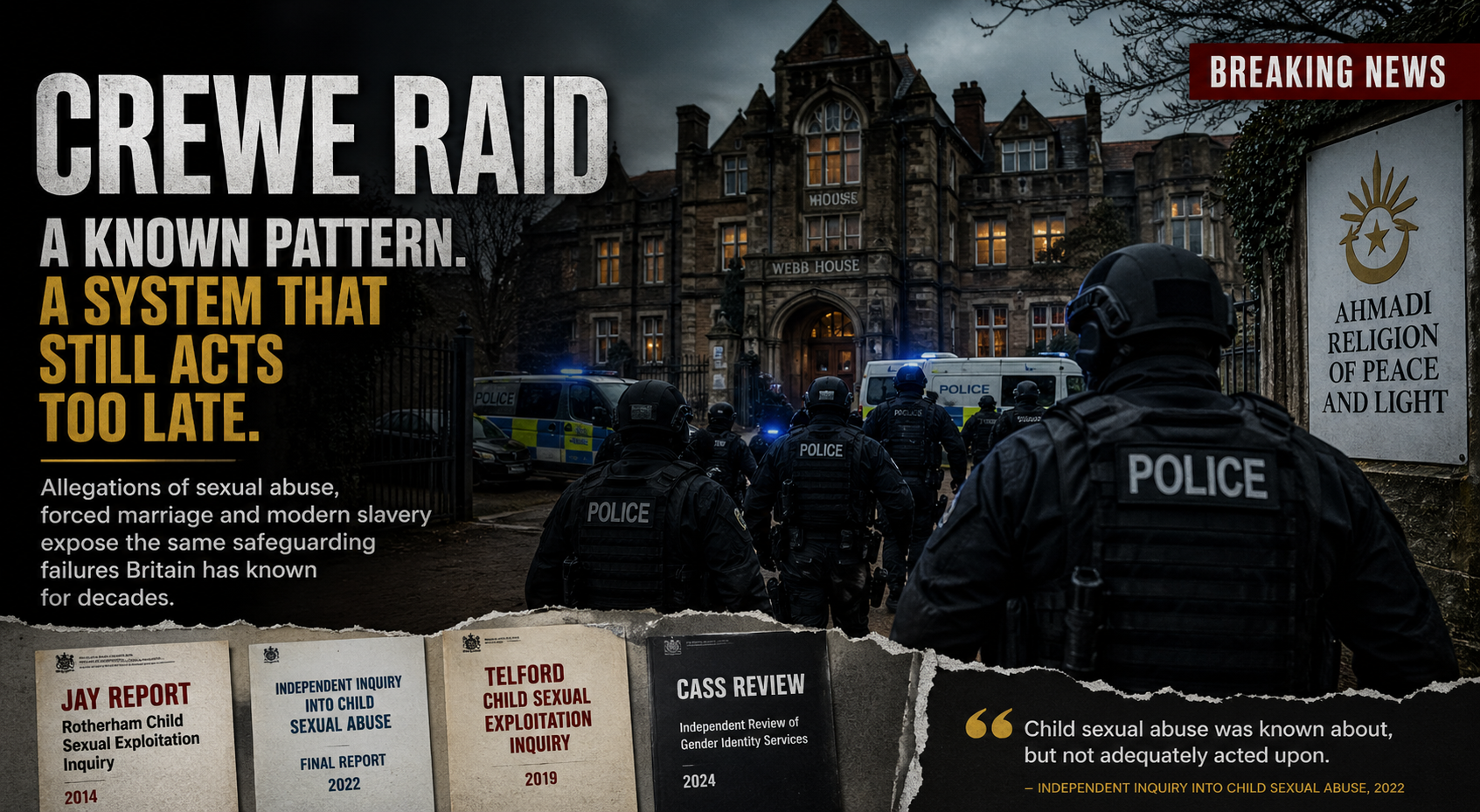
Crewe Raid Exposes a Known Safeguarding Pattern—And a System That Still Acts Too Late

The images from Crewe are arresting: more than five hundred officers descending on Webb House, a former orphanage now serving as the headquarters of the Ahmadi Religion of Peace and Light, as arrests are made amid allegations of sexual offences, forced marriage, and modern slavery. The group’s founder, Abdullah Hashem, leads a movement both recent and marginal, emphatically unrepresentative of mainstream Islam. Cheshire Constabulary has stressed that the investigation concerns alleged criminal conduct, not religious belief. Yet the deeper significance of the case lies elsewhere. It is not the identity of the group that demands scrutiny, but the pattern—one that has been documented, investigated, and lamented repeatedly across the United Kingdom’s recent history.
A Pattern Already Known
When one strips away the particulars, Crewe bears the unmistakable features of earlier safeguarding failures. The structural dynamics exposed in the Rotherham child sexual exploitation scandal—and later analysed in detail by the Independent Inquiry into Child Sexual Abuse—reappear in recognisable form: prolonged institutional hesitation, fragmented intelligence, and a failure to interpret non-physical coercion as genuine compulsion.
In Rotherham, abuse persisted for years despite repeated warnings, with an estimated 1,400 children affected.¹ Professor Alexis Jay recorded that agencies “repeatedly failed to act on their concerns” and that victims were “let down by those who should have protected them.”² The Inquiry later confirmed that such failures were not isolated, concluding that “child sexual abuse was known about, but not adequately acted upon.”³ Similar patterns were identified in the Telford child sexual exploitation scandal, where decades of abuse were minimised or ignored.
Crucially, these failures were not merely institutional in the abstract—they were personal. In Rotherham, the leadership of the council under Chief Executive Martin Kimber and political oversight during the tenure of council leader Roger Stone came under sustained criticism for failing to ensure effective safeguarding responses.⁴ The Jay Report found a culture of denial and inaction at senior levels, where warning signs were not escalated and accountability was diffused. Crewe now presents a similar temporal question: allegations reportedly relate to events in 2023, yet a major enforcement action has only occurred in 2026. Whether this reflects evidential caution or institutional delay will be a matter for scrutiny—but the pattern is no longer episodic. It is systemic, and where it becomes systemic, responsibility is never faceless.
The Law Is Clear—The Application Less So
The United Kingdom possesses a comprehensive legal framework for addressing precisely the offences alleged in Crewe. The Modern Slavery Act 2015 criminalises servitude and forced labour, explicitly recognising psychological coercion as sufficient. The Sexual Offences Act 2003 establishes that consent requires both freedom and capacity, excluding submission obtained through fear, dependency, or manipulation. The Anti-social Behaviour, Crime and Policing Act 2014 creates a specific offence of forced marriage.
In prosecutorial terms, such a case would likely be constructed through layered evidence: course-of-conduct patterns demonstrating coercive control; victim testimony corroborated by digital communications, financial records, and movement restrictions; and proof of hierarchical influence establishing abuse of position. These are not speculative tools—they are routinely deployed in modern prosecutions. The law does not fail to recognise coercion. The system too often fails to act upon its recognition early enough.
Recognisable Warning Signs
Across multiple inquiries, a consistent set of early warning indicators has been identified: social isolation, communal living under strict authority, control over relationships and marriage, economic dependency, and the mediation of sexual access through hierarchical power structures. These conditions are not incidental; they form the architecture within which abuse becomes both normalised and concealed.
The significance of a single complainant within such an environment is well established. The Independent Inquiry into Child Sexual Abuse observed that victims were frequently dismissed at first disclosure, contributing to prolonged harm.⁵ In closed systems, one credible allegation is rarely isolated—it is often the first visible fracture in a concealed structure of abuse.
This is not merely theoretical. Home Office data on the National Referral Mechanism recorded over 17,000 potential victims of modern slavery in 2023 alone, the highest figure since records began, indicating both the scale of exploitation and the likelihood of underreporting.⁶ Where coercive environments exist, detection lags behind reality.
Cultural Sensitivity and Institutional Hesitation
In the present case, Cheshire Constabulary has correctly emphasised that the investigation concerns alleged criminal conduct, not religious belief. This distinction is essential in a plural society. Yet history demonstrates that such sensitivity can become hesitation.
The Rotherham inquiry identified a reluctance among authorities to act decisively where cultural factors were perceived to be involved, noting that “fear of being thought racist” inhibited intervention.⁷ The national inquiry later confirmed that institutional responses were frequently shaped by concerns about reputation and community cohesion rather than the primacy of victim protection.⁸ What presents as neutrality in policy can become, in practice, a failure to act at the point of risk.
Reform Without Resolution
In response to these failures, reforms have sought to recalibrate safeguarding practice. The Cass Review emphasises rigorous assessment, vulnerability, and the need to identify external influences shaping behaviour. Updated statutory guidance such as Keeping Children Safe in Education reinforces the recognition of coercive control and contextual harm. Judicial clarification in For Women Scotland Ltd v Scottish Ministers [2024] UKSC 16 underscores the importance of objective criteria in safeguarding decisions.
These reforms are not trivial. They reflect a growing recognition that safeguarding must be grounded in reality rather than deference to ideology or sensitivity. Yet the structural weakness remains: the system continues to intervene after consolidation of harm, not at the stage of emerging pattern.
Safeguarding for children has improved markedly; safeguarding for vulnerable adults embedded in closed communities remains comparatively underdeveloped. The law is capable—but its application is still conditioned by hesitation.
A Test of Institutional Will
The events in Crewe therefore represent not an anomaly, but a test. A test not only of systems, but of those who lead them. Rotherham demonstrated that failure at scale is rarely the result of front-line ignorance alone; it is the product of leadership cultures that fail to prioritise safeguarding when it is inconvenient, complex, or reputationally risky.
The scale of the operation suggests seriousness. But scale is the language of response, not prevention. The decisive question is not how forcefully the system acts once engaged, but how early it is willing to act before certainty becomes unavoidable—and who is willing to take responsibility for that decision.
Conclusion: The Pattern We Refuse to Break
The United Kingdom does not lack the legal instruments to address abuse within closed or high-control communities. It does not lack inquiry findings, statutory guidance, or empirical evidence. What it has lacked, repeatedly, is the institutional will—and the leadership accountability—to act at the moment when suspicion first becomes pattern.
Crewe will proceed through the courts, as it must. But the deeper judgment lies elsewhere. A system that recognises warning signs yet delays intervention does not suffer from ignorance—it suffers from hesitation. And hesitation, in safeguarding, is not a neutral space. It is the interval in which harm compounds, victims are silenced, and systems entrench themselves beyond easy reach.
The pattern is established. The evidence is abundant. The mechanisms are in place.
What remains uncertain is whether the next failure will be explained—or prevented.
- Alexis Jay, Independent Inquiry into Child Sexual Exploitation in Rotherham (1997–2013) (Rotherham Metropolitan Borough Council, 2014), p.1.
- Ibid., pp.1–2.
- Independent Inquiry into Child Sexual Abuse, Final Report (London, 2022), Executive Summary, p.15.
- Jay, Rotherham Report, pp.91–95; see also Louise Casey, Report of Inspection of Rotherham Metropolitan Borough Council (2015), pp.9–12.
- Independent Inquiry into Child Sexual Abuse, Final Report, p.17.
- UK Home Office, National Referral Mechanism Statistics UK, End of Year Summary 2023, published 2024.
- Jay, Rotherham Report, p.93.
- Independent Inquiry into Child Sexual Abuse, Final Report, pp.17–18.
RELATED ARTICLES


LATEST POSTS
- Today’s Mass: September 26 SS. Cyprian and Justina, MartyrsThe persecution of Diocletian broke out at that time, and Cyprian and Justina were seized and presented to Diocletian himself, who judged them. Justina was scourged and Cyprian was torn with iron hooks. After this they were both sent back to Diocletian in chains. He commanded that their heads be cut off, and they died; martyrs for the Faith!
- 27.09.26 Nuntiatoria CXXV: VERITAS NON MUTATUR CONSENSUThis edition emphasises that truth remains constant, regardless of institutional consensus. It explores how authority should serve existing realities rather than define them, stressing the importance of preserving the Church’s traditions and teachings. The Church’s role is to guard and transmit truth, not to create it through agreement or procedure.
- ORDO w/c 27.09.26The week begins with the Eighteenth Sunday after Pentecost, honouring various saints, culminating in the feast of St Francis of Assisi. Key celebrations include St Wenceslaus, St Michael the Archangel, St Jerome, and St Thérèse of the Child Jesus. The period highlights the call to surrender worldly attachments in devotion to God.
- Rupnik’s accusers appeal to Leo XIV: the women are still outside the doorThe text explores the concept of “spiritual denial” within the Catholic Church regarding serious allegations against church leaders. It argues that this denial, often perceived as loyalty, leads to evasion of uncomfortable truths. The piece emphasises that acknowledging these failures does not undermine the Church’s integrity, urging faithful confrontation of wrongdoing while maintaining justice for all involved.
- TRADITIONIS CUSTODES BY THE NUMBERS: WHAT ROME’S 2025 DECREE REGISTER ACTUALLY SHOWSThe Vatican’s 2025 decree register clarifies the status of the Traditional Roman Mass, detailing 34 decrees concerning 33 jurisdictions and 55 parish churches. While 41 locations have renewed permissions, this system requires repeated authorisation from Rome, indicating administrative dependency on continuous approval for traditional practices rather than expanding opportunities.






Leave a Reply