
The Politics of Accusation: Public Religion, Nick Timothy, and the Closure of Debate
When Description Becomes Offence
The controversy surrounding Nick Timothy’s remarks on public Islamic prayer in Trafalgar Square has exposed a deeper fault line within Britain’s political and cultural order: not merely disagreement over religion, but the growing inability to describe it.
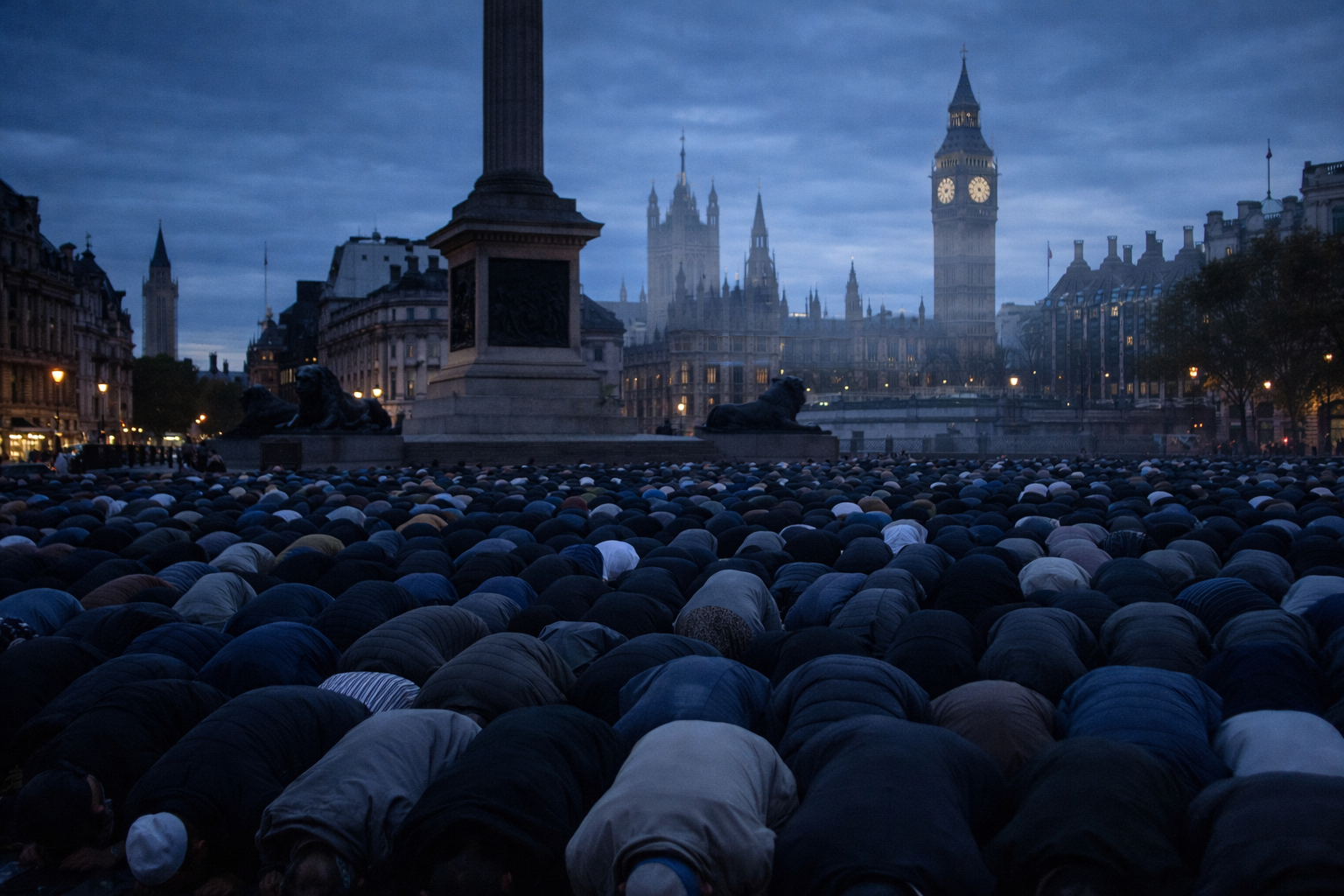
Timothy characterised the public recitation of Islamic prayer during a Ramadan gathering as “an act of dominance,” clarifying that he was not describing participants as extremists but identifying what he perceived to be a broader sociological dynamic.¹ The response was immediate. Political opponents condemned the remarks as inflammatory, while senior figures—including the Prime Minister—criticised the language as inappropriate.²
Yet what followed is more revealing than the initial exchange. The substance of Timothy’s argument—whether certain forms of public religious expression carry distinct civic and symbolic meanings—was not seriously engaged. Instead, the discussion shifted almost immediately to the legitimacy of raising the question at all.
This is no longer incidental. It is structural.
Theological Reality and Civic Abstraction
At the centre of the controversy lies a fact that modern discourse struggles to accommodate: religious claims are not interchangeable.
The Islamic adhan—the call to prayer—contains an explicit and exclusive theological assertion: “there is no god but God.” This is not a neutral cultural performance but a declaration of truth. To observe this is not polemical; it is descriptive.
By contrast, many civic religious expressions in Britain—Christmas illuminations, nativity scenes, or menorah lightings—function largely as symbolic or commemorative acts, often detached from explicit doctrinal proclamation. To treat these as identical phenomena is not pluralism, but abstraction.
The Church herself has never accepted such flattening. Nostra Aetate affirms that while elements of truth may be found in other religions, she “proclaims, and ever must proclaim Christ ‘the way, the truth, and the life.’”³ Recognition is not equivalence. Dialogue is not doctrinal surrender.
The difficulty, therefore, lies not in Timothy’s observation, but in a cultural framework in which such distinctions can no longer be articulated without sanction.
Context and Contestation: Disorder and Divergent Narratives
This debate does not unfold in a vacuum. It intersects with a wider pattern of reported incidents and contested interpretations concerning religious and communal tensions in public space.
In March 2026, Bob Blackman raised in Parliament a disturbance at a Holi celebration in Harrow, stating that a group of approximately twenty individuals disrupted the event, with only one arrest made.⁴ He further alleged that those responsible were connected to a nearby mosque and warned that such incidents risked inflaming broader tensions.
In the same period, multiple attacks on businesses in Wembley—including restaurants and shops on Ealing Road—were confirmed by the Metropolitan Police. Groups were reported to have entered premises, caused damage, and fled, with investigations ongoing and limited arrests.⁵
Yet the interpretation of these events remains sharply contested. Police and local officials have stated that they have found no evidence that the Harrow disturbance was religiously targeted, urging restraint and caution in attributing motive.⁶ Blackman, however, has continued to argue that the pattern warrants political attention.
This divergence is not incidental. It reflects a deeper tension between institutional caution and political perception—between evidential thresholds and the interpretation of emerging patterns.
Flashpoint Cases: Commerce, Conscience, and Escalation
The same dynamics can be observed at the level of ordinary civic life.
In 2026, Harman Singh Kapoor, a Sikh restaurant owner in London, became the centre of a public controversy after maintaining a policy of not serving halal meat.⁷ The decision—lawful and consistent with Sikh practice—triggered protests, harassment, and sustained online backlash.
The situation escalated through a series of confrontations and increasingly polarised public exchanges, culminating in police involvement and an arrest.⁷ Crucially, there is no verified evidence that the arrest was made on the basis of the restaurant’s refusal to serve halal food itself. Rather, it appears to have arisen from the breakdown of order surrounding the dispute.
This distinction is essential.
What began as a matter of commercial autonomy and religious conscience became, in short order, a focal point for communal tension, political framing, and state intervention. The issue was no longer what was served, but what the decision symbolised—and how it was contested.
From Critique to Prohibition
It is precisely within this climate that Timothy’s remarks take on their significance.
Rather than prompting analysis of the underlying issues—religious expression, public space, and social cohesion—the response has been to reclassify the act of raising such questions as itself suspect. The term “Islamophobia,” though often used to identify genuine prejudice, has expanded in practice into a category capable of absorbing analytical claims about religion in public life.
Notably, there remains no single statutory definition of the term in UK law. The 2018 proposal by the All-Party Parliamentary Group on British Muslims—defining Islamophobia as “a type of racism that targets expressions of Muslimness”—has not been formally adopted by the government.⁸ The result is a concept that is politically potent but legally indeterminate.
This indeterminacy enables a shift from argument to discipline. The question ceases to be whether a claim is true, and becomes whether it is permissible.
A Climate of Asymmetry
The broader context reinforces this concern.
The Batley Grammar School case, in which a teacher went into hiding after showing a caricature of the Prophet Muhammad during a lesson, remains emblematic.⁹ The episode demonstrated the real-world consequences of perceived religious offence, not only socially but personally.
At the same time, large-scale public religious events—such as the Trafalgar Square Ramadan gathering—are actively endorsed as expressions of inclusion and civic unity.¹ The tension lies precisely here: between the encouragement of religious visibility and the restriction of critical reflection upon it.
Whether or not each individual incident is directly connected, the cumulative effect is a perception of asymmetry—one that shapes how such controversies are understood.
Conclusion: The Price of Silence
The Timothy episode is not about one man, one remark, or one event. It is about the narrowing of the space in which serious discussion can occur.
A genuinely plural society requires more than tolerance; it requires the capacity to distinguish—to recognise differences in belief, meaning, and implication without collapsing them into offence.
If that capacity is lost, then pluralism itself becomes unsustainable. For a society that cannot name what it sees will, in time, lose the ability to understand it.
And what cannot be understood cannot be governed.
¹ Reporting on Trafalgar Square Ramadan event and Timothy’s remarks: The New Arab (2026).
² Political reaction including criticism from senior UK figures: The New Arab (2026).
³ Nostra Aetate, §2.
⁴ Parliamentary remarks by Bob Blackman concerning Harrow Holi disturbance: Times of India (2026).
⁵ Metropolitan Police-confirmed incidents involving attacks on Wembley businesses: Eastern Eye (2026).
⁶ Statements from police/local officials denying confirmed religious targeting: Harrow Monitoring Group (2026).
⁷ Reporting on Harman Singh Kapoor case and arrest: Hindustan Times; Times of India (2026).
⁸ All-Party Parliamentary Group on British Muslims, Islamophobia Defined (2018).
⁹ Batley Grammar School case: BBC News (2021–2024).
RELATED ARTICLES


LATEST ARTICLES
- Today’s Mass: September 19 S. Eustace & Companions, MartyrsSt. Eustachius, formerly General Placidus, experienced a transformative vision of Christ while hunting. After converting with his family, he endured persecution, losing them temporarily. Reuniting after military success, he ultimately refused to worship pagan deities, leading to his martyrdom with his family. They were later honoured with a church.
- Sermon for St. Eustacius/ Seventeenth Sunday after PentecostThe feast of St. Eustacius, celebrated on the Seventeenth Sunday after Pentecost, commemorates early Christian martyrs who refused to renounce their faith. Despite limited historical knowledge of St. Eustacius, his story embodies the courage of many Christians who, facing persecution from the Roman Empire, chose martyrdom over idolatry, ultimately shaping the Church’s foundation.
- Today’s Mass: September 19 St. Januarius, Bishop and Companion MartyrsSt. Januarius and companion martyrs were martyred during the persecution under Diocletian. St. Januarius, patron of the city of Naples and bishop of Beneventum, was beheaded with his deacons and some others.
- Sermon for St. Januarius and his CompanionsToday we celebrate the feast of St. Januarius and his companions. About St. Januarius little is known except that he was among the many martyrs during the great persecution under the Emperor Diocletian.
- 20.09.26 Nuntiatoria CXXIV: QUOD ACCEPIMUS, CUSTODIMUS ET TRADIMUSThe editorial emphasises the importance of understanding our inheritance as custodians rather than owners. It highlights the obligation to preserve and transmit the Christian Faith, sacraments, and traditions to future generations. Through gratitude and fidelity, those who receive must ensure that what has been entrusted does not end with them.


Leave a Reply