

Unequal Justice: Hate Crime Prosecutions and the Fracturing of Britain’s Legal Order
In a nation whose identity has long been bound to the impartial administration of justice, the integrity of the legal system is not an abstract principle but a civilisational necessity. Law, in the English tradition, is not merely procedural; it is moral in character, rooted in the conviction that all persons stand equal before it. When that conviction falters—when justice appears unevenly applied—the consequences are not confined to the courtroom. They extend into the realm of public trust, social cohesion, and ultimately the legitimacy of the state itself.
Recent data, obtained through Freedom of Information requests from Home Office policing figures, has brought this question into sharp relief. The analysis suggests that hate crimes recorded against Muslims are nearly twice as likely to result in prosecution as those recorded against Jews. Expressed numerically, approximately one in fifteen anti-Muslim hate crimes proceeds to prosecution, compared with only one in twenty-six antisemitic offences.¹ These are not merely low prosecution rates; they are uneven ones. And it is the disparity, rather than the absolute figures alone, that demands explanation.
This disparity is rendered more striking by the well-established pattern of victimisation in Britain. For over a decade, official statistics and independent monitoring bodies have consistently shown that Jewish people are the most targeted religious group per capita in the United Kingdom.² The Community Security Trust, the principal body monitoring antisemitism, has documented sustained increases in incidents, including record-breaking annual totals in recent years.³ These incidents range from verbal abuse and harassment to threats, vandalism, and physical assault. The scale and persistence of such hostility have placed the Jewish community in a uniquely exposed position.
Yet exposure has not translated into proportionate legal response. The Crown Prosecution Service, tasked with bringing cases before the courts, operates under the well-established Full Code Test, requiring both a realistic prospect of conviction and a determination that prosecution is in the public interest.⁴ These criteria are indispensable to the integrity of the justice system. They prevent frivolous or unjust prosecutions and ensure that the coercive power of the state is exercised responsibly. But they also place considerable weight on evidential sufficiency—weight which, in practice, can result in a high attrition rate between reported offence and prosecuted case.
It is here that complexity enters the analysis. Hate crimes are frequently difficult to prosecute. Many occur online under conditions of anonymity. Others take place in volatile public environments where identification is uncertain and evidence fragmentary. The legal threshold for proving hostility as a motivating factor further complicates proceedings. These challenges are real, and they must be acknowledged if any serious assessment is to be made.
However, complexity cannot serve as a universal explanation for disparity. The question remains: why should these evidential challenges result in materially different prosecution outcomes between categories of religious hate crime? If similar evidential constraints apply across the board, then significant divergence in prosecution rates requires more than procedural explanation. It requires scrutiny.
That scrutiny has, until recently, been difficult to sustain due to a lack of transparency. For years, campaigners have called on the CPS to publish detailed breakdowns of hate crime prosecutions by category. While commitments to greater openness were periodically made, comprehensive disaggregated data was not routinely released.⁵ The result has been a persistent gap between institutional assurances and publicly verifiable evidence.
Into that gap has flowed distrust. Surveys of British Jews reveal a profound lack of confidence in the criminal justice system’s response to antisemitism. Only a small minority believe that the CPS does enough to protect them, while a substantial majority doubt that antisemitic offences will be prosecuted even when supported by sufficient evidence.⁶ Such findings do not merely reflect dissatisfaction; they indicate a systemic erosion of credibility.
Credibility, once lost, is not easily restored. A justice system depends upon the cooperation of those it serves. Victims must be willing to report offences; witnesses must be willing to testify; communities must be willing to believe that the law operates without prejudice. When these conditions fail, enforcement becomes reactive, partial, and ultimately ineffective.
The broader political and legal context cannot be ignored. In recent years, the enforcement of hate crime legislation has become increasingly entangled with wider debates over identity, speech, and social cohesion. Legislative and policy initiatives aimed at addressing religious hostility have expanded in scope, yet not always with uniform clarity. Without transparent and consistent application, such frameworks risk generating the very inequalities they are intended to prevent.
This is why the present issue cannot be dismissed as a narrow statistical anomaly. It touches upon the fundamental principle that justice must be both equal and seen to be equal. Where disparities exist, they must be explained. Where explanations are insufficient, reform must follow.
The most immediate and necessary step is full transparency. The CPS should publish comprehensive data on hate crime prosecutions, disaggregated by category, and including detailed attrition rates at each stage of the process. Such publication should not be sporadic or reactive, but systematic and routine. Only then can meaningful analysis take place.
Beyond transparency lies the question of remedy. If disparities are found to arise from evidential challenges, then investigative capacity must be strengthened—particularly in relation to online offences. If they stem from prosecutorial decision-making, then guidance and oversight must be reviewed. If they reflect broader structural issues within policing or reporting mechanisms, then those too must be addressed.
Yet even as these practical considerations are examined, a deeper truth remains. The law is not merely an instrument of order; it is a symbol of justice. When that symbol appears compromised—when one community perceives itself as insufficiently protected—the damage extends beyond the immediate issue. It strikes at the shared confidence upon which a lawful society depends.
Britain has long claimed a legal tradition rooted in fairness, continuity, and restraint. That tradition cannot be sustained by assertion alone. It must be demonstrated in practice, particularly in moments of strain. The data now emerging presents such a moment. It demands not defensiveness, but clarity; not reassurance, but evidence.
If the disparity is real, it must be corrected. If it is misunderstood, it must be explained. But it cannot be ignored. For in the end, the question is not only whether justice is done, but whether it is believed to be done. And once that belief falters, the restoration of trust becomes infinitely more difficult than its preservation.
- Home Office, Hate Crime, England and Wales, Year Ending March 2024, Statistical Bulletin (London: Home Office, 2024); supplementary prosecution outcome data obtained via Freedom of Information requests and analysed by Campaign Against Antisemitism.
- Home Office, Hate Crime, England and Wales statistical releases (various years), showing religion-based hate crime rates and proportional victimisation; see also Office for National Statistics (ONS), population estimates for religious groups.
- Community Security Trust, Antisemitic Incidents Report 2023 (London: CST, February 2024), documenting 4,103 antisemitic incidents, the highest annual total recorded by CST.
- Crown Prosecution Service, The Code for Crown Prosecutors (London: CPS, 2018, updated 2023), §§4.6–4.14 (Full Code Test: evidential stage and public interest stage).
- UK Parliament, House of Commons debates and written questions on CPS hate crime data transparency (e.g., HC Deb, various sessions 2018–2024); Campaign Against Antisemitism, correspondence and submissions to the CPS regarding publication of prosecution statistics.
- Campaign Against Antisemitism, Antisemitism Barometer 2023 (London: CAA, 2023), findings on Jewish community confidence in policing and prosecution of antisemitic crime.
RELATED ARTICLES


LATEST ARTICLES
- Today’s Mass: October 08 St Bridget of SwedenSaint Bridget of Sweden, born around 1302, was a noblewoman renowned for her piety and prophetic revelations. After marrying Prince Ulpho and raising eight children, she led a life of austerity and charity, founding the Order of the Holy Saviour. She died in Rome in 1373 and was canonised in 1391.
- Today’s Mass: October 07 Pope St Mark, ConfessorSt Mark’s brief pontificate teaches that God measures fidelity, not duration or worldly achievement. Christ alone possesses the everlasting priesthood; His servants are stewards of what they have received. With the commemorated martyrs, St Mark reminds us to persevere faithfully, so that when the Lord comes, He finds us “so doing.”
- Omnia autem probate: quod bonum est tenete ~ Prove all things; hold fast that which is good: Spiritual Conference for Nuntiatoria CXXVIThe conference reflects on St Paul’s assertion to “prove all things” in relation to self-judgement and the Church. It explores themes of synodality, ecumenism, and the importance of discernment, emphasising the need for humility in understanding truth and the challenge of maintaining genuine holiness in the midst of contemporary ecclesiastical crises.
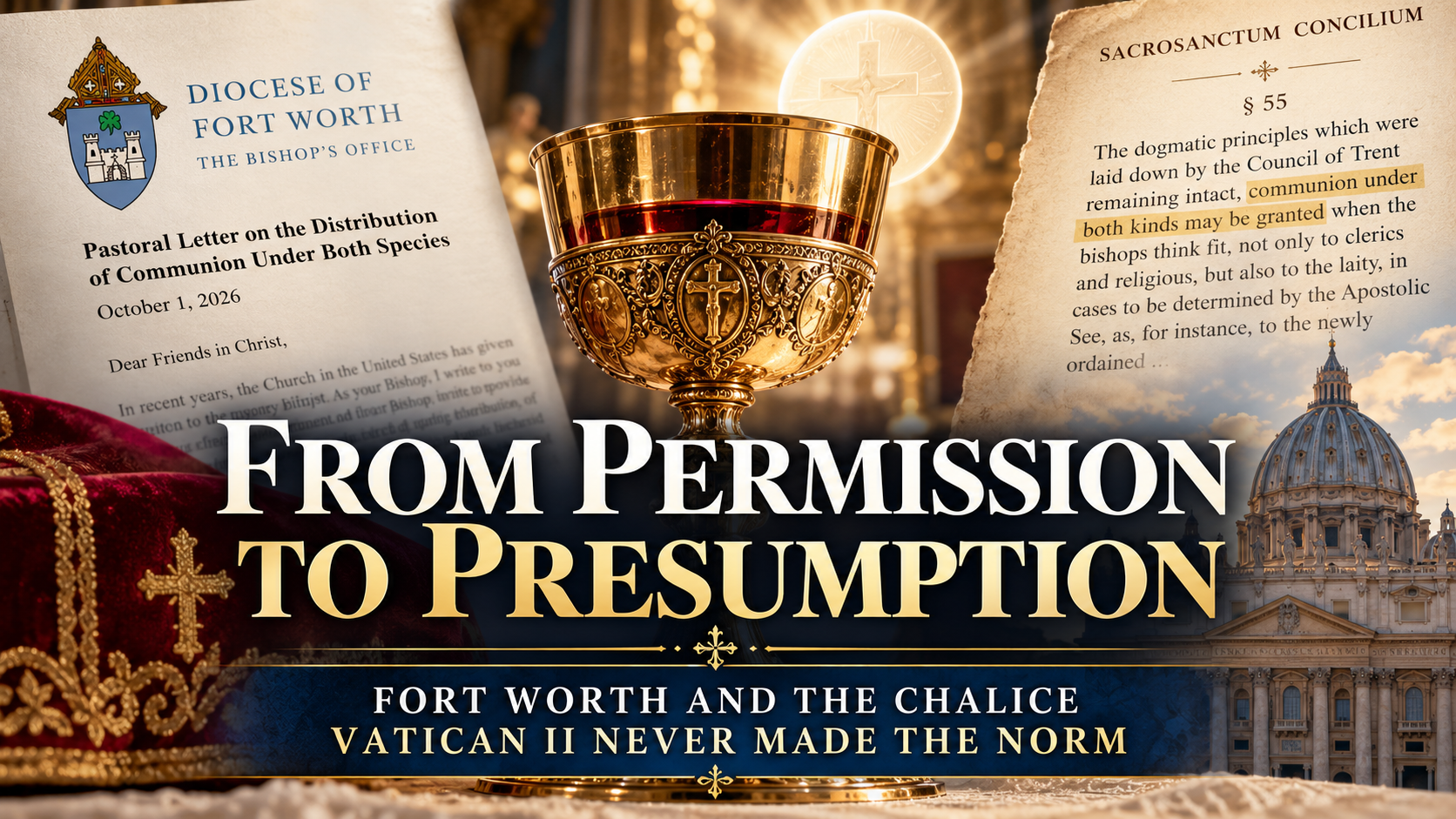
- FROM PERMISSION TO PRESUMPTION: Fort Worth and the Chalice Vatican II never made the NormBishop Michael Olson has implemented strict limitations on the distribution of Communion under both species in the Diocese of Fort Worth, prompting a discussion on the historical evolution of liturgical practices following Vatican II. This decision aims to reaffirm the doctrine of the Eucharist, emphasising that Christ is fully present under either species, while addressing misconceptions surrounding modern practices.
- AUGSBURG 2030: Can Rome commemorate a Confession it once confuted?Pope Leo XIV aims to revitalise the ecumenical spirit of the Augsburg Confession for its 2030 anniversary. However, historical responses from Rome highlight significant doctrinal differences between Catholics and Lutherans. True reconciliation must acknowledge these unresolved issues, as merely celebrating commonality risks glossing over critical theological distinctions that led to the Reformation.




Leave a Reply