
When the Altar Requires a Barrier: The New Security at St Peter’s and the Crisis of Sacred Space
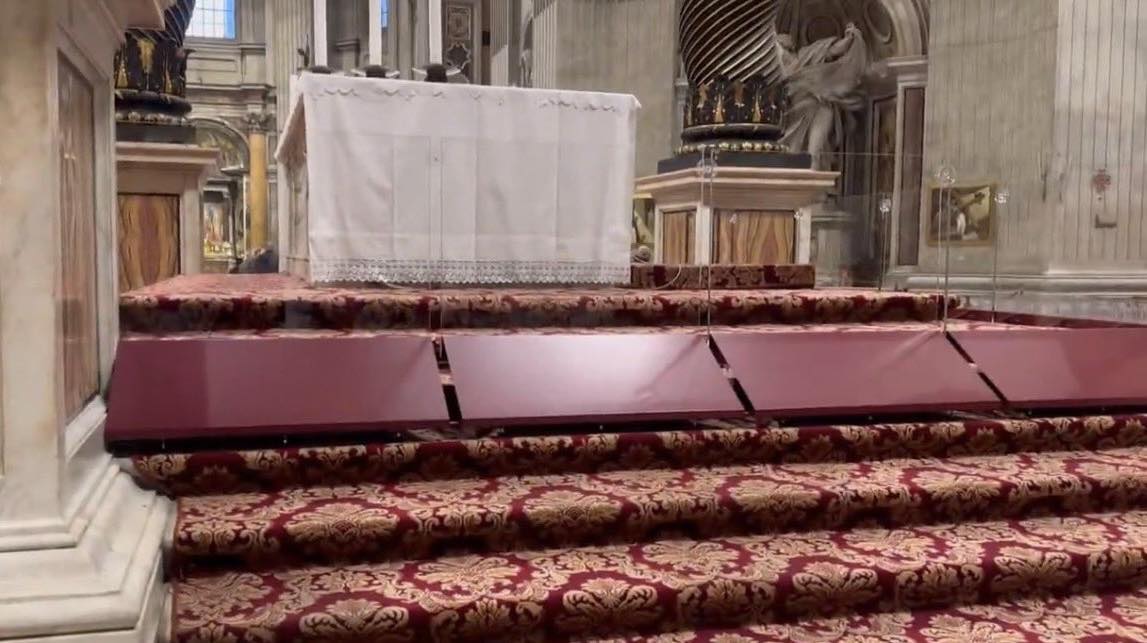
In recent weeks a new protective installation has appeared around the papal altar beneath Bernini’s baldachin in St Peter’s Basilica. At first glance the structure is modest: transparent polycarbonate panels arranged around the sanctuary platform, supported by low angled panels designed to prevent access to the steps. The design is modular, reversible, and deliberately unobtrusive. It does not pierce the ancient marble pavement nor permanently alter the fabric of the basilica. Yet the very presence of this barrier reveals a deeper and more troubling reality.
The papal altar of St Peter’s—one of the most sacred locations in Christendom—now requires protection from the public.
The Papal Altar and the Tomb of the Apostle
The altar beneath the bronze baldachin of Gian Lorenzo Bernini stands directly above the tomb of Saint Peter the Apostle. Archaeological excavations beneath the basilica in the mid-twentieth century confirmed that the high altar is positioned over the ancient memorial shrine venerated by Christians since the earliest centuries.¹ From the beginning of the Constantinian basilica in the fourth century, the altar at this location served as the focal point of Roman pilgrimage and papal liturgy.²
Unlike most Catholic altars, the papal altar of St Peter’s has historically remained open without rails or permanent barriers. This arrangement reflected the ancient Roman basilica layout in which the sanctuary and confessio formed a continuous sacred space, visually linking the sacrifice of the Mass with the tomb of the Apostle beneath it.³ The bronze baldachin erected by Bernini between 1624 and 1633 marked this sacred centre without enclosing it.⁴
The openness of the altar was therefore not an accident of architecture. It was an expression of a deeper theological and cultural reality. The sanctuary could remain open because the faithful instinctively understood its sanctity.

A Modern Security Intervention
That assumption can no longer be taken for granted. In response to several disturbing incidents in recent years, the Fabbrica di San Pietro—the body responsible for the maintenance and administration of the basilica—has installed a transparent protective barrier around the sanctuary steps.⁵
The panels are constructed of high-strength polycarbonate, chosen for its transparency and impact resistance. Their modular design allows them to be removed quickly for major papal liturgies or altered if required for conservation purposes.⁶ The installation seeks to balance two competing priorities: protecting the altar and preserving the visual integrity of the basilica’s interior.
The Vatican has been careful to avoid the appearance of militarising the basilica. St Peter’s receives more than twenty million visitors annually, and heavy fencing or permanent railings would dramatically alter the character of the sanctuary.⁷ The transparent barrier therefore represents a compromise between accessibility and security.
Yet the measure raises an uncomfortable question: why is such protection necessary at all?
A Pattern of Disturbing Incidents
The decision to install the barrier did not arise in isolation. Over the past several years the basilica has witnessed a number of highly publicised incidents involving individuals climbing onto or vandalising the altar.
In June 2023 a protester stripped naked and mounted the altar platform beneath the baldachin before being removed by Vatican security.⁸ In February 2025 another intruder climbed onto the altar and knocked over several historic candlesticks valued at tens of thousands of euros.⁹ Other incidents have involved attempts to disrupt the sanctuary area or use it as a stage for demonstrations.
These events illustrate a broader problem confronting historic churches across Europe. As sacred spaces become major tourist destinations, the cultural instinct for reverence weakens. Visitors may admire the architecture and artworks of a basilica while remaining unaware—or indifferent—to its liturgical meaning.
The result is a gradual erosion of the boundary between sacred space and public spectacle.

The Loss of the Sacred
For centuries the great basilicas of Christendom functioned within a civilisation that recognised the meaning of sacred space. Pilgrims approaching the sanctuary did so with an understanding that the altar represented the centre of the Church’s sacramental life. The steps leading to it marked a threshold between the ordinary world and the place where the sacrifice of the Mass is offered.
Such boundaries did not need to be enforced by barriers because they were upheld by a shared culture of reverence. To step onto an altar without liturgical purpose was not merely improper; it was unthinkable.
The need for protective panels around the papal altar therefore signals a deeper cultural shift. What was once guarded by conscience must now be guarded by physical structures.
This development reflects the broader secularisation of Western society. Churches are increasingly perceived as historic monuments rather than living centres of worship. Tourists move through them as they would through museums, photographing the artworks and architectural details while remaining detached from the sacred realities those structures were built to serve.
In such an environment the sanctuary risks becoming merely another elevated platform.
Security and the Open Church
The Vatican’s response illustrates the delicate balance required in preserving both the sanctity and accessibility of the basilica. St Peter’s is not only the principal church of the Catholic world but also one of the most visited sites on earth. Maintaining its openness to pilgrims while protecting its liturgical centre is a constant challenge.
The transparent barrier represents an attempt to resolve that tension. By remaining visually discreet it preserves the sightlines toward Bernini’s baldachin and the papal altar. At the same time it establishes a clear boundary that discourages physical intrusion.
In this sense the barrier functions not only as a security measure but also as a visual reminder that the sanctuary is not an ordinary space.
A Silent Catechesis
Paradoxically, the barrier may serve as an unintended form of catechesis. Its presence signals that the altar is different from the surrounding space. It marks a threshold and invites visitors to recognise that the sanctuary exists for a sacred purpose.
Yet the very need for such a reminder reveals how far modern culture has drifted from its Christian foundations. A civilisation that understands holiness does not need plexiglass to defend its altars.
The true solution to the problem confronting St Peter’s Basilica therefore lies not in stronger barriers but in the recovery of a sense of the sacred. When people recognise the altar as the place where heaven touches earth, reverence becomes instinctive.
Until that understanding returns, even the most sacred sanctuary in Christendom may require a protective screen.
The transparent panels now surrounding the papal altar stand as a quiet but powerful symbol of the age in which we live. They testify to the enduring importance of sacred space—and to the cultural amnesia that now threatens it.
- John Evangelist Walsh, The Bones of St Peter (New York: Doubleday, 1982), pp. 111–130.
- Liber Pontificalis, Life of Constantine; cf. Richard Krautheimer, Rome: Profile of a City, 312–1308 (Princeton University Press, 1980), pp. 26–33.
- Josef A. Jungmann, The Mass of the Roman Rite: Its Origins and Development, vol. 1 (New York: Benziger, 1951), pp. 215–218.
- Tod A. Marder, Bernini and the Art of Architecture (New York: Abbeville Press, 1998), pp. 133–140.
- Fabbrica di San Pietro, announcement regarding protective installations at the Altar of the Confession, Vatican communications release, 2026.
- Ibid.
- Vatican tourism and pilgrimage statistics cited in Vatican News reports on St Peter’s visitor numbers.
- Reuters, “Man climbs onto altar at St Peter’s Basilica during protest,” June 2023.
- Catholic News Agency, reports on vandalism incident at St Peter’s Basilica, February 2025.
RELATED ARTICLES


Latest ARTICLES
- Today’s Mass: September 09 Day II in the Octave of The Nativity of the Blessed Virgin MaryThe feast of Our Lady’s Nativity, of ancient Eastern origin and established at Rome by the time of Pope St Sergius I, celebrates Mary as the immaculate New Eve and the dawn of salvation, the chosen tabernacle from whom the Redeemer would take His flesh. Today the Church also commemorates St Gorgonius, an officer of the imperial household at Nicomedia who, with his companion Dorotheus, embraced the Faith and suffered martyrdom under Diocletian in A.D. 303; his relics were later translated to Rome.
- NOMEN MANET, RES DEEST ~ The Name Remains; the Reality Is Lacking: Spiritual Conference for Nuntiatoria CXXIIThe content emphasises the disconnect between the names associated with Catholicism and the actual practices of faith. It highlights the importance of embodying belief through genuine actions, urging self-examination rather than mere external observance. Ultimately, it advocates for a restoration of sincerity in faith, calling individuals to authentically reflect their beliefs through their lives and worship.
- Mary Is Co-Redemptrix: Cardinal Burke Reopens Rome’s Marian ControversyCardinal Raymond Leo Burke has declared the Virgin Mary as “Co-Redemptrix” amidst controversy over the Vatican’s restriction on this title. The debate revolves around the appropriateness of certain theological language and whether terminology historically used can still accurately express Marian cooperation in Redemption without compromising Christ’s unique role.
- When Politics Defines Doctrine: Edmund Waldstein, Integralism and the New Boundary at HeiligenkreuzThe ongoing exclusion of Father Edmund Waldstein from teaching at Heiligenkreuz has sparked debate on the limits of acceptable Catholic thought, particularly regarding integralism and its relationship to Church doctrine. Critics argue that Waldstein and similar positions challenge both Catholic teachings and democratic values, raising questions about the intersection of faith and politics.
- Christianity Is Right ~ Not Right WingThe article discusses the distinction between Catholic orthodoxy and modern political ideologies, particularly the Right and Christian nationalism. It argues that Catholic beliefs about family, morality, and authority predate contemporary political classifications and should not be conflated with right-wing politics. The ordo amoris framework is presented as a guiding principle for evaluating political alliances while maintaining a focus on the common good and the Social Kingship of Christ.



Leave a Reply