
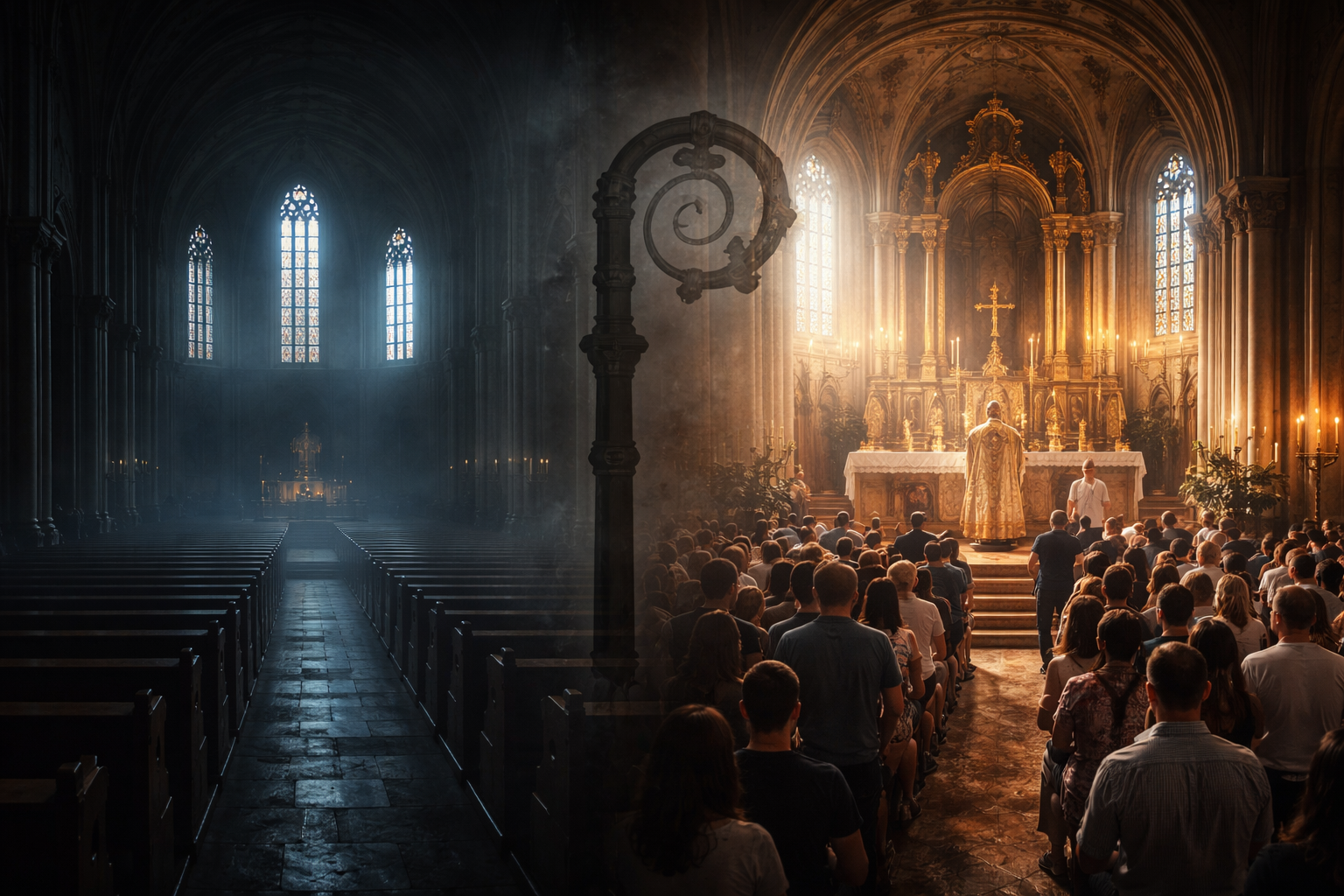
Germany’s Vanishing Church: Collapse, Contradiction, and the Crisis of Authority
In 2025, the Catholic Church in Germany recorded one of the most dramatic contractions in its modern history. More than half a million Catholics were lost in a single year. Only twenty-five men were ordained to the priesthood across the entire country. A Church once regarded as one of the most institutionally powerful, financially secure, and pastorally progressive in the world now stands as the clearest empirical case of ecclesial decline in the West.
This is not an isolated fluctuation. It is the acceleration of a long-unfolding trajectory—one that now demands not merely pastoral explanation, but theological interpretation.
The Event: A Church in Numerical Freefall
According to official figures released by the German Bishops’ Conference, the Catholic Church in Germany experienced a net loss of approximately 549,000 members in 2025, bringing total membership down to roughly 19.2 million, or just under a quarter of the population.¹ Of these losses, more than 300,000 were the result of formal defections (Kirchenaustritt), a legal act by which individuals remove themselves from Church rolls—often to avoid the state-collected Church tax.²
At the same time, priestly vocations have reached historic lows. Only twenty-five diocesan priests were ordained in 2025 across Germany’s twenty-seven dioceses—a figure almost inconceivable when set against the 557 ordinations recorded in 1962.³
The implications are immediate and structural. With hundreds of priests retiring or dying annually, the German Church is now operating under a severe replacement deficit, ensuring continued contraction regardless of short-term fluctuations in membership.
Mass attendance reflects the same pattern. Fewer than 7 percent of German Catholics now attend Sunday Mass regularly.⁴ Entire regions are being reorganised into large pastoral units, with single priests responsible for multiple parishes. Churches are being closed, repurposed, or sold.
This is not renewal. It is managed decline.
The Model: Wealth Without Transmission
What makes the German case particularly significant is not merely the scale of decline, but the conditions under which it has occurred.
The Catholic Church in Germany is one of the wealthiest in the world, funded through the Kirchensteuer (church tax), which generates billions of euros annually.⁵ It maintains extensive institutional infrastructure: schools, charities, administrative bodies, and a highly professionalised clerical and lay workforce.
At the same time, it has been at the forefront of ecclesial adaptation. The German “Synodal Way” has proposed or endorsed reforms relating to governance, sexuality, clerical life, and the role of women—often framed as necessary responses to modernity and the abuse crisis.⁶
Yet despite—or, more precisely, within—this context of wealth and adaptation, the Church has experienced its most severe contraction.
This raises an unavoidable question:
What if the crisis is not the result of insufficient adaptation, but of a deeper failure of transmission?
For all its resources, the German Church has struggled to retain members, form new priests, and sustain regular sacramental life. The institutional structure remains expansive; the lived reality contracts.
The Pattern: Decline Through Dilution
The German case illustrates a broader pattern observable across Western Christianity: where religious identity becomes attenuated—less distinct, less demanding, less clearly differentiated from the surrounding culture—participation declines.
This is not a uniquely Catholic phenomenon. Sociological studies of religion have consistently shown that communities which maintain clear boundaries, higher expectations, and stronger internal coherence tend to retain members and generate vocations more effectively than those which minimise such distinctions.⁷
In Germany, decades of accommodation have coincided with:
- declining Mass attendance
- collapsing vocations
- weakening doctrinal clarity (at least in perception)
The result is not a broader, more engaged Church, but a thinner, less stable one.
The problem is not simply moral or disciplinary. It is structural: a system designed to sustain large-scale institutional presence without corresponding depth of belief and practice.
Authority Without Life: A Theological Reading
At this point, the data gives way to a deeper question. What is being revealed is not only sociological decline, but a fracture within the nature of ecclesial authority itself.
The Church is not merely an institution; she is a sacramental society. Authority within her is not reducible to governance. It is ordered toward sanctification and truth. The bishop’s office—regendi, sanctificandi, docendi—presumes that governance, sacramental life, and teaching form a coherent whole.⁸
Yet in Germany, these elements appear increasingly disjoined.
Jurisdiction remains. Structures endure. The machinery of governance continues to operate. But sacramental participation diminishes, and doctrinal confidence weakens. Authority persists in form, but struggles in effect.
This is the essence of the present crisis:
authority retained juridically, but attenuated existentially
Where the life of grace is no longer robustly transmitted—through liturgy, catechesis, and disciplined Christian living—authority becomes administrative rather than formative. It governs, but does not generate.
Continuity and Coherence
In contrast, communities within the Church that have maintained a stronger continuity of liturgical and doctrinal life—such as the Priestly Fraternity of St. Peter and the Institute of Christ the King Sovereign Priest, alongside more contested bodies like the Society of St. Pius X—demonstrate a markedly different pattern.
Though smaller in scale, these communities often exhibit:
- higher Mass attendance
- stronger family formation
- disproportionately higher vocations
The explanation is not reducible to preference or nostalgia. It lies in coherence: a stable liturgical form, clear doctrinal teaching, and a distinct moral framework reinforcing one another.
This coherence produces what might be termed ecclesial density—a concentration of belief and practice sufficient to sustain transmission across generations.
A System Under Judgment
Germany, then, is not merely an outlier. It is a test case.
It demonstrates that:
- wealth does not guarantee vitality
- adaptation does not ensure retention
- institutional scale does not secure continuity
Instead, the decisive factor is whether the Church effectively transmits the life she has received.
Where that transmission weakens, decline follows—even under the most favourable structural conditions.
Conclusion: A Warning and a Threshold
The German Church now stands at a threshold. Its current trajectory—marked by demographic contraction, vocational collapse, and structural consolidation—cannot be sustained indefinitely without profound transformation.
But the significance of Germany extends beyond its borders.
It offers a forewarning to the wider Church: that a model prioritising institutional adaptation over doctrinal and liturgical continuity may ultimately undermine the very life it seeks to preserve.
The crisis, therefore, is not simply one of numbers. It is one of identity and transmission.
Until that is addressed—not only in principle, but in practice—the pattern observed in Germany will not remain confined to Germany.
It will repeat.
- German Bishops’ Conference (DBK), Kirchliche Statistik 2025; summary figures widely reported in The Pillar, 2025.
- Ibid.; see also German civil law provisions governing Kirchenaustritt.
- German Bishops’ Conference historical ordination data; comparison with 1962 figures cited in The Pillar, 2025.
- DBK statistical releases on Mass attendance (latest available data, 2024–2025).
- Federal Ministry of Finance (Germany), data on Kirchensteuer revenue; corroborated by DBK financial reports.
- Official documents of the German Synodal Way (Synodaler Weg), 2019–2024.
- Rodney Stark and Roger Finke, Acts of Faith (University of California Press, 2000).
- Second Vatican Council, Lumen Gentium, §§20–27; Council of Trent, Session XXIII.
RELATED ARTICLES


Latest ARTICLES
- WHEN THE BISHOP BECOMES THE MESSAGE: The Cult of Personality, Episcopal Pride and the Betrayal of Apostolic TrustArchbishop Josef Grünwidl of Vienna has openly advocated for women’s ordination, reflecting a troubling trend among bishops who express personal opinions at odds with established Catholic doctrine. This practice undermines their primary role of teaching the faith and raises concerns about episcopal pride and the proper handling of doctrinal authority by the Church.
- SANDIE PEGGIE: WHEN THE UNION FAILS THE WOMEN IT SHOULD DEFENDThe Royal College of Nursing successfully defended its actions in a discrimination case brought by Sandie Peggie, yet the ruling highlights concerns about the union’s failure to acknowledge members’ rights amid ideological conformity. This raises critical questions regarding the adequacy of trade union representation for employees facing complex workplace issues.
- Today’s homily: St Winefride of HolywellSt Winefride’s courage, and the survival of devotion to her through centuries of persecution, reveal the cost and beauty of Christian fidelity. Her feast challenges us to move beyond outward observance, cultivate genuine holiness, resist compromise, and persevere in sanctifying grace, ready to meet Christ, our divine Bridegroom.
- Today’s Mass: November 3 St Winefride of HolywellThe spring attached to her legend has given its name to Holywell (Tre Ffynnon), Clwyd, and down the centuries, and right up to the present day, pilgrims have travelled there in the hope of finding healing for their illnesses. Such pilgrimages even continued throughout the Reformation with 14,000 people and 150 priests gathered there on St Winefride’s feast day in 1629 – a time when Catholics were still dying as martyrs.
- THE GOSPEL IS NOT AN ALIBI FOR BUREAUCRACYBishop Philip North contends that spiritual renewal is paramount for the Church of England, sidelining organisational reform. He defends diocesan administration despite concerns over rising costs and declining clergy and congregations. This editorial emphasises the need for both faithful evangelisation and responsible financial stewardship as interconnected necessities for the Church’s survival.






Leave a Reply