
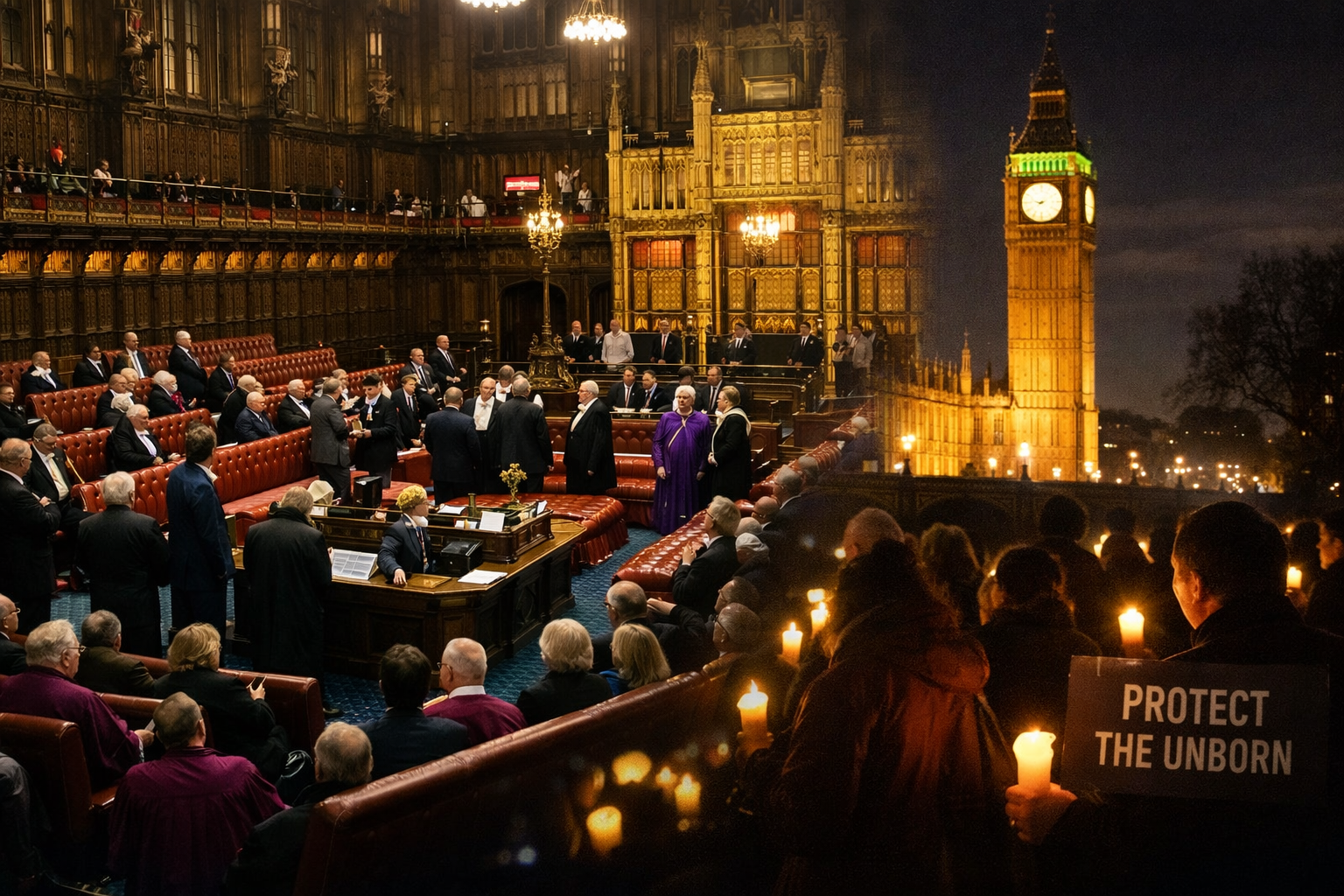
Decriminalisation by Stealth: The House of Lords, the Crime and Policing Bill, and the Quiet Unravelling of Legal Protection
A Decisive Moment Concealed in Procedure
In the late hours of parliamentary business—when scrutiny is thin and public attention thinner—the House of Lords has taken a decision of profound consequence. Amendments seeking to restrain the decriminalisation of abortion within the Crime and Policing Bill have been rejected, and with them, a final opportunity—at least at this stage—to preserve the remaining legal architecture protecting unborn life.
The amendment advanced by Baroness Monckton, which sought to remove or limit the decriminalisation provision, was defeated by 185 votes to 148.¹ A further amendment, introduced by Baroness Stroud, aiming to end the continuation of telemedical abortion provision—commonly referred to as “pills by post”—was rejected by 191 votes to 119.²
These were not peripheral questions. They were the central points upon which the integrity of the existing legal framework depended.
The Legal Framework Under Strain
Since its enactment, the Abortion Act 1967 has operated as a structure of conditional permission within a broader criminal prohibition. Abortion, in principle, remained unlawful under the Offences Against the Person Act 1861, but permitted under tightly defined circumstances subject to medical certification and gestational limits.³
The present legislative shift alters that equilibrium. By removing criminal penalties for women procuring abortions outside the statutory framework, the law ceases to function as a boundary and becomes instead a guideline—normative rather than enforceable.
This is not merely a technical adjustment. It is a transformation of first principles.
Telemedicine and the Collapse of Safeguards
The rejection of Baroness Stroud’s amendment compounds this shift. The policy of telemedical abortion—introduced during the COVID-19 pandemic as an emergency measure—permits the prescription and delivery of abortifacient drugs without an in-person consultation.⁴
In isolation, such a policy raises questions of medical oversight and safeguarding. In conjunction with decriminalisation, those questions become structural concerns.
As Baroness Spielman observed during the debate, the combination of remote access and diminished legal constraint produces a system in which:
- gestational limits become difficult to verify,
- coercion or concealment becomes harder to detect, and
- the distinction between lawful and unlawful practice becomes increasingly theoretical.⁵
A regulatory regime without enforcement is, in effect, no regime at all.
Legislation Without Scrutiny
Perhaps the most striking feature of this development is not only its substance but its method.
Peers opposing the amendments repeatedly noted that these changes—arguably among the most significant alterations to abortion law in decades—have been advanced:
- without pre-legislative scrutiny,
- without formal public consultation, and
- without a comprehensive impact assessment.⁶
This procedural deficit is not incidental. It is constitutive of the moment. The magnitude of the change is inversely proportional to the depth of its examination.
In a legislature that has, in other contexts, subjected moral questions—such as assisted suicide—to extended and meticulous scrutiny, the contrast is stark.
A Divided Moral Witness
It is within this context that the intervention of Sarah Mullally must be understood. Her confirmation that she would vote against decriminalisation represents a notable departure from the prevailing reticence of ecclesial leadership.
Yet the significance of that intervention is necessarily limited by the theological framework from which it proceeds.
The Church of England has long affirmed the sanctity of unborn life, while permitting abortion under certain conditions—a position formalised in the General Synod statement of 1980.⁷ This attempt at moral equilibrium—between principle and exception—has proven unstable over time. Exceptions, once granted, tend toward expansion; limits, once qualified, tend toward erosion.
Thus, while Mullally’s vote signals resistance to further liberalisation, it does so from within a system that has already conceded the central premise.
From Prohibition to Permission
The deeper transformation underway is conceptual.
A legal system grounded in prohibition-with-exceptions communicates that abortion is a grave moral matter, permitted only under constrained conditions. A system grounded in decriminalisation communicates something different: that abortion is a matter of personal discretion, regulated administratively rather than morally.
This is not merely a shift in law. It is a shift in anthropology.
The unborn child, once recognised—however imperfectly—as a subject of legal concern, becomes instead an object within a framework of choice. The language of rights displaces the language of duties; the vocabulary of autonomy replaces that of moral order.
An Asymmetry in Moral Deliberation
The events of this week are rendered more striking by their juxtaposition with developments elsewhere.
In Scotland, legislators have recently rejected proposals to legalise assisted suicide, citing concerns for the vulnerable and the integrity of medical ethics.⁸ There, caution prevailed over innovation.
In Westminster, by contrast, the trajectory is reversed. The vulnerability of the unborn—less visible, less audible, less politically salient—commands less restraint.
This asymmetry is instructive. It reveals not a consistent ethic, but a selective one.
Conclusion: The Quiet Establishment of a New Settlement
What has occurred in the House of Lords is not a dramatic rupture but a quiet realignment. No formal declaration has been made; no explicit renunciation of principle has been announced. And yet, in substance, a new settlement is emerging.
The law, having relinquished its prohibitive force, will increasingly function as a facilitator rather than a restraint. The moral vocabulary that once undergirded it will persist for a time, but as rhetoric rather than reality.
And this is the characteristic pattern of such transformations: not revolution, but attrition; not proclamation, but accommodation.
A society does not abandon its moral framework in a single act. It does so gradually, by redefining its terms, relaxing its limits, and adjusting its expectations—until what was once unthinkable becomes merely unregulated.
¹ UK Parliament, House of Lords Division, Crime and Policing Bill (Report Stage), amendment on decriminalisation, March 2026.
² UK Parliament, House of Lords Division, Crime and Policing Bill (Report Stage), amendment on telemedical abortion, March 2026.
³ Abortion Act 1967; Offences Against the Person Act 1861, ss. 58–59.
⁴ UK Department of Health and Social Care, Temporary approval of home use for both stages of early medical abortion, 2020; made permanent in England and Wales, 2022.
⁵ House of Lords debate, Crime and Policing Bill, remarks attributed to Baroness Spielman, March 2026 (Hansard record).
⁶ Parliamentary debate commentary and briefing materials circulated to peers during Report Stage, March 2026.
⁷ Church of England General Synod, Statement on Abortion, 1980.
⁸ Scottish Parliament, Division on Assisted Dying Bill, March 2026.
RELATED ARTICLES


LATEST ARTICLES
- Today’s Mass: September 19 S. Eustace & Companions, MartyrsSt. Eustachius, formerly General Placidus, experienced a transformative vision of Christ while hunting. After converting with his family, he endured persecution, losing them temporarily. Reuniting after military success, he ultimately refused to worship pagan deities, leading to his martyrdom with his family. They were later honoured with a church.
- Sermon for St. Eustacius/ Seventeenth Sunday after PentecostThe feast of St. Eustacius, celebrated on the Seventeenth Sunday after Pentecost, commemorates early Christian martyrs who refused to renounce their faith. Despite limited historical knowledge of St. Eustacius, his story embodies the courage of many Christians who, facing persecution from the Roman Empire, chose martyrdom over idolatry, ultimately shaping the Church’s foundation.
- Today’s Mass: September 19 St. Januarius, Bishop and Companion MartyrsSt. Januarius and companion martyrs were martyred during the persecution under Diocletian. St. Januarius, patron of the city of Naples and bishop of Beneventum, was beheaded with his deacons and some others.
- Sermon for St. Januarius and his CompanionsToday we celebrate the feast of St. Januarius and his companions. About St. Januarius little is known except that he was among the many martyrs during the great persecution under the Emperor Diocletian.
- 20.09.26 Nuntiatoria CXXIV: QUOD ACCEPIMUS, CUSTODIMUS ET TRADIMUSThe editorial emphasises the importance of understanding our inheritance as custodians rather than owners. It highlights the obligation to preserve and transmit the Christian Faith, sacraments, and traditions to future generations. Through gratitude and fidelity, those who receive must ensure that what has been entrusted does not end with them.



Leave a Reply