
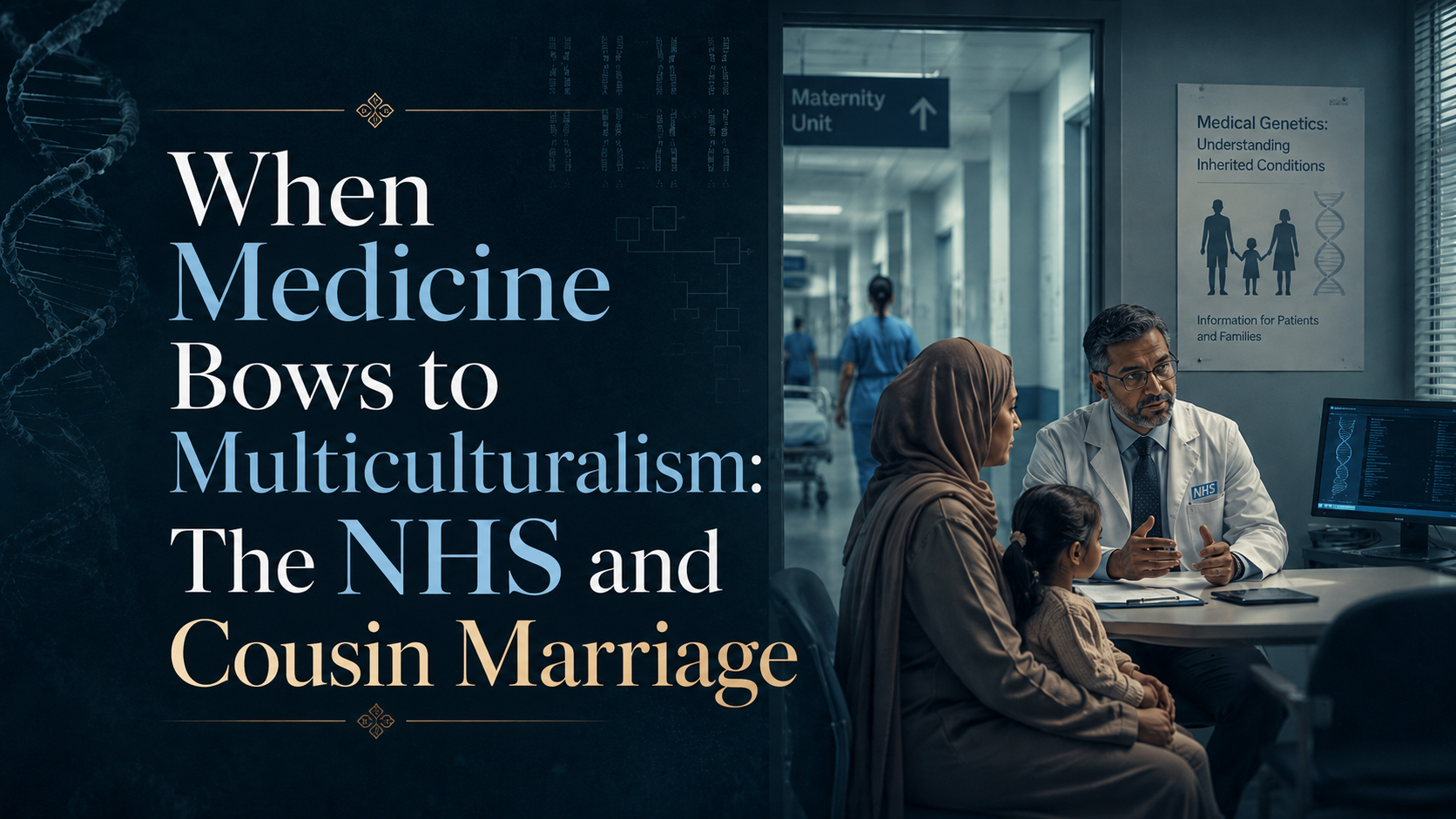
The scandal is not that the NHS formally adopted cousin marriage as policy. It is more revealing than that. Its own professional training told doctors and midwives that the dangers of consanguinity had been “exaggerated”, invited them to consider the supposed benefits of marrying within the family, and warned against concentrating too heavily upon infant mortality. The Government has now admitted that parts of the training were inappropriate. The medical evidence did not change. What changed was that the ideology behind the language was exposed.
The most damaging criticism that can be made of an institution is often not that it deliberately set out to do something absurd, but that its governing assumptions had become so distorted that the absurdity no longer appeared absurd to those responsible for it. That is the real significance of the latest revelations concerning NHS training on cousin marriage. The NHS did not issue a national clinical directive commanding Britons to marry their cousins. It did something more characteristic of our age: it taught healthcare professionals to approach an objectively increased genetic risk through the vocabulary of cultural sensitivity, stigma, social advantage and “informed reproductive choice”, until the behaviour producing the additional risk appeared almost to require protection from the medical facts surrounding it.
The Telegraph reported on 7 August that NHS e-learning materials used by midwives, nurses, GPs and genetic counsellors had taught staff that the health risks arising when close relatives have children had been “exaggerated”. One of the training sessions dealt explicitly with the “benefits of marrying within the family”. Staff were encouraged to put the increased risk associated with consanguinity “in perspective” by comparing it with other factors associated with congenital abnormality and neonatal death, including maternal age, smoking, obesity and social deprivation. Three of five modules were subsequently withdrawn, while revised material remains available through the NHS Learning Hub.¹
This was not the first warning. In January, an earlier Telegraph investigation disclosed NHS training material stating that “85 to 90 per cent of cousin couples do not have affected children”, warning that close-relative marriage was “often stigmatised in England”, and saying that its associated genetic risks had been exaggerated. The documents went further. Marriage within the family, staff were told, could provide “financial and social security” for individuals, families and wider kinship networks, while discussion of the health risks should be balanced against supposed benefits derived from “collective social capital”. The material even complained that previous attempts to improve services had sometimes focused too narrowly upon reducing infant mortality rather than enhancing reproductive choice.²
Pause over that sentence, because it reveals the problem more clearly than any political denunciation could. The material arose within a healthcare system whose maternity programme exists precisely because stillbirth, neonatal death, congenital disease and maternal harm are matters to be prevented wherever reasonably possible. Yet those producing professional education apparently considered it necessary to warn clinicians against concentrating too narrowly upon infant mortality when discussing a practice associated with increased genetic risk. At some point the hierarchy of purposes had been inverted. Preventing avoidable suffering was no longer simply the clinical priority. It had to be balanced against the danger that frank discussion might be experienced as culturally insensitive.
The Department of Health and Social Care initially attempted an important but limited distinction. When Conservative MP Shivani Raja asked about NHS material stating that consanguineous marriage had “benefits” and that genetic defects among children of such unions had been “exaggerated”, the Government replied on 2 March that these phrases had not appeared in formal NHS “guidance”; they had appeared in NHS “training materials”. It stressed that the training also acknowledged genetic risk and that the Department itself had played no part in developing, approving or distributing the material. But the Government also confirmed that the material had been retired and that it was examining how it had come to be produced in order to ensure that it did not happen again.³
That distinction should be preserved because accuracy matters. It would therefore be careless to report simply that “NHS policy supports cousin marriage”. The NHS has expressly denied that proposition, and its current materials recognise the risks associated with consanguinity. But the distinction does not rescue the institution from criticism. Training is how professional assumptions are transmitted. When midwives, GPs, health visitors, paediatricians, public-health practitioners and genetic counsellors are taught how to understand and discuss a particular medical subject, what appears in their educational material plainly matters. A statement need not possess the juridical status of “guidance” before it influences clinical culture.
Indeed, the Government eventually conceded precisely that there had been a serious problem. On 9 June, responding to Richard Holden MP after an NHS investigation, the Department of Health and Social Care stated that “the medical evidence is clear that first cousin marriages are high risk” and referred expressly to “the genetic defects and harm that they can cause”. More significantly, it announced that the investigation had concluded and had found that “some aspects of the training were inappropriate”. Relevant materials, it said, had already been retired or amended.⁴
That admission changes the character of the controversy. We are no longer dealing merely with a disagreement between conservative politicians and diversity-conscious NHS educators over the interpretation of culturally sensitive language. The Government responsible for the health service investigated the material and itself concluded that elements of the training were inappropriate. The question, therefore, is no longer whether critics imagined a problem. The Government has acknowledged that one existed. The question is how the assumptions which produced it acquired sufficient authority to enter professional NHS education at all.
For the medical evidence had not been hidden. The celebrated Born in Bradford cohort study examined data relating to more than 11,000 mothers and hundreds of validated congenital anomalies. Its central finding was unambiguous. The congenital-anomaly rate among non-consanguineous couples across the ethnic groups studied was approximately 2.5 per cent. Among first-cousin couples it was approximately 6.5 per cent. After adjusting for relevant variables, the researchers calculated a multivariate risk ratio of 2.19 and described consanguineous marriage as a major risk factor for congenital anomalies. Crucially, deprivation did not explain away the association.⁵
Those figures need to be handled responsibly. They do not mean that most children born to first cousins suffer congenital abnormalities. They plainly do not. A 6.5 per cent rate means that the great majority do not. Neither does the existence of an increased risk justify contempt towards families, much less towards children born with disabilities or inherited disease. The dignity of a human life is not diminished because its conception involved greater genetic risk. A disabled child is not a statistical mistake, nor is his worth measured by the circumstances in which his parents conceived him.
But none of that changes what the numbers mean. If one set of circumstances produces congenital abnormalities at around 2.5 per cent and another produces them at around 6.5 per cent, the second circumstance carries a substantially greater risk. Saying that most children remain healthy does not abolish the difference. It merely substitutes an absolute reassurance for the relative comparison which clinicians are supposed to explain.
The same rhetorical device would be recognised immediately in almost every other field of medicine. Most smokers do not develop lung cancer after a particular cigarette. Most obese people do not suffer a heart attack tomorrow morning. Most pregnancies at advanced maternal age do not end in catastrophe. Most journeys undertaken while exceeding the speed limit end without anybody dying. None of those propositions is remotely sufficient to show that the relevant risk has been “exaggerated”. Public health exists precisely because behaviours can deserve discouragement even when the adverse outcome remains statistically less likely than the healthy one.
This is why the comparison with maternal age, smoking and obesity is particularly revealing. The training apparently intended these examples to put consanguinity “in perspective”. Yet perspective cuts both ways. The NHS does not respond to the health consequences of smoking by producing training entitled “Benefits of Tobacco Use” and directing clinicians to balance warnings about cancer against the social solidarity smokers may experience outside the workplace. It does not teach maternity staff that obesity should be approached by emphasising the collective social capital of communities in which obesity is prevalent. Nor would anyone suppose that acknowledgement of the psychological or social reasons why a person smokes removes the clinician’s obligation to explain its medical consequences clearly.
Why, then, did marriage between close relatives require a different conceptual framework?
The answer appears to lie less in medicine than in the institutional fear of stigma. The original training repeatedly situated the subject within concerns about cultural sensitivity, community engagement and the danger of blame. That concern is not imaginary. Consanguineous marriage is particularly associated in Britain with some Pakistani and other South Asian communities, and irresponsible discussion can easily descend into ethnic hostility. Healthcare workers should not humiliate patients, stereotype families or treat a person as culpable merely because he belongs to a population in which a practice is more common. Genetic counselling should be accurate, humane and sensitive.
But cultural sensitivity is a method of communicating truth. It cannot become an instrument for modifying the truth being communicated.
If a practice carries an objectively increased medical risk, equality requires that those most affected by that practice receive particularly clear information about it. Anything else becomes an inverted paternalism. It says, in effect, that one community may be addressed straightforwardly about smoking, alcohol, obesity, vaccination, sexual behaviour and maternal age, but another must have an inherited social practice wrapped in compensating discussion of its financial advantages because ordinary candour would be culturally uncomfortable.
That is not respect. It is condescension.
Nor does this problem disappear by invoking “informed reproductive choice”. Genuine informed choice depends upon accurate understanding of risk. One does not increase autonomy by surrounding inconvenient medical facts with ideological cushioning until the patient is unsure whether the health professional regards the risk as medically significant at all. Information has to be proportionate, but proportionality is not minimisation. The purpose of genetic counselling is neither to frighten people nor to reassure them into predetermined choices. It is to tell them what is known.
There is a further reason for caution. Consanguinity is not always adequately described by imagining two otherwise unrelated family lines suddenly producing a single first-cousin marriage. In communities where marriage between relatives has recurred across generations, family structures can create levels of shared ancestry more complicated than the ordinary textbook example. That is precisely why careful family history, appropriate genomic assessment and access to specialist counselling matter. It is another reason why the subject belongs primarily within rigorous clinical medicine rather than a political theology of multicultural reassurance.
The NHS itself now appears to recognise this. Its present Learning Hub programme bears the title “Close relative marriage, genetic risk and equitable access to clinical genomic services” and expressly teaches healthcare professionals about consanguinity and associated genetic risks, recessive genetic disorders, stillbirth, neonatal and infant mortality, and routes into genomic services for at-risk families. Its current midwifery material says that genetic information should be incorporated into routine health-promotion work and that professionals should know how to raise the issue sensitively and refer families appropriately.⁶ That is a sensible balance: truth without humiliation, clinical seriousness without contempt.
Yet the retreat itself raises questions that have not been answered merely because three modules were removed. Who commissioned the discarded material? Who wrote it? Who reviewed it? What intellectual framework persuaded educated health professionals that a session on the “benefits of marrying within the family” belonged inside medical training associated with reducing infant mortality? What internal safeguards failed before ministers found themselves explaining to Parliament that the NHS was investigating its own educational content?
The controversy was also preceded by another revealing episode. In September 2025, NHS England’s Genomics Education Programme published an article discussing “various potential benefits” of first-cousin marriage, including stronger extended-family support and economic advantages. Following public criticism, NHS England withdrew the article and said that it had been published by mistake, explaining that it had been intended as a summary of the public-policy debate rather than clinical advice or NHS policy. The British Medical Journal subsequently reported both the withdrawal and NHS England’s explanation.⁷ The disputed professional training was therefore not an isolated phrase torn from nowhere. The same conceptual instinct — medical risk balanced against supposed social advantages — had surfaced elsewhere within NHS educational material.
At this point the issue becomes much larger than cousin marriage. Western public institutions have spent decades learning to fear one accusation above almost all others: insensitivity. That fear began from a proper recognition that human beings deserve respect regardless of race, religion or cultural background. But bureaucratic doctrines have a habit of escaping their original purpose. Non-discrimination can mutate into an unwillingness to discriminate intellectually between good practices and harmful ones. Respect for cultures can become an assumption that criticism of a custom constitutes hostility towards the people who practise it. Before long, institutions become more anxious about the vocabulary in which a problem is discussed than about the problem itself.
Medicine cannot survive that inversion intact.
The physician’s obligation is not to validate every social practice encountered in the consulting room. Neither is it to impose political conformity upon the patient. It is to diagnose, explain, advise and treat according to medical truth while respecting the patient’s dignity and lawful freedom. Sometimes that truth will offend fashionable opinion. Sometimes it will conflict with an inherited custom. Sometimes the patient will reject the advice. None of those possibilities entitles the professional institution to soften a recognised risk until the facts become subordinate to the sensibilities surrounding them.
Catholics, however, should approach the controversy with greater precision than those whose argument begins and ends with disgust at cousin marriage. The Church does not teach that marriage between first cousins is intrinsically evil in every conceivable circumstance. Under current canon law, consanguinity in the collateral line constitutes a diriment impediment through the fourth degree, which encompasses first cousins, but the impediment at that degree is capable of dispensation. The Church therefore recognises proximity of blood as an objective and serious consideration in marriage without pretending that every such union is morally identical or absolutely incapable of being permitted.⁸
That distinction is important. Catholic moral reasoning is not eugenics. The worth of marriage cannot be reduced to the production of genetically optimal offspring, and the worth of a child can never depend upon his health. Christianity has perhaps the strongest possible reason for rejecting such reasoning: every human person, healthy or disabled, is created by God, possesses an immortal soul and may never be treated merely as a biological outcome to be optimised.
But Catholic respect for life also excludes deliberate indifference to foreseeable harm. Prudence belongs to moral reasoning. Marriage establishes not merely a private romantic partnership but a family, and the welfare of future children is therefore a legitimate consideration for spouses, pastors, doctors and, within its proper competence, civil authority. Recognising a significant inheritable risk is not to despise those who suffer from the condition. It is to take seriously the good of the persons who may be affected by it.
Britain itself is now debating whether civil law should go further. A First Cousins (Prohibited Relationships) Bill received its first reading in the House of Commons on 17 June 2026 and is presently scheduled for second reading on 15 January 2027. The proposal forms part of a wider political debate over whether first-cousin marriage should remain lawful and whether sexual relationships between first cousins should also be prohibited.⁹ Catholics are not required to pretend that every possible legislative response follows automatically from the medical evidence. Whether prohibition is the wisest civil remedy involves questions of proportionality, enforceability, liberty, safeguarding, forced marriage and the distinction between sin, risk and criminal law.
Those questions deserve serious debate. What should no longer require debate is whether the medical facts themselves may be diluted because their implications are politically awkward.
The NHS controversy is consequently about more than consanguinity. It concerns the purpose of institutions. The NHS enjoys extraordinary public trust because Britons assume that, whatever its bureaucratic shortcomings, its medical judgments are supposed to be governed by evidence. Once the public suspects that evidence is being filtered through ideological assumptions about which truths may safely be spoken, that trust begins to corrode.
The answer is not cruelty. It is not ethnic scapegoating. It is not sneering at families whose customs differ from those of the majority. It is not treating disabled children as burdens who ought never to have existed. Every one of those responses would be morally repellent.
The answer is simply to recover the distinction modern institutions increasingly struggle to maintain: a person may deserve unconditional human dignity while a practice associated with that person’s community remains open to rational criticism.
One may love the patient and question the behaviour. One may respect the family and explain the risk. One may oppose racial prejudice while refusing cultural relativism. One may defend the dignity of every disabled child while seeking to prevent avoidable disease. None of those propositions contradicts another unless ideology has already replaced reason.
That is why the Government’s admission is so important. The medical evidence did not suddenly become clearer in June 2026 than it had been when the modules were written. Genetics had not changed. The congenital-anomaly figures had not transformed overnight. The children had not suddenly acquired a greater claim upon institutional concern.
What changed was scrutiny.
Once the material escaped the protected vocabulary of professional education and ordinary people were allowed to see sentences about the “benefits” of marrying within the family, “collective social capital”, exaggerated risk and excessive concentration upon infant mortality, the conceptual inversion became obvious. The Government investigated. The material was withdrawn or rewritten. Ministers admitted that elements had been inappropriate.
That should not be the end of the matter.
An institution serious about learning from failure should ask not merely which phrases caused embarrassment, but which assumptions made those phrases appear reasonable in the first place. Otherwise the vocabulary will change while the ideology survives, waiting to reappear in another policy field where empirical reality collides with the demands of cultural sensitivity.
The scandal is therefore not accurately summarised by the slogan “the NHS supports cousin marriage”. The truth is narrower, more defensible and ultimately more disturbing. NHS professional education taught healthcare workers to consider alleged social and economic benefits of close-relative marriage, characterised some discussion of its genetic dangers as exaggerated or stigmatising, and cautioned against too narrow a concentration upon infant mortality. When those materials came under scrutiny, the Government itself concluded that aspects of them were inappropriate.
No embellishment is necessary.
A health service should be compassionate enough to treat every person with dignity.
It should also be courageous enough to tell every person the truth.
When compassion is detached from truth it ceases to be compassion and becomes sentimentality. When equality requires facts to be spoken differently according to the culture of the listener, it ceases to be equality and becomes patronage. And when medicine begins asking what it is culturally permissible to say before asking what is medically true, it has forgotten what medicine is for.
The NHS has now corrected the words.
The more important question is whether it has corrected the thinking that produced them.
¹ Michael Searles, “NHS told midwives that cousin marriage risks were ‘exaggerated’,” The Telegraph, 7 August 2026.
² Fiona Parker, “NHS defends cousin marriages because ‘only 15pc lead to birth defects’,” The Telegraph, 18 January 2026.
³ Department of Health and Social Care, answer to Shivani Raja MP, Written Question 112408, 2 March 2026.
⁴ Department of Health and Social Care, answer to Richard Holden MP, Written Question 1717, 9 June 2026.
⁵ Born in Bradford, “Cousin marriage and congenital anomalies in a multiethnic birth cohort,” reporting Sheridan et al., Journal of the Royal College of Physicians of Edinburgh, 2013.
⁶ NHS Learning Hub, “Close relative marriage, genetic risk and equitable access to clinical genomic services”; NHS Learning Hub, “Close relative marriage and genetic risk: your role as a midwife.”
⁷ Adrian O’Dowd, “NHS pulls controversial blog on first cousin marriage—but expert argues that it was ‘factually based’,” The BMJ, 1 October 2025.
⁸ Codex Iuris Canonici, cann. 1078 and 1091, Holy See.
⁹ UK Parliament, First Cousins (Prohibited Relationships) Bill, Session 2026–27, first reading 17 June 2026; second reading scheduled for 15 January 2027.





Leave a Reply