

Government by Ambiguity: How Imprecision Became a Technique of Power
From parliamentary bills and hate-crime statutes to online-safety regimes and Rome’s decree against the Society of Saint Pius X, contemporary authority increasingly pronounces moral conclusions without supplying the juridical precision by which those conclusions may be tested. Ambiguity is no longer merely a defect of legislation. It has become a method by which power escapes the limitations that law was intended to impose upon it.

The characteristic vice of contemporary legislation is not simply that it is badly written. It is that it is written so that authority may say everything while committing itself to almost nothing.
Governments, regulators, ecclesiastical dicasteries and institutional hierarchies increasingly speak through terms of immense moral force but uncertain juridical content: “hatred”, “harm”, “misinformation”, “hostility”, “abuse”, “dignity”, “safety”, “inclusion”, “systemic risk”, “formal adherence”, “full communion” and “schismatic activity”. These words appear decisive because they identify the virtuous and the reprehensible, the protected and the condemned. Yet the acts to which they refer, the intention they require and the limits of their application are frequently left undefined.
This is not a question of literary elegance. Legal precision is one of the restraints imposed upon power. A precise law binds the subject, but it also binds the authority administering it. It requires the lawgiver to identify the act he prohibits, the reason for its prohibition, the persons to whom the law applies and the circumstances in which a penalty follows. An imprecise law binds the subject while leaving the ruler free to decide afterwards what the law was intended to mean.
Saint Thomas Aquinas, adopting Saint Isidore’s account of the qualities of human law, teaches that law should be clearly expressed, lest obscurity itself become injurious. Law is not merely the command of a superior. It is an ordinance of reason, directed towards the common good and promulgated by one who has care of the community. It must therefore communicate an intelligible rule rather than announce the disposition or displeasure of an institution.¹
The same principle survives in modern jurisprudence as legal certainty. A person must be able to discover, from the law itself and with appropriate advice where necessary, what conduct carries legal consequences. Perfect certainty is impossible, but a law must be sufficiently precise to prevent discretion from becoming arbitrary. In penal law the requirement is stricter still: nullum crimen, nulla poena sine lege—there is no crime and no punishment without law—and lex certa requires that the offence itself be sufficiently defined.²
The contemporary lawgiver increasingly resists that discipline. He prefers broad moral categories, adjustable standards and legislation completed later by regulation, guidance or administrative interpretation. The text supplies the vocabulary of condemnation; the official supplies its operative meaning.
That displacement is politically useful. It allows factions to agree upon words whose precise implications would divide them. It enables an authority to claim that it has acted decisively while postponing the difficult questions. It permits the breadth of a provision to be cited when power is sought and its qualifications to be cited when that power is challenged. Above all, it removes the decisive judgement from the law and places it in the hands of whoever administers it.
Rome and the Conflation of Canonical Categories
The decree issued by the Dicastery for the Doctrine of the Faith on 2 July 2026, following the episcopal consecrations conducted by the Society of Saint Pius X at Écône, provides an ecclesiastical example of the same juridical disorder.
It begins with a precisely identifiable event. Bishop Alfonso de Galarreta consecrated four priests as bishops without a pontifical mandate. Canon 1387 expressly provides that both the bishop who confers such a consecration and the person who receives it incur an automatic excommunication reserved to the Apostolic See. Whatever arguments arise concerning necessity, imputability or diminished culpability, the external act and its principal participants are identifiable.³
The decree then moves beyond that defined offence. It describes the consecration as an “act of a schismatic nature”, invokes both canon 1387 and the separate offence of schism under canon 1364, and declares Bishop Bernard Fellay excommunicated because, by acting as a co-consecrator, he “publicly adhered to the schismatic act”. It concludes by warning clergy and lay faithful not to adhere to “the schism of the Priestly Fraternity of Saint Pius X”.⁴
The accompanying explanatory note moves further still. It declares that all sacred ministers belonging to the Society “are in schism” and must be considered schismatics. It states that laypeople who “formally adhere” to the Society are schismatic and excommunicated. It announces that SSPX confessions and marriages are invalid and instructs the faithful to abstain from celebrations and activities promoted by the Society.⁵
Several distinct juridical propositions have therefore been compressed into one institutional condemnation. Consecration without pontifical mandate is one canonical offence. Schism is another. Assistance at a consecration, membership of a priestly society, the exercise of ministry within it, formal adherence to a movement, attendance at its chapels and participation in its activities are not interchangeable categories.
Canon 751 defines schism as “the refusal of submission to the Supreme Pontiff or of communion with the members of the Church subject to him”. Canon 1364 attaches excommunication to the person who commits that delict. Canon 1321 requires an external violation gravely imputable through malice or culpability and begins with the presumption of innocence. Canon 18 requires laws imposing penalties or restricting rights to be interpreted strictly.⁶
The decree identifies the consecration, but it does not identify the external act by which every SSPX priest has personally refused submission to the Pope. It does not distinguish those involved in the consecrations from those who were not, superiors from subordinates, or priests who deny papal authority from priests who expressly profess it while resisting particular commands or disputing particular teachings. Institutional membership is treated as supplying what penal law would ordinarily require to be established personally.
The 2026 note invokes a 1996 note of the Pontifical Council for Legislative Texts. That earlier document did state that the ministerial activity of SSPX priests appeared to be an evident sign of formal adherence. Yet it also explained that such adherence required two complementary elements: an internal choice freely and consciously placing the Lefebvrist position above obedience to the Pope, and an external manifestation of that choice. It distinguished the sin of schism from the canonical delict and acknowledged that canonical excuses and mitigating circumstances remained applicable.⁷
The 2026 text adopts the conclusion while omitting the reasoning by which individual culpability is to be established. It transforms ministerial activity from evidence of a disposition into a general declaration of personal canonical status. It does so without explaining how the required internal and external elements are to be assessed in individual cases, or how the altered circumstances since 1996—including prolonged Roman negotiations, the remission of the 1988 episcopal excommunications and the later concession of sacramental faculties—affect the application of the earlier judgement.
The ambiguity is more serious for the laity. The 1996 note expressly states that occasional participation in SSPX liturgical acts or activities is insufficient to establish formal adherence, that attendance is not an unequivocal sign, that the person’s intention must be considered and that cases must be judged individually in the competent external and internal fora. The 2026 note incorporates those conditions but then broadly exhorts the faithful to abstain from the Society’s celebrations and activities.⁸
The distinction between pastoral warning and penal liability is therefore left dangerously indistinct. Is exclusive attendance required for formal adherence, or can regular attendance suffice? Does financial support constitute adherence? Does public defence of the Society’s position? Does rejection of the decree? Does participation in a pilgrimage, school, retreat or youth organisation? The note cites the phrase “formal adherence” without explaining how ordinary Catholics are to recognise the point at which association becomes a canonical delict.
The statement concerning the sacraments exhibits the same defect. Pope Francis granted SSPX priests the faculty to hear confessions validly and licitly “until further provisions are made”. The Holy See subsequently approved a procedure by which local ordinaries could grant faculties for SSPX marriages. The new explanatory note evidently intends to supersede those arrangements, yet it does not expressly identify itself as the juridical act revoking the papal faculty, state the extent or effective date of that revocation, or address marriage delegations already granted by diocesan bishops.⁹
Canon law itself warns against such implication. Canon 20 provides that a later law abrogates an earlier one when it expressly says so, is directly contrary to it or completely reorders the subject. Canon 21 adds that, in doubt, the revocation of a prior law is not presumed and that later provisions should, so far as possible, be harmonised with earlier ones. The explanatory note announces invalidity but does not explain its own juridical character: whether it is new legislation, an authentic interpretation, a general administrative decree, an instruction or merely an explanation of the preceding decree.
The question is not whether the Holy See possesses authority to alter sacramental faculties. It does. The question is whether an instrument intended to govern sacraments, marriages and consciences should leave the existence and scope of that alteration to inference.
The decree’s weakness is therefore deeper than its severity. Severe legislation can still be exact. The weakness lies in its movement from a defined act to an undefined corporate condition; from the culpability of particular bishops to the status of every priest in a society; from personal schism to institutional association; and from the alteration of sacramental faculties to a declaration that does not identify precisely how that alteration juridically occurred.
It condemns with certainty while defining with hesitation.
Parliament Without Legislation
Civil government has developed its own means of transferring meaning away from the enacted text. One of the most consequential is the proliferation of “skeleton legislation”: Acts of Parliament that announce an objective while leaving the substance of the law to ministers, regulators or later statutory instruments.
The House of Lords Delegated Powers and Regulatory Reform Committee defines skeleton legislation as legislation in which little of the policy appears on the face of the Bill and the real operation of the Act is left to delegated legislation that Parliament cannot amend, but only accept or reject. Its report Democracy Denied? warned that the practice transfers legislative power from Parliament to the Executive, while its later review found major Bills repeatedly deficient through skeletal provisions, open-ended delegated powers and devices allowing ministers to determine matters that properly belonged in primary legislation.¹⁰
A skeleton Bill often appears substantial because it creates duties, offices, procedures and regulatory powers. What it does not contain is the complete rule. Parliament authorises ministers to define relevant persons, specify prohibited conduct, create exemptions, determine thresholds, amend schedules, issue codes and make whatever further provision they consider appropriate.
The politically contentious decisions are thereby removed from the legislative stage. Parliament approves the architecture; ministers furnish the rooms afterwards. The law may be altered through instruments receiving only abbreviated scrutiny and which Parliament ordinarily cannot amend.
Guidance extends this displacement further. It may be described as non-binding, but institutions answerable to regulators will normally treat it as authoritative. The practical rule becomes distributed among the statute, regulations, codes of practice, departmental circulars, explanatory notes and internal compliance policies. A person reading the Act may still be unable to discover the standard by which he will actually be judged.
Responsibility then disappears into the structure. Parliament points to the minister; the minister to the regulator; the regulator to its statutory duty; the institution to the guidance; and the official applying the rule claims merely to be implementing what others required. The subject confronts an obligation whose author no longer admits to having written it.
Hate Crime and Legislation by Emotion
Hate-crime legislation reveals another method of juridical imprecision: the conversion of an emotional or ideological category into the substance of law.
There is no inherent difficulty in treating a proved hostile motive as an aggravating feature of an established crime. An assault committed against someone because of his race or religion may possess an additional moral gravity. The difficulty begins when “hatred” ceases to be evidence explaining a defined act and becomes the central legal category that the legislation itself declines adequately to define.
The Hate Crime and Public Order (Scotland) Act 2021 makes it an offence, in relation to several protected characteristics, to behave in a manner that a reasonable person would consider threatening or abusive with the intention of stirring up hatred. The requirement of intention is important, but the concepts at the centre of the offence—“abusive” and “hatred”—remain dependent upon extensive evaluative judgement.¹¹
“Threatening” has a comparatively intelligible core. “Abusive” is less stable. It may describe intimidation, degradation or sustained personal invective, but in public controversy it is also routinely applied to ridicule, satire, theological condemnation, severe political criticism and refusal to affirm another person’s beliefs. The Act does not settle the distinction. It transfers the drawing of that boundary to police officers, prosecutors and courts.
The administrative category of the “non-crime hate incident” demonstrates how such elasticity expands beyond the statute. The guidance examined in Miller v College of Policing permitted an incident to be recorded according to the perception of the alleged victim or another person even where no crime had occurred. The Court of Appeal found that the guidance failed adequately to protect freedom of expression and recognised the chilling effect produced when lawful political speech becomes the subject of a police record.¹²
The category was juridically extraordinary: an event officially classified as involving hate although it was not criminal and the presence of hatred did not have to be proved. Perception supplied the classification that evidence would ordinarily be required to establish.
This is the natural progression of indefinite legal language. Parliament adopts an elastic moral category. Administrative guidance enlarges it. Public bodies create subordinate classifications around it. Employers, universities, charities and professional regulators then reproduce the official terminology. The citizen is governed not merely by the statute but by an entire interpretative culture descending from it.
Ireland and the Definition that Defines Nothing
Ireland offers an almost perfect example of circular statutory drafting. The Criminal Justice (Hate Offences) Act 2024 defines hatred as “hatred against a person or a group of persons” on account of one or more protected characteristics.
The object of the hatred is identified; the substance of hatred is not. Hatred is defined by saying that it means hatred.¹³
The speech offences proposed in the original Bill were removed before enactment, and the resulting Act concentrates principally upon existing crimes aggravated by hatred and upon sentencing. Yet the circular definition survived.
A statutory definition is supposed to narrow, clarify and distinguish. A definition of theft, fraud or assault identifies the elements separating the offence from other conduct. “Hatred means hatred” gives the appearance of legislative precision while returning the citizen to the very word for which precision was required. The moral category has been enacted, but its juridical content remains to be supplied by prosecutors and judges.
The European Union and the Government of Risk
The European Union’s Digital Services Act illustrates a more recent technique: regulation not merely of defined unlawful conduct but of “systemic risk”.
Very large online platforms and search engines must assess actual or foreseeable negative effects upon fundamental rights, civic discourse, electoral processes, public security, public health, minors and personal well-being. They must then adopt reasonable, proportionate and effective measures to mitigate those risks. The Regulation recognises that information need not itself be illegal in order to contribute to a systemic risk, while the European Commission may issue guidance recommending measures to be adopted.¹⁴
Each component appears moderate. The effects must be negative, the risks systemic and the measures proportionate. Yet the legal obligation depends upon predictions about the possible effect of lawful information upon concepts as expansive as “civic discourse”, “electoral processes” and “public security”.
The object of regulation is no longer an identifiable act but an information environment; no longer a proved injury but a forecast risk; no longer direct causation but contribution. The practical content of the law consequently emerges through Commission guidance, regulatory dialogue, codes of conduct, platform risk assessments, algorithmic interventions and the designation of supposedly authoritative sources.
Once law is constructed around anticipated systemic consequences, almost any contested opinion may be reclassified as one element in a larger danger. The regulator need not show that the statement is unlawful or that it caused a specific injury. It need only conclude that its circulation contributes to an environment capable of producing a negative effect.
Australia and Predictive Harm
Australia’s proposed Communications Legislation Amendment (Combatting Misinformation and Disinformation) Bill 2024 followed the same model.
The Bill treated content as misinformation where it contained information reasonably verifiable as false, misleading or deceptive and was reasonably likely to cause or contribute to serious harm. Serious harm included effects upon elections, public health, the economy, critical infrastructure and other public interests. The Australian Communications and Media Authority would have acquired powers concerning platform rules, industry codes, standards and risk-management obligations.¹⁵
The uncertainty did not lie merely in the word “false”. “Misleading” is broader than falsehood; “contribute to” is broader than cause; and “reasonably likely” converts the regulatory judgement into a prediction. Disputed truth, indirect causation and anticipated social injury were combined in one formula.
The Australian Parliamentary Library observed that the definitions created uncertainty about the breadth of content captured and questioned the Bill’s compatibility with freedom of expression. A Senate committee ultimately recommended that it be withdrawn, and the Government did not proceed with it.¹⁶
The significance of the proposal remains. It revealed the instinct to regulate information not simply according to demonstrable falsity but according to official predictions concerning its possible effect upon public policy. Truth was made subordinate to risk assessment.
Canada and Liberty by Permission
Canada’s Combatting Hate Act, which received Royal Assent on 18 June 2026, provides another variation. It defines hatred as an emotion of an “intense and extreme nature” clearly associated with “vilification and detestation”. That is more substantial than Ireland’s circular definition, but it still explains one abstract moral category through two others whose application must be inferred from language, symbols, context and purpose.
The Act also criminalises the wilful promotion of hatred through public display of specified symbols, including symbols resembling those listed closely enough that they are likely to be regarded as such. It provides a defence where the display serves a “legitimate purpose”, including journalism, education or art, that is “not contrary to the public interest”. At the same time, it repeals the specific defence formerly available for good-faith expression upon a religious subject or an opinion based upon a religious text, while inserting a general clarification for public-interest discussion that does not wilfully promote hatred.¹⁷
The structure is characteristic. Parliament adopts an extensive moral category and then reassures the citizen through an exception. The exception is itself qualified by “legitimate purpose” and “public interest”, which require another official judgement.
Liberty has not been stated simply as a boundary the state may not cross. It has been placed within a defence whose availability depends upon official approval of the purpose for which the liberty was exercised.
France and the Outsourcing of Judgement
France’s 2020 law against hateful content online attempted to transfer decisions concerning complex criminal expression to private platforms operating under intense time pressure. Certain material had to be removed within twenty-four hours and some categories within one hour.
The French Constitutional Council observed that determining whether expression was manifestly unlawful could require close attention to context and complex legal analysis. The short deadlines and potential penalties created a strong incentive for platforms to remove contested material regardless of whether its unlawfulness had been properly established. The principal provisions were struck down as disproportionate restrictions upon freedom of expression.¹⁸
The method is now familiar. The state need not make every restrictive decision itself. It imposes broad obligations and serious regulatory risks upon intermediaries, knowing that they will adopt the most cautious interpretation.
An employer, bank, publisher, university or technology company has little incentive to vindicate a citizen’s disputed liberty when the institution itself bears the danger. Public power thereby produces private restriction while avoiding responsibility for each particular decision. The legislature creates the uncertainty, the intermediary absorbs the risk and the citizen loses the freedom.
The Temptation Is Not Confined to One Ideology
This corruption of legal language is not the monopoly of the political Left. Florida’s Individual Freedom Act, commonly called the Stop WOKE Act, prohibited compulsory workplace instruction endorsing specified propositions concerning race, sex, privilege and responsibility. The State attempted to characterise the prohibited instruction as discriminatory conduct rather than protected expression.
The United States Court of Appeals for the Eleventh Circuit rejected that argument, holding that the Act regulated speech according to viewpoint. It prohibited the presentation of certain ideas from one side of a political controversy while permitting their rejection.¹⁹
The example matters because the underlying vice belongs to power rather than to a single faction. One government may legislate against “hate”, “misinformation” and “harm”; another against “divisiveness”, “indoctrination” and “woke ideology”. In either case, the danger arises when a contested ideological description is converted into a legal category and presented as though it were neutral.
Legislation by Adjective
These examples differ in jurisdiction and subject, but their grammar is remarkably consistent.
Expression is protected if it is reasonable. Journalism is protected if it has a legitimate purpose. Religious discussion is protected if it serves the public interest. Conduct becomes criminal when it is abusive. Information becomes regulable when it contributes to systemic risk or serious harm. Association becomes penal when it amounts to formal adherence. Communion is restored only when it is full. An institution’s preferred interpretation becomes the responsible, safe or authoritative one.
This is legislation by adjective. The noun appears to identify the right, offence or condition; the adjective returns control of its meaning to the administrator.
The adjective also conceals the ideological judgement. A government does not admit that it has adopted a particular philosophy of speech, equality, sex, religion, authority or social order. It says only that it is preventing harm, protecting dignity, ensuring safety, preserving communion or mitigating risk.
The disputed political or theological premise is hidden inside a word that no respectable person wishes to oppose. Who favours hatred, harm, abuse, danger, misinformation or schism? The language places the accused at a moral disadvantage before the legal argument has begun.
This is why contradiction may become institutionally useful. The broad provision satisfies those demanding action; the limiting clause reassures those fearing excess. The authority may invoke either according to circumstance.
A law may promise freedom of expression while requiring speech to be reasonable. It may insist upon personal culpability while declaring an entire class of persons delinquent. It may protect religious discussion while withdrawing a specific religious defence. It may claim to regulate unlawful content while requiring lawful information to be managed as a systemic risk. It may cite a case-by-case test while issuing a general corporate condemnation.
The contradiction preserves the authority’s range of movement. When accused of excess it points to the safeguard; when urged to act it points to the breadth of the power.
From the Rule of Law to the Rule of Interpretation
The cumulative effect is a change in the character of government. The subject no longer asks simply, “What does the law forbid?” He must ask, “How might an authority choose to characterise what I do?”
He must anticipate whether criticism will be classified as abuse, error as misinformation, association as adherence, dissent as hostility, lawful speech as systemic risk, religious teaching as hatred, or a recognised liberty as contrary to the public interest.
This uncertainty governs before any formal decision is made. The subject avoids not merely what is prohibited but whatever might afterwards be redescribed through the language of harm, hatred, safety, risk or communion. He regulates himself according to the possible judgement of an unknown official applying an unstable standard.
A clear law governs acts. An indefinite law governs dispositions, associations and atmospheres.
It also dissolves responsibility. Parliament blames the minister, the minister the regulator, the regulator the guidance, the institution its compliance obligations, the platform its risk assessment, the bishop the dicastery and the dicastery an earlier note. Each authority interprets what another supposedly required. No one admits to having made the final rule, although the subject remains bound by it.
That is government by ambiguity: the subject is bound by the text, while the authority remains free to determine the text’s meaning.
The Recovery of Juridical Honesty
The remedy is not to demand that law eliminate every question of interpretation. Human language cannot anticipate every circumstance, and concepts such as intention, reasonableness and proportionality have a legitimate place in jurisprudence.
The remedy is to insist that uncertainty remain at the margins rather than occupy the substance of an accusation.
Where authority prohibits an act, it must define the act. Where intention is required, it must identify the relevant intention. Where membership or association carries consequences, it must distinguish association from personal culpability. Where an existing faculty or right is withdrawn, it must identify the instrument and extent of that withdrawal. Where liberty is protected, its protection should not depend upon whether officials approve the purpose for which it was exercised.
Above all, moral denunciation must not be permitted to substitute for legal reasoning.
Hatred is evil, but saying that hatred is evil does not define hatred. Schism is a grave sin and canonical delict, but describing an act as schismatic does not establish the personal schism of everyone associated with those who committed it. Misinformation can be dangerous, but official confidence that a proposition is harmful does not establish that it is false. Risk is real, but predicting risk does not identify the precise act by which an individual becomes culpable.
The lawgiver who imposes grave consequences assumes a grave obligation to speak clearly. He may not transfer the cost of his own imprecision to the person condemned.
The rule of law begins when authority accepts that it too is bound by the words it promulgates. Contemporary power increasingly prefers the opposite arrangement: it chooses the words, reserves their interpretation and condemns the subject for failing to anticipate what they would eventually be made to mean.
That is not the perfection of law. It is the replacement of law by administration.
Whether the instrument proceeds from Westminster, Holyrood, Dublin, Brussels, Ottawa, Canberra, Paris, Florida or Rome, the principle is the same. Authority that refuses to define its accusation should not presume to condemn. Authority that will not reconcile its own propositions should not require the subject to bear their contradictions.
Where precision ends, arbitrary power begins.
- Honeyfund.com Inc. v. Governor of Florida, 94 F.4th 1272, United States Court of Appeals for the Eleventh Circuit, 4 March 2024.
media.ca11.uscourts.gov/opinions/pub/files/202213135.pdf - Thomas Aquinas, Summa Theologiae, I–II, q. 95, a. 3.
newadvent.org/summa/2095.htm - European Court of Human Rights, The Sunday Times v. United Kingdom (No. 1), Application no. 6538/74, judgment of 26 April 1979, para. 49.
hudoc.echr.coe.int/eng?i=001-57584 - Code of Canon Law, cann. 1321–1324 and 1387.
vatican.va/archive/cod-iuris-canonici/eng/documents/cic_lib6-cann1311-1363_en.html;vatican.va/archive/cod-iuris-canonici/eng/documents/cic_lib6-cann1364-1399_en.html - Dicastery for the Doctrine of the Faith, Decree, 2 July 2026.
vatican.va/roman_curia/congregations/cfaith/documents/rc_ddf_doc_20260702_decreto-scomunica-fsspx_it.html - Dicastery for the Doctrine of the Faith, Explanatory Note, 2 July 2026.
vatican.va/roman_curia/congregations/cfaith/documents/rc_ddf_doc_20260702_nota-esplicativa-fsspx_it.html - Code of Canon Law, cann. 18, 751, 1321 and 1364.
vatican.va/archive/cod-iuris-canonici/eng/documents/cic_lib1-cann7-22_en.html;vatican.va/archive/cod-iuris-canonici/eng/documents/cic_lib3-cann747-755_en.html;vatican.va/archive/cod-iuris-canonici/eng/documents/cic_lib6-cann1311-1363_en.html;vatican.va/archive/cod-iuris-canonici/eng/documents/cic_lib6-cann1364-1399_en.html - Pontifical Council for Legislative Texts, Explanatory Note on the Excommunication for Schism Incurred by Adherents of the Movement of Bishop Marcel Lefebvre, 24 August 1996, nn. 5–9.
vatican.va/roman_curia/pontifical_councils/intrptxt/documents/rc_pc_intrptxt_doc_19960824_vescovo-lefebvre_it.html - Ibid., nn. 7–9.
- Francis, Apostolic Letter Misericordia et misera, 20 November 2016, n. 12; Pontifical Commission Ecclesia Dei, letter concerning faculties for SSPX marriages, 27 March 2017.
vatican.va/content/francesco/en/apost_letters/documents/papa-francesco-lettera-ap_20161120_misericordia-et-misera.html;press.vatican.va/content/salastampa/en/bollettino/pubblico/2017/04/04/170404d.html - House of Lords Delegated Powers and Regulatory Reform Committee, Democracy Denied? The Urgent Need to Rebalance Power Between Parliament and the Executive, HL Paper 106, 24 November 2021; End of Session 2022–23 Report, HL Paper 32, 19 December 2023.
publications.parliament.uk/pa/ld5802/ldselect/lddelreg/106/10603.htm;publications.parliament.uk/pa/ld5804/ldselect/lddelreg/32/3203.htm - Hate Crime and Public Order (Scotland) Act 2021, s. 4.
legislation.gov.uk/asp/2021/14/section/4 - R (Miller) v. College of Policing [2021] EWCA Civ 1926.
judiciary.uk/wp-content/uploads/2022/07/Miller-v-College-of-Policing-judgment-201221.pdf - Criminal Justice (Hate Offences) Act 2024, Ireland, s. 2.
irishstatutebook.ie/eli/2024/act/41/section/2/enacted/en/index.html - Regulation (EU) 2022/2065, Digital Services Act, arts. 34–35 and recitals 79–86.
eur-lex.europa.eu/legal-content/EN/TXT/HTML/?uri=OJ:L:2022:277:FULL - Parliament of Australia, Parliamentary Library, Communications Legislation Amendment (Combatting Misinformation and Disinformation) Bill 2024, Bills Digest no. 14, 2024–25.
aph.gov.au/Parliamentary_Business/Bills_Legislation/bd/bd2425/25bd014 - Senate Environment and Communications Legislation Committee, Communications Legislation Amendment (Combatting Misinformation and Disinformation) Bill 2024: Report, November 2024, recommendation 1.
aph.gov.au/Parliamentary_Business/Committees/Senate/Environment_and_Communications/MisandDisinfobill/Report - Parliament of Canada, Combatting Hate Act, SC 2026, c. 15, ss. 4, 5, 11.1 and 12, assented to 18 June 2026.
parl.ca/DocumentViewer/en/45-1/bill/C-9/royal-assent - Conseil constitutionnel, Decision no. 2020-801 DC, 18 June 2020.
legifrance.gouv.fr/jorf/id/JORFTEXT000042031998
RELATED ARTiCLES


LATEST ARTICLES
- Today’s Mass: October 07 Pope St Mark, ConfessorSt Mark’s brief pontificate teaches that God measures fidelity, not duration or worldly achievement. Christ alone possesses the everlasting priesthood; His servants are stewards of what they have received. With the commemorated martyrs, St Mark reminds us to persevere faithfully, so that when the Lord comes, He finds us “so doing.”
- Omnia autem probate: quod bonum est tenete ~ Prove all things; hold fast that which is good: Spiritual Conference for Nuntiatoria CXXVIThe conference reflects on St Paul’s assertion to “prove all things” in relation to self-judgement and the Church. It explores themes of synodality, ecumenism, and the importance of discernment, emphasising the need for humility in understanding truth and the challenge of maintaining genuine holiness in the midst of contemporary ecclesiastical crises.
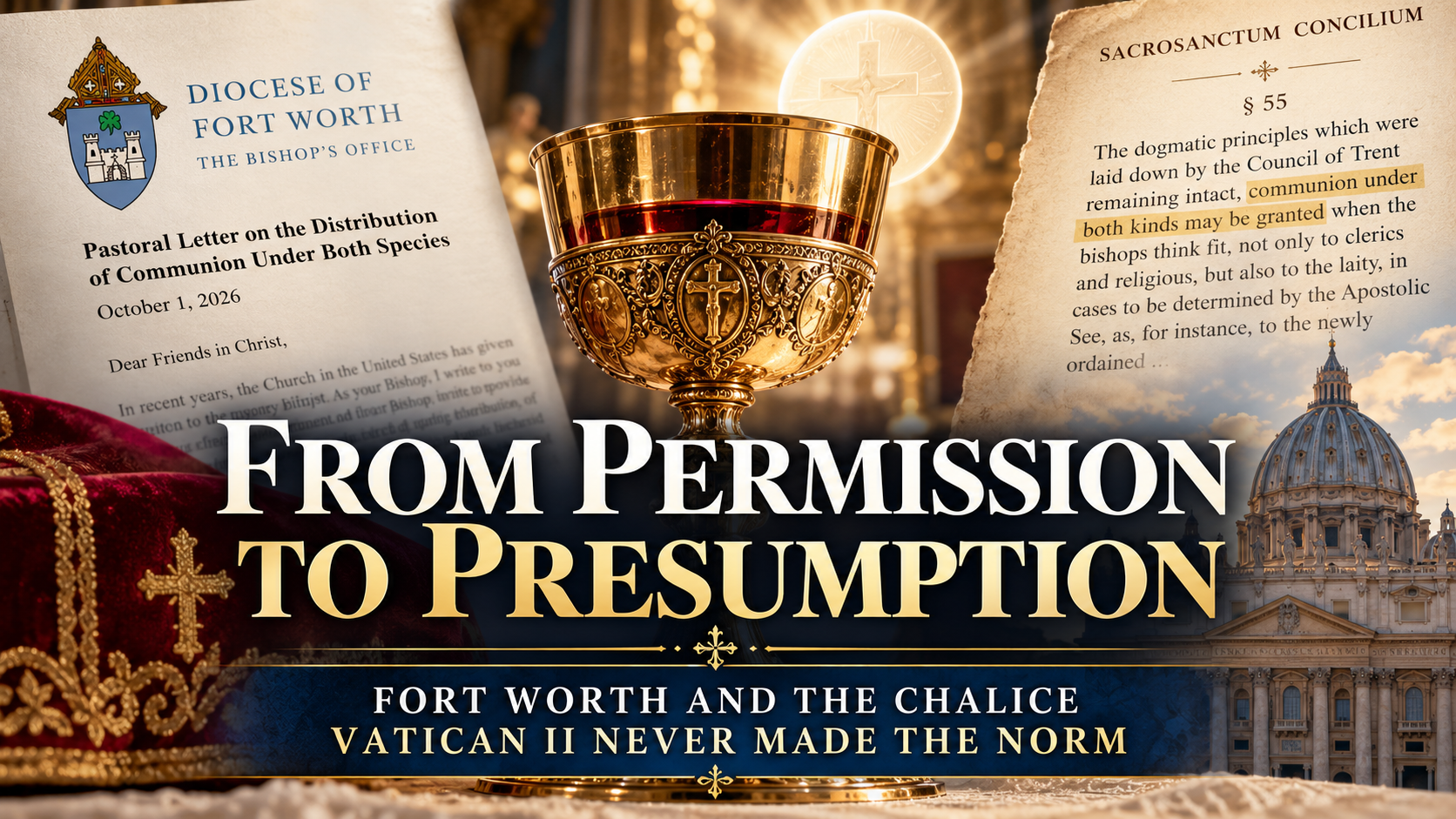
- FROM PERMISSION TO PRESUMPTION: Fort Worth and the Chalice Vatican II never made the NormBishop Michael Olson has implemented strict limitations on the distribution of Communion under both species in the Diocese of Fort Worth, prompting a discussion on the historical evolution of liturgical practices following Vatican II. This decision aims to reaffirm the doctrine of the Eucharist, emphasising that Christ is fully present under either species, while addressing misconceptions surrounding modern practices.
- AUGSBURG 2030: Can Rome commemorate a Confession it once confuted?Pope Leo XIV aims to revitalise the ecumenical spirit of the Augsburg Confession for its 2030 anniversary. However, historical responses from Rome highlight significant doctrinal differences between Catholics and Lutherans. True reconciliation must acknowledge these unresolved issues, as merely celebrating commonality risks glossing over critical theological distinctions that led to the Reformation.
- Today’s homily: St BrunoThe text reflects on Saint Bruno’s journey towards a life of solitude, prayer, and contemplation, emphasising the importance of genuine pursuit of God amidst distractions. It highlights that true spiritual growth requires silence and self-examination, urging believers to reclaim quiet moments for reflection, repentance, and devotion in daily life.
CURRENT EDITION


Today’s Mass Propers
- Today’s Mass: October 07 Pope St Mark, Confessor
 St Mark’s brief pontificate teaches that God measures fidelity, not duration or worldly achievement. Christ alone possesses the everlasting priesthood; His servants are stewards of what they have received. With the commemorated martyrs, St Mark reminds us to persevere faithfully, so that when the Lord comes, He finds us “so doing.”


Leave a Reply