
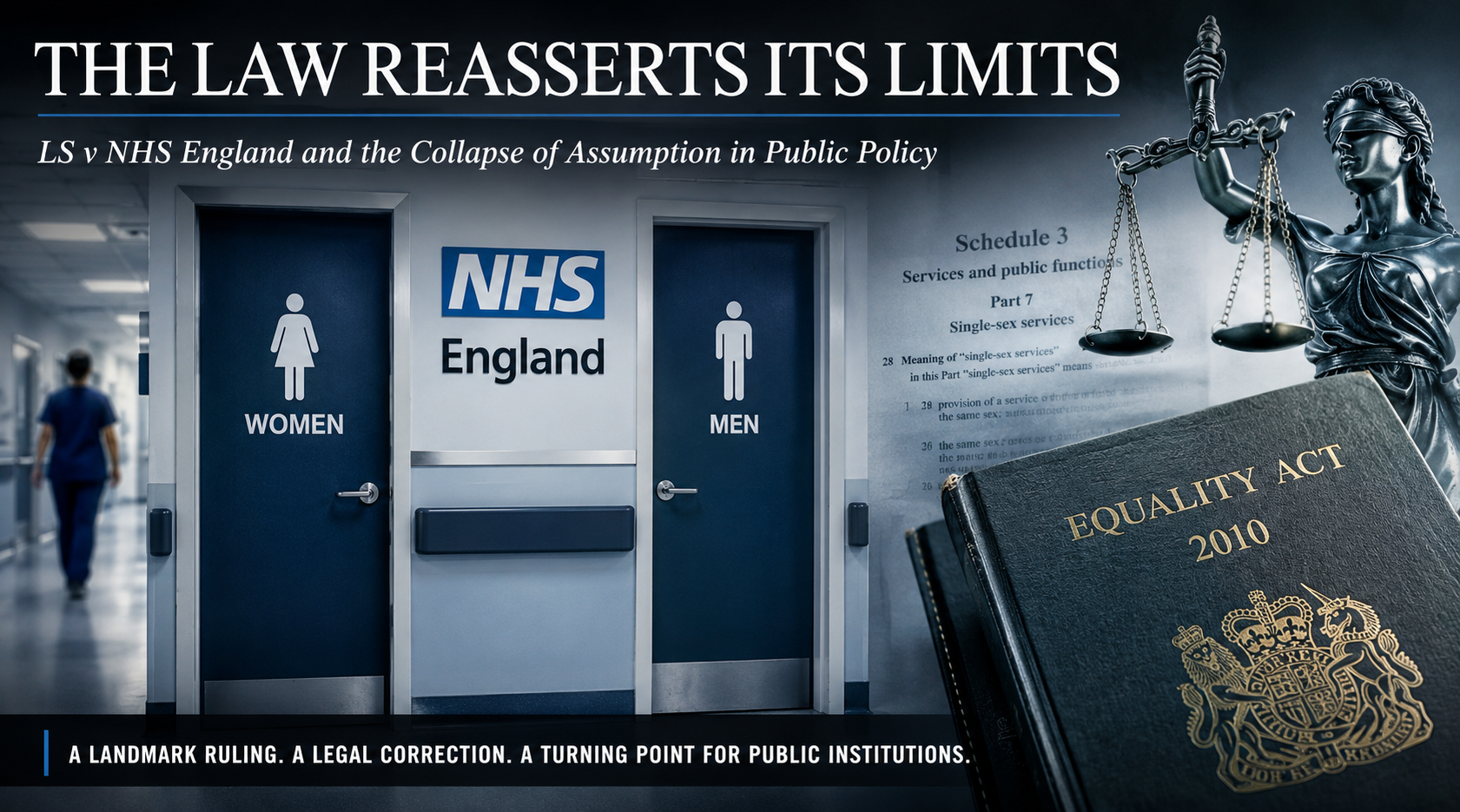
The Law Reasserts Its Limits: LS v NHS England and the Collapse of Assumption in Public Policy

The Employment Tribunal ruling in LS v NHS England marks a decisive legal correction to a decade of policy-making built on untested assumptions about gender identity and the law. By upholding claims of indirect sex discrimination and harassment, the Tribunal has exposed a fundamental category error at the heart of many public-sector policies and signalled a new phase of legal accountability for institutions that have failed to reconcile inclusion with statutory duty.
There are moments in legal development when a judgment does not merely clarify the law but exposes the accumulated consequences of misunderstanding it. The decision in LS v NHS England is one such moment. It does not create new law. It does something more disruptive: it reveals that a significant body of institutional practice has been operating on premises that the law does not, and never did, support.¹
At the centre of the case lies a policy familiar across the public sector. NHS England’s “Trans Equality Policy” permitted staff to access single-sex facilities—specifically toilets and showers—based on gender identity rather than biological sex, contingent upon “full-time presentation” in the acquired gender.² Such policies have, for years, been presented as both progressive and legally compliant, often adopted with little scrutiny under the assumption that the Equality Act required or at least endorsed such arrangements.³
That assumption has now been tested—and it has failed.
The claimant, a female employee who is also Muslim and suffers from PTSD related to male violence, challenged the policy on the basis that it placed her—and women more broadly—at a particular disadvantage. NHS England accepted that disadvantage existed.⁴ This concession was legally decisive. Under section 19 of the Equality Act 2010, once a disadvantage to a protected group is established, the burden shifts to the respondent to demonstrate that the policy is a proportionate means of achieving a legitimate aim.⁵
The Tribunal found that NHS England failed to do so, concluding in substance that the respondent had not demonstrated that the policy was a proportionate means of achieving a legitimate aim, particularly in light of the availability of less intrusive alternatives and the acknowledged impact on female staff.⁶
The reasoning is both technical and profound. While the aim of promoting dignity and inclusion for trans-identifying staff may be legitimate, the means adopted must withstand scrutiny. They must be necessary, balanced, and the least intrusive available. In this case, they were not. The Tribunal noted the existence of practical difficulties acknowledged by NHS witnesses themselves, and, more importantly, the failure to consider alternatives such as gender-neutral facilities—an omission fatal to the claim of proportionality.⁷
Yet the most consequential aspect of the ruling lies elsewhere. The Tribunal rejected, implicitly but unmistakably, the notion that there exists any general legal right for individuals to access single-sex facilities on the basis of gender identity.⁸ This is not a minor clarification. It strikes at the conceptual core of a wide range of policies currently embedded across public institutions.
The Equality Act protects the characteristic of gender reassignment. It does not dissolve the legal category of sex. Nor does it create an automatic entitlement to override sex-based provisions. On the contrary, Schedule 3 of the Act expressly preserves and authorises single-sex services where justified.⁹ These are not reluctant exceptions carved out of an otherwise neutral scheme; they are positive legal provisions recognising that privacy, dignity, and safeguarding sometimes require clear and enforceable boundaries.
The Tribunal’s analysis therefore aligns with, and gives practical effect to, the Supreme Court’s reasoning in For Women Scotland Ltd v Scottish Ministers. In that case, the Court reaffirmed that “sex” within the meaning of the Act refers to biological reality, and that statutory interpretation cannot be stretched to accommodate conceptual ambiguity without undermining the coherence of the law itself.¹⁰ LS v NHS England brings that principle down from abstraction into the lived reality of workplace policy.
The second pillar of the judgment—harassment—is equally significant. NHS England argued that its policy was not intended to harass. The Tribunal accepted this but found that intention is not determinative. The effect of the policy, in practice, was to violate the claimant’s dignity and create an environment that could reasonably be described as hostile or degrading, both in relation to her sex and her gender-critical beliefs.¹¹
This finding reinforces the legal recognition, established in appellate authority, that gender-critical beliefs are protected philosophical beliefs under the Equality Act.¹² It also establishes a crucial boundary: institutional policies, even when framed in inclusive terms, can themselves constitute unlawful conduct where they disregard the legitimate interests of others. Inclusion, in law, is not achieved by erasure, but by balance.
It is at this point that the arguments of critics must be addressed directly. Organisations such as Stonewall have long advanced the position that access to single-sex facilities based on gender identity is essential to equality and dignity, and many public bodies have adopted policies closely aligned with that framework.¹³ Some employment lawyers have similarly suggested that restricting such access risks breaching protections for gender reassignment under the Equality Act.¹⁴
The difficulty with these arguments is not that they are insincere. It is that they collapse a structured legal framework into a single overriding principle. The Equality Act does not operate in this way. It does not grant automatic priority to one protected characteristic over another. It requires a proportionality assessment—evidence-based, context-specific, and capable of withstanding scrutiny. What LS v NHS England demonstrates is that policies derived from advocacy positions, however widely adopted, will not survive that scrutiny if they fail to engage properly with the statutory scheme.
What the case ultimately exposes is a systemic failure of legal reasoning within public institutions. Over time, policy-making has drifted away from statute and towards consensus. Internal HR frameworks, diversity training modules, and external guidance have been treated not as advisory, but as determinative.¹⁵ The result is that institutions have acted as though legal obligations could be inferred from prevailing norms rather than derived from enacted law.
That is the failure. And that is why the consequences are now emerging.
Public bodies across the United Kingdom—schools, hospitals, universities, local authorities—have implemented materially similar policies, often with minimal legal scrutiny. Many have relied on guidance that, while influential, carries no statutory authority. In doing so, they have exposed themselves to precisely the kind of challenge that succeeded in this case.
This is not a retreat from equality. It is a reassertion of its legal foundations. Equality under the law depends upon clarity of categories, coherence of principles, and the disciplined application of statutory tests. When those are replaced by fluid concepts and unexamined assumptions, the result is not inclusion but conflict—and, ultimately, liability.
The deeper lesson of LS v NHS England is therefore not about one policy or one institution. It is about the limits of reinterpretation. Law can evolve. It cannot be silently rewritten through practice.
For years, many institutions behaved as though it could.
This judgment is what happens when the law answers back.
¹ Employment Tribunal, LS v NHS England (Leeds ET, March 2026), as reported in legal summaries and contemporaneous reporting.
² Ibid.; Didlaw press statement (2026).
³ Equality and Human Rights Commission, workplace guidance (2023–2024); policy adoption trends across UK public bodies.
⁴ Employment Tribunal, LS v NHS England (2026), respondent concession as reported.
⁵ Equality Act 2010, s.19.
⁶ Employment Tribunal, LS v NHS England (2026), proportionality findings as reported.
⁷ Ibid.
⁸ Ibid.; interpretation consistent with statutory framework.
⁹ Equality Act 2010, Schedule 3, Part 7.
¹⁰ For Women Scotland Ltd v Scottish Ministers.
¹¹ Employment Tribunal, LS v NHS England (2026), harassment findings; cf. Equality Act 2010, s.26.
¹² Forstater v CGD Europe [2021] UKEAT/0105/20/JOJ.
¹³ Stonewall, workplace inclusion guidance.
¹⁴ Employment law commentary on gender reassignment protections under Equality Act 2010.
¹⁵ Public sector equality and diversity frameworks; EHRC guidance usage in institutional policy formation.
RELATED ARTiCLES


LATEST ARTICLES
- Today’s Mass: October 27 Vigil of SS Simon & Jude, ApostlesThe vigil of SS Simon and Jude celebrates their apostolic contributions and shared commemoration in the Church. St. Jude, author of a New Testament Epistle, and Simon, with a shared mission in Mesopotamia and Persia, exemplify zealous anticipation of liturgical solemnities. Their legacy is acknowledged through prayers and reflections in early Christian traditions.
- THE KING’S OATH AND THE DEAD OF SAINT GEORGE’SA tragic attack during a Christian funeral in Karak, Jordan, resulted in nine fatalities and numerous injuries. King Abdullah II has pledged severe retaliation, leading to the arrest of three suspects. The Latin Patriarchate supports the monarchy’s role in ensuring religious freedom, while the Orthodox community vows to remain in their homeland amidst ongoing concerns for their safety.
- THE LAW OF A CHURCH THAT HAS NOT YET BEEN REUNITEDAt the Angelicum conference, Orthodox and Anglican scholars discussed the future of ecclesiastical law alongside Vatican cardinals. Cardinal Koch advocated for a new ecumenical juridical order, connecting these discussions to the upcoming Synodal Assembly of 2028. The conference aimed to address how different Christian governance models could influence Catholic law and authority.
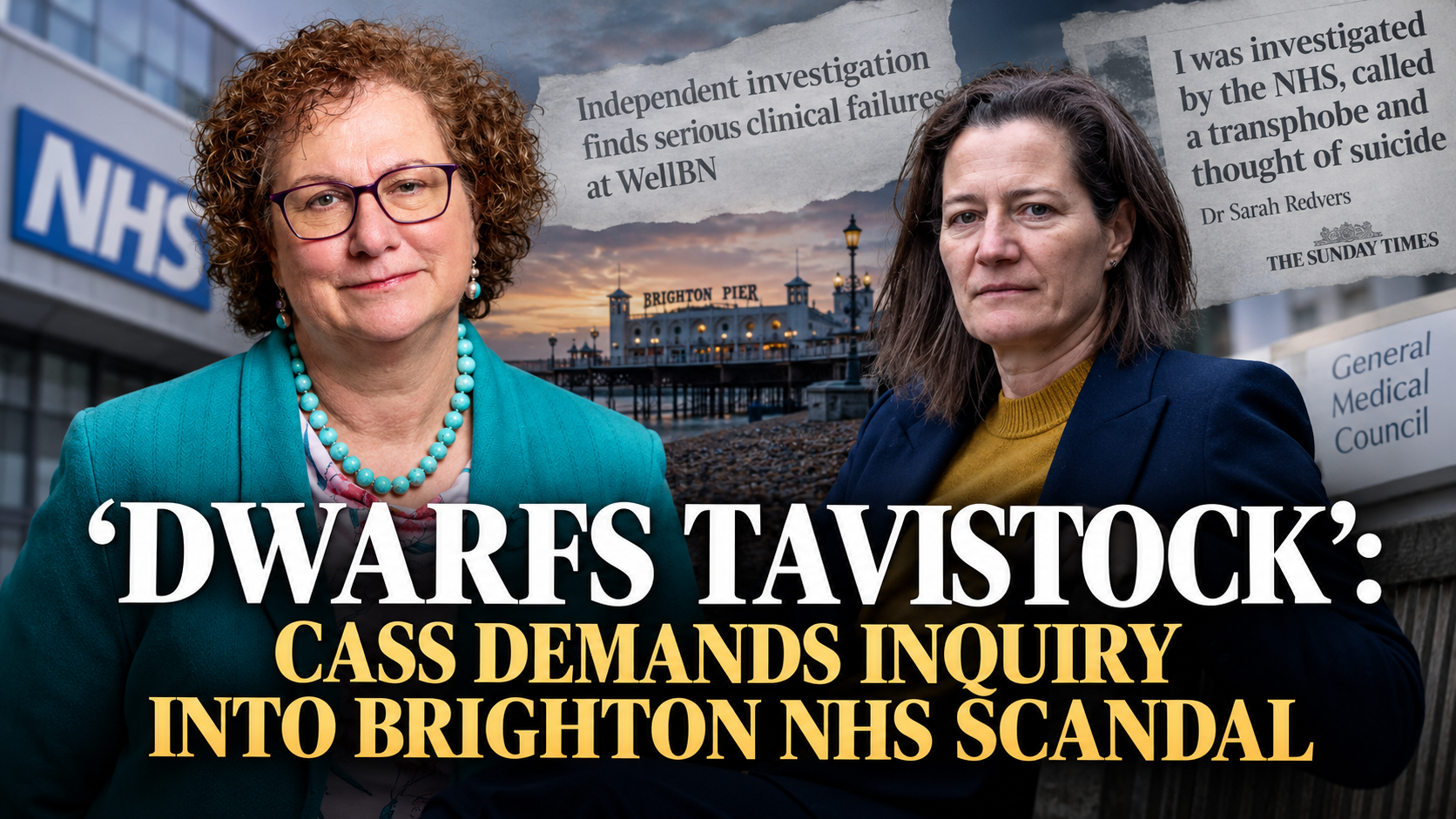
- ‘DWARFS TAVISTOCK’: Baroness Cass demands Inquiry into Brighton NHS ScandalBaroness Hilary Cass has called for an independent inquiry into Brighton’s WellBN practice, claiming it overshadowed the Tavistock scandal. An investigation revealed severe clinical failures affecting 78 children, alongside the distressing treatment of safeguarding GP Dr Sarah Redvers, who raised alarms about these practices and faced retaliation. Accountability within the NHS is urgently needed.
- “THAT’S JUST PARANOIA”: Dr Joseph Shaw and the Crisis beyond the Latin MassDr Joseph Shaw’s recent interview highlights his support for the Traditional Latin Mass but inadequately addresses the Society of Saint Pius X’s (SSPX) concerns regarding the Church’s doctrinal crisis. He dismisses SSPX’s fears as paranoia, yet the Society’s extensive theological arguments underscore that preserving the older liturgy is insufficient for restoring Catholic Tradition.
CURRENT EDITION


DAILY MASS ONLINE
One of the earliest online apostolates dedicated to the Traditional Latin Mass, Old Roman TV began broadcasting the Holy Sacrifice on the Feast of the Assumption, 15 August 2008. During the COVID-19 pandemic, additional programming — devotions, catechesis, and conferences — was added to support the faithful in prayer and formation.
Support the daily Holy Mass on Old Roman TV by offering a Mass intention — for loved ones, thanksgiving, or the repose of souls. Your intention helps sustain the sacred liturgy and brings grace to those you remember before God’s altar.
SUPPORT THE DAILY MASS ONLINE
Likely the world’s longest-running daily online broadcast of the
Traditional Latin Mass, streaming faithfully since the
Feast of the Assumption 2008.

This apostolate cannot continue without immediate help
Please support us with a contribution toward
chapel rent, sacristy supplies, operating costs, and web-hosting.
Our essential monthly costs reach £1,000.
MASS INTENTIONS
If your offering is for a Mass Intention, kindly complete the form below in full so we may correctly match it to your donation. For anniversary intentions — birthdays, wedding anniversaries, anniversaries of death — please be sure to include the relevant date.


Today’s Mass Propers
- Today’s Mass: October 27 Vigil of SS Simon & Jude, Apostles
 The vigil of SS Simon and Jude celebrates their apostolic contributions and shared commemoration in the Church. St. Jude, author of a New Testament Epistle, and Simon, with a shared mission in Mesopotamia and Persia, exemplify zealous anticipation of liturgical solemnities. Their legacy is acknowledged through prayers and reflections in early Christian traditions.



Leave a Reply