
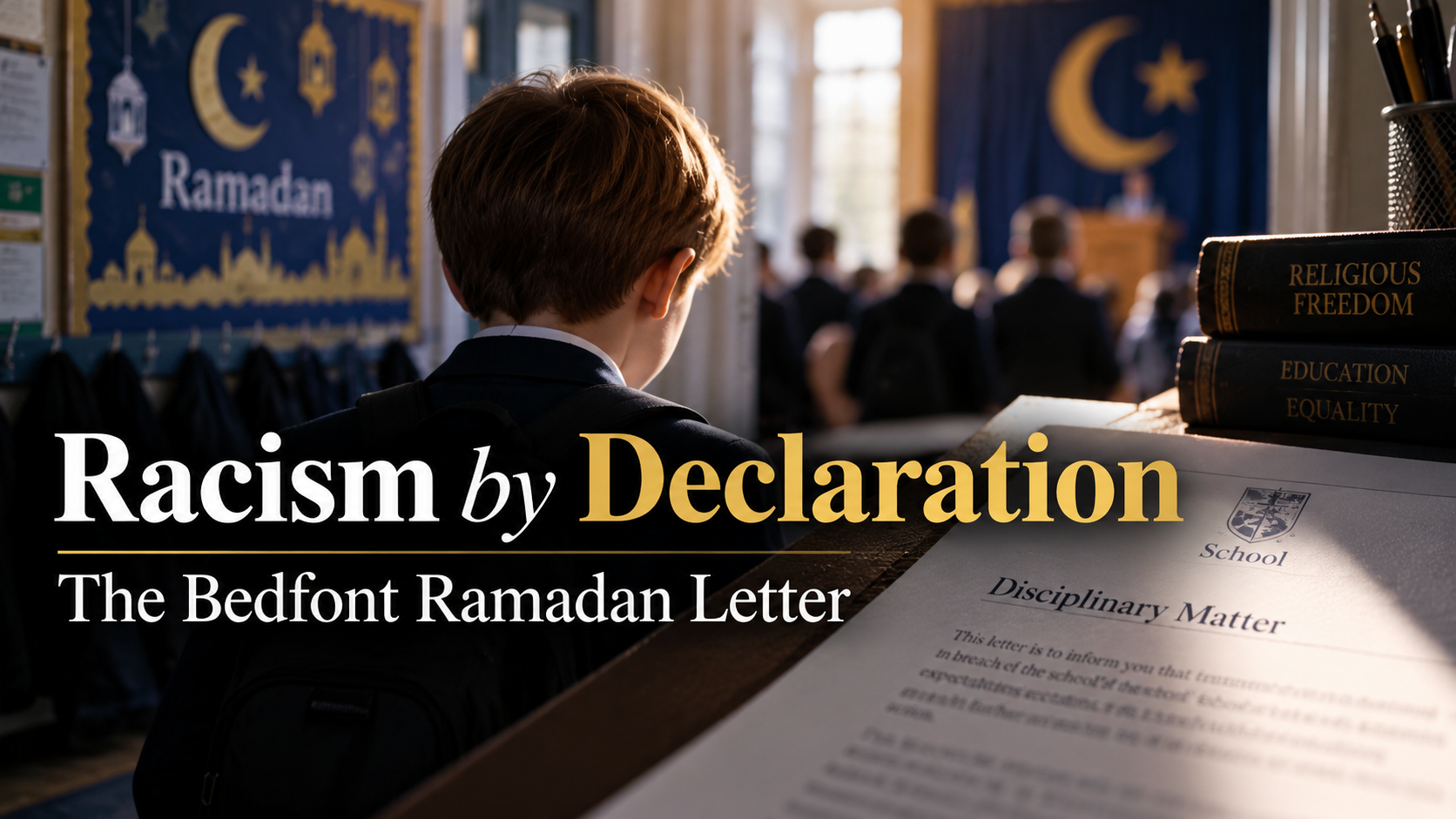
An eleven-year-old’s school is not a courtroom, but serious accusations still require evidence. A letter attributed to Bedfont Primary School classified a pupil’s objection to a Ramadan assembly as racist and threatened a permanent disciplinary record. The school’s published policies, the law and government guidance raise an uncomfortable question: where, precisely, was the racism?
“Why do we have to do this? I won’t do it. You can’t force me.” These were among the words reportedly spoken by a pupil at Bedfont Primary School, west London, during an assembly concerning Ramadan. There was more questioning, an apparent refusal to participate, and an allegation that the child pointed and laughed while classmates were singing. For this, according to a letter bearing the school’s official heading, the incident was classified as racist and designated for entry into the child’s behaviour record and the school’s register of racist incidents. There is no suggestion in the document that the pupil used a racial epithet, referred disparagingly to anyone’s ethnic origins or expressed hostility towards Muslims as people. The offence described began with a child’s objection to participating in a religiously themed activity. The accusation made against him was racism.¹
The correspondence, dated 11 March 2025, became the subject of wider publicity in February 2026. A photograph of the letter was published with the pupil’s identity obscured. It appears on Bedfont Primary School stationery, includes the school’s contact details and is signed by a member of staff. These details are consistent with the school’s public identity, although independent authentication and confirmation of the complete circumstances remain outstanding. Nor has a substantive response from the school to the published allegations been established. This qualification matters, but it must not become an excuse for avoiding scrutiny of the document itself. Its language is sufficiently explicit to permit examination of the reasoning it contains. The letter does not merely report an incident for investigation. It informs the parents that a racist incident occurred, announces that it will be recorded as such and warns of further sanctions should another occur.²
The wording reveals the difficulty immediately. The letter invokes a definition of racial harassment attributed to the former Commission for Racial Equality, referring to violence or other mistreatment connected with colour, race, nationality or ethnic origins. Having established that standard, it proceeds to describe conduct that does not, on its face, satisfy the definition it has just quoted. The child resisted participation, questioned whether he could be compelled, and allegedly laughed at other children singing. No explanation is provided for the transition from those actions to the finding of racism. Perhaps some additional evidence existed, although the letter does not identify it. Perhaps a fuller investigation took place, although none is described. What cannot reasonably be maintained is that the behaviour recounted automatically demonstrates racial hostility. The document supplies a conclusion without explaining the evidential connection upon which that conclusion depends.
The distinction is neither pedantic nor an invention of critics of contemporary equality policies. It appears in the Government’s own educational guidance. In Bullying Around Racism, Religion and Culture, produced by the Department for Education and Skills, the purpose of recording perceived racist incidents is explained with unusual clarity. Such recording is intended to ensure that allegations are taken seriously and investigated rather than ignored. The guidance expressly distinguishes perception and allegation from proof. Indeed, it states that an incident alleged or perceived to be racist does not thereby become racist.³ This is the distinction that seems to have disappeared from the Bedfont letter. A perceived incident may warrant an entry for investigation; the published correspondence instead communicates the classification as an established disciplinary conclusion. What investigation preceded it, and what evidence supported that conclusion, remain undisclosed.
There is an important historical irony here. The broad approach to recording racist incidents arose in part from the Stephen Lawrence Inquiry and the recognised failure of public institutions to identify and respond to genuine racial hostility. Its purpose was protective. It sought to prevent complaints being disregarded because officials considered them insignificant or inconvenient. But a framework designed to ensure that accusations are investigated can become unjust if the initial accusation acquires the status of a finding before the evidence has been considered. A safeguard for victims must not become a mechanism for dispensing with fairness towards the accused, particularly when the accused is a child. An institution does not demonstrate its commitment to racial equality by making the classification of racism easier than the demonstration of racism itself.
This requires a further distinction increasingly neglected in public discourse. Islam is a religion, not a race. Muslims belong to numerous races, nationalities and ethnic communities, and genuine anti-Muslim prejudice may certainly be expressed through racial hostility. Religion and ethnic identity may overlap in particular circumstances, and discriminatory behaviour can exploit that overlap. Nevertheless, the Equality Act 2010 recognises race and religion or belief as distinct protected characteristics.⁴ Objection to Islamic doctrine, non-participation in an Islamic observance, and mistreatment of a Muslim child are not interchangeable forms of conduct. The first may be an exercise of intellectual or religious freedom; the second may concern conscience; the third may warrant disciplinary intervention, depending upon its nature. Where racial or religious prejudice is alleged, the relevant evidence must be identified. Otherwise the language of protection can be extended to cover the very disagreement that religious pluralism is supposed to permit.
Nor should the allegation of laughter be quietly converted into evidence of an entirely different offence. If the pupil mocked classmates with the intention of humiliating them, a teacher would have every justification for correcting him. Children should learn that religious disagreement does not excuse discourtesy, and no pupil should be ridiculed merely for taking part in an activity permitted by the school. But laughing at a performance, even unkindly, does not establish hostility towards the performers’ race. Whether the child was laughing at his classmates, their singing, the situation itself or the prospect of being required to participate is not explained. That difference matters. Education involves teaching children to regulate immature behaviour, not treating every misjudgement as evidence of a settled prejudice. It is possible to correct discourtesy without accusing a child of racism, just as it is possible to uphold freedom of conscience without approving every manner in which a child expresses it.
The school’s own account of religious education makes the disciplinary classification harder to understand. Bedfont publicly undertakes to teach pupils to examine the claims of religious and non-religious worldviews, to evaluate those claims critically and to express agreement or disagreement respectfully. Its curriculum statement explicitly recognises the need to develop children’s understanding of their own beliefs and values through reflection and questioning.⁵ There is much to commend in that stated intention. Yet the practical test of such an educational philosophy arises when a child voices disagreement that the institution has not anticipated or finds inconvenient. The obligation to be respectful cannot reasonably mean that dissent is permitted only when sufficiently disguised to escape notice. A child may require instruction in the courteous expression of disagreement; he should not have to surrender the disagreement itself.
There is a revealing further complication in the school’s published disciplinary material. Its Behaviour and Relationships Policy, approved in September 2025, distinguishes relatively ordinary misbehaviour, including refusal to follow instructions and intentionally upsetting others, from the more serious category of intentional racist acts or words. Its Anti-bullying Policy, reviewed in September 2026, distinguishes racist bullying directed towards ethnic background or skin colour from prejudicial bullying related to religion and other characteristics.⁶ These documents postdate the reported incident and cannot be presented as the policies governing the March 2025 decision. They do, however, illustrate why accuracy in classification matters. The later anti-bullying document goes so far as to describe racist bullying, without qualification, as a criminal offence, before acknowledging elsewhere that bullying itself is not a criminal offence. Racially aggravated criminal offences have specific legal ingredients; the broad category of bullying is not automatically a crime. The inconsistency is not evidence of what happened in 2025, but it hardly encourages confidence that the terminology is always being handled with sufficient care.
The immediate question of participation also requires legal clarity. Bedfont is a community primary school without a religious designation. English law requires maintained schools to provide religious education and, subject to the applicable exceptions, collective worship. Parents possess statutory rights to withdraw their children from religious education or collective worship, and collective worship in community schools must ordinarily be wholly or mainly of a broadly Christian character unless the prescribed arrangements for an exception apply.⁷ A pupil of primary-school age does not ordinarily possess an independent statutory right to withdraw himself merely by announcing his refusal. That is an important limitation. But the existence of legitimate school authority does not mean that every activity can properly be imposed as religious participation, or that resistance automatically constitutes discrimination. The character of the Ramadan assembly, the nature of the song, whether pupils were merely learning about an observance or expected to join in its religious expression, and whether parental consent or withdrawal had been discussed are all essential to understanding the episode. None is satisfactorily established by the published letter.
The distinction between instruction and observance is fundamental. A pupil can reasonably be expected to learn what Muslims believe about Ramadan, to understand the practices associated with fasting and prayer, and to treat Muslim classmates with consideration. Such knowledge is part of a proper education. Participation in an observance is another matter. A school may teach the words of a religious prayer as an object of study without requiring children to adopt it as their own prayer. It may explain devotional music without treating reluctant participation in singing as hostility towards believers. The fact that activities occur within an educational setting does not make their religious significance disappear. A serious school should be able to explain the distinction to parents and pupils rather than relying upon disciplinary authority to overcome uncertainty.
An institution committed to diversity should be particularly attentive to this problem. The language of inclusion often assumes that participation in the activities of different communities is necessarily evidence of respect. Frequently it is no such thing. Respect does not require religious conformity, nor does toleration demand enthusiastic public affirmation. A Christian may respectfully decline to participate in an Islamic devotion; a Muslim may similarly decline participation in Christian worship. A child of no religion may reject both. The proper response is to distinguish a refusal to participate from an intention to insult, and then judge any separate misconduct on its merits. Indeed, a plural society that cannot accommodate conscientious non-participation has misunderstood the nature of pluralism. Its apparent harmony has been purchased by demanding conformity precisely where it professes to value difference.
This is not an isolated question in Nuntiatoria’s recent examination of education and religious liberty. In March, Preferential Treatment or Public Principle? The Question Schools Must Answer considered a Canadian school’s Ramadan arrangements and the danger of accommodation becoming an obligation imposed upon those who do not share a religious observance. The Politics of Accusation, published two days later, examined how substantive criticism of Islamic religious expression can become submerged beneath accusations of prejudice.⁸ The Bedfont correspondence brings these concerns from the realm of public policy into the immediate relationship between adult authority and childhood conscience. It is one thing to restrict a public debate by attaching an accusation to dissent. It is another to place such an accusation in the disciplinary history of a pupil who may be too young to understand its implications and insufficiently equipped to contest it.
Those implications are not trivial. The disputed letter declares that the incident will be added both to the child’s behaviour record and to the register of racist incidents, although there is no independent confirmation that the entries were subsequently made or retained. Bedfont’s more recent anti-bullying documentation acknowledges that certain records may be passed to a child’s next school. Under the applicable legal provisions, parents can seek access to educational records held by maintained schools, while data protection legislation provides means of challenging inaccurate personal information.⁹ A school’s duty to maintain records of suspected prejudice is legitimate; its duty to distinguish suspicion from substantiated misconduct is equally important. The consequences of inaccurate classification may outlast the original episode, and the imbalance of authority between school and family makes careful procedural safeguards indispensable.
The issue also deserves to be placed within the larger question of Britain’s religious education. Section 375 of the Education Act 1996 requires locally agreed syllabuses to reflect the predominantly Christian character of Britain’s religious traditions while taking account of other principal religions.¹⁰ This does not mean that every lesson must concern Christianity, still less that Islam should be excluded from the curriculum. It means that the Christian inheritance of the country remains a recognised part of the educational settlement. Christianity is not merely one cultural artefact among many, interchangeable with whichever religious festival happens to be under discussion. Its influence upon English history, law, language, architecture, literature, morality and public institutions is profound. An education that diminishes this inheritance while treating criticism of other religious claims with unusual sensitivity would be intellectually unbalanced. Whether such an imbalance exists at Bedfont cannot be determined from this single incident, but the principle remains relevant to the national discussion.
There is, from a Catholic standpoint, an additional and deeper concern. Religious faith demands the assent of the intellect and will; it cannot be produced by the mere external imitation of religious behaviour. The Church has always distinguished the formation of conscience from the coercion of conscience, and the proper authority of those responsible for education from any supposed power to compel interior belief. St Thomas Aquinas recognised that conscience must be instructed and corrected where erroneous, but this does not make compulsion a substitute for persuasion.¹¹ A child may not always understand the distinctions involved. That is precisely why adults must. The teacher’s responsibility is not merely to ensure that the programme continues uninterrupted, but to help a young person understand how conviction, courtesy and obedience relate to one another. None is served by treating dissent as an offence whose seriousness has yet to be demonstrated.
Bedfont’s governors, and where appropriate the local authority, should be able to explain what happened without identifying the child or compromising the privacy of other pupils. Was the letter authentic? What precisely were the children singing, and what were they being asked to do? Did the pupil refuse to participate in a devotional act, or was he objecting to an ordinary lesson about Ramadan? Was there evidence of hostility towards another child’s ethnicity or religion beyond the conduct described? Was an investigation undertaken before the letter was issued, and was the child given an opportunity to explain himself? Most importantly, upon what evidence was the incident classified as racist, and was that classification subsequently reviewed, retained or withdrawn? These are questions about institutional accountability, not a demand that the school abandon its duty to protect pupils from genuine discrimination.
The absence of a verified institutional response prevents a final judgement about the underlying incident. It does not prevent a judgement about the adequacy of the reasoning disclosed in the letter. There is a difference between approaching official explanations sceptically and presuming misconduct by every institution. The former is indispensable to independent journalism; the latter would merely substitute one prejudice for another. The responsibility here is to scrutinise an accusation of racism according to its substance, without allowing either the school’s authority or the wider political controversy to determine the conclusion in advance. The correspondence, as published, does not provide the evidence necessary to sustain the gravity of its own classification.
Schools have an unquestionable duty to combat racism. That duty cannot be faithfully discharged by obscuring the difference between racism and ordinary misbehaviour, between religious offence and racial hostility, or between dissent and discrimination. Every unjust accusation weakens public confidence in the seriousness of genuine accusations. Every failure to distinguish legitimate conscience from deliberate cruelty teaches children that moral language is an instrument of authority rather than a means of describing truth. A pupil’s laughter may deserve correction; his refusal may require a conversation with his parents; his understanding of other religions may need improvement. But none of these considerations relieves the adults who accuse him of racism from their obligation to establish what he actually did and why it merits that description.
The gravity of this case lies not in the fact that a child objected to a Ramadan assembly. Children object to school activities every day. It lies in the apparent willingness of an institution to attach an exceptionally serious moral accusation to behaviour whose discriminatory character the available account fails to establish. Where adults have the authority to make such accusations, they bear the greater responsibility for precision, proportion and fairness. That responsibility is not diminished by the virtuous purposes invoked in their policies. It is made more demanding by them.
A school may require a child to behave respectfully. It must not confuse respect with religious conformity. And before it teaches a child that he is guilty of racism, it ought to be able to tell him exactly where the racism occurred.
¹ Percepcions, A British Schoolboy Has Been Accused of Racism for Not Wanting to Celebrate Ramadan at a State School, 9 February 2026; photograph of the circulated correspondence.
² Department for Education, Get Information About Schools: Bedfont Primary School, URN 135831; Percepcions, A British Schoolboy Has Been Accused of Racism, 9 February 2026.
³ Department for Education and Skills, Bullying Around Racism, Religion and Culture, Section 2.1, pp. 47–48.
⁴ UK Parliament, Equality Act 2010, Section 9: Race, and Section 10: Religion or Belief.
⁵ Bedfont Primary School, Religious Education: Intent, Implementation and Right to Withdraw, school curriculum statement.
⁶ Bedfont Primary School, Behaviour and Relationships Policy, approved September 2025, pp. 10–11; Anti-bullying Policy, reviewed September 2026, sections 2–3 and 5.
⁷ UK Parliament, School Standards and Framework Act 1998, Sections 69–71, and Schedule 20: Collective Worship; Department for Education, Collective Worship in Schools.
⁸ Nuntiatoria, Preferential Treatment or Public Principle? The Question Schools Must Answer, 18 March 2026; The Politics of Accusation: Public Religion, Nick Timothy, and the Closure of Debate, 20 March 2026.
⁹ Bedfont Primary School, Anti-bullying Policy, September 2026, Appendix: Support and Sanctions Ladder; Information Commissioner’s Office, Accessing Pupils’ Information and Your Right to Get Your Data Corrected.
¹⁰ UK Parliament, Education Act 1996, Section 375(3): Agreed Syllabuses of Religious Education.
¹¹ St Thomas Aquinas, Summa Theologiae, I–II, q. 19, aa. 5–6, concerning the relationship between conscience, error and the will.





Leave a Reply