
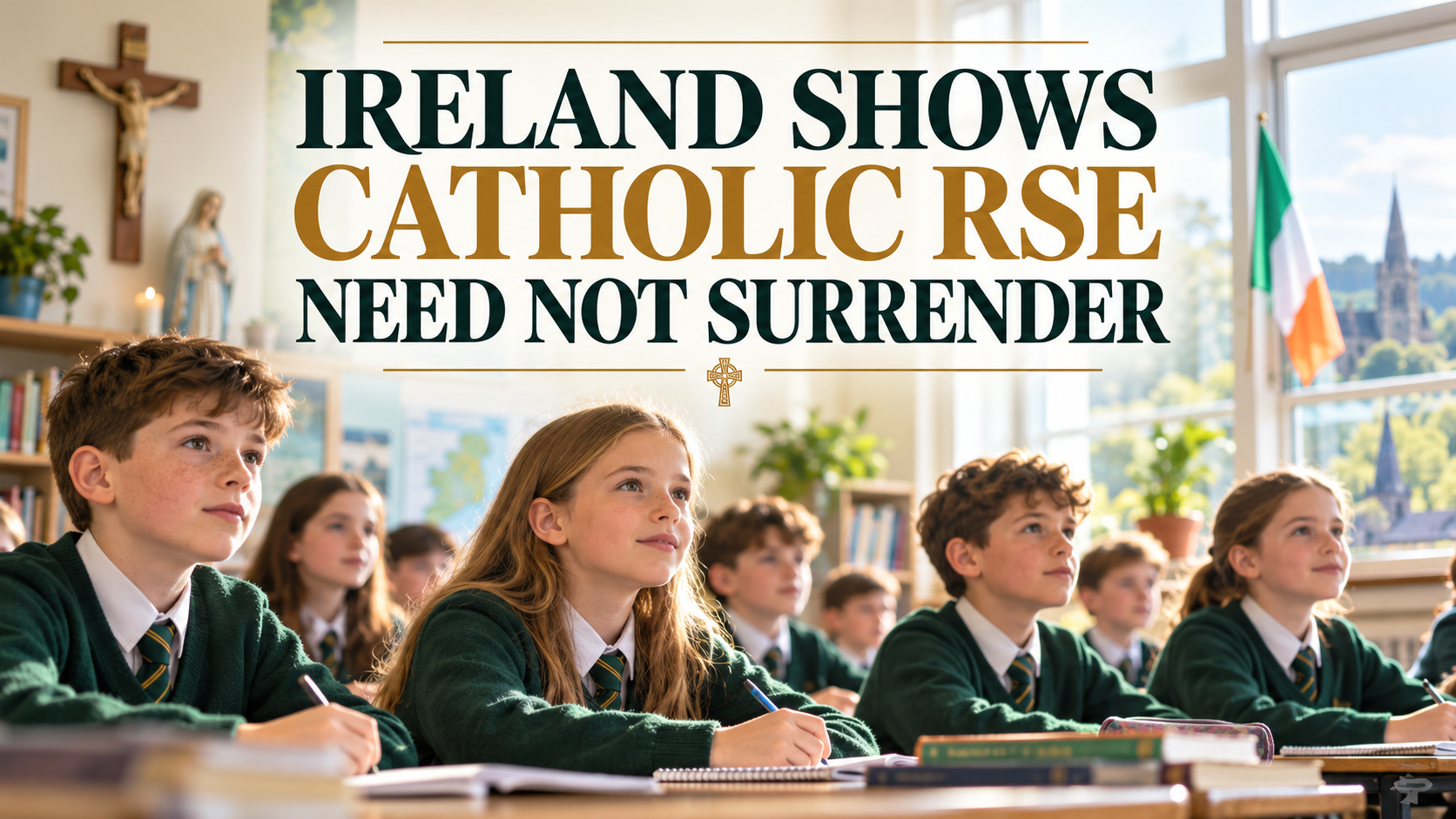
Ireland’s new Living Love Senior programme is important not because it avoids the difficult questions of sex, relationships and gender, but because it attempts to answer them from within Catholic anthropology. The circumstances are specifically Irish. Yet the comparison with England and Wales is instructive: the bishops there have already stated much the same anthropology with considerable clarity. The question is whether that clarity consistently reaches the classroom.
Something important has happened in Irish Catholic education. The Catholic Education Partnership, working within the structures of the Irish Church, has launched Living Love Senior, a new programme intended to support Relationships and Sexuality Education within Senior Cycle SPHE in Catholic post-primary schools. Archbishop Eamon Martin introduced it in September not as a device for evading contemporary questions but as a means of confronting them from within a coherent Catholic understanding of the human person.¹
The jurisdiction matters. This is an Irish initiative responding to an Irish educational situation. In the Republic its immediate setting is the new Senior Cycle SPHE specification, which schools have until September 2027 to introduce for pupils entering fifth year.² The wider Living Love project has also been constructed with Catholic education across the island in mind, earlier resources being designed in harmony with requirements in both jurisdictions.³ None of this changes English RSHE law, Welsh RSE or any other educational framework. What Ireland offers the rest of the Catholic world is therefore not a ready-made legal template. It offers something more fundamental: an example of how Catholic education can engage contemporary requirements without first conceding the anthropology by which those requirements are interpreted.
That distinction goes to the heart of the matter. Relationships and sexuality education inevitably concerns questions which are not morally neutral: sexual behaviour, marriage, contraception, abortion, pornography, fertility, consent, sexual orientation, gender identity and, beneath all of them, the meaning of the human body. A Catholic school cannot simply accept whatever understanding of man accompanies the surrounding culture and then add a prayer, a Scripture quotation and a concluding reference to dignity. If the education is genuinely Catholic, Catholic anthropology must provide its intellectual architecture.
Living Love appears to have grasped this. Archbishop Martin described contemporary culture as separating realities which properly belong together, among them “biological sex from gender”. More decisively, he stated: “Respect for the dignity of all does not require the Catholic school to abandon its own understanding of the human person.”¹ There, in a sentence, is the distinction which much contemporary educational debate has obscured. The dignity of the person is unconditional. The truth of every proposition by which a person understands himself is not.
Nor is this merely an episcopal gloss subsequently laid over an otherwise conventional RSE programme. Existing Living Love classroom material gives us a glimpse of the anthropology from which the Senior initiative has developed. Its publicly available resources include lessons on The language of the body, Sexual Attraction, Love and intimacy, My body and my identity, Dating with integrity, Sex and Marriage and The Gift of Fertility.³ More significantly, a written submission published by the National Council for Curriculum and Assessment reproduces this passage from the Catholic Education Partnership’s existing Sex and Marriage lesson: “Our human biology is important only a man and a woman can be physically united in the deepest and most intimate way through sex.”⁴
That sentence is worth lingering over. “Our human biology is important” sounds almost embarrassingly elementary. In the present dispute it is anything but. It asserts that the sexed body is not an incidental piece of information subordinate to an autonomous inner identity. It says that embodiment has meaning, and that the meaning of sexual union cannot be understood independently of the male and female bodies which make it possible. One need not dress the proposition in polemical language. Its implications are already considerable.
Accuracy requires one qualification. This quotation comes from earlier Living Love material reproduced in an NCCA consultation submission, not from a publicly available copy of the new Senior Cycle teaching pack. We should not put words into resources we have not yet examined. But the evidence is nevertheless relevant. It shows the anthropology already present within the Living Love project; the new Senior programme has now been launched by the Primate of All Ireland with an explicit insistence upon embodiment and the inseparability of biological sex from a Catholic understanding of the person. That is sufficient to establish the direction of travel without pretending to possess material which is not yet publicly available.
This is also why Living Love is potentially more important than another Catholic response to another curriculum revision. It recovers a distinction which educational fashion has done much to blur: teaching a pupil about an idea is not the same as teaching the pupil that the idea is true.
Catholic pupils should know what is meant in contemporary society by gender identity. They should know why some people experience profound distress concerning their sexed bodies, why gender dysphoria requires serious pastoral sensitivity, and why these questions have become politically and culturally contentious. They should understand what contraception is, what abortion is, how pornography distorts sexuality, what consent means, why coercion is wrong, and what civil society says about different forms of relationship. A Catholic education which simply refuses to mention the world into which its pupils are about to emerge would be an inadequate education.
But knowledge is not assent. Describing a contemporary belief does not require a Catholic school to teach that belief as anthropology. Explaining contraception does not prevent the Church’s moral judgement upon contraception being stated. Teaching the civil law concerning abortion does not oblige the school to treat the morality of abortion as an open Catholic question. Discussing gender identity does not require an institution to begin by accepting that every person possesses an internal gender which may override bodily sex.
Indeed, if those categories have already been admitted as unquestioned facts before Catholic teaching appears, much of the argument has been conceded in advance. Catholic doctrine then arrives not as the truth by which the subject is ordered but as a denominational qualification added to somebody else’s understanding of the human person.
That is why the body matters so much. Catholic sexual morality is incomprehensible when detached from Catholic anthropology. Chastity makes sense because the body belongs intrinsically to the person rather than functioning as an instrument for the will. Marriage makes sense because male and female embodiment is meaningful. Sexual restraint makes sense because freedom exists for the good rather than merely for choice. The Church’s teaching on sexual union makes sense because love, fidelity, embodiment and procreation are not arbitrary fragments which can be separated indefinitely without altering the meaning of the act itself.
Living Love therefore seems strongest where it refuses to begin with a collection of prohibitions. The Catholic answer to sexual confusion is not simply a longer list of things which may not be done. It is an account of what man is, what the body means, what freedom is for, what love demands and why our created nature cannot be remade by assertion.
Parents also stand near the centre of the Irish question. Article 42 of the Constitution of Ireland recognises the family as the “primary and natural educator” of the child and guarantees the inalienable right and duty of parents concerning their children’s religious, moral, intellectual, physical and social education.⁵ Archbishop Martin likewise placed real emphasis upon parental involvement in RSE.¹ This is not the school graciously permitting anxious mothers and fathers to peer through a window into a professional domain. It recognises an authority which exists before the school and which the school is meant to assist.
The distinction becomes especially important when whole-school policy is considered. Ireland’s Bí Cineálta procedures, in force since September 2025, require recognised schools to address gender-identity bullying alongside cyberbullying, racist bullying, sexist bullying and sexual harassment.⁶ The protection of children against bullying is entirely proper. Catholic schools ought to be exemplary in it. No pupil should be mocked, threatened, isolated or abused because of sexuality, appearance, sex or perceived identity.
But protecting a pupil from cruelty does not establish an anthropology. A child may possess an unconditional right not to be bullied while the ideas by which that child interprets himself remain open to examination. That is not a loophole around compassion. It is what permits genuine compassion to coexist with intellectual integrity.
The larger test for Living Love will therefore be whether the anthropology of the lesson becomes the anthropology of the school. It would be incoherent to teach one account of embodiment during RSE while staff training, pastoral policy, visiting speakers or institutional vocabulary quietly presume another. Catholic ethos cannot mean that the crucifix remains on the classroom wall while the understanding of the human person beneath it has been outsourced.
At this point the comparison with England and Wales becomes especially instructive.
The Catholic Bishops’ Conference of England and Wales has already addressed the underlying doctrinal question in its 2024 pastoral reflection Intricately Woven by the Lord. It is not an RSHE teaching programme, and should not be criticised as though it were one. On anthropology, however, it is clear. The bishops reject the proposition associated with Gender Identity Theory that everybody possesses an internal gender identity which can fail to correspond with biological sex. They state that sexual identity is not merely a cultural or social construction, affirm the significance of sexual differentiation and join that teaching to a call for compassionate accompaniment of people experiencing gender dysphoria.⁷
The significant contrast with Ireland, therefore, is not that the English and Welsh bishops have failed to teach Catholic anthropology. They have. In important respects their stated position and Archbishop Martin’s are remarkably close.
The question is what happens between the episcopal document and the classroom.
One of the most widely used Catholic RSHE programmes in England and Wales is Life to the Full, produced independently by Ten Ten Resources. Here previous controversy requires care. Life to the Full has not been nationally “adopted” or formally approved by the Catholic Education Service. Ten Ten itself states that the CES does not approve externally produced RSHE programmes, leaving such judgements to individual dioceses, although the CES has commissioned Ten Ten to provide teacher-training material for the delivery of Catholic RSHE.⁸
Nor is it accurate simply to pronounce Life to the Full heterodox and move on. Ten Ten affirms the unity of body and soul, the value of human life from conception, sexual difference, the place of sexual intercourse within marriage, and its unitive and procreative meaning. It has also responded in detail to criticism and altered material where it considered revision justified. Claims that the programme directed pupils to Childline for material on contraception, abortion and gender identity, for example, were answered specifically: Ten Ten says its Childline references concern safeguarding and abuse, not those subjects.⁹ Catholic criticism loses rather than gains credibility by continuing to repeat a charge after the evidence for it has been answered.
But clearing away exaggerated charges leaves a more important question.
Ten Ten itself recognises the difficulty. Its educational method seeks common ground with pupils who may have little Catholic formation and attempts to lead them gradually towards the Church’s understanding of sexuality. It candidly acknowledges the tension between pastoral sensitivity and the clear presentation of moral teaching, saying: **“We know we have yet to get that balance perfectly right.”**⁸ That admission deserves to be treated seriously rather than weaponised. Teaching adolescents who arrive in the classroom already formed by social media, pornography and contemporary assumptions is genuinely difficult.
The issue is not that a Catholic teacher must begin every lesson by reciting a paragraph of the Catechism. Nor is there anything suspect about beginning with the experience of the pupil. The danger comes when the categories used to describe that experience have already imported the anthropology which Catholic teaching is subsequently expected to correct.
That has been the central concern in our previous examination of Catholic RSHE in England and Wales. The decisive test is no longer whether orthodox propositions can be found somewhere within Life to the Full. They plainly can. The question is whether Catholic anthropology consistently governs the architecture of the lesson, or whether it sometimes arrives after the pupil has already been invited to understand the issue through categories whose philosophical premises are substantially secular.
The distinction is not academic. If gender identity is introduced simply as an innate interior reality, the argument concerning the sexed body has largely been settled before Catholic anthropology enters the room. If sexual activity is framed principally through consent, personal choice and harm reduction, the Catholic account of chastity, marriage and the proper end of sexuality risks sounding like an additional religious restriction upon an otherwise complete secular ethic. If abortion or contraception is first presented through the language of competing personal choices, Catholic teaching can easily appear to pupils as one opinion among several rather than a judgement arising from an integrated understanding of human nature.
Ten Ten has continued to revise its secondary resources, including material dealing with gender identity.¹⁰ That willingness to revise is a strength. The purpose of criticism ought to be improvement, not the preservation of an adversary in amber. But Ireland now presents an opportunity to ask whether the pedagogy itself might be made more secure by placing Catholic anthropology more obviously at the beginning.
That is what makes the early evidence from Living Love interesting. “Our human biology is important.” The body means something. Sexual difference means something. Male and female complementarity means something. Biological sex cannot simply be pulled away from gender. Respect for every person does not require surrender of the Catholic account of the person.
The anthropology establishes the grammar; the difficult conversation follows.
That is a more robust order of teaching because it does not require Catholicism to fight its way back into a discussion after the essential premises have already been established elsewhere. Contemporary theories can still be presented accurately and sympathetically. Difficult experiences can still be treated with pastoral care. Pupils who disagree can still be respected completely. But everyone knows from the beginning that the Catholic school is not anthropologically neutral.
There is consequently a certain irony in the comparison. England and Wales already possess, in Intricately Woven by the Lord, much of the doctrinal clarity which Ireland is now placing at the centre of Living Love Senior. The problem is not a shortage of episcopal teaching. The question is whether policies, lesson plans, outside resources, staff formation and classroom practice consistently speak with the same voice.
That question reaches far beyond Ten Ten. Catholic schools operate under real pressure: legislation, statutory guidance, inspection regimes, safeguarding responsibilities, equality law, external providers and staff who may themselves have received little formation in Catholic anthropology. Institutional drift does not normally begin with a dramatic announcement that Catholic doctrine is being discarded. It begins with the adoption of apparently convenient terminology, model policies and professional resources whose underlying assumptions are rarely examined.
Language then does the work. A disputed concept becomes an administrative category; the category becomes normal; the assumptions behind it disappear from view. Eventually questioning the concept itself sounds extreme because the institution has forgotten that a philosophical decision was ever made.
Living Love offers a possible way out of that trap, precisely because it does not propose ignorance as the alternative. Archbishop Martin wants Catholic schools to discuss pornography, gender, consent, sexual pressure, fertility, relationships and the other difficult realities confronting young people.¹ The Church cannot complain that the culture has catechised children while declining to catechise them herself.
But catechesis worthy of the name must do more than append Catholic conclusions to secular premises. It must teach young Catholics how to see.
That is why the Irish development deserves more than congratulation. It sets a test for itself. If Living Love is to succeed, its anthropology must survive contact with actual classrooms. Teachers will require formation rather than merely electronic resources. Parents must be able to see what is being taught. Boards, patrons and governors will need the confidence to defend Catholic principles when difficult cases arise. Whole-school policies must not contradict what the RSE lesson says about the body.
And it sets a test beyond Ireland. England and Wales need not copy an Irish curriculum designed for another educational system. Nor would it yet be responsible to declare Living Love Senior categorically superior to Life to the Full before the complete Senior materials have been examined in operation. But Catholic educators can already ask a more fundamental question prompted by the Irish example.
If our bishops have clearly said what man is, does our educational practice begin there?
That is the real comparison between Living Love and the provision familiar in England and Wales. The bishops on both sides of the Irish Sea can articulate a recognisably Catholic anthropology. Ireland now appears determined to make that anthropology visibly constitutive of the teaching programme itself. England and Wales possess the doctrine; the continuing question is how consistently that doctrine governs the pedagogy pupils actually encounter.
Catholic schools need not choose between ignorance and surrender. They can teach pupils what contemporary society believes without teaching them that contemporary society must therefore be correct. They can protect vulnerable children without making disputed ideas immune from criticism. They can explain gender identity without conceding that gender determines sex, explain contraception without concealing Catholic moral teaching, and explain abortion without pretending that the value of unborn human life is an open question within Catholicism.
This is not indoctrination masquerading as education. Every educational system necessarily operates from some account of the human person. The intellectually honest Catholic school makes its account explicit rather than smuggling another one in under the label of neutrality.
That is why Living Love Senior matters. Its importance lies less in winning another skirmish in the culture war than in recovering a principle Catholic education should never have lost: the Church does not educate children by borrowing somebody else’s account of what a human being is.
The immediate curriculum is Irish. The statutory circumstances are Irish. The experiment will first succeed or fail in Irish Catholic schools. But the challenge it presents to Catholic education elsewhere is unmistakable. England and Wales already possess Intricately Woven by the Lord. Their bishops have stated that embodiment and sexual differentiation matter and that an interior claim of gender cannot simply replace biological sex. Catholic educators must now ensure that the same clarity survives all the way from the bishops’ conference to the pupil’s desk.
The circumstances are Irish. The principle is Catholic.
- Archbishop Eamon Martin’s address to educators in Mullingar — Irish Catholic Bishops’ Conference, 9 September 2026; address accompanying the launch of the Living Love Senior Programme.
- New and revised subjects and programmes published — National Council for Curriculum and Assessment; implementation timetable for Senior Cycle SPHE.
- Living Love – RSE resources — Catholic Education Partnership; existing Living Love resources developed for Catholic post-primary schools in Ireland.
- Senior Cycle SPHE Written Submissions — Individuals — NCCA consultation material reproducing wording from Living Love, Module 2, My Relationships, Lesson 8, Sex and Marriage.
- Constitution of Ireland — Article 42 on the family as the primary and natural educator of the child.
- Bí Cineálta Procedures to Prevent and Address Bullying Behaviour for Primary and Post-Primary Schools — Department of Education and Youth; the procedures encompass gender-identity bullying and came into effect for schools from September 2025.
- Intricately Woven by the Lord — Catholic Bishops’ Conference of England and Wales, 2024; pastoral reflection on gender, embodiment and sexual identity.
- Statement from Ten Ten Resources — Ten Ten Resources; explanation of the pedagogy of Life to the Full, its relationship with the Catholic Education Service and its response to criticism.
- Life to the Full — Response to Criticism — Ten Ten Resources; detailed response concerning Catholic teaching, parents, safeguarding, Childline, contraception, abortion and gender identity.
- Life to the Full Secondary Changes 2024–25 — Ten Ten Resources; revisions to the secondary programme, including changes to material on gender identity.
- Catholic education lands fatal blow on woke SPHE — Dr Niamh Regan, The Irish Catholic, 1 October 2026; commentary on the launch and significance of Living Love Senior.



Leave a Reply