
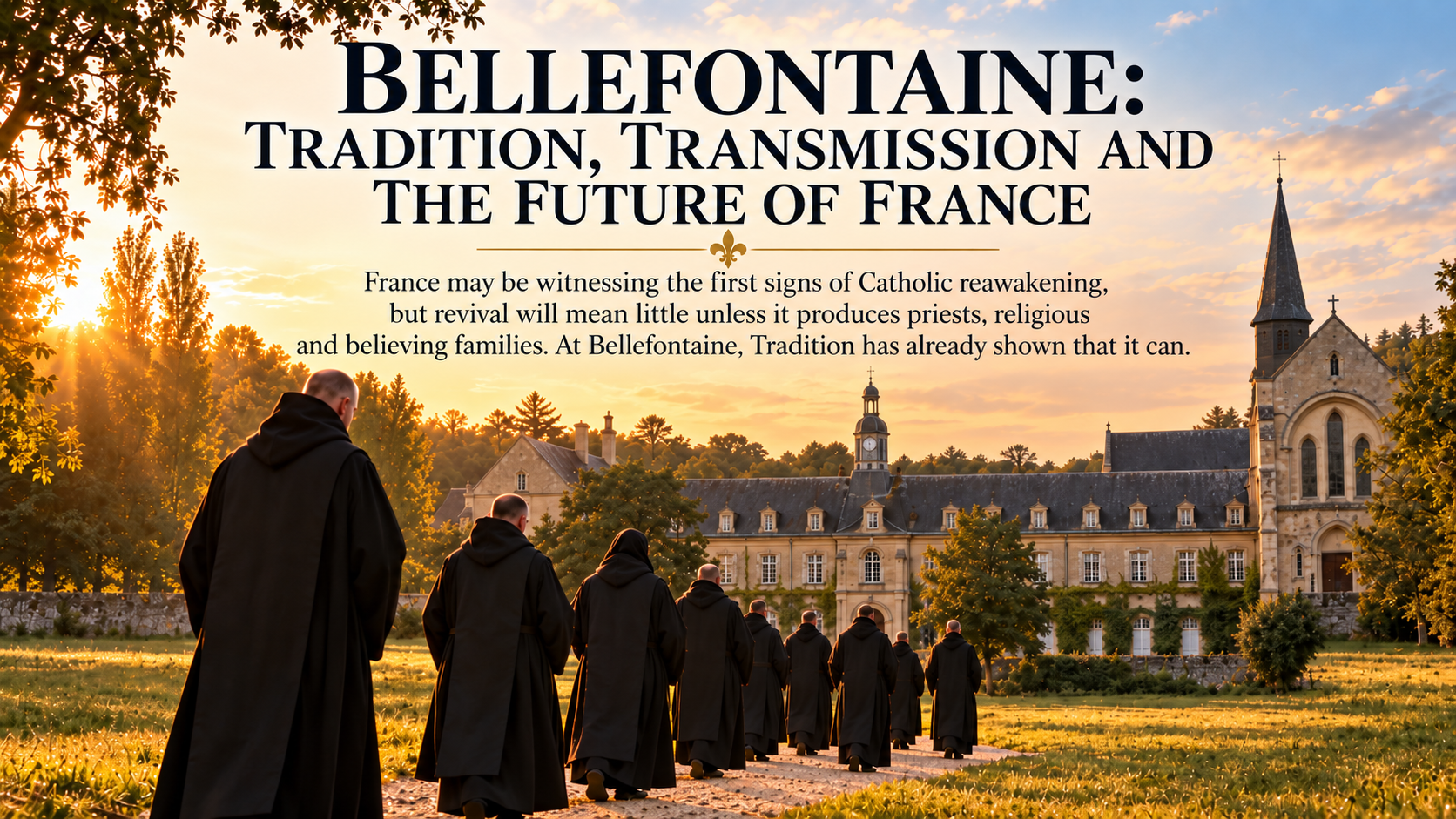
The arrival of twelve monks from Le Barroux at the ancient Abbey of Bellefontaine is more than an attractive story of Catholic continuity. It brings into unusually sharp focus the crisis of transmission in the French Church: an ageing community, no longer capable of replacing itself, has handed its monastery to monks formed by precisely the traditional liturgy and religious observance which an earlier generation considered unsuited to modernity. The wider figures are no less striking. Of the twenty-three French contemplative monasteries in a recent study whose Office remained exclusively in Latin, not one closed, while substantial losses occurred among houses using the vernacular. With adult conversions rising rapidly, immense crowds gathering around Pope Leo XIV and tentative growth in priestly discernment, France may have been given another opportunity for Catholic renewal. Bellefontaine suggests that the Church will squander it if she does not recover the Tradition which still knows how to produce heirs.
In 1305, Bertrand de Got, Archbishop of Bordeaux, was staying at the Abbey of Bellefontaine in Anjou when word arrived that the cardinals assembled at Perugia had elected him Pope. He took the name Clement V, and his pontificate would become inseparable from the beginning of the Avignon period. Bellefontaine preserves an intimate memorial of the connection in the venerable statue of the Blessed Virgin traditionally associated with Clement’s gratitude to the monastery. More than seven centuries later Notre-Dame de Bellefontaine remains in the abbey church, looking upon another moment when the survival of monastic life there depended upon whether the inheritance could pass from one generation to another.¹
On 11 July 2026, the feast of Saint Benedict, twelve monks from Sainte-Madeleine du Barroux were formally installed at Bellefontaine. They succeeded a Trappist community whose members, after generations of fidelity, had become too few and too elderly to sustain the enormous monastery and its estate. The transfer was conducted with admirable generosity, and the Trappists deserve gratitude for ensuring that the house remained a monastery rather than becoming another secularised fragment of France’s Catholic patrimony. Yet the dignity of their departure should not obscure what the arrival of their successors means: one community had reached the end of its demographic ability to continue, while another possessed twelve monks whom it could send to begin again.²
That is the real significance of Bellefontaine. The story is not primarily about conserving an ancient building, preserving a statue or maintaining a picturesque continuity with medieval France; it is about transmission. A monastery remains alive only when there are monks to inhabit it, and a religious tradition remains alive only when one generation considers what it has received sufficiently compelling to hand it to another. Bellefontaine survived as a monastery because Le Barroux had produced heirs.
The provenance of those heirs cannot be incidental to the story. Dom Gérard Calvet began the community which became Le Barroux in 1970, amid the upheaval of post-conciliar religious life, deliberately undertaking what the abbey itself describes as an “experience of tradition”: prayer, silence, manual work, the Latin Office and the traditional liturgy. Today its offices are still sung in Latin and Gregorian chant and its Masses celebrated according to the traditional Roman rite.³ Whatever judgement one makes about the ecclesiastical controversies which accompanied Dom Gérard’s foundation, the practical result is difficult to dispute. The experiment in Tradition did not merely survive; it became sufficiently fecund to found, expand and eventually send twelve monks to another monastery.
That matters because France is not suffering from a shortage of monastic buildings. It is suffering from a shortage of monks and nuns willing to live in them. Sociologist Isabelle Jonveaux’s study of French contemplative life found that ninety-one monasteries among those recorded at the beginning of her survey period had closed or announced their closure by 2026. Nearly one contemplative house in three had disappeared in fewer than twenty years, while the pace of closure had accelerated as communities aged beyond the point at which their shrinking numbers could sustain houses built for a very different religious age.⁴
The liturgical figures within that research are particularly difficult to dismiss. Among monasteries where the Office was celebrated in French, 34 per cent had closed; among those using both French and Latin, the figure was 19 per cent. Of the twenty-three houses whose Office remained exclusively in Latin, not one had closed. The closure rate in that group was zero.⁴
There is an important distinction to preserve here. The study classified houses according to the language of the Office rather than conducting a census of every feature by which a community might be described as Traditionalist, and the use of Latin cannot by itself be treated as a mechanism which manufactures vocations. Yet precision about the category makes the finding more, not less, worthy of attention. An exclusively Latin Office normally belongs to a wider culture of Gregorian chant, inherited liturgical form, stronger continuity of observance, visible religious identity and the conviction that the monastery receives a way of life which is not perpetually remade according to contemporary taste. Within the French cohort actually studied, those houses survived while substantial proportions of the more thoroughly vernacularised monastic world disappeared.⁴
Nuntiatoria drew attention to this contrast in July because the figures appeared to confirm what individual closures had already begun to suggest. La Grande Trappe, Compiègne, Port-du-Salut, Nevers and other houses were not being emptied by anticlerical officials or revolutionary confiscation. They were reaching the end because new generations were not arriving in sufficient numbers to replace those who had grown old. The fundamental problem was therefore not property but transmission, and once that is understood the preservation of the building can no longer be confused with the survival of the life for which the building exists.⁵
The same problem lay behind our earlier consideration of “Christianity without contrast”. A religious vocation is an extraordinarily demanding proposition. It asks a man or woman to surrender marriage, property, ordinary independence and a great measure of personal choice in order to live poverty, chastity and obedience within an objective rule of life. Such renunciation remains intelligible when God is presented as worth everything; it becomes less intelligible as the visible and ascetical difference between consecrated life and ordinary secular existence is progressively reduced.⁶
Much of the post-conciliar reform of religious life was driven by a sincere desire to remove obstacles thought to prevent modern men and women from understanding the vocation. Habits were modified or abandoned, enclosure weakened, ascetical customs relaxed, inherited ceremonial simplified, the vernacular displaced Latin, and the older language of mortification, sacrifice and separation from the world often yielded to categories of community, personal development, pastoral activity and social engagement. The intention was renewal through adaptation. After sixty years, however, the extraordinary ageing and disappearance of communities formed within that settlement oblige the Church to ask whether adaptation succeeded in the one area without which no religious institute has a future: attracting successors.
Le Barroux tested a different proposition. It did not assume that the traditional form of Benedictine life had become incomprehensible simply because contemporary culture had changed. It offered prayer, silence, obedience, stability, Gregorian chant, Latin worship and the discipline of the Rule without pretending that their demands could be made easy. The young men who accepted that proposition grew up in the same secular France which is invoked to explain the decline elsewhere. They are not refugees from the 1950s but Europeans formed amid modernity, and their existence therefore makes it difficult to maintain that modernity itself renders strong traditional observance impossible.
Bellefontaine gives the comparison unusual clarity because the two trajectories meet in the same monastery. The old community had reached a point at which fidelity alone could not compensate for the absence of successors; the monks themselves recognised the problem and sought a community capable of carrying the life forward. Le Barroux could answer because it had men to send. There is no need to disparage those who left in order to recognise the significance of those who arrived.
The lesson reaches beyond monasteries. The Church does not survive through institutional continuity alone. A diocese can merge parishes, a religious institute can consolidate properties and a bishops’ conference can devise ever more sophisticated plans for administering scarcity, but none of these things replaces the Christian act of transmission. Catholicism has a future only when priests are followed by priests, religious by religious, and believing parents by believing children who themselves become capable of transmitting the Faith.
Seen in that light, Tradition is no longer merely an internal question about whether Catholics attached to older liturgical forms should be accommodated. The more consequential question is whether the Church can afford to marginalise one of the few religious cultures in contemporary Western Catholicism which is repeatedly showing an ability to create successors. Bellefontaine is important because it turns that question from theory into something one can see: twelve monks walking into a house which would otherwise have ceased to function as a monastery.
The timing is especially important because the French religious story in 2026 is no longer wholly one of decline. At Easter, 13,234 adults were baptised into the Catholic Church in France, compared with 4,124 in 2016. More than 8,100 adolescent catechumens were also recorded, and 42 per cent of the adult catechumens were aged between eighteen and twenty-five.⁷ These figures do not undo the enormous losses in infant baptism, Catholic marriage, priestly numbers or regular practice, but they do demonstrate that the generation raised most completely within secular France has not lost the capacity for religious conversion.
Pope Leo XIV’s September visit made the same unexpected phenomenon publicly visible. Around 80,000 young people filled the Stade de France for the vigil, while the Vatican estimated attendance at the great Paris Mass at approximately 800,000.⁸ There were sound reasons for the Pope himself to warn against being “naively optimistic”: a spectacular papal occasion cannot be equated with the return of ordinary Sunday observance, and emotional enthusiasm is not yet conversion. Nevertheless, a Church which wishes to evangelise cannot be indifferent when hundreds of thousands gather publicly for Catholic worship in the capital of a country which has spent generations defining itself through laïcité.
There is even tentative evidence that the movement towards conversion may begin to produce vocations. Entries into the French propaedeutic year preceding formal seminary formation rose from ninety-nine in 2023 to 110 in 2024 and 146 in 2025, an increase of almost half in two years. Those responsible for formation have reported the appearance of young converts and reverts among those knocking at their doors.⁹ These figures remain small beside France’s historical priestly strength and they have not yet worked through into a substantial rise in ordinations, but after decades of almost uninterrupted contraction a reversal at the point of entry deserves attention.
France may therefore have been given something which scarcely seemed imaginable during the worst years of collapse: another opportunity. The conversions are real, the vocational enquiries are real and the enormous papal crowds are real, even if nobody yet knows whether they represent the beginnings of lasting restoration. What happens to those people after their first enthusiasm will decide far more than the statistics recorded in 2026.
Pope Leo recognised part of the problem when he met catechumens and the newly baptised in Paris. He warned against the “post-baptismal emptiness” which can follow conversion when the newly received Catholic is insufficiently incorporated into the continuing life of the Church, and he called for comprehensive formation and genuine integration into Christian worship and community.¹⁰ His concern is unquestionably justified. The more difficult question is whether the prevailing ecclesiastical culture in France is prepared to consider that its own liturgical assumptions may be part of the problem which such formation must overcome.
A young convert must indeed be initiated into the liturgical life of the Church, but that formulation immediately raises the question of what liturgical life he will normally be shown. If his initiation means little more than absorption into the conventional post-conciliar parish culture of the Novus Ordo Missae, then the Church is entitled to ask whether she is attempting to consolidate new growth within the same religious environment in which so much previous growth disappeared. That is not an argument about the validity of the reformed rite, nor does it deny that it can be celebrated with genuine dignity and reverence. It is an argument about demonstrated pastoral fruit.
The reform was presented in part as a means of making worship more accessible and intelligible to modern man, yet the decades in which it became virtually universal in France coincided with an unprecedented withdrawal of modern man from Catholic worship. Religious life was reshaped to engage contemporary culture while houses emptied; seminaries were reconfigured while vocations collapsed; parish worship became linguistically and ceremonially more accessible while regular practice fell to a fraction of its former level. No responsible historian would pretend that liturgical reform alone caused that collapse, but neither is it credible to insist that the liturgical culture within which the collapse occurred is beyond examination.
The present generation makes that examination more urgent because many of those approaching the Church do not appear to be asking Catholicism to resemble the culture they already possess. Contemporary France provides abundant informality, personal autonomy, therapeutic vocabulary, political activism, entertainment and self-expression. What it does not readily provide is sacred order, transcendence, silence, authoritative moral teaching, inherited ritual or the experience of belonging to something which existed before the individual and makes claims upon him. These are precisely the things which the older Catholic tradition communicates most naturally.
If a young man encounters Catholicism because he has begun to perceive the priesthood as sacrifice, it matters whether the worship into which he is formed sustains that perception. If a young woman contemplates religious life because she seeks radical consecration, it matters whether the religious community presented to her is visibly and objectively different from secular professional existence. If a convert discovers the old Mass, Gregorian chant, the Divine Office, fasting, traditional devotions and the saints, it matters whether his pastors recognise those discoveries as gateways into Catholic depth or treat them as warning signs of an unhealthy attachment to the past.
The connection with Bellefontaine should by now be obvious. Le Barroux has not generated vocations by suppressing the contrast between monastic life and modern life but by making that contrast meaningful. Its liturgical inheritance teaches the monk that worship is received rather than invented, that the sacred is not constructed around his personality and that sacrifice stands at the centre of Christian existence. Those lessons prepare the imagination for a vocation in which the individual quite literally gives his life away.
This is the importance of liturgy to the vocational argument. Latin and Gregorian chant do not cast a spell upon young men, nor does the traditional rite provide an automatic solution to secularisation. Rather, a stable, hieratic and sacrificial liturgy creates a world within which stable, hierarchical and sacrificial commitments are intelligible. The priest at the altar, the monk in choir and the religious under a Rule are not accidental products of Catholic worship; the way the Church worships helps form the kind of lives Catholics can imagine offering to God.
The Jonveaux figures therefore deserve more than a passing footnote in discussions about the future of French religious life. Of the houses she examined, those retaining the exclusively Latin Office recorded no closures at all, while the vernacular categories suffered substantial losses.⁴ The correct response is neither to turn that finding into an extravagant universal law nor to bury it beneath qualifications until it says nothing. It is to acknowledge that the strongest liturgical continuity in the study coincided with the strongest institutional survival and then to investigate seriously why.
Bellefontaine supplies one answer. Le Barroux did not inherit the monastery because someone in an ecclesiastical office preferred old vestments; it inherited Bellefontaine because it possessed monks. The question the French Church should ask is therefore not simply why some young Catholics happen to like Traditional worship, but what kind of Catholic culture forms men capable of entering a monastery, remaining there and eventually becoming numerous enough to found elsewhere.
That question also alters the significance of restrictions upon the traditional Roman liturgy. Traditionis custodes and its implementation have commonly treated attachment to the older rite as a difficulty to be contained in the interests of a presumed future liturgical unity. Yet a Church losing priests, religious and practising faithful has to consider whether suppressing one of the few Catholic environments displaying conspicuous intergenerational vitality is really a policy suited to that future. If the young are discovering Tradition at the same moment that ecclesiastical authority attempts to make access to it more difficult, pastoral policy may find itself working against the very renewal for which Church leaders publicly give thanks.
The familiar accusation of nostalgia has become particularly inadequate. A French Catholic born in 2004 cannot nostalgically remember the Church before the Council, because he never knew it. If he discovers the traditional Roman Mass, the old Office or a monastery such as Le Barroux, he is encountering something new to him even though it is old in itself. The phenomenon is not the refusal of an elderly generation to let go of its childhood but the decision of a younger generation to claim an inheritance which was not part of its childhood at all.
This is where the Traditionalist argument should be stated without embarrassment. The Church needs Tradition. She does not need it because every post-conciliar initiative was worthless, because every Traditional community is perfect, or because changing liturgical books tomorrow would miraculously reverse sixty years of secularisation. She needs it because the Church cannot exist without transmission, and the worship, doctrine, asceticism and disciplined continuity preserved within Tradition provide an ecclesial environment in which transmission demonstrably continues to occur.
The distinction is important. Tradition is not merely one spirituality among several which enriches an otherwise self-sufficient post-conciliar Church. It contains the memory of what priesthood, sacrifice, consecration, hierarchy, asceticism and sacred worship mean when they are not continually translated into categories borrowed from the surrounding age. As those concepts become less intelligible elsewhere, the places which preserved them become increasingly important not merely to Traditionalists but to the survival of recognisably Catholic life.
France now provides an unusual test. The institutional Church has thousands of new Catholics entering through the baptistery and a tentative increase in young men approaching priestly formation. It has just witnessed crowds around the Pope on a scale which contradicted easy assumptions about the disappearance of Catholic identity. None of this guarantees revival, but it does mean that the question has changed. The Church is no longer only asking how to administer decline; she must decide what to do with unexpected growth.
The wrong answer would be to assume that the ecclesiastical culture formed during the decades of decline requires no reconsideration. If the converts of 2026 are given the same thin catechesis, the same embarrassed relationship with inherited Catholic discipline and the same liturgical assumptions under which previous generations ceased practising, a genuine awakening may still disappear. The Church could congratulate herself upon an extraordinary year of baptismal statistics and discover a decade later that the people represented by those statistics had largely gone.
The better course is already visible at Bellefontaine. Renewal there did not require another theory about adapting the monastery to contemporary expectations. It required monks who believed sufficiently in the received form of Benedictine life to live it. The monastery was renewed because Tradition had generated men capable of receiving an inheritance and continuing it.
There is no reason for a Traditionalist journal to conceal the conclusion behind an artificial neutrality. Objectivity requires that the figures be stated accurately and their limitations respected; it does not require pretending that contrary outcomes are equivalent. In the French study, the houses with an exclusively Latin Office suffered no closures. In the wider landscape, ninety-one contemplative monasteries disappeared or announced their closure. At Bellefontaine, the community which supplied the future came from a monastery explicitly founded to preserve traditional liturgy and traditional monastic life.³ ⁴
Those facts do not permit us to declare every question settled, but they certainly permit us to ask why an ecclesiastical establishment anxious about the future continues to regard Tradition principally as a difficulty inherited from the past. If the strongest surviving forms of religious life are precisely those which maintained features abandoned elsewhere, then recovery rather than further abandonment ought at least to be considered. When an institution faces extinction, it is a strange form of prudence which refuses to learn from those who are not becoming extinct.
The same principle applies to the new French conversions. Thirteen thousand adult baptisms will matter historically only if those Catholics remain Catholic, raise Catholic families, enter seminaries and convents, teach the Faith to others and one day bury a generation of present churchmen knowing that the Faith entrusted to them has not died with them. That is how revival becomes Tradition: what has been received becomes something which can again be handed on.
Bellefontaine is consequently more than an encouraging footnote to the French Catholic crisis. Its old stones contain the entire question. An ageing community reached the end of its capacity to continue, and another generation entered the cloister because somewhere else Tradition had successfully formed it. The Church cannot guarantee her future by preserving buildings or by celebrating temporary increases in religious interest; she must create the conditions in which people become willing to surrender their lives to what she teaches.
That is why Bellefontaine should trouble as much as it encourages. It demonstrates that decline is not simply imposed upon Catholicism by an irresistible secular age, because men formed within that same age are still willing to become monks when Catholic life is presented to them whole. It suggests that the question is not only why contemporary society produces fewer vocations, but why certain forms of Catholicism continue to produce them nonetheless.
France may now have another chance to find out. If the thousands appearing at the font are met with the fullness of Catholic Tradition — doctrinally, morally, liturgically and ascetically — the present stirrings may yet become priests, religious, families and communities capable of rebuilding what has been lost. If they are instead assimilated without reflection into the same post-conciliar culture which accompanied the great retreat, the Church may eventually discover that she was given a revival and did not know how to keep it.
Beneath the gaze of the Virgin associated with Clement V, the monks at Bellefontaine have already supplied a simpler answer. Catholic inheritance survives when it becomes strong enough in one generation to command the allegiance of the next. The Church does not merely need Tradition because Tradition is beautiful, venerable or historically hers; she needs it because without transmission she has no future, and Bellefontaine shows, with unusual clarity, where transmission is still taking place.
- Abbaye du Barroux, Chronique de l’abbaye Notre-Dame de Bellefontaine : 11 juillet 2026.
- Diocèse d’Angers, L’abbaye de Bellefontaine accueille les moines du Barroux.
- Abbaye du Barroux, L’histoire du monastère.
- La Vie, « Il y a une accélération des fermetures de monastères » : une étude inédite dresse un état des lieux pour la France.
- Nuntiatoria, Ninety-One Monasteries Closed: The Liturgical Divide in France’s Vocational Collapse.
- Nuntiatoria, Christianity Without Contrast: Vocational Decline in the West and the Adoption of the Zeitgeist.
- Conférence des évêques de France, Enquête du catéchuménat 2026 : les baptêmes adultes et adolescents en chiffres.
- Reuters, Hundreds of thousands in Paris cheer Pope Leo in largest event of French tour.
- Cath.ch, Regain des séminaires en France, chute des étudiants en théologie en Allemagne.
- Pope Leo XIV, Meeting with the Members of the Provincial Synodal Assembly, Catechumens and Newly Baptized, 26 September 2026.






Leave a Reply