
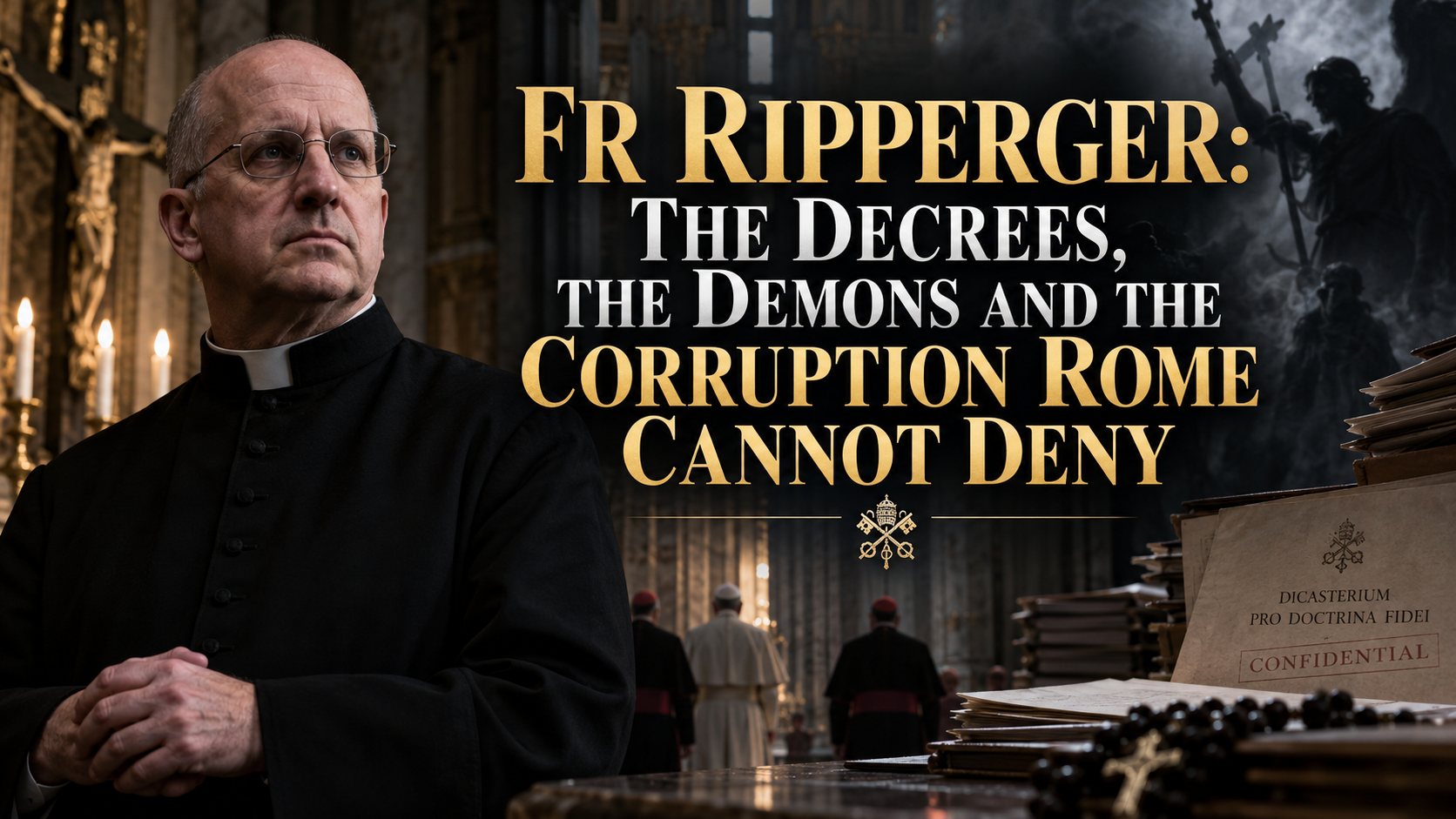
The Exorcists’ Warnings, the Evidence of Ecclesiastical Corruption and the Questions Denver Has Yet to Answer
New testimony suggests that Fr Chad Ripperger’s withdrawal from public speaking may concern his defence of traditional Catholic teaching on marriage and the family, while a former diocesan official disputes Denver’s account of the arrangement as voluntary. These developments follow reports of earlier restrictions concerning his public teaching and renewed attention to his warnings about corruption within the Church. From Malachi Martin and Fr Gabriele Amorth to the Boston Globe investigation and the Vatican’s McCarrick Report, the historical record establishes grave ecclesiastical wrongdoing. The question is how the Church should assess further testimony, enforce its own discipline and exercise episcopal authority in the service of truth.
The controversy surrounding Fr Chad Ripperger has exposed a disturbing contradiction in contemporary ecclesiastical life. An experienced exorcist alleges that serious moral corruption has penetrated influential levels of the Catholic hierarchy, and much of the ensuing discussion concerns whether information attributed to demons can be believed. Yet the Church has already spent more than two decades confronting documentary evidence of priests committing grave offences, bishops concealing allegations and ecclesiastical authorities failing to protect the innocent. That corruption does not depend upon the credibility of an exorcist. It has been established by investigations, judicial proceedings, institutional records and the Holy See itself. The more consequential question raised by Fr Ripperger is whether the full extent of that corruption, including its possible organisation and supernatural dimensions, has ever been adequately examined.
The immediate controversy began when the Archdiocese of Denver announced on 19 October 2026 that Archbishop James Golka had requested Fr Ripperger to undertake a year-long withdrawal from public speaking and interviews. The stated purpose was to allow him to concentrate upon the Society of the Most Sorrowful Mother and those whom it serves. According to Denver, the priest readily agreed, and the arrangement will be reviewed after a year. The Archdiocese thanked him for his priestly service and exorcism ministry, subsequently confirming that he remained in good standing. No published decree establishes that Fr Ripperger has incurred canonical suspension, lost his faculties or been forbidden to offer Mass. Nevertheless, the interruption of an internationally recognised teaching apostolate is substantial, and the generality of the official explanation has invited questions which subsequent developments have made increasingly difficult to dismiss.¹
On 22 October, Catholic author and podcaster Timothy Gordon publicly claimed that Fr Ripperger had personally identified a principal reason for the intervention. Gordon wrote: “Fr. Ripperger told me directly that the main ideological reason they offered him was his view of women/marriage/family”. He connected the controversy with the priest’s contribution to What a Woman Is, a documentary examining feminism, patriarchy and the traditional Christian understanding of marriage. This is attributable testimony from a named commentator claiming direct knowledge of a conversation with Fr Ripperger. It is not an anonymous rumour, but neither is it an independently established account of Archbishop Golka’s motives. Fr Ripperger has not publicly confirmed Gordon’s explanation, and Denver has not identified the documentary or the priest’s teaching on marriage as the reason for the withdrawal.²
Gordon’s allegation nevertheless acquires additional significance from correspondence reported independently by Mike Lewis of Where Peter Is. Lewis describes a response dated 3 June 2026 from an employee of Denver’s office for clergy acknowledging complaints about Fr Ripperger’s statements concerning women and marriage. The reply indicated that the Archdiocese was examining the concerns and intended to address them with the priest. If accurately reported, this correspondence establishes that such complaints had reached diocesan authorities months before the October announcement. It does not establish that they caused the subsequent restriction. The distinction is important, but so is the chronology: Gordon’s explanation now corresponds to an identifiable subject of earlier diocesan scrutiny.³
The matter is theologically consequential because the disputed teaching concerns an inheritance which cannot simply be dismissed as a personal eccentricity. Catholic doctrine has historically defended the complementary duties of husband and wife, the husband’s responsibility for the good government of the family, the wife’s corresponding obligations, and the mutual charity without which domestic authority degenerates into domination. Pius XI’s Casti Connubii defended the ordered character of Christian marriage while insisting upon the dignity of both spouses and the duties of love and justice incumbent upon the husband. These principles cannot legitimately be discarded merely because contemporary culture finds them unfashionable. Equally, not every personal formulation of patriarchal authority automatically possesses the authority of Catholic doctrine. A bishop may correct theological error or imprudent expression. But if traditional teaching on marriage has contributed to the restriction of a priest’s ministry, the faithful may reasonably ask what particular statements were judged objectionable and by what doctrinal standard.⁴
A separate challenge to Denver’s explanation emerged the same day. Mgr Ricardo Coronado-Arrascue, formerly judicial vicar and chancellor of the Diocese of Colorado Springs under Bishop Golka, disputed the characterisation of Fr Ripperger’s withdrawal as voluntary. Interviewed by John-Henry Westen, Coronado described his own contested departure from diocesan office and alleged that Golka had portrayed it as mutually agreeable despite the circumstances being otherwise. Applying that experience to Fr Ripperger, he declared: “I can promise you that it wasn’t Father’s wish.” His account of his own dealings with Golka is personal testimony concerning a disputed administrative history. His conclusion about Fr Ripperger’s private meeting is a further inference, not independent proof of what occurred. Nevertheless, it raises a serious question about the language employed when episcopal requests carry the practical weight of hierarchical authority.⁵
A priest’s relationship with his Ordinary is not an agreement between parties possessing equal authority. Canon 273 establishes an obligation of clerical reverence and obedience; other canons regulate preaching, faculties and ecclesiastical discipline. A priest may willingly accept a decision because he recognises his duty of obedience, even where he would not independently have chosen the course requested. Conversely, a bishop’s possession of authority does not establish that pressure was improperly applied. Consent, obedience and compulsion are not interchangeable categories. Denver’s statement establishes its official account of the arrangement. Coronado’s allegation questions the degree of voluntariness involved. Neither removes the need to distinguish lawful episcopal direction from the prudent exercise of that direction.⁶
There is a further complication. On 20 October, Mike Lewis reported obtaining correspondence showing that Archbishop Samuel Aquila had investigated Fr Ripperger’s statements concerning psychiatric illness and medication during 2025. The letters reportedly describe interim restrictions and a formal decree issued in August requiring professional disclaimers, consultation with qualified specialists and limitations upon statements extending beyond the priest’s competence. The decree itself has not been published, and Denver has not confirmed whether those requirements remain operative or influenced Archbishop Golka’s present decision. Such concerns, if substantiated, would belong to the legitimate responsibilities of episcopal supervision. The traditional Roman Ritual itself warns exorcists against presuming possession too readily and requires discernment between extraordinary spiritual affliction and natural illness. But an earlier intervention concerning medical assertions does not automatically justify a general withdrawal from unrelated theological instruction.³
The latest developments therefore present several possible explanations for the present restriction: concerns about psychiatric statements, objections concerning marriage and feminism, the demands of Fr Ripperger’s public engagements, or the responsibilities of his priestly Society. More than one consideration may have been involved. None has been established as the decisive cause. The obligation of responsible commentary is not to manufacture a complete explanation from incomplete evidence. It is to identify what is known, examine the significance of the reported testimony, and ask why an intervention with substantial public consequences has received so little explanation concerning its actual grounds.
Behind this immediate controversy lies Fr Ripperger’s more serious testimony concerning ecclesiastical corruption. During his appearance on the Shawn Ryan Show, released on 5 March 2026, he described information allegedly disclosed during exorcisms concerning wrongdoing among influential churchmen. He spoke of “very specific rituals and crimes” attributed to members of the hierarchy, maintaining that details had emerged concerning particular persons and activities. His recorded interview establishes that he made these claims. The guilt of any person allegedly implicated cannot be established through the interview alone. But it would misrepresent Fr Ripperger’s account to portray him as merely speculating that ecclesiastical figures might occasionally succumb to temptation. He was alleging the existence of particular wrongdoing which he believed had become known through repeated extraordinary manifestations.⁷
Importantly, Fr Ripperger did not present himself as the sole witness. He added: “And it’s not just me.” He maintained that other exorcists had encountered comparable disclosures, including references to particular persons, and expressly named Fr Gabriele Amorth, the former exorcist of the Diocese of Rome, as someone who had complained of similar concerns. He also described the experience of another senior Roman exorcist whose identity he declined to disclose. The evidential distinction is straightforward. Fr Ripperger’s account of his own experiences constitutes direct testimony; his report concerning the unnamed priest remains second-hand. Fr Amorth’s published statements independently establish that he himself expressed concerns about demonic influence within ecclesiastical circles. Those sources differ in weight, but their convergence as testimony merits consideration rather than summary dismissal.⁷
Fr Ripperger also maintained that the disclosures were unsolicited. His explanation was that “the demons are compelled sometimes by our Lord to talk about this stuff”. That is his theological interpretation of what occurred, not an independently established judgement about the origin or truthfulness of the manifestations. Nevertheless, the distinction between deliberately interrogating demons about hidden matters and encountering apparently spontaneous disclosures during legitimate exorcism is relevant to the Church’s traditional discipline. The Roman Ritual warns against curiosity and unnecessary questioning. It also recognises extraordinary knowledge among possible manifestations requiring discernment. Catholics are not obliged to assume that every reported disclosure is truthful; neither does Catholic doctrine require the a priori dismissal of every extraordinary experience.⁷
The existence of Satan and the fallen angels belongs to the deposit of Faith. The Gospels present Our Lord’s authority over demons as a reality of His divine mission, and the Church has maintained exorcism precisely because she recognises extraordinary spiritual affliction. This theological foundation is not negotiable. Yet the certainty of the doctrine does not confer certainty upon every individual interpretation. An exorcist may accurately report an experience while remaining mistaken about its significance. A manifestation may contain genuine information alongside deception. The ordinary demands of investigation remain necessary when allegations concern identifiable persons. The supernatural origin claimed for a statement neither invalidates it automatically nor transforms it into a judicial finding.
Fr Gabriele Amorth’s testimony is particularly relevant. In March 2010, the experienced Roman exorcist publicly alleged that satanic influence had reached ecclesiastical circles, including influential positions within the Vatican. Contemporary reporting attributed to him more particular allegations concerning occult associations. Those were statements made by a named priest, not findings reached by an ecclesiastical tribunal. Other exorcists questioned whether the evidence justified every conclusion he drew. Nevertheless, Amorth’s testimony demonstrates that concerns about grave spiritual corruption were not peculiar to Fr Ripperger or invented after the present dispute.⁸
Amorth made an important distinction in a CNN interview on 16 March 2010. Discussing the clerical abuse scandals, he explained that the devil tempts individuals throughout society, particularly those occupying positions of religious authority. He nevertheless cautioned against equating sexual offending with extraordinary demonic possession. Such offenders remained responsible for their conduct and required genuine conversion, confession and repentance. This distinction preserves both the supernatural character of temptation and the moral culpability of the sinner. The existence of demonic influence does not excuse human wickedness; nor does the presence of ordinary human motives exclude a spiritual dimension to grave ecclesiastical wrongdoing.⁸
Warnings concerning the spiritual corruption of ecclesiastical institutions predate these interviews by decades. Malachi Martin, the Irish-born Catholic priest and author, raised such concerns through his writings and public appearances. His Hostage to the Devil, published in 1976, introduced accounts of possession and exorcism to a broad readership. His 1996 novel Windswept House portrayed occult activity and attempts at internal ecclesiastical subversion, while Martin subsequently claimed that aspects of his fiction reflected persons and circumstances known to him. Those assertions constitute attributable testimony; the novel itself remains fiction and cannot establish that its depicted events occurred. Yet Martin’s warnings were articulated before the investigations which subsequently exposed the scale of clerical abuse and institutional concealment. Their historical significance lies in that chronology, not in the assumption that later scandals retrospectively prove every extraordinary allegation.⁹
The decisive change in public understanding came through documentary investigation rather than exorcism. On 6 January 2002, the Boston Globe published the results of its Spotlight investigation into allegations against Fr John Geoghan and the response of the Archdiocese of Boston. Internal correspondence, civil proceedings and testimony demonstrated that serious allegations had been known to ecclesiastical authorities while accused priests continued to receive assignments or access to children. The evidence exposed not merely individual offending, but administrative decisions which contributed to the continuation of abuse. This was investigative journalism founded upon records capable of independent scrutiny. It established that institutional concealment was not simply an accusation advanced by critics of the hierarchy.¹⁰
The John Jay College study commissioned by the American bishops subsequently identified allegations not withdrawn or established as false against 4,392 priests during the period 1950–2002, involving approximately 10,667 reported victims. These figures derived from institutional surveys and do not represent equivalent numbers of criminal convictions or canonical judgements. Nevertheless, they demonstrated the extraordinary scale and geographical extent of recorded allegations. The Dublin Commission of Investigation subsequently documented serious failures in the management of abuse allegations within the Irish Church, while the Pennsylvania grand jury, reporting in August 2018 after examining extensive diocesan records, identified credible allegations concerning more than three hundred priests and over one thousand victims. These investigations possessed different legal standing, but their documentary findings established recurrent patterns of institutional failure which could no longer be dismissed as isolated administrative mistakes.¹¹
The case of Theodore McCarrick demonstrated that grave personal misconduct had reached the highest levels of ecclesiastical influence. In February 2019, the Congregation for the Doctrine of the Faith announced that a canonical penal process had found the former cardinal guilty of solicitation in confession and offences against the Sixth Commandment involving minors and adults, aggravated by abuse of power. His appeal was rejected, and dismissal from the clerical state became definitive. This was a formal ecclesiastical judgement establishing specified offences, not another allegation awaiting investigation.¹²
The Holy See’s McCarrick Report, published on 10 November 2020, examined what ecclesiastical authorities knew, how warnings were communicated and how decisions concerning McCarrick’s advancement and continued influence were made. Drawing upon Vatican, nunciature and diocesan records, together with extensive witness testimony, it documented serious failures in communication, discernment and the handling of concerns. The report also recorded contradictory information and assurances upon which authorities had relied. It was an official historical and administrative investigation, not a further penal judgement establishing every allegation it discussed. Together with the canonical conviction, however, it supplied authoritative evidence that grave misconduct and failures of governance had reached senior levels of the Church.¹³
This history provides the indispensable context for Fr Ripperger’s testimony. When he maintains that morally compromised men have occupied positions of ecclesiastical influence, the general proposition has already been established. When he suggests that institutional loyalty and personal influence may conceal wrongdoing, documented investigations provide examples of precisely that phenomenon. None of these findings establishes that particular churchmen participated in occult rituals or organised satanic associations. What they establish is that the environment of profound corruption and concealment within which Fr Ripperger situates his allegations is historically real. The distinction between documented wrongdoing and further allegations of occult activity must be maintained without pretending that the former has no bearing upon the plausibility of concealed misconduct.
His additional contention concerning deliberate infiltration is a separate historical question. Fr Ripperger has suggested that persons associated with Communism, Freemasonry and Satanism entered ecclesiastical institutions during the decades preceding the Second Vatican Council with intentions hostile to the Church. Such a claim requires evidence of identifiable persons, organisational relationships, deliberate purposes and corresponding actions. The documented hostility of Communist regimes to Catholicism and the Church’s longstanding condemnation of Freemasonry establish the existence of organised ideological opposition. They do not, by themselves, establish the particular infiltration campaign described. But neither can investigations principally concerned with abuse and safeguarding be expected to resolve the entire history of ideological penetration into ecclesiastical institutions. The hypothesis requires its own evidential examination.
Fr Ripperger cited a Vatican instruction issued around 1960 as evidence of Rome’s concern about the suitability of candidates for religious life and Holy Orders. The document was Religiosorum Institutio, issued by the Sacred Congregation for Religious on 2 February 1961 with the approval of John XXIII. It prescribed detailed requirements concerning chastity, moral suitability, psychological fitness, vocational discernment and the responsibilities of religious superiors. Its purpose was not to identify clandestine organisations, but to establish disciplinary standards governing admission and formation. Its significance is that Rome considered deficiencies in vocational discernment sufficiently serious to require an authoritative and binding intervention.¹⁴
The instruction’s subsequent juridical status requires precision. It belonged to the legislative framework preceding the revised Code of Canon Law promulgated in 1983. Canon 6 governs the abrogation of earlier legislation, while canon 34 addresses the juridical force of instructions, including their cessation where the laws which they implement cease. Later reforms altered the discipline of religious formation. No express decree wholly abrogating Religiosorum Institutio has been established in the materials examined, but that absence does not demonstrate that every individual provision remains independently enforceable. Express repeal, juridical supersession and continuity of substantive principles are distinct questions. The continuing legal force of a particular provision must be determined through its relationship to subsequent law, not assumed merely because the original instruction has never disappeared from historical circulation.¹⁵
What can be established is that Rome did not abandon the underlying restrictive principles concerning admission to Holy Orders. In 2005, the Congregation for Catholic Education, with the approval of Benedict XVI, issued an instruction specifying criteria concerning candidates with homosexual tendencies, including particular exclusions from seminary admission and ordination. An April 2008 rescript expressly clarified that those requirements applied to all houses of priestly formation, including those under dicasteries responsible for religious institutes. The Ratio Fundamentalis Institutionis Sacerdotalis promulgated in December 2016 reaffirmed the relevant criteria. These were subsequent authoritative norms within the revised canonical order, not remnants of a discipline simply discarded after Vatican II.¹⁶
Their existence makes the question of enforcement more urgent. Did bishops, rectors and religious superiors consistently observe the standards prescribed by Rome? Were credible warnings investigated? Where failures occurred, were they the result of negligence, institutional loyalty, deliberate concealment or organised ideological influence? Each explanation requires its own evidence. The existence of legislation establishes what ecclesiastical authorities prescribed, not how consistently they obeyed it. Nor should homosexual attraction, misconduct involving adults, abuse of power and offences against minors be conflated. These are distinct moral, disciplinary and legal categories. The documented abuse crisis does, however, establish that in particular cases ecclesiastical authorities failed to exercise the supervision and protection which their office required.
This history brings the controversy back to Denver. If Archbishop Aquila’s reported restrictions concerned inaccurate or imprudent claims about psychiatric treatment, their justification must be judged according to the evidence and the proper limits of a priest’s professional competence. If objections to Fr Ripperger’s teaching about marriage contributed to Archbishop Golka’s intervention, their theological basis requires equally careful examination. A statement concerning medical treatment is not judged by the same criteria as an exposition of Casti Connubii. The Church cannot abandon traditional doctrine because it is culturally unfashionable, any more than it can excuse empirically unsound advice because the speaker is devoted to Tradition. Proper episcopal correction must identify the problem actually requiring correction.
Fr Ripperger himself made an important distinction about ecclesiastical authority during his interview with Shawn Ryan. Asked whether a bishop secretly engaged in occult wrongdoing would retain the authority associated with his office, he replied affirmatively, explaining that it remained “by virtue of his office as a bishop”. Personal moral corruption did not automatically extinguish jurisdiction. This is a fundamental Catholic principle. The Church’s hierarchical constitution cannot depend upon the personal holiness of every officeholder, nor can allegations of wrongdoing automatically dissolve episcopal authority. Grave sin may render its exercise unjust or scandalous without necessarily invalidating the office itself. Fr Ripperger’s own testimony therefore gives no warrant for substituting private judgement for legitimate ecclesiastical government merely because corruption is alleged.⁷
The principle applies equally to Archbishop Golka. He possesses legitimate authority within the limits of his office, and Fr Ripperger has publicly complied with his request. No established evidence connects the present withdrawal with the Vatican officials whom the priest suspects of opposing his ministry. It would consequently be unwarranted to describe the restriction as retaliation for exposing hidden crimes. But episcopal jurisdiction does not establish that every particular administrative decision is prudent, necessary or proportionate. Nuntiatoria has consistently distinguished recognition of legitimate authority from unquestioning approval of its exercise. A priest may obey a decision without proving it wise. A bishop may possess the right to act without having supplied a satisfactory public account of why that action was necessary.¹⁷
The latest testimony concerning Denver intensifies rather than resolves that difficulty. Gordon claims direct knowledge that teaching on women, marriage and the family was a principal objection. Correspondence reported by Lewis independently supports the existence of earlier complaints on those subjects. Coronado challenges the characterisation of the present arrangement as voluntary, but from a different and contested administrative experience. Denver’s statement describes the withdrawal as mutually accepted and directed towards the needs of Fr Ripperger’s community. These accounts cannot all be treated as possessing equivalent authority, nor do they necessarily exclude one another. Several considerations may have contributed to the decision. The central problem is that the Archdiocese has not explained sufficiently which considerations actually governed it.
The supernatural dimension of this controversy must also be retained without allowing it to displace the ordinary responsibilities of justice. Catholic theology recognises the activity of Satan through temptation, deception and the encouragement of sin. Human beings nevertheless remain responsible for their choices. The concealment of abuse, manipulation of ecclesiastical authority and protection of offenders may therefore be understood as profoundly destructive spiritual acts without supposing that everyone responsible was possessed. Fr Amorth’s distinction between temptation and possession is indispensable. The supernatural interpretation of evil does not replace documentary evidence of wrongdoing. It recognises the spiritual significance of what that evidence establishes.
The testimony of exorcists should consequently neither be treated as equivalent to canonical judgement nor dismissed as incapable of contributing to legitimate enquiry. Fr Ripperger’s account of unsolicited disclosures, his reference to Fr Amorth and his report of another Roman exorcist’s experiences provide identifiable avenues for further examination. Where allegations concern particular persons or offences, independently verifiable evidence is necessary before guilt can be established. Where credible information suggests criminal conduct, appropriate civil and ecclesiastical authorities must investigate according to their responsibilities. The extraordinary circumstances in which information is reportedly obtained need not prevent preliminary consideration, but they do not dispense with the safeguards owed to the accused or the protection owed to victims. The Church has already suffered grievously from failing to investigate credible complaints. That failure cannot be remedied by replacing institutional disbelief with indiscriminate accusation.
The larger danger is that the present dispute becomes another contest between personalities while the historical substance of ecclesiastical corruption is neglected. Whether Fr Ripperger appears on another podcast matters less than whether specific allegations of wrongdoing are properly investigated. Whether commentators approve of his theological emphasis matters less than whether bishops enforce the disciplinary obligations entrusted to them. The victims of abuse and those scandalised by its concealment are not served by arguments which turn a crisis of justice and government into a contest over the popularity of one priest or the reputation of one Archbishop.
The evidence permits conclusions of differing certainty. McCarrick’s guilt was established through a definitive canonical process. The Holy See’s subsequent investigation documented serious failures in institutional decision-making. The Boston and Pennsylvania investigations examined substantial records concerning abuse and concealment. The John Jay study quantified recorded allegations across a defined period, while the Dublin Commission documented failures in another ecclesiastical jurisdiction. Malachi Martin and Fr Gabriele Amorth left attributable warnings concerning spiritual corruption and occult influence, although their particular allegations have not all been independently established. Fr Ripperger has added his own testimony and reported the experiences of other exorcists. Gordon and Coronado have now raised further questions concerning Denver’s intervention. These sources belong within the same enquiry, but they do not possess identical evidential authority.
That distinction strengthens rather than diminishes the case for investigation. Documented corruption establishes that wrongdoing occurred. Institutional concealment demonstrates that some warnings were disregarded. Repeated legislation concerning vocational suitability establishes that Rome possessed disciplinary standards requiring enforcement. The testimony of experienced exorcists raises questions about the possible wider extent and supernatural character of ecclesiastical corruption. The new allegations concerning Denver raise questions about the reasons for episcopal intervention and the manner in which those reasons have been communicated. None requires automatic acceptance of every assertion. None justifies the dismissal of serious testimony merely because its implications are uncomfortable.
A Catholic understanding of the Church must hold together truths which modern controversy repeatedly separates. The Church is holy and indefectible; her ministers may be grievously sinful. Episcopal authority is divinely instituted; its exercise may be imprudent or unjust. The devil is real; not every crime requires extraordinary possession. The supernatural order exists; natural evidence remains necessary when judging particular historical events. Exorcists exercise a genuine ministry; their personal interpretations do not constitute the Magisterium. Traditional Catholic doctrine concerning marriage cannot be discarded through cultural fashion, yet every personal application of that doctrine remains subject to proper theological examination. These distinctions are not concessions to modern scepticism. They are requirements of Catholic truthfulness.
Fr Ripperger’s withdrawal may ultimately prove spiritually beneficial to his community. Archbishop Golka may possess legitimate reasons which are not yet publicly known. Gordon’s account may identify an important consideration without exhausting the explanation, while Coronado’s testimony may illustrate difficulties of ecclesiastical administration without establishing that those difficulties occurred in the present case. The available evidence does not justify certainty concerning any of these possibilities. But the developments of 22 October make Denver’s general explanation increasingly inadequate to answer the questions which the decision itself has created.
The Holy See’s wider responsibility remains unchanged. It must ensure that disciplinary norms are enforced, credible allegations investigated, victims protected and ecclesiastical authority never employed to preserve scandal at the expense of the innocent. A Church which repeatedly legislates against dangers while failing to confront them in practice does not demonstrate the strength of its government. It exposes the distance between law and obedience, office and responsibility, and the supernatural mission of the Church and the conduct of those entrusted with its administration.
The Church does not need demons to establish that corruption has existed within her hierarchy. Her own investigations, judicial decisions and institutional records have already done so. But Catholics who believe in the reality of demons cannot reasonably exclude the possibility that extraordinary spiritual testimony may disclose further matters worthy of investigation.
Neither should the description of a substantial restriction as voluntary be treated as proof that every question concerning its origin and purpose has been answered. The Archbishop’s authority deserves recognition; the priest’s obedience deserves respect. Neither principle requires the faithful to regard administrative language as a substitute for an intelligible explanation.
The present controversy therefore presents two connected obligations. Where Fr Ripperger alleges grave ecclesiastical wrongdoing, specific and verifiable claims deserve investigation. Where Denver restricts a priest’s public teaching, the exercise of authority should be sufficiently clear to distinguish doctrinal correction, pastoral direction and disciplinary action. Both obligations serve the same purpose: the defence of truth within the Church.
The question is not whether Catholics should believe an exorcist rather than a bishop, nor whether ecclesiastical authority may govern without inviting public approval of every decision. It is whether those entrusted with that authority possess the courage to establish the truth, explain their actions where justice permits, and confront wrongdoing even when it implicates men who share their office.
The Church’s authority exists to defend the Faith and sanctify souls. It was never instituted to make the sins of her ministers invisible—or to make the exercise of their authority immune from legitimate enquiry.
- Archdiocese of Denver, Archdiocese of Denver Statement on Fr. Ripperger, 19 October 2026; Gina Christian, Denver Archbishop Asks Prominent Exorcist to Step Out of Media Spotlight for 1 Year, OSV News, 19 October 2026.
- Myles Allman, Timothy Gordon Says He Knows the Real Reason Why Fr. Ripperger Was Silenced, LifeSiteNews, 22 October 2026.
- Mike Lewis, Fr. Ripperger Steps Back: Denver Restricted Him in 2025, Where Peter Is, 20 October 2026, including correspondence dated 3 June 2026.
- Pius XI, Casti Connubii, 31 December 1930; What a Woman Is, documentary, December 2025.
- John-Henry Westen, Interview with Mgr Ricardo Coronado-Arrascue, The John-Henry Westen Show, Episode 604, 22 October 2026.
- Catholic Church, Code of Canon Law, Canons 212, 220–221 and 273; Canon 764; Canon 1333.
- Shawn Ryan, Father Chad Ripperger, Episode 285, Shawn Ryan Show, 5 March 2026; Interview Transcript, BeCurious; Rituale Romanum, De exorcizandis obsessis a dæmonio, Titulus XI, Caput I.
- Richard Owen, Chief Exorcist Father Gabriele Amorth Says Devil Is in the Vatican, The Times, 11 March 2010; CNN, The Situation Room: Interview with Fr Gabriele Amorth, 16 March 2010.
- Malachi Martin, Hostage to the Devil, Reader’s Digest Press, 1976; Windswept House: A Vatican Novel, Doubleday, 1996.
- Boston Globe Spotlight Team, Church Allowed Abuse by Priest for Years, The Boston Globe, 6 January 2002.
- John Jay College of Criminal Justice, The Nature and Scope of Sexual Abuse of Minors by Catholic Priests and Deacons in the United States, 1950–2002, February 2004; Government of Ireland, Report by Commission of Investigation into Catholic Archdiocese of Dublin, 2009; Pennsylvania Office of the Attorney General, 40th Statewide Investigating Grand Jury Report, August 2018.
- Congregation for the Doctrine of the Faith, Press Release Concerning Theodore Edgar McCarrick, 16 February 2019.
- Holy See Secretariat of State, Report on the Holy See’s Institutional Knowledge and Decision-Making Related to Former Cardinal Theodore Edgar McCarrick, 1930–2017, 10 November 2020.
- Sacred Congregation for Religious, Religiosorum Institutio, 2 February 1961.
- Catholic Church, Code of Canon Law, Canon 6; Canon 34; Congregation for Institutes of Consecrated Life, Potissimum Institutioni, 2 February 1990.
- Congregation for Catholic Education, Instruction Concerning the Criteria for the Discernment of Vocations with Regard to Persons with Homosexual Tendencies, 4 November 2005; Secretariat of State, Rescriptum ex Audientia, 8 April 2008; Congregation for the Clergy, Ratio Fundamentalis Institutionis Sacerdotalis, 8 December 2016.
- Nuntiatoria, Fr Ripperger’s Year of Silence: Obedience Is Not an Explanation, 20 October 2026; Authority Is Not Alchemy: The New Mass, the Long Reform and the Limits of Liturgical Obedience, 14 August 2026.



Leave a Reply