
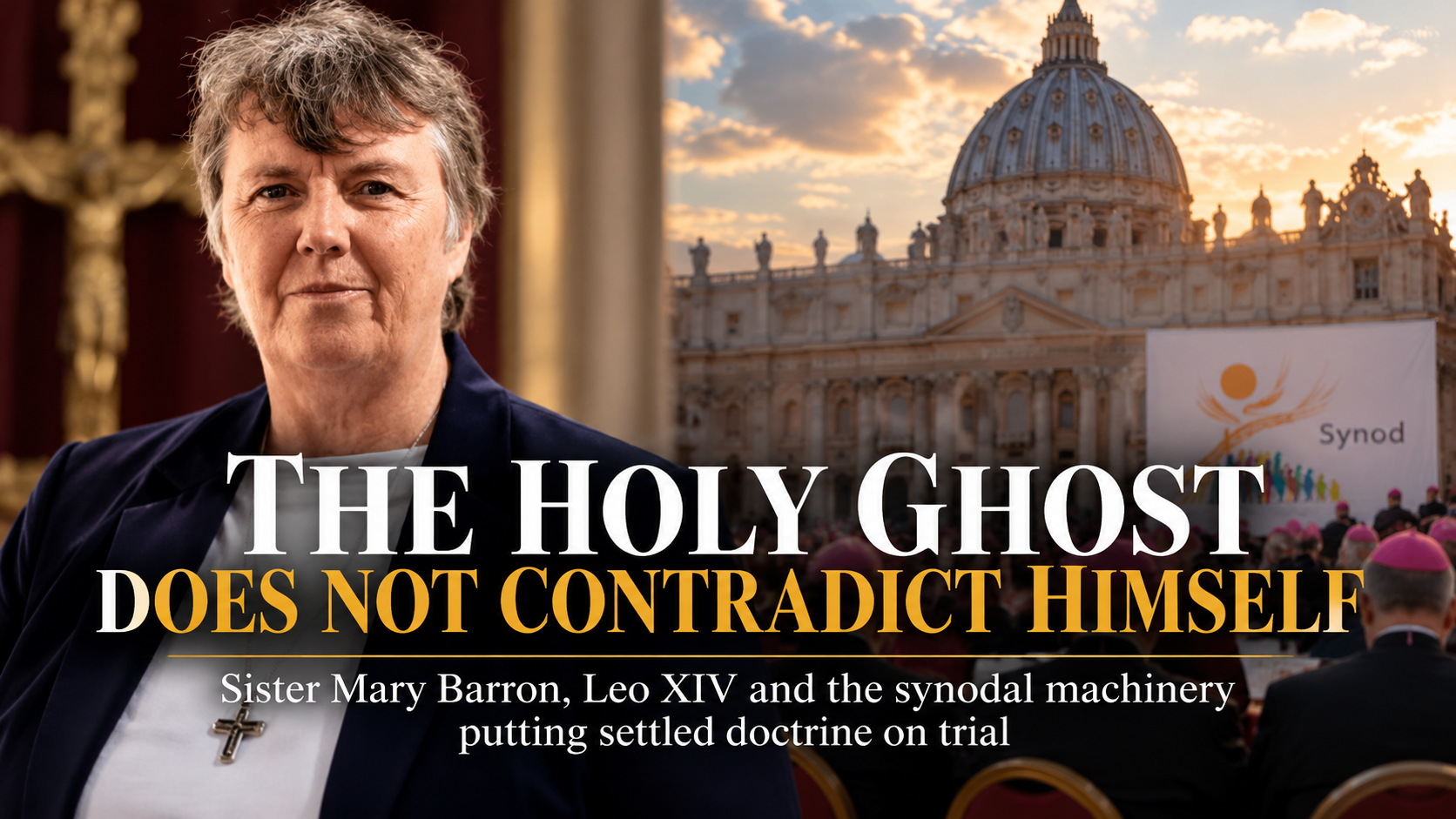
Sister Mary Barron, Leo XIV and the synodal machinery putting settled doctrine on trial
An incoming senior Vatican official suggests that women who feel called to priesthood may be expressing the will of the Holy Ghost. Behind this extraordinary proposition lies a more serious danger: Pope Leo XIV’s continuing synodal programme is institutionalising a method through which subjective experience can be invoked to challenge definitive Catholic teaching. The threat is not simply to the doctrine of Holy Orders, but to the authority of Revelation itself.
A woman believes God is calling her to the priesthood. The Catholic Church teaches that she cannot receive priestly ordination. The obvious question is whether she has correctly understood the experience she describes. Yet Sister Mary Teresa Barron, recently appointed to senior Vatican office by Pope Leo XIV, proposes approaching the matter from the opposite direction. Perhaps the Church should discern whether the Holy Ghost is indeed calling women to priesthood. The personal conviction becomes a reason to reconsider the Church’s judgement. What should be tested against Revelation is instead presented as potentially capable of modifying the Church’s understanding of it.
This is not a minor confusion about pastoral language. It strikes at the foundation of Catholic doctrinal authority.
Sister Barron was appointed on 8 October as adjunct secretary of the Dicastery for Evangelization and president of the Pontifical Mission Societies, assuming office on 4 January 2027. Her position was already known. During the Synod on Synodality in October 2024, she spoke publicly of women who sensed a vocation to priesthood or diaconate and urged the Church to consider what the Spirit might be asking. Interviewed again by EWTN News on 19 October 2026, she returned to the question with remarkable candour. Asked whether the door to women’s priestly ordination remained open, she replied: “Who am I to say whether the door is open or closed?” She suggested that the Church should accompany women who experience such a calling and discern whether it represents what the Spirit is asking of the whole Church.¹
The answer to her rhetorical question was given more than thirty years ago. In Ordinatio Sacerdotalis, John Paul II declared that the Church has no authority whatsoever to confer priestly ordination upon women and that this judgement must be definitively held by all the faithful. The Congregation for the Doctrine of the Faith subsequently confirmed, under Cardinal Joseph Ratzinger, that the teaching belongs to the deposit of faith and has been infallibly proposed by the ordinary and universal Magisterium. Cardinal Luis Ladaria reaffirmed its definitive character in 2018. The matter was not left awaiting a more inclusive consultation, a favourable social climate or further testimony from women persuaded of their own priestly vocation.²
Sister Barron’s formulation therefore raises a question which should profoundly disturb Catholics. If the Church has definitively declared that she lacks authority to confer priestly ordination upon women, in what sense can the Holy Ghost be calling women to receive it? An individual may sincerely experience such a conviction, but sincerity cannot establish its divine origin. A man who feels called to the priesthood cannot demand ordination because of the strength of his conviction. The Church must recognise an authentic vocation, not merely acknowledge an aspiration. Still less can an interior experience oblige the Church to reconsider an impossibility arising from her divinely established sacramental constitution.
The word called is carrying an extraordinary theological burden. It is being used to move from the undeniable fact that certain women experience a desire for priestly ministry to the radically different proposition that God may be asking the Church to recognise that desire as an authentic priestly vocation. The first belongs to pastoral experience. The second asserts something about the will of God. No amount of testimony can bridge the difference without reference to what God has already revealed.
Traditional Catholic spiritual theology has always insisted upon this distinction. St John of the Cross warned against excessive confidence in private spiritual experiences. St Ignatius of Loyola taught the careful testing of interior movements. St Paul instructed Christians to prove all things and hold fast that which is good (1 Thessalonians 5:21). A claimed inspiration is not authenticated by its emotional intensity, persistence or apparent generosity. It must be judged against the objective rule of faith.
This is precisely where the contemporary appeal to lived experience becomes dangerous. In secular institutional practice, personal testimony is increasingly treated as a privileged means of identifying injustice, exclusion and structural deficiencies. There are circumstances in which such evidence is indispensable. A homeless person may expose failures in housing provision; a victim of abuse may identify deficiencies in safeguarding arrangements. Their experiences can reveal facts which administrators have neglected. But the Church’s sacramental constitution is not a public-service programme requiring periodic adjustment according to the experiences of its users. Revelation is not a policy framework awaiting revision whenever sufficient numbers describe its requirements as exclusionary.
The essential distinction is between experience as evidence of circumstances and experience as a proposed source of doctrinal authority. Sister Barron’s intervention crosses towards the second category. Women experience what they understand as a priestly calling; therefore the Church must discern whether the Spirit may be calling her towards something previously excluded. The existing doctrine is not explicitly denied. It is rendered provisional by the suggestion that continued discernment might produce a different conclusion.
Nuntiatoria identified this problem in “When Settled Doctrine Becomes an Open Question,” published following Sister Barron’s appointment. The concern was not that a woman had been entrusted with significant missionary responsibility, but that someone publicly associated with reopening the question of women’s ordination had been elevated to a major Vatican office. Her subsequent interview advances the story considerably. Having received papal promotion, she has reaffirmed the reasoning which made the appointment controversial. What might once have been dismissed as an unfortunate formulation during a synodal press conference is now the reiterated position of an incoming senior official of the Roman Curia.³
The significance extends beyond Sister Barron because her argument corresponds closely to the methodology which Pope Leo XIV has chosen to perpetuate.
On 20 May 2026, the General Secretariat of the Synod published its programme for the assemblies leading to October 2028. It is structured around four stages: Recollecting, Interpreting, Orienting and Celebrating. Dioceses will review their experiences of synodal implementation during the first half of 2027. Episcopal conferences will interpret those experiences through theological-pastoral reports. Continental assemblies will identify common priorities and orientations. Their conclusions will contribute to the working document for the Ecclesial Assembly in Rome in 2028. Participants are explicitly expected to help sustain the process beyond that gathering.⁴
The mechanism is important. Experiences are gathered, interpreted and progressively translated into pastoral orientations. Those orientations acquire increasing institutional weight as they move from diocesan consultations through episcopal conferences and continental assemblies towards Rome. The process is not designed merely to discover what Catholics think. It is intended to shape how ecclesiastical institutions operate.
Cardinal Mario Grech, Secretary General of the Synod, has described this as a spiritual exercise rather than a sociological consultation. The distinction is intended to protect its ecclesiastical character. Yet it also exposes the theological difficulty. If conclusions emerging from organised consultation are interpreted as indications of what the Holy Ghost is bringing about, what safeguards prevent subjective demands from acquiring an authority they do not possess?
A consultation may establish that many people desire something. It cannot thereby establish that God wills it. An episcopal conference may identify widespread dissatisfaction with a doctrine. It cannot establish that the doctrine is mistaken. An international assembly may produce an overwhelming consensus. It cannot confer upon the Church an authority which she has definitively declared she does not possess.
The danger arises when the process itself becomes an alternative source of legitimacy. An initially subjective claim is heard, discussed, interpreted and incorporated into ecclesiastical recommendations. Once the recommendations are described as the fruit of communal discernment, those who challenge them may be accused of resisting the Spirit rather than invited to examine their conformity with Revelation.
This is not an imaginary difficulty invented by opponents of synodality. At the Vatican press conference of 2 October 2026, introducing Leo XIV’s tenth-anniversary gathering on Amoris Laetitia, Father Giacomo Costa SJ explained that a synodal process does not conclude with the approval of a document. The document enters ecclesiastical life, where different approaches are tried, their results assessed and subsequent steps discerned. Experience becomes central to evaluating implementation and determining what should follow.⁵
That method may be perfectly legitimate when applied to prudential arrangements. The Church can improve administrative procedures, pastoral communication and practical methods of evangelization by examining their consequences. But the same procedure becomes dangerous when applied without distinction to questions governed by divine law or definitive teaching. Pastoral practices may develop in conflict with doctrine. If their results are subsequently treated as evidence of what the Spirit is asking, the departure risks acquiring the appearance of authentic development.
The experience of Amoris Laetitia illustrates the problem. Where differing pastoral interpretations have emerged concerning marriage, conscience and sacramental discipline, the question cannot simply be which approaches participants have found most fruitful or compassionate. It must first be whether those approaches conform to the moral and sacramental doctrine the Church is bound to uphold. Otherwise, practice becomes the means by which doctrine is progressively deprived of its practical force.
This is the danger Nuntiatoria has addressed in its earlier commentaries on synodality, ecclesiastical governance and the reception of Amoris Laetitia. The latest Barron controversy shows how that methodological difficulty can extend beyond moral theology into the constitution of Holy Orders itself. An experience of vocation, interpreted through the language of communal discernment, is presented as a reason for continuing to examine a question the Church has definitively answered.
The resulting contradiction is disguised as patience. Nothing is being changed, the faithful are assured; the Church is merely listening. But there is no virtue in indefinitely discerning whether something impossible has become possible. Nor is it humble to treat the Church’s definitive teaching as one contribution among many to a conversation whose eventual outcome must remain open.
The distinction between priesthood and diaconate must also be maintained. Historical questions concerning deaconesses have been examined by successive commissions. The Petrocchi Commission’s findings, published in December 2025, did not support admitting women to the diaconate understood as a degree of the sacrament of Holy Orders, while acknowledging that its conclusion was not itself definitive. That unresolved theological question cannot be used to reopen the distinct and definitively settled teaching concerning women’s priestly ordination.⁶
There is a further irony. The assumption that a woman who sincerely desires to serve Christ should be considered for ordination if her vocation is to be properly recognised reveals a distinctly clericalist understanding of ecclesiastical worth. It measures the significance of apostolic service according to proximity to ordained office. The Blessed Virgin Mary possessed a dignity exceeding that of every bishop and apostle without receiving Holy Orders. St Catherine of Siena admonished popes; St Teresa of Avila reformed religious life; St Thérèse of Lisieux became patroness of the missions without ever exercising sacerdotal ministry. The Church’s greatest examples of feminine holiness require no revision of sacramental doctrine to establish their importance.
Sister Barron’s own missionary career demonstrates that women may exercise substantial responsibility within the Church. Her appointment to the Pontifical Mission Societies confirms that reality. Yet the significance of her work does not justify treating the reported priestly aspirations of other women as grounds for renewed doctrinal uncertainty. The Church can recognise their generosity, examine their gifts and assist them in discovering an authentic vocation without suggesting that Christ’s institution of Holy Orders remains negotiable.
Pope Leo XIV cannot be treated as a detached observer of this development. He has continued the synodal implementation programme inherited from Francis, encouraged its progression towards 2028 and supported the structures intended to give it permanence. The General Secretariat itself has stated that the implementation phase has been confirmed and promoted by the present Pope. Leo has also appointed Sister Barron despite the public record of her earlier statements. These are acts of ecclesiastical governance for which his pontificate bears responsibility.⁷
The question is not whether Leo has secretly resolved to authorise women’s ordination. That allegation is unnecessary and unsupported. The documented decisions already present a sufficiently serious problem. A pope charged with safeguarding the deposit of faith is sustaining an institutional process in which claims of subjective experience can be interpreted as signs of the Spirit’s direction, while an incoming senior appointee publicly applies similar reasoning to a definitive teaching on the priesthood. The responsibility to ensure that the process cannot be employed against received doctrine lies ultimately with the authority which maintains it.
This is particularly troubling when contrasted with Rome’s treatment of traditional Catholics. Those who retain the traditional Roman liturgy, defend inherited theological formulations or question contemporary disciplinary restrictions may face severe limitations in the name of obedience and ecclesiastical unity. Yet Sister Barron’s uncertainty concerns not a recent disciplinary decision, but the Church’s definitive teaching about her own sacramental authority. What account of ecclesiastical obedience makes attachment to an inherited liturgical tradition a cause for suspicion while the reopening of an infallibly taught doctrine appears compatible with appointment to senior office?
The discrepancy is not resolved by insisting that ordination has not actually changed. The issue is the authority accorded to doctrine in the present ecclesiastical culture. A definitive teaching can remain formally intact while its contradiction becomes increasingly respectable, its defenders are portrayed as insufficiently open to discernment and its practical application is treated as an obstacle to pastoral progress.
Nor does canon law provide a complete safeguard against such developments. No ecclesiastical legislation can overturn divine law. Nevertheless, the institutionalisation of synodal procedures can affect formation, episcopal appointments, pastoral guidance, diocesan priorities and the treatment of those who question prevailing expectations. What begins as consultation may become administrative practice; what becomes habitual practice may eventually acquire juridical expression. As Nuntiatoria argued in its previous examination of synodality and canon law, the danger lies not only in formal doctrinal pronouncements but in the cumulative reconfiguration of ecclesiastical governance.⁸
The implications for evangelization are grave. Missionaries do not proclaim an evolving collection of religious possibilities whose ultimate meaning awaits the next international consultation. They transmit the faith received from the Apostles. A convert instructed that the Church’s teaching must be definitively held is entitled to expect that those entrusted with directing her missionary work will acknowledge its finality. If definitive doctrine may perpetually be returned to discernment whenever experience appears to challenge it, the Church’s claim to teach with authority begins to lose its intelligibility.
The papal office exists precisely to prevent such confusion. The successor of Peter is charged with confirming his brethren in the faith, not presiding over an indefinite reconsideration of the deposit entrusted to the Church. Authentic doctrinal development may clarify, deepen and explain what has been received. It cannot establish the opposite of what the Church has infallibly taught. Nor can the Holy Ghost who guides the Church into truth become the alleged author of a contradiction to that truth.
This is the central threat posed by Leo XIV’s continuing synodal programme. Its danger does not depend upon a dramatic decree announcing the abandonment of Catholic doctrine. A teaching may be deprived of practical authority long before anyone openly repudiates it. Its apparent finality can be weakened through perpetual consultation, its defenders marginalised as obstacles to discernment and its continued observance represented as a pastoral difficulty awaiting resolution.
Sister Barron’s latest remarks reveal how easily this can happen. The Church has declared that she possesses no authority to confer priestly ordination upon women. An incoming senior Vatican official nevertheless speaks of women who feel called and of a process through which the Church might discern what the Spirit intends. The contradiction is not resolved by invoking openness. It is intensified by suggesting that openness to the Spirit requires reconsidering what the Church definitively teaches.
Leo XIV must therefore answer a question more consequential than whether he personally favours any particular proposal concerning women’s ministry. Will he ensure that the synodal process is governed by the deposit of faith, or will the interpretation of lived experience increasingly determine which teachings are treated as open to reconsideration? The process has his support, its implementation is under way, and its continuation beyond 2028 is already envisaged. The responsibility for its doctrinal boundaries cannot be indefinitely delegated to committees.
There is no authentic discernment in asking the Holy Ghost to contradict Himself. There is no fidelity to Tradition in treating the Church’s definitive judgements as provisional. And there is no exercise of papal guardianship in permitting a machinery of consultation to acquire practical authority over what the Church has received from Christ.
The Church is not commissioned to discover whether Revelation remains acceptable to the experiences of the present generation. She is commissioned to transmit Revelation faithfully to every generation. If synodality reverses that responsibility, it ceases to serve the Church’s mission and becomes a threat to the faith it was supposed to proclaim.
1. Hannah Brockhaus, New Vatican Official Says Men and Women Are ‘In This Together as Witnesses to God’, EWTN News, 20 October 2026; Victoria Cardiel, Pope Leo XIV Appoints Sister Mary Barron President of Pontifical Mission Societies, EWTN News, 8 October 2026.
2. John Paul II, Ordinatio Sacerdotalis, 22 May 1994, §4; Congregation for the Doctrine of the Faith, Responsum ad Propositum Dubium, 28 October 1995; Luis F. Ladaria, In Response to Certain Doubts Regarding the Definitive Character of the Doctrine of Ordinatio Sacerdotalis, 29 May 2018.
3. Nuntiatoria, When Settled Doctrine Becomes an Open Question, 9 October 2026.
4. General Secretariat of the Synod, Towards the Ecclesial Assembly of October 2028, 20 May 2026.
5. Holy See Press Office, Press Conference to Present “Ten Years after Amoris Lætitia: Proclaiming the Gospel with Families Today”, 2 October 2026.
6. Vatican News, Petrocchi Commission Says No to Female Diaconate, Though Judgment Not Definitive, December 2025.
7. General Secretariat of the Synod, Towards the Ecclesial Assembly of October 2028, 20 May 2026; A Sign of Support and Encouragement, 26 June 2026.
8. Nuntiatoria, Synodality’s Next Step: Writing the Revolution into Canon Law, 1 October 2026.



Leave a Reply