
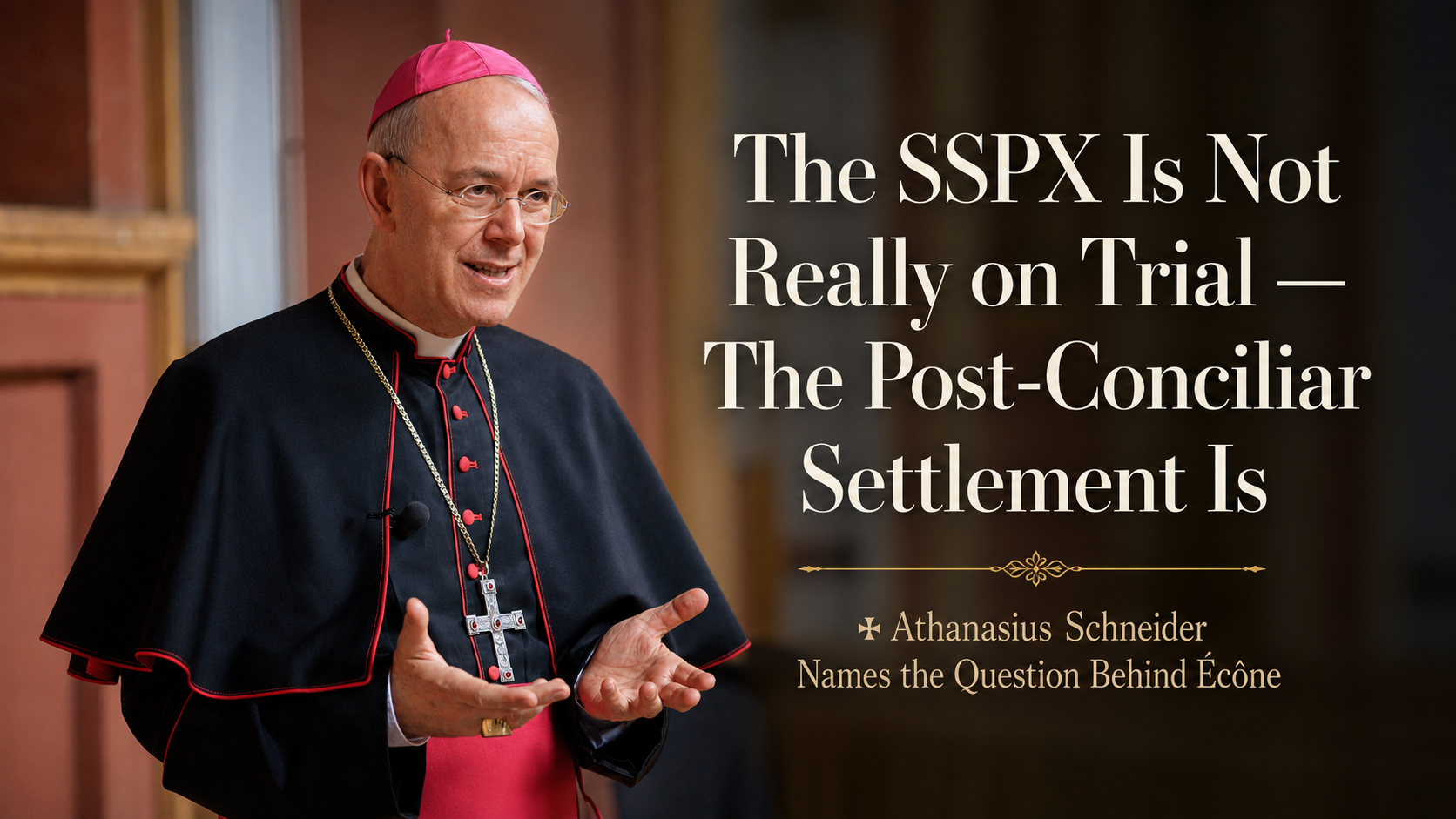
The SSPX Is Not Really on Trial — The Post-Conciliar Settlement Is
✠Athanasius Schneider Names the Question Behind Écône

The most important sentence in ✠Athanasius Schneider’s remarkable intervention on the Society of Saint Pius X is not his defence of the Society against the accusation of formal schism, nor his distinction between Divine Law and positive ecclesiastical law, nor even his comparison of the present crisis with the ordeal of St Athanasius. It is his declaration that if the Holy See were seriously to confront the objective ambiguities which he identifies in certain conciliar statements and in the reformed liturgy, “it would mark the beginning of the end for the modernist project within the Church.”¹ That is an extraordinary statement from a serving Catholic bishop because it changes the object of the controversy. ✠Schneider is not merely asking Rome to be generous towards a difficult priestly society, to remit penalties, or to devise another canonical accommodation for the traditional Roman Mass. He is saying that the conflict surrounding the SSPX points to something far larger: an unresolved dispute concerning the post-conciliar settlement itself. The uncomfortable truth is that the SSPX is not really what is on trial. The post-conciliar settlement is.
That does not make the episcopal consecrations at Écône on 1 July canonically insignificant. Canon 1387 provides that both a bishop who consecrates another bishop without pontifical mandate and the man who receives that consecration incur latae sententiae excommunication reserved to the Apostolic See.² On 2 July the Dicastery for the Doctrine of the Faith declared ✠Alfonso de Galarreta and the four newly consecrated bishops — ✠Pascal Schreiber, ✠Michael Goldade, ✠Michel Poinsinet de Sivry and ✠Marc Hanappier — to have incurred excommunication; it treated ✠Bernard Fellay separately, declaring that his participation as co-consecrator constituted public adherence to the act and brought him under canon 1364 §1.³ The accompanying explanatory Note went further, declaring SSPX sacred ministers to be in schism and warning of consequences for clergy and laymen who formally adhere to it.⁴ Those are serious assertions and serious penalties. A responsible Traditionalist analysis should neither conceal nor trivialise them.
Their very gravity, however, forces the question which precedes them. Why did bishops and priests who profess the Roman Primacy, recognise Leo XIV as Pope and insist upon their desire to remain Catholic nevertheless conclude that they must resist him in so grave a matter? Leo himself acknowledged shortly before the consecrations the devotion to liturgical life, commitment to priestly formation, apostolic zeal and “desire for fidelity to Tradition” found among many associated with the Society, even while begging its superiors to desist from what he called the impending “schismatic act”.⁵ Rome therefore recognises that fidelity to Tradition is among the motives at work while simultaneously judging the action arising from that conviction to be gravely contrary to ecclesial communion. That tension cannot be resolved simply by repeating the penalty.
It is precisely this deeper question that ✠Schneider addresses. He describes the SSPX as confronting a genuinely “tragic choice”: either submit to what it believes are doctrinal and liturgical ambiguities, or disobey a grave papal command in order to preserve what it regards as the integrity of the Faith and worship of the Church. He presents the dilemma as a choice between preserving the Faith as it has “been taught by the Magisterium throughout the ages” and securing canonical recognition from the Pope. Nor is this, in his presentation, a dispute about aesthetics, Latin, lace, birettas, altar rails or the position of the celebrant at Mass. ✠Schneider explicitly identifies “certain newly introduced doctrinal ambiguities” and the demand that the Society accept not merely the validity of the reformed Mass but its “correctness” or legitimacy notwithstanding what he calls its “doctrinal and ritual vagueness”.¹
That is ✠Schneider’s diagnosis of the dilemma, and it should be recognised as such rather than carelessly converted into the wording of an official Vatican formula. But this makes his intervention more significant, not less. A serving Catholic bishop is publicly asserting that the canonical confrontation cannot be understood apart from unresolved questions about Vatican II, the post-conciliar Magisterium and the liturgical reform. One may disagree with his assessment. One may maintain that particular conciliar texts have been misunderstood, that certain criticisms of the reformed liturgy are exaggerated, or that the SSPX has itself sometimes failed to distinguish sufficiently between doctrine, prudence and discipline. What can no longer credibly be maintained is that the dispute is adequately explained by saying that Traditionalists simply dislike modern Catholicism and refuse to obey the Pope.
✠Schneider’s criticism of what he calls “legalism” and “papalism” is therefore central. He identifies two tendencies which, in his judgement, have narrowed Catholic perceptions of authority: treating the legal order as though it were quasi-absolute, and treating obedience to the Pope as though it admitted no meaningful theological distinctions. He warns against an “undifferentiated and almost absolute obedience to the Pope” which risks placing obedience to a particular papal command on the same level as obedience to Divine Revelation.¹ Catholic obedience has never meant that every exercise of ecclesiastical authority possesses identical theological weight. The Pope is the supreme visible pastor of the Church, but he is not the author of the deposit of Faith. His authority exists to guard, define, defend and transmit what the Church received. Positive ecclesiastical law possesses genuine binding force, but it does not thereby become Divine Law.
✠Schneider puts the distinction starkly: “No one may contradict Divine Law and remain a Catholic.” Yet, he continues, in genuinely extraordinary circumstances a Catholic may be required in conscience to act contrary to positive law precisely in order to remain uncompromisingly faithful to Divine Law.¹ This proposition does not prove that the SSPX has successfully demonstrated such necessity in the present case. That remains open to examination. But the category itself cannot simply be abolished because its application is inconvenient. That a law is ecclesiastical rather than divine certainly does not make it optional; most ecclesiastical discipline consists precisely of binding positive law. Yet no human law possesses the same ontological character as the law of God, and Catholic theology cannot preserve obedience by erasing that distinction.
The same care is required when speaking of schism. ✠Schneider objects that a dangerously narrow understanding has developed in which “material disobedience to the Pope — regardless of intention — is virtually equated with formal schism.”¹ Canon law itself preserves a distinction which polemics can obscure. Canon 751 defines schism as refusal of submission to the Supreme Pontiff or refusal of communion with the members of the Church subject to him, while canon 1371 separately provides penalties for a person who, after warning, persists in disobedience to a lawful command or prohibition of the Apostolic See, Ordinary or Superior.⁶ The existence of separate juridical categories does not determine every difficult case, but it is enough to show that disobedience and schism cannot simply be treated as synonyms.
Disobedience can be grave. It may be sinful. In particular circumstances it may accompany or manifest schismatic intent. The DDF has expressly judged the 2026 consecrations in precisely that way.³ But an argument still has to be made between the fact of disobedience and the conclusion that there exists a principled rejection of Roman authority. ✠Schneider accordingly describes formal schism as rejection “in principle, of papal authority through the establishment of a separate hierarchy”, and contrasts this with the case of those who retain supernatural faith in papal primacy and infallibility and profess a desire to live in genuine submission to papal authority even while claiming that an extraordinary crisis prevents that submission from being fully realised in practice.¹ His application of that distinction to the SSPX may be contested. The distinction itself cannot.
Indeed, this is what makes the SSPX problem so difficult. Were the Society simply sedevacantist, the ecclesiological issue would be clearer. But it is not. Its Profession of Catholic Faith of 24 June explicitly recognises the Roman Pontiff as successor of St Peter, Vicar of Jesus Christ, supreme and universal Pastor and visible head of the whole Church, possessing supreme, full, immediate and universal jurisdiction. It states that pastors and faithful owe him respect and filial obedience in the legitimate exercise of his office, while insisting that the Magisterium is ordered to safeguarding the revealed deposit and that popes and bishops are guardians rather than masters of Revelation.⁷ Whatever criticism one makes of the document as a whole, those propositions are plainly not a denial of papal primacy.
Nor did the Society address its profession to some hypothetical future Roman authority. It deliberately placed it before Pope Leo XIV and the College of Cardinals and expressed the hope that the text might one day become the basis for an “honest discussion with the Holy See, in a spirit of peace, brotherhood, and charity.”⁸ It told Rome that it regarded Tradition, historically guarded and transmitted by the Apostolic See, as the necessary foundation of ecclesial regeneration. That does not settle whether its subsequent resistance was justified, but it makes the theology of the confrontation rather more complicated than the simple picture of a body which has ceased to care what Rome thinks.
It is here that ✠Schneider’s intervention becomes most uncomfortable. He does not merely plead sincerity on the Society’s behalf. He says that, through its insistence upon doctrinal and liturgical clarity, the SSPX renders “a great service to the entire Church — a service of historical value.” He describes it as “virtually the only community in the Church today” which openly and persistently calls attention to ambiguities in certain conciliar statements and in the rite of the New Mass, seeking their unequivocal clarification and, where necessary, amendment according to the constant Magisterium. Then comes his most consequential conclusion: should the Holy See take those objections seriously and acknowledge objective ambiguities where they exist, this “would mark the beginning of the end for the modernist project within the Church.”¹
That is the real story. For decades the SSPX has principally been presented as an ecclesiastical problem to be managed: irregular clergy who must somehow be reconciled, Traditionalists who must somehow be persuaded to receive Vatican II correctly, an inherited wound whose canonical consequences must eventually be healed. ✠Schneider reverses the direction of examination. Perhaps the Society has preserved questions which the Church herself still needs to answer. One need not accept his phrase “virtually the only community” without qualification; bishops, theologians, clergy and lay scholars beyond the Society have raised many of the same questions. What is difficult to deny is the SSPX’s institutional persistence. For half a century it has resisted the solution repeatedly proposed to Traditional Catholics: accept the post-conciliar settlement in principle, then discuss how its disputed elements are to be interpreted.
The question Rome has generally been more willing to entertain is how Vatican II may be interpreted in continuity with Tradition. Far more difficult has been the prior question whether a particular non-definitive conciliar formulation may actually require correction. Rome has been willing to discuss how the reformed liturgy might be celebrated reverently; much less welcome has been the question whether elements of the reform itself represent an unnecessary or damaging rupture with inherited Roman liturgical practice. Traditionalists have repeatedly been asked how they might reconcile themselves to the post-conciliar Church; less frequently has institutional Catholicism been willing to ask whether the post-conciliar Church ought to recover things which Traditionalists preserved. Those are not semantic differences. They determine in advance what kinds of answers are permitted.
✠Schneider therefore makes a particularly penetrating observation about the “hermeneutic of continuity”. He does not dismiss it; he says that such an approach is in itself valid and helpful. But he warns that it can become a “kind of ‘straitjacket’”, cosmetically covering wounds caused by ambiguity rather than permitting those ambiguities to be recognised and treated.¹ That is the danger whenever a hermeneutical method becomes a predetermined verdict. If every disputed proposition must, before serious examination, be found continuous with what preceded it, then continuity is no longer being demonstrated. It is being stipulated. Interpretation ceases to ask what the evidence permits us to conclude and instead becomes an intellectual mechanism for ensuring that only one conclusion can ever be reached.
This is why a merely canonical settlement cannot finally resolve the SSPX question. Imagine that every SSPX priest and bishop were regularised tomorrow, every chapel granted canonical standing and every disciplinary penalty removed. What would thereby have been demonstrated concerning religious liberty, ecumenism, interreligious dialogue, ecclesiology, collegiality, the understanding of Tradition, or the relationship between the traditional Roman Rite and the reform which followed the Council? Nothing. Administrative reconciliation might make theological disagreement easier to address; it could not substitute for addressing it. Nuntiatoria has made precisely this point throughout the present crisis: the canonical question is real, but Rome cannot indefinitely use it as a surrogate for the doctrinal one.⁹ ¹⁰
The same difficulty becomes still more conspicuous when viewed against contemporary claims about synodality. The modern ecclesiastical vocabulary repeatedly promises listening, accompaniment, dialogue, discernment and the patient reception of difficult voices. Yet the SSPX has spent decades requesting substantive doctrinal engagement concerning conciliar and post-conciliar developments, and too often the practical answer has amounted to dialogue on condition that the disputed settlement itself first be accepted. As Nuntiatoria has argued before, a synodal Church which can hear almost every grievance except the complaint that elements of its own recent reform may require correction risks turning “listening” into little more than a method of managing predetermined conclusions.¹¹
And this is where ✠Schneider’s language about a “modernist project” becomes especially important. He traces the deeper roots of the present crisis beyond 1988, beyond Vatican II itself, and beyond the events of 2026, locating them in tendencies which, he says, began “more than a hundred years ago”.¹ Whether every historian would define the genealogy in precisely those terms is not the decisive point. The implication is unmistakable: Écône did not create the crisis. Écône is one manifestation of it. The SSPX remains troublesome precisely because its continued existence prevents the post-conciliar settlement from becoming an unquestioned historical fact. Its seminaries, priories, schools, chapels, families and successive generations of priests constitute an institutional reminder that substantial questions about the last sixty years were never answered simply because the reforms themselves acquired age.
None of this makes the SSPX right about everything, and Traditionalists should be particularly suspicious of an argument which requires them to pretend otherwise. Necessity cannot become an incantation by which every desired act automatically becomes justified. Resistance cannot become a permanent ecclesiology. Private judgement cannot quietly establish itself as an alternative magisterium. Catholics cannot denounce papalism while behaving as though every priest, bishop, chapel or commentator possesses an individual veto over Roman authority. If Tradition is invoked as the standard, then the divine constitution of the Church, the visibility of the hierarchy and the Roman Primacy themselves belong to that Tradition. A resistance which eventually destroys the principles it claims to defend would merely reproduce the revolutionary logic it originally opposed.
✠Schneider himself does not take that road. His comparison with St Athanasius must nevertheless be handled carefully. The history of Pope Liberius, the formulae associated with him, and his treatment of Athanasius contains genuine historiographical disputes; the fourth-century Arian crisis cannot simply be photocopied onto 2026. Yet the theological point of the analogy is perfectly intelligible. Canonical standing at a particular historical moment is not an infallible measure of doctrinal fidelity, and ecclesiastical authority can make serious prudential errors during times of doctrinal crisis. Schneider recalls a moment in which Athanasius would not purchase ecclesiastical peace at the price of what he believed to be compromise with error.¹ The analogy does not prove that the SSPX is Athanasius. It proves that “Rome has condemned you” is not, by itself, a complete theology of Church history.
His appeal to St Augustine near the conclusion is similarly deliberate. Augustine speaks of good men driven from the congregation of Christ who patiently endure injury for the Church’s peace and “attempt no novelties in the way of heresy or schism”, remaining intent upon the good of the Church even while separated from those who mistreated them.¹ ✠Schneider plainly invites the reader to consider whether something analogous may be discerned in the present situation. But perhaps the quotation which best expresses the principle underlying his whole argument comes from St Athanasius himself: “The canons and decrees of the Church were not given at the present day”; neither, Athanasius continues, did the Faith originate in his own time, but **“came down to us from the Lord through His disciples.”**¹
There lies the Traditionalist case in miniature. The Faith is received; the liturgy is received; the Church is received; the papacy is received. None is ours to invent. This does not mean that history stands still. Doctrine develops, discipline changes, liturgical rites grow, and the Church necessarily responds to new controversies and circumstances. But authentic development receives what came before and unfolds it. It cannot contradict its own principles and then invoke the mere passage of time as proof of continuity. The distinction between development and rupture is therefore not a Traditionalist eccentricity but one of the indispensable questions by which claims of reform must be judged.
This brings us to the question Rome still has to answer. If the SSPX is wrong about Vatican II, show precisely where it is wrong. If it has misunderstood Dignitatis humanae, demonstrate the continuity rather than simply asserting it. If its objections to ecumenism confuse abuses with authentic doctrine, establish the distinction. If its criticism of the reformed liturgy mistakes legitimate development for rupture, demonstrate the organic continuity historically, ritually and theologically. If its understanding of necessity is false, answer the theological and canonical argument which it advances. But if some of its objections are substantially correct, then Rome must possess enough confidence in the indefectibility of the Church to acknowledge that fact.
That is not surrender to the SSPX. It is taking the SSPX seriously. The distinction matters. Taking an argument seriously does not require accepting it; it requires exposing it to evidence, Tradition, theology and historical fact without predetermining that institutional prestige must emerge untouched. Nothing Catholic can be endangered by such an enquiry. A pastoral Council is not diminished by legitimate clarification. A non-definitive formulation cannot be harmed by correction if correction proves necessary. A liturgical reform does not acquire immunity from historical judgement merely because legitimate authority promulgated it. And prudential decisions do not become infallible because several decades have passed since they were taken. If everything disputed is genuinely reconcilable with the preceding Magisterium and liturgical Tradition, a serious examination will establish that continuity. If something is not, the Church loses nothing by knowing the truth.
This is therefore why the present crisis concerns considerably more than the fate of the bishops consecrated at Écône. For decades Traditionalists themselves have been examined: their obedience, their motives, their canonical status, their understanding of authority, their seminaries, their bishops, their priests and their faithful. ✠Athanasius Schneider has now asked, in effect, whether the evidence they have spent those decades presenting might itself deserve examination. That changes the axis of the controversy. The question is no longer merely whether the SSPX will accept the post-conciliar settlement. It is whether that settlement can withstand the theological and historical scrutiny which demands for submission have too often postponed.
And ✠Schneider does not conclude by abandoning Rome. Quite the contrary. His final profession is unmistakably Catholic: “I believe in the invincibility of the Church and of the Papacy,” he writes, expressing his confidence that the Holy See will one day shine again “as the Cathedra of truth before the entire world.”¹ His argument therefore cannot honestly be appropriated as sedevacantism or simple anti-papalism. It is an appeal for Rome to become more perfectly what Rome exists to be. The papacy does not exist to guarantee the irreformability of every ecclesiastical policy adopted within living memory. It exists to confirm the brethren in the Faith, maintain communion in truth, and guard the deposit entrusted by Christ to His Church.
If the SSPX has resisted beyond what necessity permits, that must be corrected. If Rome has demanded more than Tradition permits, that must also be corrected. The governing principle cannot be the preservation of institutional prestige, the defence of a post-conciliar narrative, the vindication of Archbishop Lefebvre, or the vindication of those who opposed him. It must be the truth. ✠Athanasius Schneider’s intervention matters because he has shifted the question from whether Traditionalists have behaved properly to whether some of the things against which they resisted were themselves proper. He has suggested that the men standing in the dock may have spent decades pointing towards evidence which the court itself has been reluctant to examine.
If that examination finally begins, it need not mean the defeat of the papacy, Vatican II or the Church. It may mean something considerably more Catholic: receiving what is true, clarifying what is ambiguous, correcting what is defective, abandoning what genuinely cannot be reconciled with what was handed down, and allowing the Roman See to exercise its authority not as custodian of an ecclesiastical era but as guardian of the perennial Faith. That would not be the end of the Church. It might indeed be, as ✠Schneider has now dared to say, “the beginning of the end for the modernist project within the Church.”¹
¹ ✠Athanasius Schneider, “The Dilemma Between Preserving the Unambiguous Integrity of the Catholic Faith and Being Canonically Recognized by the Pope”, statement published by Diane Montagna, 17 August 2026.
² Codex Iuris Canonici (1983), Book VI, as revised, can. 1387.
³ Dicastery for the Doctrine of the Faith, Decree concerning the episcopal consecrations carried out by the Society of Saint Pius X, Prot. N. 99/2009, 2 July 2026.
⁴ Dicastery for the Doctrine of the Faith, Explanatory Note concerning the Society of Saint Pius X, Prot. N. 99/2009, 2 July 2026.
⁵ Leo XIV, Letter to Fr Davide Pagliarani, Superior General of the Priestly Fraternity of Saint Pius X, 29 June 2026.
⁶ Codex Iuris Canonici, can. 751; Book VI, cann. 1364 §1 and 1371.
⁷ Society of Saint Pius X, Profession of Catholic Faith of the Society of Saint Pius X to Enlighten Souls in the Face of Modern Errors, 24 June 2026, especially nn. 73–82.
⁸ Society of Saint Pius X, Open Letter to His Holiness Pope Leo XIV and to the Cardinals of the Holy Church, 24 June 2026.
⁹ “Attendance Is Not Schism: Rome, the SSPX and the Canonical Rights of the Laity”, Nuntiatoria, 3 July 2026.
¹⁰ “No Burden Beyond Necessity — Except for Tradition? Rome’s Unequal Terms for SSPX Reconciliation”, Nuntiatoria, 3 July 2026.
¹¹ “Rome’s Treatment of the SSPX Exposes the Fraud of Synodality”, Nuntiatoria, 31 July 2026.
RELATED ARTiCLES


LATEST ARTICLES
- YET ANOTHER PRIEST TURNS TO THE SSPXThe Diocese of Knoxville has revoked Fr David Mary Engo’s faculties following his involvement with an SSPX-related ministry, just months after endorsing him. This case exemplifies a troubling trend of priests seeking traditional expressions of faith in response to the suppression of authorised liturgy, raising critical questions about the Church’s approach to tradition.
- IRELAND SHOWS CATHOLIC RSE NEED NOT SURRENDERIreland’s Living Love Senior programme aims to integrate Catholic anthropology into Relationships and Sexuality Education for post-primary students. Launched by Archbishop Eamon Martin, it addresses contemporary issues while emphasising the significance of human embodiment. This initiative seeks to ensure Catholic teaching consistently shapes educational practices, contrasting with existing approaches in England and Wales.
- BELLEFONTAINE: WHEN TRADITION MOVES INTO THE EMPTY CLOISTERThe arrival of twelve monks from Le Barroux at Abbey Bellefontaine highlights the French Church’s struggle with transmission amidst an ageing community. It underscores the survival of traditional liturgy, where Latin Office monasteries thrived compared to vernacular ones. With rising adult conversions and papal engagement, the Church faces a crucial opportunity for renewal through Tradition.
- Today’s homily: St Francis of AssisiThe homily reflects on Saint Francis of Assisi, highlighting his transformation from a wealthy youth to a devoted servant of Christ. Emphasising that true sanctity lies in humility and detachment from worldly possessions, it urges believers to seek a deeper faith that mirrors Francis’ commitment to the Cross and the Gospel, ultimately leading to true liberation.
- Today’s Mass: October 05 St Francis of AssisiSaint Francis of Assisi, born in 1182 in Italy, transformed from a wealthy youth to a devoted servant of the poor and sick after a life-changing experience in war. He founded the Franciscans and the Poor Clares, advocated for peace, and notably received the stigmata. He died in 1226 and was canonised shortly after.
CURRENT EDITION


Today’s Mass Propers
- Today’s Mass: October 05 St Francis of Assisi
 Saint Francis of Assisi, born in 1182 in Italy, transformed from a wealthy youth to a devoted servant of the poor and sick after a life-changing experience in war. He founded the Franciscans and the Poor Clares, advocated for peace, and notably received the stigmata. He died in 1226 and was canonised shortly after.

Leave a Reply