

Given to God: The Hidden Life of Our Lady
MASS Salve, sancta Parens
EPISTLE Ecclesiasticus 24:14–16
GOSPEL St Luke 11:27–28
HOMILIST Mt Revd Jerome Lloyd OSJV

In the Name of the Father, and of the Son, and of the Holy Ghost. Amen.
Carissimi, beloved in Christ
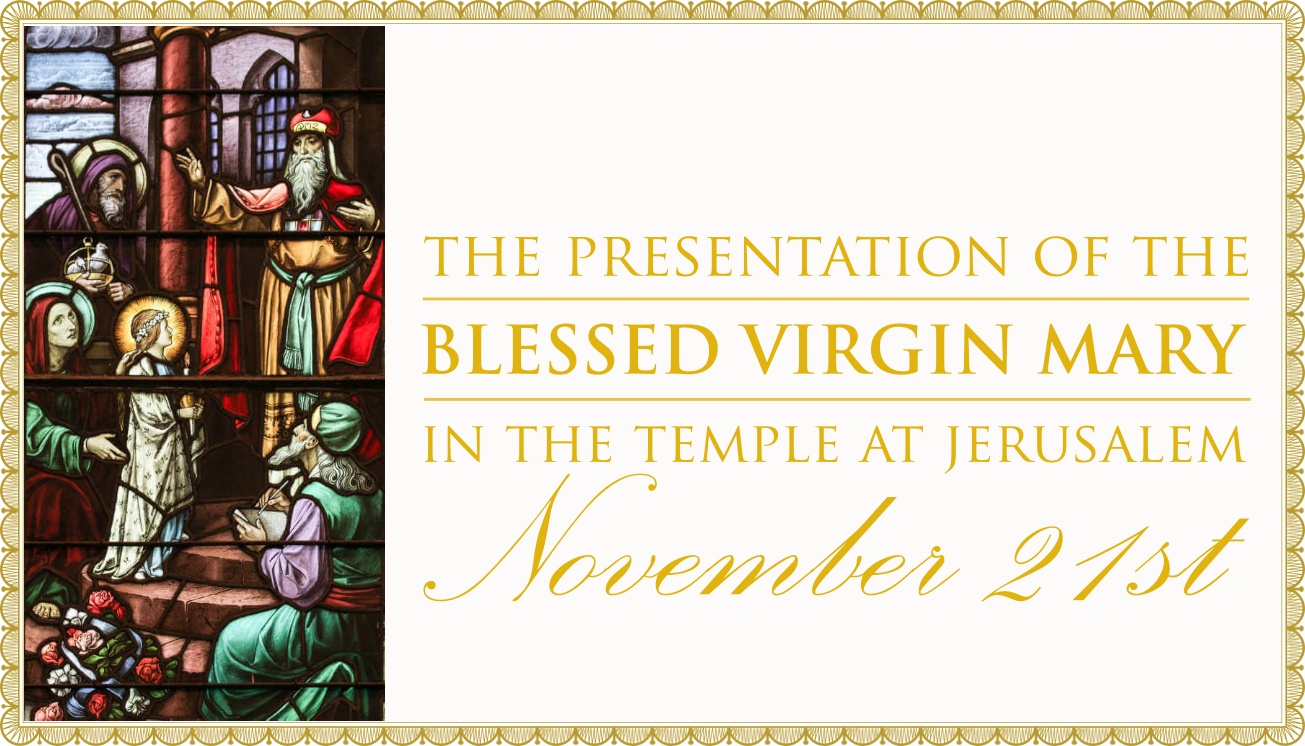
There is something beautiful about the fact that the Church celebrates Our Lady’s Presentation in the Temple, although the Gospels tell us nothing about her childhood. We know what happened when Gabriel came to Nazareth, and something of her life at Bethlehem, Cana and Calvary. Yet of those early years, when she was growing into womanhood, Holy Scripture is silent.
Perhaps that silence is worth considering. We live in an age which finds it difficult to believe anything important can happen without being noticed. Every achievement must be announced, every experience recorded. Yet the greatest creature God ever made spent almost all her earthly life in obscurity. Before the world heard her name, Mary was already holy.
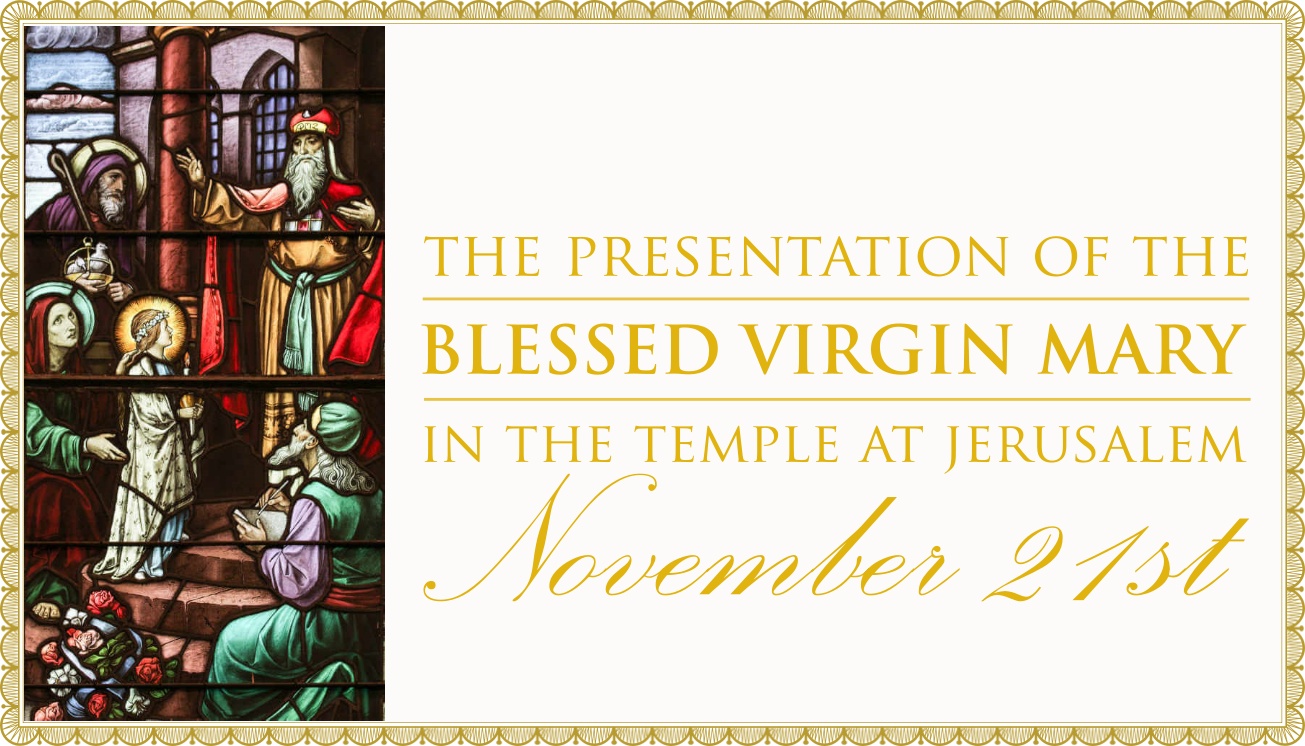
Today’s feast commemorates the ancient tradition that Saints Joachim and Anne brought their daughter to the Temple at Jerusalem and dedicated her to God. The story appears in the Protoevangelium of James, an early Christian writing which is not Holy Scripture. Its details cannot be treated as though St Luke had recorded them. Nevertheless, the Church recognises in this tradition a fitting expression of Our Lady’s complete dedication to God.
In the Christian East, the feast is called the Eisodos, the Entry of the Mother of God into the Temple. Consider the image: a child enters the sanctuary where Israel worshipped the Lord, while she herself is destined to become the living sanctuary in which the eternal Son of God will take flesh. The Temple was built for God’s worship; Mary would bear God Himself into the world. The ancient Ark held signs of God’s covenant. She would bear the Author of the covenant in her womb.
Mary’s holiness did not begin when she became the Mother of God. From the first instant of her conception, she was preserved from original sin through the foreseen merits of Jesus Christ. She was redeemed by her Son more perfectly than any other human creature: preserved from the stain from which we must be cleansed. Yet she remained wholly dependent upon God. Her Immaculate Conception neither made her divine nor deprived her of freedom. When she answered the angel, ‘Behold the handmaid of the Lord,’ she freely accepted the vocation for which Providence had prepared her.
Today’s Gospel helps us understand this. A woman in the crowd cries out, ‘Blessed is the womb that bore thee, and the paps that gave thee suck.’ Our Lord replies, ‘Yea rather, blessed are they who hear the word of God, and keep it.’
Is He diminishing His Mother’s honour? St Augustine explains that Mary’s blessedness includes her believing obedience. She received God’s word in faith before she conceived the Word made flesh. Her divine maternity remains an incomparable privilege; her response shows us the holiness with which she fulfilled it. We cannot share her unique vocation, but we can imitate her readiness to hear God and obey Him.
And that begins earlier than we sometimes imagine. A child learns what matters by watching the adults around him. He notices whether his parents pray, whether Sunday Mass is gladly attended, whether the crucifix has an honoured place at home, and whether the commandments are observed when inconvenient. He learns forgiveness when his father admits he was wrong, and charity when his mother helps a neighbour without expecting applause. Children are remarkably perceptive when an adult’s conduct contradicts an adult’s instructions.
At Baptism, a child receives the supernatural life of grace. Parents and godparents undertake obligations extending far beyond the ceremony. They must help him know the Faith, practise it and grow in virtue. There is no reason to postpone this formation until he can follow a theological explanation. A small child can learn the Sign of the Cross, fold his hands in prayer, and genuflect before the Blessed Sacrament. Understanding deepens with age; reverence can begin much sooner.
This does not require every household to resemble a monastery. Family life has noise, disorder and occasional exasperation. Children are children, and parents remain people in need of patience and forgiveness. But a Catholic home should possess a recognisable spiritual character. The Faith ought to shape its habits, decisions, celebrations and the way its members treat one another. We cannot reasonably expect children to regard God as central if He is always given whatever time remains after everything else.
Nor does this responsibility belong only to parents. Grandparents, godparents, teachers, priests and faithful friends may exercise an influence which endures beyond their lives. Some know the sorrow of relatives who have abandoned religious practice. They remain within reach of our prayers. St Monica could not compel Augustine to become a Christian. She prayed, persevered and witnessed to her faith. We should remember her when our efforts appear fruitless. God may be working in a soul long before we see evidence of it.
The Epistle gives another aspect of today’s mystery. Divine Wisdom speaks of dwelling among God’s people, and the Church applies these words to Our Lady. We must distinguish the scriptural figure from the doctrine it illuminates. The eternal, uncreated Wisdom of God is the divine Son Himself. Mary is His chosen Mother, the creature in whom the Word took flesh. Her dignity comes entirely from Him.
Authentic devotion to Our Lady therefore leads us towards her Son. At Cana she tells the servants, ‘Whatsoever he shall say to you, do ye.’ That remains an excellent examination of our Marian devotion. A person may possess a beautiful image of Our Lady and neglect his prayers. He may wear her scapular while refusing to abandon serious sin. Sacramentals are valuable aids to devotion; they do not dispense us from repentance, obedience or the sacraments.
Much of Our Lady’s holiness was lived away from public attention, in prayer and the duties of Nazareth. Our own lives contain similar opportunities: prayer offered when we would rather sleep, kindness shown when patience is exhausted, a duty completed when nobody is watching. We need not wait for an extraordinary calling before beginning to serve God faithfully. The small occasions of obedience are already before us.
Above all, we must remain close to the sacraments. Our Lady bore the Word made flesh; at Holy Mass we adore that same Lord truly present beneath the sacramental species. The sacrifice offered here is the sacrifice of her Son. We must approach Holy Communion worthily and with gratitude. Where mortal sin has destroyed the life of grace, we must seek restoration through sincere contrition and sacramental confession. We cannot ask Mary to lead us to Jesus while deliberately refusing the mercy He offers.
The Collect asks that, through Our Lady’s intercession, we may be presented in the temple of God’s glory. The child whom tradition places in Jerusalem’s Temple reminds us of the heavenly sanctuary for which we were created. As the ecclesiastical year approaches its conclusion, that prayer deserves our attention. Our earthly lives are passing, and one day we shall stand before God. We shall need more than affectionate memories of religious observances. We must have persevered in the grace of Christ.
Let us ask the Blessed Virgin to teach us her quiet fidelity. May our homes honour Christ, our daily duties become occasions of charity, and our reception of the sacraments deepen our love for Him. Then, through the mercy of her divine Son, may we too be presented at last in the temple of His eternal glory.
In the Name of the Father, and of the Son, and of the Holy Ghost. Amen.



Leave a Reply