
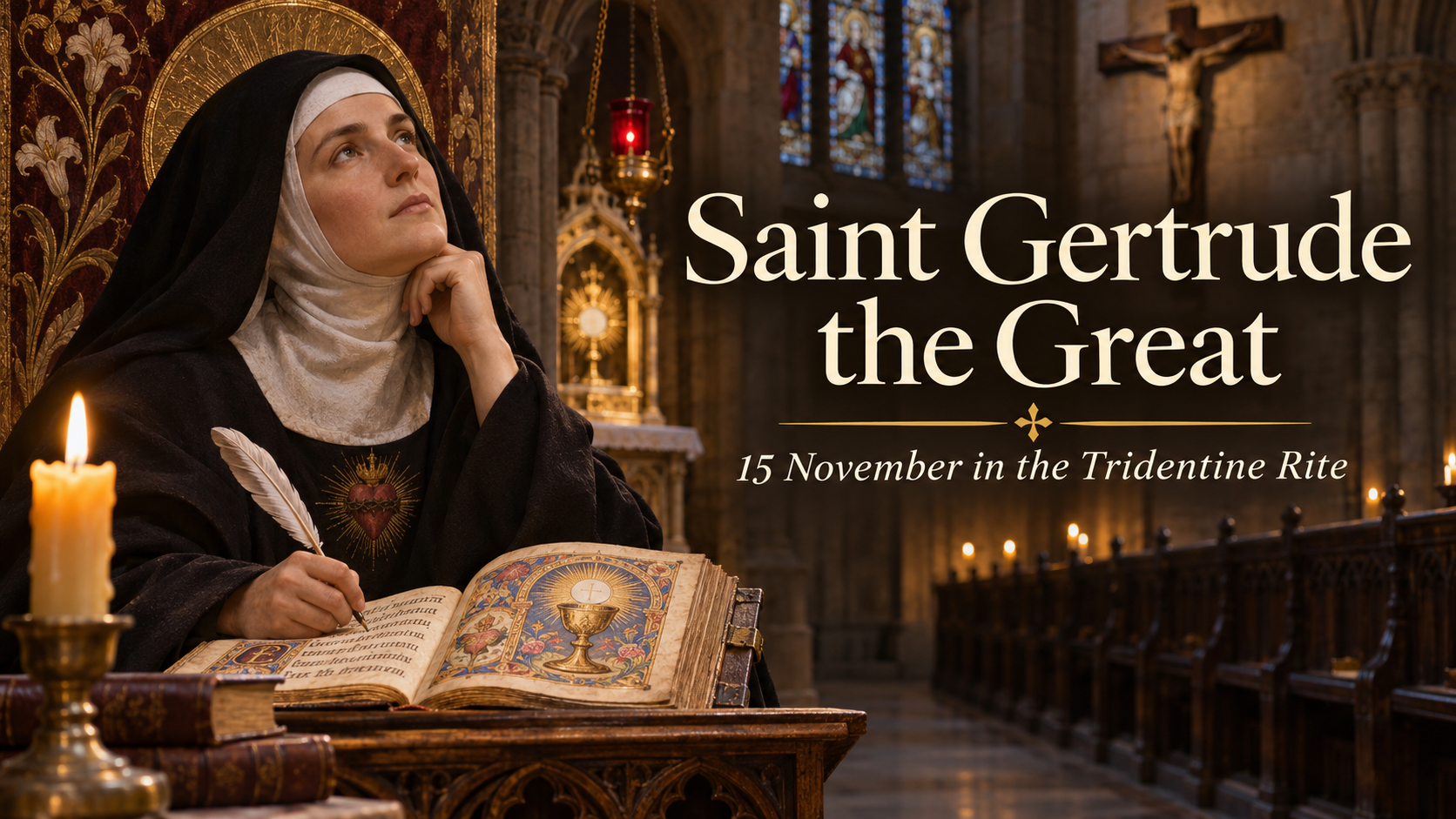
The Feast of 15 November in the Traditional Roman Rite: The Proper of the Mass, the Spirituality of Helfta and the Theology of Divine Love
The Roman Missal opens the feast of St Gertrude the Great with words from the forty-fourth Psalm: Dilexisti iustitiam et odisti iniquitatem. Thou hast loved justice and hated iniquity. They belong to a royal marriage-song which Christian tradition has long understood as celebrating Christ the King and His Bride, the Church. Their application to a thirteenth-century nun, whose religious life was spent within the walls of a Saxon monastery, reveals something of the Church’s understanding of sanctity. Gertrude founded no religious order and exercised no authority over the Church. Her distinction arose from an extraordinary interior life, nourished by Scripture, the Divine Office and the Holy Eucharist, through which she became one of the most influential spiritual writers of medieval Christendom.
The traditional Roman calendar commemorates St Gertrude on 15 November, although later editions of the Missal assign her feast to the following day. Clement XII extended her celebration to the universal Church in 1738, initially assigning 17 November, the anniversary traditionally associated with her death. The feast was moved to 15 November in 1739, preserving the established celebration of St Gregory Thaumaturgus on the seventeenth. The introduction of St Albert the Great into the universal calendar subsequently occasioned Gertrude’s transfer to 16 November in 1932. Under the earlier arrangement, her feast is a Double, celebrated in white vestments, with the Mass Dilexisti from the Common of Virgins and a Collect proper to the saint.¹
In 2026, the fifteenth falls on a Sunday. According to the earlier rubrics retained in the traditional Ordo, St Gertrude’s Double takes precedence over the ordinary Sunday, which is commemorated. The Mass consequently includes the Gloria and Creed, the Preface of the Most Holy Trinity, and the commemoration of the Twenty-fifth Sunday after Pentecost in the Collect, Secret and Postcommunion. The Sunday Gospel is read as the proper Last Gospel. Its formulary is that of the Sixth Sunday after Epiphany, resumed towards the conclusion of the ecclesiastical year. These provisions preserve the Sunday within the celebration while allowing the saint’s Mass to supply the principal liturgical texts.
Most of the Mass was composed for the wider commemoration of holy virgins, drawing upon the Church’s ancient interpretation of consecrated virginity as a sign of the soul’s espousal to Christ. Only the Collect names Gertrude and addresses her particular spiritual witness. Yet the inherited prayers, readings and chants acquire a striking relevance when considered alongside her writings. They speak of the divine Bridegroom, the preparation of the heart, the charity necessary for salvation and the consummation of Christian life in eternal communion with God.
Gertrude was born on 6 January 1256, although her birthplace and parentage remain unknown. At five years of age she entered the monastery of Helfta, near Eisleben, where she received an unusually comprehensive education in Latin literature, the liberal arts and the intellectual disciplines cultivated in the great monastic schools. Helfta’s religious life was shaped by Benedictine observance and strongly influenced by Cistercian spirituality, although its precise institutional affiliation has been disputed by historians.
The community brought together several remarkable women. Abbess Gertrude of Hackeborn governed the monastery during much of the saint’s lifetime; St Mechtilde of Hackeborn, the abbess’s sister, became her spiritual teacher; and Mechtilde of Magdeburg brought to Helfta the religious and literary tradition of the Beguines. Gertrude the Great belonged to this company as a professed religious and scholar, and was never herself abbess. Older accounts, including the traditional Breviary lessons, confused her with Gertrude of Hackeborn, attributing to her an abbacy which she never exercised and biographical details which cannot be reconciled with the better historical evidence. Her death is generally placed in 1301 or 1302, rather than the year 1292 given in the older legend.²
Gertrude possessed a formidable appetite for learning. She subsequently acknowledged that the pursuit of literature and human knowledge had occupied her affections more completely than was appropriate for one consecrated to God. On 27 January 1281, during the hour of Compline, she experienced the decisive spiritual illumination which redirected her life. In an encounter which she understood as a manifestation of Christ, she recognised the wounds of the Crucified Saviour and began a profound conversion of her intellectual and religious interests.
Pope Benedict XVI, in his general audience of 6 October 2010, described this change as a movement from secular literary studies towards sacred theology. Gertrude did not abandon learning. Her scholarship was placed at the service of divine revelation, and her subsequent writings exhibit an extensive knowledge of Scripture, patristic literature and the theological inheritance of the Church.³
The Introit, therefore, offers considerably more than an acknowledgement of an exemplary moral life. Psalm 44 is fundamentally Christological. The Epistle to the Hebrews applies its language of righteousness and divine anointing to the Son of God (Hebrews 1:8–9). The righteousness celebrated in the Psalm belongs supremely to Christ; the saints share in His holiness by grace. The Church employs these words in the Mass of a virgin because consecration to Christ is understood as a participation in His life, His charity and His victory over sin.
The accompanying psalm verse, Eructavit cor meum verbum bonum, possesses a meaning extending beyond the immediate celebration of the saint. St Augustine, in his exposition of Psalm 44, considers the verse in relation to the divine Word and the mystery of His eternal generation from the Father. He understands the Psalm as celebrating the heavenly Bridegroom and His Bride, the Church, united through the Incarnation and Redemption. Gertrude’s spiritual marriage belongs within this greater mystery. Her intimacy with Christ is intelligible because the Word became flesh, suffered for mankind and established His Church as the instrument of salvation.⁴
The Collect expresses the distinctive character of her sanctity with remarkable economy:
Deus, qui in corde beatae Gertrudis Virginis iucundam tibi mansionem praeparasti.
God is addressed as the One who prepared within Gertrude’s heart a dwelling pleasing to Himself. The prayer then asks that, through her merits and intercession, He might mercifully cleanse the stains from our own hearts and grant us the happiness of her heavenly company.
The initiative belongs to God. He prepares His dwelling through grace, and the human person responds through faith, charity, repentance and fidelity. Even the saint’s remarkable mystical experiences were gifts received rather than achievements independently acquired.
The Collect’s petition for the cleansing of the heart also guards against interpreting her spirituality as a succession of consoling religious experiences. Gertrude’s writings contain repeated admissions of weakness, negligence and spiritual unworthiness. Her awareness of divine favour increased her gratitude and her desire for conversion. She recognised that the heart could become a dwelling of God only through the work of divine mercy.
This language recalls Our Lord’s promise in St John 14:23 that the Father and the Son will make their abode with the person who loves Christ and keeps His word. It also expresses the Catholic doctrine of sanctifying grace: the soul is elevated to a supernatural participation in God’s life, and the indwelling of the Blessed Trinity belongs to those living in His friendship. Gertrude’s mystical descriptions give an unusually vivid expression to this reality, which belongs to the ordinary doctrine of Christian sanctification.
The Epistle, taken from 2 Corinthians 10:17–18 and 11:1–2, develops the same understanding from another direction. St Paul insists that the approved servant is the one commended by God, and speaks of his desire to present the faithful as a chaste virgin to Christ. The apostle addresses the Christian community, whose fidelity he describes under the image of marriage.
Its application to consecrated virginity is particularly appropriate, since religious profession gives a public and enduring expression to that dedication to God which belongs, according to their state, to all the baptised. Yet Gertrude’s life supplies a further lesson. Her learning, religious observance and extraordinary spiritual favours would have been fruitless without the humility and charity by which the soul is directed towards God. She understood that divine approval could never be secured through intellectual distinction or the possession of exceptional gifts.
The Gradual continues the imagery of Psalm 44, speaking of beauty, truth, meekness and justice. The Alleluia verse describes the procession of virgins brought joyfully before the King. These texts place consecrated virginity within the wider Christian understanding of heavenly glory. The beauty which renders the soul pleasing to Christ is chiefly the beauty of grace and virtue, perfected through charity.
Gertrude’s intellectual conversion gives this imagery particular force. Her early accomplishments were substantial, but she came to understand that knowledge must be ordered towards the love of God. Her writings retained the literary refinement and theological intelligence acquired through education, now employed in the service of prayer and the instruction of others.
The Gospel, Matthew 25:1–13, provides perhaps the most searching commentary upon the feast. Our Lord recounts the parable of the ten virgins, five wise and five foolish, who go out to meet the bridegroom. All carry lamps, and all await his arrival. The difference lies in their preparation. The wise have retained sufficient oil, while the foolish discover too late that their lamps cannot endure the delay.
The Fathers understood the parable as a warning concerning the necessity of persevering charity. St Augustine, in his sermon on the ten virgins, explains that they represent the Christian faithful more widely, and that the oil signifies the charity and inward righteousness without which outward observance cannot secure salvation. The foolish virgins may possess the appearance of virtue and perform works which attract human admiration, but they lack that interior disposition which renders their actions pleasing to God.
St John Chrysostom, in his seventy-eighth homily on St Matthew, develops the interpretation with particular reference to almsgiving and mercy. Virginity is a noble undertaking, but its excellence cannot excuse the absence of charity towards those in need. The parable warns against supposing that even the most demanding religious observances are sufficient when the fundamental obligations of Christian love have been neglected.⁵
These patristic interpretations illuminate Gertrude’s witness. Her religious vocation involved the renunciation of marriage and the observance of monastic discipline, but the spiritual worth of that renunciation depended upon the love of Christ which animated it. Her devotion to the Sacred Heart was inseparable from her concern for the salvation of souls, her intercessory prayer and her efforts to communicate divine truth through her writings.
At Helfta, contemplative life was understood as an offering made for the Church. Gertrude’s prayers extended beyond her own salvation, embracing the needs of others and the faithful departed. The charity demanded by the Gospel could therefore be exercised within the cloister through the duties of community life, counsel, spiritual assistance and intercession.
Her association with the Sacred Heart deserves particular attention, since her writings preceded the revelations granted to St Margaret Mary Alacoque by several centuries. Gertrude contemplated the Heart of Christ as the manifestation of His divine love, especially in His Passion and in the Holy Eucharist. She spoke of the wounds of the Saviour as the means by which divine mercy reached the soul, and of His Heart as a place of refuge, consolation and intimate communion.
Blessed Cardinal Ildefonso Schuster, in his Liber Sacramentorum, distinguished the spiritual character of the revelations associated with Gertrude from those subsequently granted to St Margaret Mary. For Gertrude, devotion to the Heart of Jesus was intimately bound to the whole mystery of Christ as encountered through the Church’s liturgy. The Incarnation, Passion and Eucharistic sacrifice were contemplated in the light of the divine love which they revealed. Her spirituality did not depend upon a devotional structure separated from the ordinary worship of the Church.⁶
Dom Prosper Guéranger made substantially the same observation when discussing the saint in The Liturgical Year. Gertrude’s writings were permeated with the language of Scripture and the Divine Office. Her reported mystical experiences frequently occurred while she was praying the Church’s appointed texts, and their imagery reflected the psalms, antiphons, responsories and prayers which formed her daily religious life.
The saints and mysteries encountered throughout the liturgical year were for Gertrude living realities, contemplated through the sacramental and devotional life of the Church. The sacred texts supplied the language through which her spiritual experiences were understood and expressed.⁷
Her Spiritual Exercises demonstrate the same relationship. The seven exercises draw upon the rites and mysteries of Baptism, religious profession, the Divine Office and preparation for death. They concern the renewal of baptismal grace, the purification of the soul and its readiness for final union with Christ.
The Herald of Divine Love, composed partly by Gertrude herself and partly by other members of her community, likewise reveals a profoundly liturgical understanding of Christian life. Its visionary accounts must be read with proper regard for their literary composition and the distinction between Gertrude’s own writings and those recorded by her companions. Modern scholarship generally identifies Book II as substantially her own work, while the remaining books represent the literary and devotional activity of the Helfta community.⁸
The Offertory returns to Psalm 44 and its image of the queen standing at the right hand of the king, clothed in splendour. Within Christian exegesis, the figure of the queen has been understood principally in relation to the Church, and also applied to the Blessed Virgin Mary. The individual virgin saint participates in the splendour of the heavenly Bride through her membership of Christ’s redeemed people.
Gertrude’s devotion to the Blessed Virgin was considerable. She regarded Our Lady as her mother and protectress, and her mystical writings repeatedly associate Marian intercession with the soul’s approach to Christ. The splendour of the saints proceeds from Christ, whose grace makes them holy, while the honour given to them is ultimately referred to God.
The Secret asks that the offering of God’s people may be acceptable to Him in honour of His saints, through whose merits the faithful recognise that they have received assistance in tribulation. This prayer, drawn from the Common, places the commemoration of Gertrude within the sacrificial action of the Mass. She is honoured as a member of the Church triumphant and invoked as an intercessor, while the Eucharistic sacrifice remains directed to God alone.
The Communion antiphon returns to the Gospel’s wise virgins, whose lamps remain ready for the coming of the bridegroom. Its position within the Mass gives the parable a particular sacramental resonance. The faithful who have heard the warning concerning the necessity of preparation now approach the altar to receive Christ in the Blessed Sacrament. The heavenly Bridegroom, whose final coming is awaited, is already sacramentally present under the appearances of bread and wine.
For Gertrude, devotion to the Eucharist occupied a central place in her spiritual life. Her writings bear witness to a profound awareness of the love of Christ manifested in the gift of His Body and Blood. The preparation of the soul for Holy Communion, thanksgiving following its reception and the desire for complete union with Christ belong among her recurring spiritual concerns.
The Communion antiphon thus expresses something fundamental to her experience. The vigilance demanded by the Gospel is sustained by grace, received through the sacramental life of the Church. Holy Communion strengthens charity and prepares the faithful for that eternal communion with God towards which Christian life is directed. The wise virgins represent those who persevere in readiness for the Bridegroom; Gertrude’s devotion to the Blessed Sacrament illustrates the means by which such readiness may be cultivated.
The Postcommunion completes this movement. Having received the sacred gifts, the faithful ask that God will continue to sustain them through the intercession of the saint whose festival they celebrate. The prayer joins Eucharistic nourishment to the continuing demands of Christian life. Participation in the sacred mysteries is intended to bear fruit in perseverance, charity and the purification of the heart.
There is particular appropriateness in celebrating Gertrude during November, when the Church’s liturgy turns increasingly towards death, judgement and eternal life. Her writings contain reflections upon the soul’s final passage to God, together with prayers for the faithful departed. Her seventh Spiritual Exercise concerns preparation for death, understood in the light of Christ’s mercy and the hope of eternal union with Him.
The association must be understood according to the Church’s established doctrine. The widely circulated prayer attributed to St Gertrude, sometimes accompanied by a promise that its recitation releases precisely one thousand souls from Purgatory, has no established basis in her authenticated writings. Such numerical assurances find no warrant in the Church’s authoritative teaching on indulgences and suffrages for the dead. Gertrude’s genuine spiritual inheritance offers substantial encouragement to pray for the departed without attaching unsupported promises to particular devotional formulae.⁹
The commemoration of the occurring Sunday adds another dimension to the celebration in 2026. The resumed Sixth Sunday after Epiphany presents the parables of the mustard seed and the leaven (Matthew 13:31–35). Both describe the kingdom of heaven through the growth and transforming action of something initially small and easily overlooked.
Gertrude’s influence offers a remarkable historical illustration. Her life was concealed within a religious community in medieval Saxony. Her writings were composed principally for the spiritual assistance of her sisters, and much of the material which eventually circulated under her name was preserved through the literary work of the community itself. Yet those writings were transmitted, translated and studied across succeeding centuries, becoming part of the wider devotional and theological inheritance of Western Catholicism.
The Mass of St Gertrude presents the Church’s understanding of holiness with considerable theological precision. Its opening Psalm places all sanctity within the mystery of Christ and His Bride. The Epistle identifies the soul’s consecration to the divine Bridegroom, while the Gradual and Alleluia celebrate the beauty of virtue and the hope of heavenly glory. The Gospel demands persevering charity, the Offertory places the saint within the communion of the redeemed, and the Eucharistic prayers direct the faithful towards sacramental nourishment and continuing sanctification.
The Collect supplies the particular interpretation of Gertrude’s witness. God prepared a dwelling for Himself within her heart; through her intercession, the Church asks that the same divine mercy may cleanse the hearts of those who celebrate her feast. Here the richness of her mystical writings finds its proper theological measure. Their value rests upon the extent to which they lead the faithful into a deeper understanding of the mysteries already revealed by Christ and entrusted to His Church.
Gertrude’s greatness lay in the degree to which she allowed those mysteries to govern her intellect, her affections and her religious life. The Divine Office supplied the words of her prayer, the Scriptures instructed her understanding, and the Eucharist nourished her union with the Saviour. The Collect asks for a share in the holiness which God wrought within her, while the Gospel provides the necessary warning that the soul must remain prepared for the coming of its Lord. The heart which welcomes Christ in this life must be made ready to behold Him in eternity.
¹ Institut du Christ Roi Souverain Prêtre, Sainte Gertrude, vierge: Textes liturgiques; Nuntiatoria, Traditional Roman Ordo: Liturgical Week, 15–22 November 2026.
² The Catholic Encyclopedia, St Gertrude the Great; Benedict XVI, General Audience: Saint Gertrude the Great, 6 October 2010.
³ Benedict XVI, General Audience: Saint Gertrude the Great, 6 October 2010.
⁴ St Augustine, Exposition on Psalm 45, corresponding to Psalm 44 in the Vulgate numbering; Missale Meum: Mass of St Gertrude the Great.
⁵ St Augustine, Sermon 43 on the New Testament (93 in the Benedictine numbering); St John Chrysostom, Homily 78 on Matthew.
⁶ Blessed Ildefonso Schuster, Liber Sacramentorum, commentary on St Gertrude, reproduced in Textes liturgiques: Sainte Gertrude.
⁷ Dom Prosper Guéranger, The Liturgical Year, Volume XV, 15 November: St Gertrude.
⁸ Kevin Magas, St Gertrude and St Mechtilde: Liturgical Mystics, Adoremus; Meret Wüthrich and Racha Kirakosian, Review of Alexandra Barratt’s translation of The Herald of God’s Loving-Kindness, The Medieval Review, 2021.
⁹ Fr Silas Henderson SDS, Saint Gertrude the Great: Friendship with the Lord Jesus.







Leave a Reply