
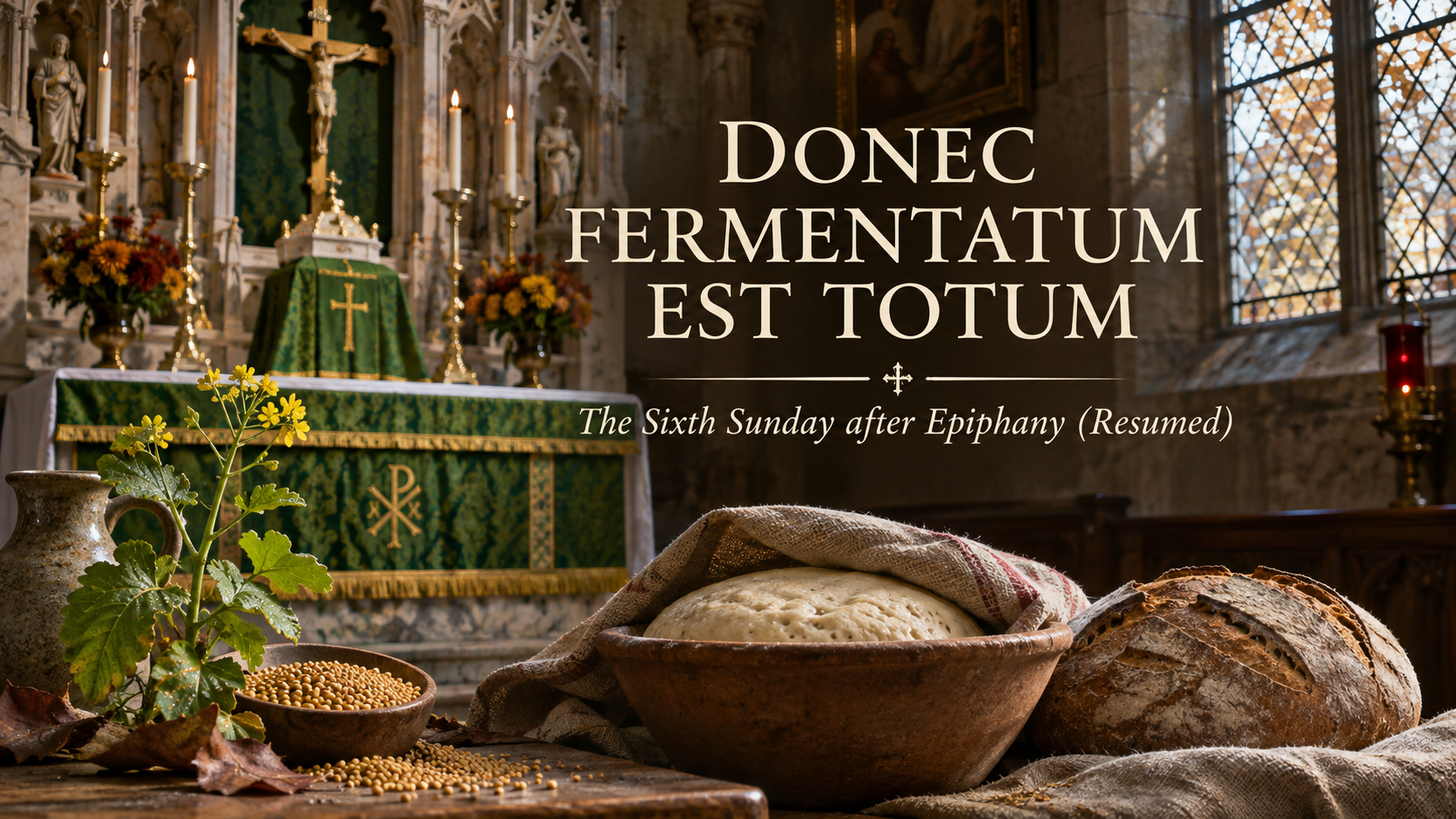
Until the Whole Was Leavened: The Mustard Seed, the Growth of Christ’s Kingdom and the Work of Divine Grace
The parables of the mustard seed and the leaven reveal how Christ establishes and extends His Kingdom through the supernatural power of grace. Heard towards the end of the ecclesiastical year, alongside St Paul’s exhortation to await the returning Saviour, they disclose the purpose of the Church’s earthly mission and the interior transformation required of those who belong to her. The Fathers, scholastic theologians and traditional liturgical commentators find in these familiar images an account of the Church’s indefectibility, the efficacy of the Gospel and the Christian’s responsibility to cooperate with grace.
Epistle: 1 Thessalonians 1:2–10 | Gospel: St Matthew 13:31–35 | Mass: Dicit Dominus | Liturgical colour: Green
Having considered last Sunday the wheat and the cockle, and the patience of Almighty God in permitting both to remain until the harvest, the Roman liturgy now returns to the same chapter of St Matthew’s Gospel and continues Our Lord’s teaching upon the Kingdom of Heaven. The servants in the previous parable had been troubled by the presence of evil within their master’s field. Christ now directs attention to the extraordinary power of the good seed itself. A grain scarcely worth noticing becomes a tree capable of sheltering the birds of the air. A small quantity of leaven, concealed within a considerable measure of flour, transforms the entire mass.
The order of these parables deserves attention. Our Lord has spoken of the different kinds of soil upon which the word of God is sown, of an enemy who introduces corruption amongst the growing wheat, and of the necessity of awaiting the harvest. His disciples might reasonably have wondered how the Kingdom could prosper amidst such difficulties. They were few, their resources insignificant, their Master opposed by influential religious authorities, and the world into which they were to carry His Gospel appeared overwhelmingly hostile to its demands.
St John Chrysostom recognised precisely this difficulty. In his forty-sixth homily upon St Matthew, he explains that the parable of the mustard seed follows the account of the cockle to reassure the disciples that the Gospel will spread despite opposition and apparent losses. Their small number is no measure of the power entrusted to them. Christ is preparing them to understand a work whose accomplishment will exceed every reasonable expectation founded upon their merely human capacities.¹
That teaching acquires a particular character when the Sixth Sunday after Epiphany is celebrated towards the conclusion of the ecclesiastical year. The parables originally belong to the season in which the Church continues to contemplate the manifestation of Christ to the nations. Their appearance in November places them within the liturgical approach to the Last Judgement, when the Kingdom proclaimed throughout the world will be brought to its consummation.
In 2026, the Sixth Sunday after Epiphany supplies the prayers and readings for the Twenty-fifth Sunday after Pentecost, 15 November. The Collect, Epistle, Gospel, Secret and Postcommunion are those of the Sixth Sunday after Epiphany, whilst the Introit, Gradual, Alleluia, Offertory and Communion are taken from the Twenty-third Sunday after Pentecost. The final Sunday before Advent, 22 November, retains the proper Mass of the Last Sunday after Pentecost. This is the traditional Roman arrangement for accommodating the Sundays omitted after Epiphany because of the variable date of Easter.²
Michael P. Foley, examining the resumed Sundays in his liturgical studies, suggests that they might more accurately be described as reconfigured. Their texts are heard within a different season and acquire a different emphasis through their association with the prayers and chants of the closing weeks after Pentecost. The conversion of the Gentiles, particularly prominent during Epiphany, is now considered in the light of the Church’s progress towards the fulfilment of history.³
The Introit, Dicit Dominus, establishes this perspective:
Dicit Dominus: Ego cogito cogitationes pacis, et non afflictionis: invocabitis me, et ego exaudiam vos: et reducam captivitatem vestram de cunctis locis.
“The Lord saith: I think thoughts of peace, and not of affliction: you shall call upon Me, and I will hear you: and I will bring back your captivity from all places.”
These words from Jeremias 29:11–14 were originally addressed to a people living in exile, whose immediate circumstances offered little encouragement to believe that their national and religious life could be restored. Jerusalem had been devastated, the Temple destroyed and the people dispersed. Yet the Lord declared that His purposes remained directed towards their restoration. The promise would be accomplished according to His providence, rather than according to the expectations of those who were suffering.
There is a close relationship between this prophetic assurance and the mustard seed. The Kingdom of God cannot be judged exclusively from its present outward circumstances. What appears defeated may already contain the principle of its renewal. What seems insignificant may become the instrument through which Almighty God accomplishes His greatest works.
The distinction is important, particularly when applied to the visible condition of the Church. The promise of indefectibility does not guarantee that every diocese, religious community, ecclesiastical institution or local mission will prosper continuously. History supplies enough examples of flourishing Christian societies which have declined, sometimes through persecution and sometimes through the infidelity of their own members. The ancient churches of North Africa, which gave Christianity such considerable figures as St Cyprian and St Augustine, did not retain their former strength indefinitely. Nor did the disappearance of particular Christian communities extinguish the Catholic Church.
The divine promises concern the Church founded by Christ, whose essential constitution, supernatural mission and means of salvation He preserves. Particular institutions remain capable of serious failure. Indeed, they may become so preoccupied with their own preservation that they neglect the very supernatural purpose for which they were established.
Dom Prosper Guéranger, commenting upon this Sunday in The Liturgical Year, understands the mustard seed as an image of the Word of God, initially confined to a small part of the world, apparently defeated through the death of Christ, yet destined to spread throughout the nations. The Church’s continued existence through persecution, doctrinal controversy and political upheaval is evidence of a vitality which cannot be adequately explained by the ordinary resources of human institutions.⁴
The Collect brings that confidence into the immediate obligations of the individual Christian:
Praesta, quaesumus, omnipotens Deus: ut, semper rationabilia meditantes, quae tibi sunt placita, et dictis exsequamur et factis.
“Grant, we beseech Thee, almighty God, that, ever meditating upon reasonable and spiritual things, we may accomplish, both in words and deeds, those things which are pleasing to Thee.”
The prayer is an admirable example of the theological precision characteristic of the ancient Roman sacramentaries. Its vocabulary is economical, yet the relationship between reason, spiritual understanding, the divine will and human action is carefully expressed.
Father John Zuhlsdorf, in his examination of this Collect, draws particular attention to rationabilia. The adjective derives from ratio, carrying associations of reason, intelligent understanding and the properly ordered activity of the human mind. In Christian liturgical Latin its meaning reaches beyond what modern English ordinarily describes as reasonable conduct.
The Christian is a rational creature made in the image of God, possessing intellect and free will. Those faculties have been wounded by original sin, yet remain capable, under the assistance of grace, of knowing truth and choosing the good. The petition therefore concerns the restoration and right employment of those powers in the service of Almighty God.
The association with Romans 12:1 is illuminating. St Paul exhorts Christians to present their bodies as living sacrifices, holy and pleasing to God, describing this offering as rationabile obsequium vestrum, their reasonable or spiritual service. Worship involves the whole person. The intellect must recognise the truth, the will must embrace the good, and the body must participate in the obedience which expresses that interior disposition.
Fr Zuhlsdorf observes that the Collect appears in the eighth-century Gregorian Sacramentary. Its continued use across the centuries preserves an understanding of Christian worship in which the deliberate exercise of intellect and will has an indispensable place. The words semper rationabilia meditantes require more than occasional religious reflection. They envisage a mind habitually occupied with the truths which ought to govern human conduct.⁵
The conclusion, et dictis exsequamur et factis, gives the prayer its necessary practical direction. The verb exsequi signifies carrying something out or bringing it to fulfilment. It is insufficient merely to recognise what pleases God. That recognition must govern speech and conduct.
There is an unmistakable connection with the Gospel. The mustard seed must actually grow. The leaven must penetrate the flour. A Christian who possesses correct religious opinions without permitting them to govern his conduct has interrupted the very process which Our Lord describes. Orthodoxy is necessary because falsehood cannot sanctify the intellect. Yet the truth which is believed must also be loved and obeyed.
This has particular importance for participation in the sacred liturgy. Attention, understanding, recollection and the deliberate offering of oneself in union with the Sacrifice of Christ constitute genuine interior participation. The activity of the soul cannot be measured by outward movement or audible performance. A person kneeling silently at Mass may be exercising his intellect and will more deliberately than another whose external occupations leave little room for recollection.
Such participation requires preparation. The faithful must learn the meaning of the prayers, understand the nature of the Holy Sacrifice, examine their consciences and approach the sacraments with the dispositions proper to their reception. The Collect assumes that divine worship ought to form the whole manner of Christian living.
St Paul, in the Epistle, supplies a remarkable example of what happens when the Gospel is received in this way.
Writing to the Thessalonians, the Apostle gives thanks for the work of their faith, the labour of their charity and the endurance of their hope in Our Lord Jesus Christ. The three theological virtues appear already in the opening verses, though they are described through their effects. Faith produces works, charity labours, and hope perseveres.
These Christians had not merely accepted a new religious vocabulary. They had abandoned idolatry, endured opposition and become examples to believers throughout Macedonia and Achaia. Their conversion had consequences which others could recognise.
St Paul recalls the manner in which the Gospel reached them:
Quia Evangelium nostrum non fuit ad vos in sermone tantum, sed et in virtute, et in Spiritu Sancto, et in plenitudine multa.
“For our Gospel hath not been unto you in word only, but in power also, and in the Holy Ghost, and in much fulness.”
The Apostle does not depreciate preaching. Faith comes through hearing the word of Christ, and the Church cannot fulfil her mission without proclaiming the truths entrusted to her. He is distinguishing the mere communication of words from the supernatural efficacy of the Gospel when received through the action of the Holy Ghost.
The preaching of St Paul was accompanied by a power which no natural eloquence could supply. Those who received the Faith were brought into a new relationship with Almighty God. Through Baptism they became members of Christ, received sanctifying grace and entered upon a life whose obligations differed profoundly from those of the pagan society around them.
The Thessalonian community had been established amid considerable difficulties. The account in Acts 17 describes opposition to Paul’s preaching and the disturbances which followed. These were recent converts, lacking the advantages of generations of Christian formation. Yet their faith had already become sufficiently evident for the Apostle to commend them to other communities.
Dom Guéranger makes a pointed comparison between these first Christians and those born into societies possessing a long Christian inheritance. The Thessalonians had only recently turned from idols. Their descendants in later Christian centuries might possess churches, schools, inherited customs and extensive religious instruction, yet nevertheless exhibit less fervour than those who had first received the Gospel.
The comparison remains uncomfortable. A Christian civilisation may preserve the material evidence of former belief long after the supernatural life which produced it has declined. Churches can remain standing when congregations have disappeared. Religious language may survive in public ceremonies after those employing it have ceased to attach much importance to its doctrinal meaning. Even within communities explicitly committed to traditional worship, familiarity may gradually replace devotion unless the faithful continue to cooperate with grace.⁶
The Apostle therefore praises something considerably more demanding than cultural continuity.
Et vos imitatores nostri facti estis, et Domini, excipientes verbum in tribulatione multa, cum gaudio Spiritus Sancti.
“And you became followers of us, and of the Lord; receiving the word in much tribulation, with joy of the Holy Ghost.”
Their fidelity was tested by suffering. The joy which accompanied it was a fruit of the Holy Ghost, arising from their participation in Christ rather than from any absence of hardship.
The Thessalonians became examples because they lived according to the Faith which they had received. Their conduct gave credibility to the preaching of the Apostles. Indeed, St Paul declares that their reputation had spread so widely that he scarcely needed to explain what had happened amongst them.
Considerable attention in contemporary Catholic evangelisation is devoted to communication strategies, institutional presentation, public relations and methods for making Christian teaching more acceptable to prevailing opinion. Yet the early Church possessed none of the resources which modern organisations consider indispensable. Its missionaries proclaimed Christ, celebrated the sacred mysteries, instructed converts and formed communities whose lives were recognisably governed by supernatural convictions.
Their success depended upon grace. They nevertheless understood the necessity of conversion, and they expected the lives of the baptised to exhibit the consequences of belonging to Christ.
The Gospel’s first parable offers the appropriate image:
Simile est regnum caelorum grano sinapis, quod accipiens homo seminavit in agro suo: quod minimum quidem est omnibus seminibus: cum autem creverit, majus est omnibus oleribus, et fit arbor, ita ut volucres caeli veniant et habitent in ramis ejus.
“The Kingdom of Heaven is like to a grain of mustard seed, which a man took and sowed in his field: which is the least indeed of all seeds; but when it is grown up, it is greater than all herbs, and becometh a tree, so that the birds of the air come and dwell in the branches thereof.”
The comparison is deliberately drawn from ordinary experience. Christ is speaking of a very small seed which, when cultivated, produces a plant remarkably large in proportion to its beginning. The agricultural image is sufficient for the purpose of the parable. Its meaning does not depend upon establishing that mustard is botanically the smallest seed in existence.
The Fathers understood the image at several complementary levels.
St Jerome regards the mustard seed as the preaching of the Gospel, whose beginnings appeared contemptible when compared with the intellectual prestige of the ancient philosophical schools. Christianity proclaimed a crucified Saviour, a God made man, and salvation through a death which appeared humiliating to the world. Those accustomed to judging religious systems according to the sophistication of their public presentation could scarcely imagine that such preaching would transform the Roman world.
Jerome finds a spiritual application in the human heart. The seed of divine teaching, initially received through faith, grows when properly nourished, until the soul becomes capable of understanding and possessing truths which once appeared beyond it. The various branches of the tree signify the richness of Christian doctrine, in which souls aspiring to heavenly things may find nourishment and rest.
St Gregory the Great, writing in his Moralia in Job, develops a more explicitly Christological interpretation. The mustard seed signifies Christ Himself, Who was apparently reduced to helplessness through His Passion and laid within the earth at His burial. From that apparent defeat came the triumph of the Resurrection. The smallness of the seed represents the humiliation of the Incarnation and Passion; the greatness of the tree manifests the glory and power of the risen Redeemer.
St Hilary of Poitiers likewise sees in the seed an image of Christ, Whose strength was revealed through the suffering and death which His enemies believed would accomplish His destruction.
These interpretations have been gathered by St Thomas Aquinas in his Catena Aurea, where the Fathers illuminate different aspects of the same Gospel passage.⁷
The Christological interpretation establishes the foundation of the ecclesiological one. The Church grows because she belongs to Christ, possesses His doctrine and receives supernatural life from Him. Her vitality does not originate independently of her divine Founder. The grain which was buried and rose again is the source of the life subsequently manifested throughout His mystical Body.
Father Henry James Coleridge SJ, in The Training of the Apostles, considers the extraordinary disparity between the Church’s first appearance and her subsequent historical influence. The Apostles possessed little worldly standing. Their first communities could scarcely have appeared threatening to the immense political and religious machinery of the Roman Empire. Yet a movement dismissed as an insignificant superstition gradually established itself throughout the imperial territories and beyond.
Coleridge also considers the application of this parable to individual holiness. A single sanctified soul can exercise an influence upon others wholly disproportionate to its public importance. The patience, wisdom, charity and persevering prayer of such persons provide support to those around them, often without any deliberate intention of acquiring influence. The saints become instruments through which the life of Christ reaches others.⁸
This deserves careful attention in an age which frequently confuses religious effectiveness with visibility. The faithful may be tempted to measure the value of an apostolate by its public recognition, numerical growth or influence upon ecclesiastical affairs. These matters have their place, but they cannot provide a sufficient judgement upon its supernatural fruitfulness.
An elderly priest who faithfully celebrates Mass, hears confessions and instructs a small congregation may accomplish more for the salvation of souls than an institution whose public standing is considerably greater. A mother who teaches her children their prayers, forms their consciences and provides an example of patient charity may influence generations she will never meet. The consequences of these actions remain largely concealed from ordinary historical records. They are nevertheless included within the providential government of God.
One must not turn the parable into a justification for negligence or a romantic attachment to smallness. Christ commands His Church to teach all nations. Her missionary obligation is universal, and genuine growth is a cause for gratitude. Yet the seed grows according to the power of the life it contains. Mere numerical expansion, purchased at the cost of doctrinal compromise, would be a poor imitation of the process described by Our Lord.
The tree in the Gospel has grown from the original seed. Its identity has not been exchanged for something more agreeable to the surrounding world.
The second parable brings the interior character of this transformation into sharper focus:
Simile est regnum caelorum fermento, quod acceptum mulier abscondit in farinae satis tribus, donec fermentatum est totum.
“The Kingdom of Heaven is like to leaven, which a woman took and hid in three measures of meal, until the whole was leavened.”
Here the image changes. The mustard seed becomes a great tree through growth from within. Leaven transforms a quantity of flour by penetrating it. The emphasis falls upon the efficacy of something introduced into a substance which then undergoes a profound alteration.
Chrysostom considers this an encouragement to the Apostles concerning the immense work awaiting them. The leaven is initially small compared with the flour, yet its power is sufficient to affect the entire quantity. The disciples should therefore be neither discouraged by their number nor intimidated by the opposition which they will encounter.
The leaven must, however, enter the flour. Its transforming action depends upon contact. Chrysostom draws from this the missionary obligation to enter the world and bring the Gospel to those who have not received it.
There is no warrant here for the notion that the Church ought to adopt the errors of the world in order to influence it. The direction of the transformation is quite clear. The flour becomes leavened through the action of the leaven. The leaven does not cease to possess its distinctive quality in order to become indistinguishable from the flour.
The theological distinction is elementary, although not always maintained in discussions of evangelisation. The Church must proclaim the Gospel to the world, entering the ordinary circumstances of human life and addressing men according to their actual condition. She must understand the languages, difficulties and legitimate aspirations of those whom she seeks to convert. Yet her mission remains the communication of revealed truth and supernatural grace.
Were she to surrender those truths which distinguish Christianity from unbelief, she would deprive herself of the very means by which she is commanded to transform the world.
The Fathers provide several interpretations of the three measures of flour. Chrysostom regards the number principally as indicating a considerable quantity. St Augustine, in his Questions on the Gospels, identifies the leaven with charity and the woman with wisdom. He suggests that the three measures may signify the whole human person, whose heart, soul and mind must be transformed by divine love.
St Jerome offers a related interpretation, understanding the woman as the Church or apostolic preaching and the three measures as spirit, soul and body. The Gospel is to establish harmony throughout the whole person, so that intellect, affections and bodily conduct are directed towards God.
Other ancient commentators associate the three measures with the nations descended from the three sons of Noe, an interpretation subsequently adopted by Dom Guéranger in considering the Church’s universal mission. St Hilary, however, records this explanation whilst questioning whether it adequately accounts for the parable. Such differences are characteristic of patristic spiritual exegesis. They disclose possible theological significations of the image without requiring every numerical detail to possess one exclusive meaning.⁹
Cornelius a Lapide, in his extensive commentary upon St Matthew, gathers these explanations and considers the leaven particularly in relation to the transforming action of charity. He records the Augustinian understanding of divine love as a power which penetrates and directs the whole interior life. The Christian’s intellect, will and affections must increasingly be governed by the love of God.
This interpretation brings the Gospel into close agreement with the Collect. The prayer asks that the Christian should meditate upon spiritual things and accomplish what pleases God in words and deeds. The leaven describes the supernatural transformation necessary for such conduct to become habitual.
Charity, as a theological virtue infused by God, is more than an agreeable sentiment or a general disposition towards benevolence. It is the supernatural love by which the soul loves Almighty God above all things for His own sake, and loves its neighbour for God’s sake. Its possession presupposes sanctifying grace. Its exercise directs the moral virtues towards man’s supernatural end.
The distinction matters because the effects of charity may resemble certain natural virtues without being identical to them. A person may be generous, patient or compassionate through temperament, education or natural affection. These are genuine human goods. Yet supernatural charity belongs to a higher order, since it unites the soul to God and directs human action towards eternal life.
The leaven therefore represents a transformation deeper than the improvement of social manners.¹⁰
The Fathers and subsequent Catholic commentators also understood the leaven as an image of the Catholic Faith’s power to form entire societies. Christian doctrine influenced the understanding of marriage, the care of the poor, the obligations of rulers, the dignity of human life, education and the administration of justice. These changes did not arise immediately or uniformly. Nor did Christian societies ever become free from sin. Nevertheless, the influence of revealed truth upon law, custom and public morality formed a considerable part of the Church’s historical mission.
It is worth remembering that these developments required Christians who actually believed the doctrines they professed. A society cannot be sanctified by religious language alone. The Gospel must enter consciences before its moral consequences can be sustained in public institutions.
The decline of Christian practice in formerly Catholic countries illustrates the same principle in reverse. The outward remains of Christian civilisation may continue for generations, while the convictions which originally sustained them gradually disappear. The consequence is often a curious condition in which inherited moral conclusions are still defended, though the theological premises which made them intelligible have been abandoned.
The remedies proposed for such decline frequently concentrate upon institutional adaptation, social relevance or the recovery of public influence. Yet Our Lord’s teaching directs attention to the supernatural principle itself. The Church’s influence follows from the communication of divine truth and grace. Where these are neglected, neither administrative reorganisation nor fashionable language can supply their absence.
There is also a distinction between the leaven of the Kingdom and other forms of leaven mentioned in Scripture. Christ elsewhere warns against the leaven of the Pharisees, which St Luke identifies with hypocrisy. St Paul employs the same image in warning that a little leaven can corrupt the whole lump. The image therefore signifies a penetrating influence whose moral character depends upon what is being communicated.
The Christian must exercise discernment. Religious opinions, habits of thought and moral practices can spread through a community without attracting much attention. This occurs with error as readily as with truth. The difference lies in the source and character of the influence, and in whether it brings those affected into greater conformity with Christ.
The final verses of the Gospel give these parables an additional significance.
Haec omnia locutus est Jesus in parabolis ad turbas: et sine parabolis non loquebatur eis: ut impleretur quod dictum erat per Prophetam dicentem: Aperiam in parabolis os meum, eructabo abscondita a constitutione mundi.
“All these things Jesus spoke in parables to the multitudes: and without parables He did not speak to them. That it might be fulfilled which was spoken by the prophet, saying: I will open My mouth in parables, I will utter things hidden from the foundation of the world.”
St Matthew here invokes Psalm 77:2 in the Vulgate numbering, a psalm associated with Asaph which recounts God’s dealings with Israel. The history of the chosen people is presented as a lesson in divine providence, human infidelity and the enduring obligations of the covenant.
Christ’s use of parables belongs to the disclosure of mysteries whose full meaning could only be understood in relation to His Person and saving work. The Kingdom had been promised through the prophets, but its establishment through the Incarnation, Passion, Resurrection and mission of the Apostles would exceed the expectations of those awaiting its arrival.
St Jerome, whose explanation St Thomas preserves in the Catena Aurea, examines the prophetic attribution of this passage and its relationship to the Psalm of Asaph. He discusses textual variants in which the prophecy was attributed to Isaias, considering whether the original reference had been to Asaph. His concern is to establish the relationship between the Evangelist’s words and the inspired text.
Christ appears as the fulfilment of Israel’s sacred history, bringing to completion the divine promises and making known their deepest meaning.¹¹
This is why the Epistle’s reference to the conversion of the Thessalonians is so appropriate. The Gentiles who once served idols have become worshippers of the true God. They have entered the Kingdom foretold by the prophets and established by Christ. The mustard seed has grown beyond the boundaries of Judea, and the leaven of the Gospel has entered the nations.
Yet the Apostle concludes with an explicitly eschatological declaration:
Et exspectare Filium ejus de caelis (quem suscitavit ex mortuis) Jesum, qui eripuit nos ab ira ventura.
“And to wait for His Son from heaven (Whom He raised up from the dead), Jesus, Who hath delivered us from the wrath to come.”
The Thessalonians had turned from idolatry to serve the living and true God, and they now awaited the return of His Son. Their conversion possessed both a present and a future character. They had already received the Faith and entered the supernatural life, but their final hope concerned the coming of Christ and the definitive fulfilment of His promises.
The position of this Epistle near the conclusion of the ecclesiastical year brings that expectation into particular prominence. Christ’s Kingdom is already present in the world through the Church and the operation of grace. Its final manifestation belongs to the consummation of history.
This prevents a mistaken interpretation of the leaven as a promise that every individual will eventually become Christian, or that human history must necessarily develop into a period of universal earthly righteousness. Such conclusions cannot be reconciled with Our Lord’s warnings concerning sin, apostasy and judgement.
The Church’s mission is universal, and her divine Founder has promised that she will endure. The precise course of her earthly history remains subject to providence. Her triumph is certain because Christ is victorious, although its final manifestation is heavenly.
The Gradual and Alleluia express the confidence and supplication appropriate to that expectation.
Liberasti nos, Domine, ex affligentibus nos: et eos, qui nos oderunt, confudisti.
“Thou hast delivered us, O Lord, from those who afflict us, and hast put to shame those who hate us.”
The words from Psalm 43 acknowledge divine deliverance even while the Church continues to experience opposition. They are followed by the Alleluia verse from Psalm 129:
De profundis clamavi ad te, Domine: Domine, exaudi orationem meam.
“Out of the depths have I cried unto Thee, O Lord: Lord, hear my prayer.”
The same cry returns at the Offertory, when the Church approaches the offering of the Holy Sacrifice. The conjunction is striking. The Gospel has promised the extraordinary growth of the Kingdom, yet the Church continues to pray from the depths of human need.
As Nuntiatoria observed in its recent examination of the De profundis, the psalm possesses particular importance in November through its traditional association with prayer for the faithful departed. Its use in this Mass embraces the whole condition of the Church Militant, whose members continue to require mercy, forgiveness and perseverance.¹²
The Secret develops the sacrificial and sanctifying character of that dependence:
Haec nos oblatio, Deus, mundet, quaesumus, et renovet, gubernet et protegat.
“May this oblation, O God, we beseech Thee, cleanse and renew us, govern and protect us.”
Four verbs govern the prayer: mundet, renovet, gubernet and protegat. The Church asks to be cleansed, renewed, governed and protected through the offering placed upon the altar.
The progression is particularly appropriate to the Gospel. The action of divine grace first addresses the disorder produced by sin. It then renews the soul, directs its subsequent conduct and sustains it against the dangers which threaten its perseverance.
The word oblatio is important. The prayer belongs to the Holy Sacrifice of the Mass, in which the one Sacrifice of Christ upon Calvary is made sacramentally present and offered to the Father through the ministry of the priest. The Church approaches Almighty God through the merits of her Redeemer, asking that the fruits of His Passion be applied to those for whom the Sacrifice is offered.
The Council of Trent taught that the Mass is a true and propitiatory sacrifice, through which God grants grace and the gift of repentance. Its fruits are received according to the divine economy and the dispositions of those who participate. The Secret therefore belongs to the objective sacrificial action of Christ, whilst its petitions recognise the continuing need for the faithful to receive and cooperate with His grace.
There is a fitting correspondence between this oration and the Collect. The latter asks that the Christian should think and act according to God’s will; the former implores the supernatural assistance through which such a life may be cleansed, renewed and sustained.¹³
At Communion the Church hears the words of Our Lord recorded in St Mark 11:24:
Amen dico vobis, quidquid orantes petitis, credite quia accipietis, et fiet vobis.
“Amen I say unto you, all things whatsoever you ask for in prayer, believe that you shall receive, and they shall come unto you.”
The promise must be understood within the whole teaching of Christ concerning prayer. Confidence in divine providence does not authorise the Christian to regard Almighty God as obliged to satisfy every temporal desire. Prayer itself is one of the means through which the will is brought into greater conformity with the divine will.
The Eucharist gives this teaching its deepest meaning. In Holy Communion the faithful receive Christ Himself, the source of the grace which sanctifies the soul. The Lord Who established the Kingdom through His Incarnation and redeemed mankind by His Passion now nourishes His members through the sacrament of His Body and Blood.
The Postcommunion expresses the effect of this supernatural nourishment:
Caelestibus, Domine, pasti deliciis: quaesumus; ut semper eadem, per quae veraciter vivimus, appetamus.
“Having been fed, O Lord, with heavenly delights, we beseech Thee that we may always desire those same things by which we truly live.”
The prayer contains an apparent paradox. Having received heavenly food, the faithful ask to continue desiring it. In ordinary eating, nourishment satisfies hunger. In the supernatural life, worthy reception of the Eucharist increases charity and deepens the soul’s desire for union with God.
Michael P. Foley, commenting upon this Postcommunion, draws attention to the passive pasti. The faithful have been fed. The initiative belongs to God, Who supplies the nourishment which human nature could never obtain through its own powers.
Foley also examines the relationship between satisfaction and desire in the prayer. The Eucharist truly nourishes the soul, yet its reception is intended to increase the appetite for heavenly things. The Christian who receives Christ worthily ought to become more attentive to His commandments, more desirous of holiness and more firmly directed towards eternal life.¹⁴
The expression per quae veraciter vivimus is especially important. The Church asks to desire those things through which we truly live. Natural existence, with its necessary occupations and legitimate satisfactions, remains a good bestowed by the Creator. Yet the supernatural life received through grace is ordered towards a destiny infinitely greater than the preservation of bodily life.
Holy Communion nourishes the soul for that destination. The Eucharist is therefore inseparable from the Christian’s final end. Its worthy reception increases sanctifying grace and charity, strengthening the faithful for the journey towards the Beatific Vision.
It is worth considering how closely this corresponds to the two parables. The mustard seed grows because it possesses a living principle. The leaven transforms the flour because its presence changes the condition of the whole. The Eucharist nourishes the supernatural life already implanted in the baptised, increasing the grace through which the soul is progressively conformed to Christ.
The image is especially appropriate when the Mass is celebrated in November. The Church remembers the faithful departed and contemplates the Last Judgement because earthly life is the period during which the soul must prepare for eternity. The sacraments are given to assist that preparation. They communicate the fruits of Christ’s Redemption, heal and strengthen those who approach them worthily, and direct the Christian towards everlasting union with God.
The spiritual application of these parables is therefore considerably more demanding than a general encouragement to undertake small acts of kindness. The small beginning matters because of the supernatural life which it contains. The leaven matters because of its power to transform. Neither image suggests that the Church’s mission can be fulfilled through the maintenance of respectable appearances or the repetition of religious language unsupported by conversion.
The faithful must receive the truth, preserve it and allow it to govern their lives. This requires sound instruction, prayer, frequent examination of conscience, the worthy reception of the sacraments and fidelity to the obligations of one’s state in life. The work often proceeds gradually. A virtue must be acquired and strengthened. A fault may require years of patient correction. A family tradition may begin with the perseverance of one person and continue through generations.
The history of the saints confirms the extraordinary consequences which may arise from such beginnings. St Benedict’s monastic rule, St Francis’s evangelical poverty, St Dominic’s preaching and St Philip Neri’s patient work amongst the people of Rome all produced effects far beyond the immediate circumstances in which their apostolates began. Their methods and particular vocations differed, but their activity proceeded from the same Catholic Faith and from lives increasingly governed by divine charity.
None of them possessed the ability to guarantee the success of his work. Each remained obliged to labour faithfully according to the opportunities and responsibilities entrusted to him.
That is a necessary distinction in considering the restoration of Catholic life. The Church’s present difficulties may be grave, and some cannot be remedied without the faithful exercise of ecclesiastical authority. Sound doctrine must be defended, the sacred liturgy preserved, the clergy properly formed and the sacraments administered according to Catholic discipline. These obligations cannot be dispensed with by appealing vaguely to patience or the hidden working of grace.
Yet the restoration of Christian life cannot be accomplished exclusively through institutional measures. The Church is renewed in her members through their conversion, sanctification and faithful cooperation with the Holy Ghost. The household in which prayer is restored, the priest who perseveres in his vocation, the penitent who returns to confession, and the Catholic who quietly brings another soul to the Faith all participate in that work.
A Church whose members are formed in holiness possesses the very principle by which her mission becomes fruitful. The absence of that holiness cannot be repaired by the multiplication of religious programmes.
The Roman liturgy has brought the faithful through a remarkable sequence during these concluding Sundays. The Twenty-third Sunday after Pentecost proclaimed Christ’s authority over death through the raising of Jairus’s daughter. The resumed Fifth Sunday considered His patience with the wheat and the cockle, and the certainty of the approaching harvest. The Sixth now declares that His Kingdom continues to grow and transform the world in the meantime.
Next Sunday, the Last Sunday after Pentecost, will present the solemn prophecy of the end, with the tribulations preceding the coming of the Son of Man. The Church will then turn towards Advent, when she prepares to celebrate the first coming of Christ while looking towards His return in glory.
The final petition of today’s Postcommunion is therefore an appropriate preparation for that passage. Having been fed with heavenly delights, the faithful ask to desire ever more ardently the things by which they truly live.
The seed has been planted. The leaven has been placed within the flour. Their efficacy depends upon the power which Almighty God has given them, while the faithful remain responsible for receiving and cooperating with that grace.
The Thessalonians had understood what such cooperation required. They had turned from idols to serve the living and true God, and they awaited His Son from heaven. Their example demonstrates the purpose of Christian conversion and the destination towards which the whole work of the Church is directed.
The Kingdom of Heaven grows through the power of its divine Founder. Our obligation is to belong to it faithfully, to preserve the truth entrusted to us, and to labour for the salvation of souls until the Lord of the harvest comes.
¹ St John Chrysostom, Homilies on the Gospel of St Matthew, Homily XLVI, on Matthew 13:24–33.
² Ordo SSPX, Twenty-fifth Sunday after Pentecost, 15 November 2026, texts of the Sixth Sunday after Epiphany; Nuntiatoria, “The Enemy Hath Done This: Divine Patience and the Certainty of the Harvest”, 7 November 2026.
³ Michael P. Foley, “The Collect and Postcommunion of the Reconfigured Sixth Sunday after Epiphany”, New Liturgical Movement, 17 November 2023.
⁴ Dom Prosper Guéranger OSB, The Liturgical Year, “The Sixth Sunday after the Epiphany”.
⁵ Fr John Zuhlsdorf, “WDTPRS – 6th Sunday remaining after Epiphany”, 17 November 2023.
⁶ Dom Prosper Guéranger OSB, The Liturgical Year, “The Sixth Sunday after the Epiphany”; Fr Leonard Goffine, Goffine’s Devout Instructions, “Sixth Sunday after Epiphany”.
⁷ St Thomas Aquinas, Catena Aurea, Commentary on Matthew 13:31–32, including St Jerome, St Gregory the Great and St Hilary of Poitiers.
⁸ Fr Henry James Coleridge SJ, The Training of the Apostles, Vol. III, Chapter XII, “The Parable of the Mustard Seed”, 1884.
⁹ St Thomas Aquinas, Catena Aurea, Commentary on Matthew 13:33, including St John Chrysostom, St Augustine, St Jerome and St Hilary of Poitiers; Dom Prosper Guéranger OSB, The Liturgical Year, “The Sixth Sunday after the Epiphany”.
¹⁰ Cornelius a Lapide SJ, Commentary on the Gospel of St Matthew, Chapter XIII, on verses 31–33; Fr Henry James Coleridge SJ, The Training of the Apostles, Vol. III, Chapter XIII, “The Parable of the Leaven”, 1884.
¹¹ St Thomas Aquinas, Catena Aurea, Commentary on Matthew 13:34–35, including St Jerome’s discussion of the prophetic citation.
¹² Nuntiatoria, “De Profundis: The Prayer That Will Not Leave the Dead Behind”, 1 November 2026.
¹³ Council of Trent, Session XXII, Doctrine on the Sacrifice of the Mass, chapters I–II, 17 September 1562.
¹⁴ Michael P. Foley, “The Collect and Postcommunion of the Reconfigured Sixth Sunday after Epiphany”, New Liturgical Movement, 17 November 2023.




Leave a Reply