
From the Holy Souls to Stir-Up Sunday: Preparing the Catholic Home for Advent and Christmas
As the ecclesiastical year draws towards its conclusion, Catholic families can recover the customs which once made the weeks before Christmas a period of cheerful industry and spiritual preparation. This week’s Domestic Church follows the traditional Ordo, maintains the daily Family Rosary for the Holy Souls, and offers practical preparations for Advent and Christmas.

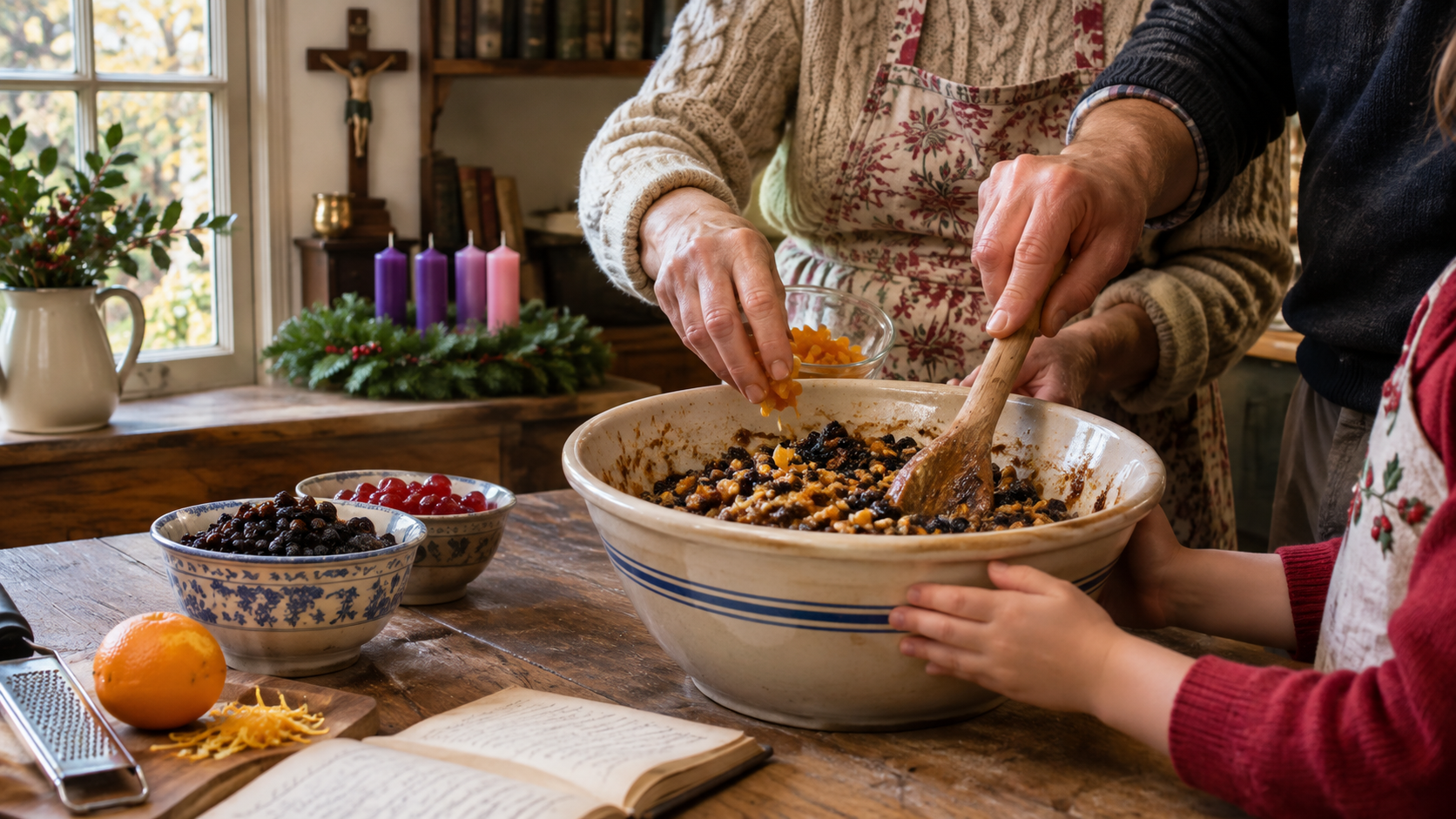
The smell of dried fruit, orange peel and spices drifting from the kitchen is among those unmistakable signs that Christmas is approaching. For generations of British families, preparing the Christmas pudding was an occasion which brought everybody into the kitchen, from the youngest child permitted to hold the spoon to the grandmother who knew, without consulting a recipe, whether the mixture needed another spoonful of brandy.
There was a practical reason for beginning early. Christmas puddings needed time to mature, fruit cakes improved with keeping, and the ordinary domestic tasks of making gifts and preparing for visitors could scarcely be left until Christmas Eve. In Catholic households these occupations took place against the background of the Church’s approaching Advent observance. The religious calendar had its own preparations, and family life was the richer for keeping them together.
Last week’s Domestic Church recalled Martinmas and the older Western custom of St Martin’s Lent, together with the continuing Nativity Fast of the Byzantine Churches. It encouraged families to consider their Advent arrangements while maintaining November’s prayers for the Holy Souls.1 We can now turn from considering those preparations to undertaking them.
The Roman liturgy moves from the resumed Sixth Sunday after Epiphany on 15 November to the Last Sunday after Pentecost on 22 November. Between them fall St Gertrude, St Gregory Thaumaturgus, the Dedication of the Basilicas of Saints Peter and Paul, St Elizabeth of Hungary, St Felix of Valois and the Presentation of the Blessed Virgin Mary. These observances provide the spiritual framework for the week.
The most involved activities are reserved for the weekends, when parents and children are more likely to have time together. During the working week simpler occupations can be undertaken after school or supper. Throughout November the daily Family Rosary continues to be offered particularly for the faithful departed, and especially for relatives and friends.
Your family’s plan for the week
The Family Rosary remains the foundation of the daily devotional programme, together with the household’s customary morning and evening prayers, the Angelus and suffrages for the Holy Souls. The programme follows the Old Roman Ordo, with a particular Rosary intention and practical family activity for each day.
| Day and observance | Family Rosary intention | Household activity |
|---|---|---|
| Sun 15 Nov Resumed Sixth Sunday after Epiphany |
Departed parents, grandparents and ancestors; those who handed down the Faith. | After Mass, bake the family Christmas cake together. Plan the Advent calendar. |
| Mon 16 Nov St Gertrude the Great |
All the Holy Souls, especially deceased relatives and those without anyone to pray for them. | Make remembrance cards for the Family Book of the Departed. |
| Tue 17 Nov St Gregory Thaumaturgus |
Departed godparents, teachers, catechists and priests. | Begin handmade Christmas cards using the Nativity and Scripture. |
| Wed 18 Nov Dedication of SS Peter and Paul |
Deceased popes, bishops and priests; fidelity of living pastors. | Clean the prayer corner. Select greenery, candles and materials for the Advent wreath. |
| Thu 19 Nov St Elizabeth of Hungary |
Departed benefactors, the poor and those who died without family or friends. | Prepare a charitable parcel. Check pudding ingredients. |
| Fri 20 Nov St Felix of Valois |
Christians who died through persecution, imprisonment or violence. | Keep Friday abstinence. Finish cards or prepare a gift for a lonely neighbour. |
| Sat 21 Nov Presentation of Our Lady |
Departed mothers, fathers and children; Christian families. | Mix Delia Smith’s Christmas pudding and leave it overnight. Finish the crib and wreath. |
| Sun 22 Nov Last Sunday after Pentecost; St Cecilia; Stir-Up Sunday |
All departed relatives and friends, especially those missed at Christmas. | After Mass, stir in the flour, let everyone take a turn with the spoon, then steam the pudding for eight hours. |
Where possible, the Rosary may be said after the evening meal. Five decades, drawn from the traditional fifteen mysteries, constitute a practicable household devotion. During November the particular intention may be announced before the Rosary, with names read from the Family Book of the Departed and the De profundis and Requiem aeternam following.
Continuing the November remembrance
The Family Book of the Departed should remain beside the crucifix or household shrine. Where possible, another cemetery visit or the offering of a Requiem Mass is appropriate. The Old Roman Apostolate’s Guild of Holy Souls continues this charity through monthly Requiems and Chantry Books.1
The ordinary household customs of the season often carry memories of those who have died: a grandmother’s Christmas cake recipe, a particular hymn associated with a parent, decorations preserved from earlier generations. Children should understand that remembering someone affectionately and praying for that person’s soul are related but distinct acts. We commend the departed to God’s mercy, without presuming to know His judgement.
Sunday 15 November: the mustard seed and the Christmas cake
Green · Resumed Sixth Sunday after Epiphany
The Gospel (Matthew 13:31–35) contains Our Lord’s parables of the mustard seed and the leaven. Both concern the Kingdom of Heaven and the manner in which God’s work develops from small beginnings. The same principle can be seen in the faithful repetition of family prayer and good customs. A child learns a prayer by hearing it at bedtime; a saint’s feast becomes familiar because the household remembers it every year.
After Mass, Sunday offers an excellent opportunity for the first substantial Christmas preparation: baking the cake. This year’s suggested recipe is the professionally published Classic Christmas Cake by James Martin, from Good Food, November 2012.7
James Martin’s Classic Christmas Cake
Source: James Martin, Good Food magazine, November 2012 · Yield: 12 slices · Preparation: 25 minutes · Baking: approximately 2 hours 10 minutes · Tin: deep 20cm round
Original published quantities: 1kg mixed dried fruit; zest and juice of one orange and one lemon; 150ml brandy (or sherry, whisky or rum); 250g softened butter; 200g light soft brown sugar; 175g plain flour; 100g ground almonds; ½ tsp baking powder; 2 tsp mixed spice; 1 tsp cinnamon; ¼ tsp cloves; 100g flaked almonds; four large eggs; 1 tsp vanilla extract.
Method at a glance: Bring the dried fruit, citrus, spirit, butter and sugar to a simmer for five minutes and cool for thirty. Mix with the remaining ingredients and bake in the prepared deep tin at 150°C (130°C fan), testing at two hours and then at ten-minute intervals. While warm, pierce and feed with two tablespoons of spirit; cool, store in a tin and feed fortnightly, stopping one week before icing. Follow the full published directions for lining and insulating the tin.7
For safety and accuracy, use the linked publisher’s full instructions alongside this guide. Do not substitute a different cake recipe or alter quantities while following the timings above.
The younger children might weigh the dried fruit, while older children measure the flour and spices. A family recipe book can record the cook’s name, date and the people who helped. An inherited recipe associated with a departed relative may be particularly treasured.
Monday 16 November: St Gertrude and the Holy Souls
White · St Gertrude, Virgin
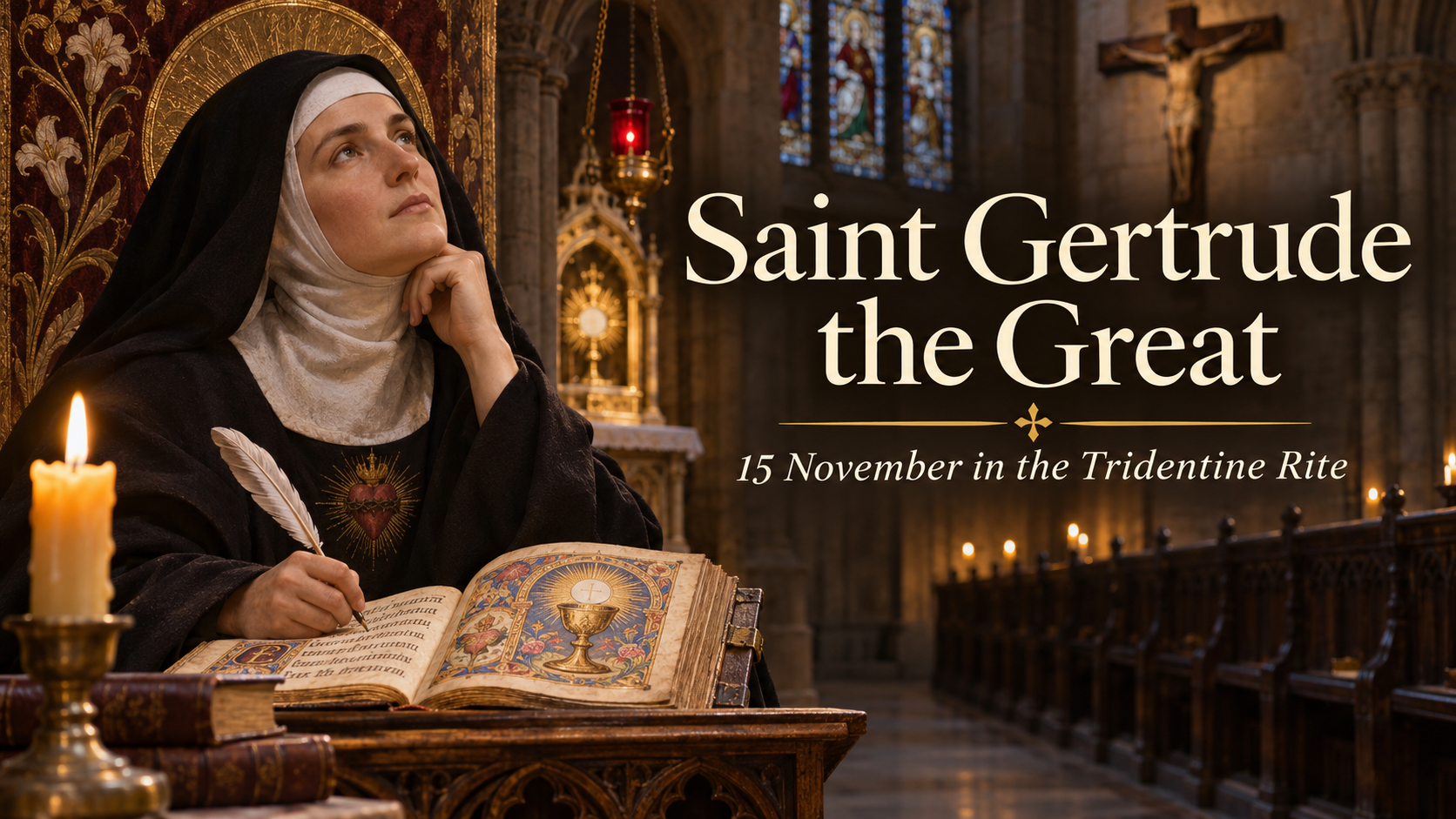
St Gertrude the Great, the thirteenth-century Benedictine mystic of Helfta, is remembered for her devotion to the Sacred Heart, profound appreciation of the liturgy and concern for the departed. Benedict XVI spoke of her in 2010, drawing attention to the centrality of her friendship with Jesus Christ and her love of Scripture.2
A widely circulated prayer bearing her name is sometimes accompanied by a numerical promise concerning souls released from Purgatory. That promise cannot be treated as established doctrine or as authenticated from her writings.3 The Church’s ancient practice of suffrages, particularly the Holy Sacrifice of the Mass, is sufficient reason to persevere.
Children’s activity: Make a remembrance card bearing the name of a deceased family member and the words Requiem aeternam dona ei, Domine, et lux perpetua luceat ei. Keep the cards in the Family Book of the Departed.
Tuesday 17 November: St Gregory Thaumaturgus and the Faith handed down
White · St Gregory Thaumaturgus, Bishop and Confessor
The third-century Bishop of Neocaesarea is remembered for defending and propagating the Faith. His feast suggests a review of what children are learning about the Incarnation and the coming Nativity, perhaps selecting short passages from St Matthew and St Luke for reading during Advent.
A simple, useful weekday activity is to begin Christmas cards. Folded card, coloured pencils and watercolours are enough. Suitable subjects are the Annunciation, the journey to Bethlehem, the Madonna and Child, or the shepherds approaching the manger. Encourage each child to write a short message rather than merely signing a name.

The words Gloria in excelsis Deo make a particularly suitable inscription. Another is the Douay-Rheims text of Luke 2:11: “For, this day, is born to you a Saviour, who is Christ the Lord.” Cards can be completed gradually during the week and posted during Advent.
Wednesday 18 November: the basilicas of SS Peter and Paul
White · Dedication of the Basilicas of Saints Peter and Paul
The feast honours the great Roman basilicas associated with the tombs of the Apostles. It provides an occasion to pray for the Sovereign Pontiff and the Church’s pastors, and to give some attention to the household’s place of prayer.4 Clean the crucifix, arrange the devotional books and remove damaged or unsuitable objects.
This is a good day to collect the materials for an Advent wreath. Three violet candles and one rose candle are customary; the rose candle belongs to Gaudete Sunday, the Third Sunday of Advent.5 Children can choose the greenery and ribbons, while adults secure suitable holders. The wreath can be assembled on Saturday and kept unlit until the First Sunday of Advent.

An Advent wreath is a domestic devotion, not a prescribed element of the Roman liturgy. Use safe, stable candle holders; battery-operated alternatives may be preferable where small children or pets are present.
Thursday 19 November: St Elizabeth of Hungary and charity
White · St Elizabeth of Hungary, Widow; commemoration of St Pontian
St Elizabeth of Hungary died in 1231, having devoted much of her short life to assisting the poor and sick. Though a princess by birth, she used her resources for practical charity and later served in a hospital at Marburg.6
As the household makes its list of Christmas presents and provisions, add somebody who might otherwise be overlooked: an elderly neighbour, a family under strain, or a person who will be alone. Children can help assemble a parcel or set aside some of their own money for charity.
A brief practical task is to ensure that the required pudding ingredients, basin, foil, parchment and string are ready for Saturday. More demanding food preparation can be reserved for the weekend.
Friday 20 November: St Felix of Valois and the captives
White · St Felix of Valois, Confessor · Friday abstinence
St Felix is traditionally associated with St John of Matha and the foundation of the Trinitarian Order, particularly devoted to the redemption of Christian captives. Pray for persecuted Christians, prisoners and those who have died deprived of spiritual consolation.
The evening’s activity should be modest: finish Christmas cards, write gift labels, or prepare a little present for somebody lonely. Keep the Church’s Friday discipline, together with any voluntary practice of St Martin’s Lent undertaken by the household.
Saturday 21 November: the Presentation of Our Lady
White · Presentation of the Blessed Virgin Mary
The feast commemorates the ancient tradition of Our Lady’s dedication to God during her childhood. The account occurs in early Christian apocryphal literature; its particulars are not established by the canonical Gospels. The feast honours Mary’s complete dedication to God and preparation for her vocation as Mother of the Redeemer.8
Pray the Rosary as a family, read St Luke’s account of the Annunciation, and prepare the empty Christmas crib. A small wooden or cardboard stable will suffice. Check and clean the figures, while keeping the Christ Child aside until Christmas. The family may also complete the Advent wreath.
The principal kitchen task today is the first stage of Delia Smith’s A Traditional Christmas Pudding. Unlike the cake, this recipe is made over two days: mix and leave overnight on Saturday, then add the flour, cover and steam on Sunday.10
Delia Smith’s A Traditional Christmas Pudding
Source: Delia Smith, Delia’s Happy Christmas · Serves: 10–12 · Basin: 1.2 litre · Initial steaming: 8 hours · Christmas reheating: 2 hours 15 minutes
Original published quantities: 110g shredded suet; 110g white breadcrumbs; 1 tsp mixed spice; ¼ tsp freshly grated nutmeg; a pinch of cinnamon; 225g dark soft brown sugar; 110g sultanas; 110g raisins; 275g currants; 25g candied peel; 25g chopped almonds; one small cooking apple; zest of half an orange and half a lemon; 2 tbsp rum; 75ml barley wine; 75ml stout; two large eggs; 50g sifted self-raising flour.
Saturday: Combine the suet, breadcrumbs, spices, sugar, fruit, nuts, apple and zests. Beat the rum, barley wine, stout and eggs separately; stir into the fruit mixture. Cover and leave overnight.
Sunday: Stir in the sifted flour. Fill a greased basin, cover with double parchment and foil, secure with string and steam over simmering water for eight hours. Cool, replace the damp coverings and store in a cool, dark place. Reheat by steaming for two hours fifteen minutes on Christmas Day. Follow the publisher’s full directions, including the consistency test and safe cooking and storage.10
Sunday 22 November: Stir-Up Sunday and the Last Sunday after Pentecost
Green · Last Sunday after Pentecost; commemoration of St Cecilia
The final Sunday of the ecclesiastical year turns the Church’s attention towards the last things. The Gospel (Matthew 24:15–35) recalls Our Lord’s teaching concerning tribulation, judgement and His coming in glory. The Church prepares to celebrate His first coming while remembering that He will come again.
The Roman Collect begins Excita, quaesumus, Domine, tuorum fidelium voluntates, traditionally rendered “Stir up, we beseech Thee, O Lord, the wills of Thy faithful.” The familiar British pudding custom took its name from these opening words, transmitted also through the Book of Common Prayer. Stir-Up Sunday is a household custom rather than a liturgical obligation.9
After Mass, gather the family to finish the pudding prepared on Saturday. Delia’s published method requires the flour to be added now, making a natural opportunity for each person to take a turn with the spoon. Some families stir from east to west in remembrance of the Magi. Instead of relying upon the old superstition of a coin or merely making a wish, each family member can offer a prayer for a departed relative or another Christmas intention.

Steam the covered pudding for the full eight hours, ensuring the water below the steamer never boils dry. Let it cool and replace the coverings before storing. On Christmas Day follow Delia’s reheating instructions. Older traditions of hiding a sixpence present an avoidable choking hazard and are best omitted, especially where young children are present.
St Cecilia’s feast is commemorated this Sunday. As patroness of sacred music, she may be remembered by singing a hymn after the pudding is prepared and praying for church musicians and choristers.11
Making a homemade Advent calendar
Commercial calendars commonly begin on 1 December, although Advent itself begins on Sunday 29 November this year. A family calendar covering the actual liturgical season therefore needs twenty-six days, from 29 November to Christmas Eve.
Use twenty-six small envelopes or folded paper bags, marked with the dates. Peg them to ribbons or twine, and put inside each a brief prayer, a Scripture passage, an act of charity or a little sacrifice. Violet paper can identify the Sundays of Advent, with rose marking Gaudete Sunday on 13 December. The daily cards might also recall St Nicholas on 6 December and the Immaculate Conception on 8 December, observing the precedence of the Sunday liturgy where applicable.

An alternative is an Advent chain of good works: each completed prayer or act of charity adds a link. A family crib can also be prepared gradually by adding a piece of straw to the empty manger after a child’s good deed. Explain the symbolism without suggesting that good works earn the Incarnation. They should direct the heart towards receiving Christ worthily.
Preparing a Jesse Tree and the Christmas crib
A Jesse Tree tells the history of salvation through simple symbols. Branches may bear ornaments recalling Adam, Noah, Abraham, Moses, David and the prophets, followed by St John the Baptist and the Blessed Virgin Mary. Read a corresponding passage of Scripture during Advent. Its name comes from Isaias 11:1, concerning the rod from the root of Jesse.
The Christmas crib may be assembled in the same family session. A stable made from a small box, wood or cardboard can be prepared now, with the manger left empty until Christmas. During Advent children may move the shepherds nearer or add straw to the manger when completing acts of charity.

Other practical preparations before Advent
Christmas decorations and cards
Paper stars, dried orange slices, cinnamon sticks and simple devotional ornaments can be prepared now and stored. Where a Christmas tree is used, families might reserve its complete decoration until nearer the Nativity so that Advent retains its character of expectation. Handmade cards for elderly relatives, priests, religious and lonely neighbours are often especially welcome; a short handwritten message has more value than an expensive card bearing no personal thought.
Gifts, hospitality and the household budget
Consider what can reasonably be spent, what might be made at home, and whether someone would appreciate a useful gift rather than a novelty. Children can prepare small presents for grandparents or godparents. Families might also invite someone who would otherwise be alone at Christmas, visit an elderly relative, or set aside a charitable parcel. Such arrangements are better made now than under pressure in the final days before the feast.
Preparing the larder
Check dried fruit, spices, flour, sugar, marzipan, baking tins and preserving jars. Mincemeat, biscuits and other Christmas foods may be prepared ahead using suitable published recipes and storage directions. A kitchen notebook can record what has been made and where it is kept. There is no particular sanctity in a well-organised larder, but anyone who has discovered a missing ingredient halfway through Christmas dinner may appreciate its practical virtues.
Preparing the soul for Advent
The first concern should be Confession. Families ought to consider when members can receive the sacrament during Advent, making arrangements in good time where necessary. Parents can choose passages from St Matthew, St Luke and Isaias for spiritual reading. A modest voluntary penitential discipline may be undertaken with regard for age, health and existing obligations; any continuation of St Martin’s Lent should be understood as voluntary, apart from applicable Church discipline.
The family’s charitable plans should have as much attention as its shopping list. Advent preparation ought to include prayer for those in need and practical help for someone whom the household has the means to assist.
Dates to prepare for
| Date | Observance | At home |
|---|---|---|
| 29 November | First Sunday of Advent | Begin the wreath, calendar and family devotions. |
| 30 November | St Andrew, Apostle | Pray for Scotland and missionary work. |
| 6 December | Second Sunday of Advent; St Nicholas | Recall St Nicholas’s generosity, respecting Sunday’s liturgical precedence. |
| 8 December | Immaculate Conception | Mass where possible and the Family Rosary. |
| 13 December | Gaudete Sunday; St Lucy | Light the rose candle. |
| 16, 18, 19 December | Advent Ember Days | Penitential observance and prayer for priests and vocations. |
| 17–23 December | Great O Antiphons | Read or sing the proper antiphon at evening prayer. |
| 24 December | Christmas Eve | Complete the crib and final preparations. |
| 25 December | Nativity of Our Lord | Christmas Mass and the beginning of Christmastide. |
Prayers for the week
Collect of the Last Sunday after Pentecost
LATINE
Excita, quaesumus, Domine, tuorum fidelium voluntates: ut, divini operis fructum propensius exsequentes, pietatis tuae remedia maiora percipiant. Per Dominum nostrum Jesum Christum Filium tuum…
ENGLISH
Stir up, we beseech Thee, O Lord, the wills of Thy faithful; that they, more earnestly seeking the fruit of divine works, may receive more abundantly the remedies of Thy mercy. Through Our Lord Jesus Christ, Thy Son…14
Prayer before Christmas preparations
O Lord Jesus Christ, Who didst humble Thyself to be born of the Blessed Virgin Mary for our salvation, bless this household and all the preparations we undertake for the celebration of Thy holy Nativity. Grant that our work may be accompanied by charity, our celebrations by gratitude, and our hearts by sincere repentance. Preserve us from excess, selfishness and forgetfulness of those in need. May all that we prepare serve the happiness of our family and the honour of Thy holy Name. Who livest and reignest with the Father and the Holy Ghost, God, world without end. Amen.
Prayer for the intercession of Our Lady
O Blessed Virgin Mary, Mother of God and Mother most pure, who didst offer thyself wholly to the divine will, obtain for us the grace to prepare faithfully for the coming of thy Son. Protect our families, guide our children, strengthen our charity and teach us to welcome Our Lord with the humility and obedience of thy Immaculate Heart. Amen.
Prayer for those alone at Christmas
O Lord Jesus Christ, Who wast born in poverty and didst sanctify the humble home of Nazareth, look with mercy upon those who are lonely, poor, sick or forgotten. Comfort those who mourn, provide for those in need, and move our hearts to assist them with generosity. Grant that the joy of Thy holy Nativity may bring consolation to the afflicted and that none whom we have the means to help may be neglected through our indifference. Amen.
The home that is ready
The Church’s observance has its own wisdom. November directs us towards the Holy Souls and the last things; Advent follows, calling the faithful to watchfulness, penance and expectation. The household need not stand idle. There are cakes to bake, puddings to steam, cards to write, gifts to prepare and visits to arrange. All can be undertaken cheerfully without anticipating the liturgical celebration itself.
Parents who have already attended to practical arrangements will have greater freedom for family prayer, catechesis, Confession and the observances of Advent. Children who have contributed to the preparations may understand more readily that Christmas involves the giving of oneself as well as the receiving of gifts.
Much of what children remember about family life consists of things which appeared ordinary at the time: the smell of cake baking, the spoon used for the Christmas pudding, the candles on the Advent wreath, a familiar prayer beside the crib. Such memories are formed because somebody cared enough to establish and maintain the customs.
The daily Family Rosary belongs naturally within this inheritance. A family that gathers to pray for its departed relatives and friends learns that the bonds of Christian charity are not extinguished by death. The children stirring a pudding this weekend may learn to remember those who once shared the table with their parents and grandparents.
Excita, quaesumus, Domine, tuorum fidelium voluntates.
Stir up, we beseech Thee, O Lord, the wills of Thy faithful.
A fitting prayer with which to conclude the ecclesiastical year, and to begin preparing for another Christmas.
1 Nuntiatoria, The Domestic Church: 8–15 November 2026, 6 November 2026; Old Roman Apostolate, Guild of Holy Souls.
2 Benedict XVI, General Audience: Saint Gertrude the Great, 6 October 2010.
3 Fr Silas Henderson SDS, Saint Gertrude the Great: Friendship with the Lord Jesus, discussion of the disputed prayer attribution.
4 Priestly Fraternity of St Pius X, Dedication of the Basilicas of Saints Peter and Paul, 18 November 2026.
5 United States Conference of Catholic Bishops, What Is Advent?, the traditional Advent wreath.
6 The Catholic Encyclopedia, St Elizabeth of Hungary, vol. 5, 1909.
7 James Martin, Classic Christmas Cake, Good Food, November 2012.
8 The Catholic Encyclopedia, Presentation of the Blessed Virgin Mary, vol. 12, 1911.
9 Waitrose & Partners, Stir-Up Sunday.
10 Delia Smith, A Traditional Christmas Pudding, Delia’s Happy Christmas, BBC Books, 2009.
11 Vatican News, St Cecilia, Virgin and Martyr.
12 Catholic Culture, History, Customs and Folklore of Advent.
13 USCCB, Advent 2026; FSSPX, Advent Ember Wednesday, 16 December 2026.
14 Missale Romanum, Collect of the Last Sunday after Pentecost; Fr Francis X. Lasance, The New Roman Missal, 1937.




Leave a Reply