
Mothering Sunday: The Maternal Church and the Customs of Laetare
Among the many customs that once gave texture and warmth to the Christian year in medieval England, few were so gentle, evocative, and theologically expressive as Mothering Sunday. In the modern imagination the day has been simplified and domesticated, reduced largely to Britain’s equivalent of Mother’s Day, marked by bouquets of flowers, greeting cards, and family meals. Yet beneath these familiar gestures lies a tradition far older and far richer than contemporary custom might suggest. Mothering Sunday was not born of sentimentality, nor was it conceived as a merely domestic celebration. It arose organically from the liturgy itself, from the Fourth Sunday of Lent—Laetare Sunday—and its meaning was rooted in the Church’s profound understanding of herself as Mother.
The medieval Christian world possessed what might be called a sacramental imagination. Time itself was not perceived as an empty succession of days but as a sacred rhythm ordered toward eternity. The Christian year unfolded like a great drama: Advent awakening longing, Christmas revealing the Incarnation, Lent leading the faithful through penance toward the Passion and Resurrection of the Lord. Each season bore its own colour, its own tone, its own spiritual atmosphere.
Within this sacred rhythm the midpoint of Lent possessed a particular poignancy. For three weeks the faithful had walked through the desert of penitence, fasting, praying, and disciplining both body and soul in preparation for the solemn mysteries of Holy Week. The austerity of the season was deliberate and necessary, reminding the Christian that the path to resurrection passes through the Cross. Yet on this Sunday the Church, like a wise mother attentive to the needs of her children, allowed a ray of Easter light to fall across the penitential landscape.
The liturgy opens with the triumphant cry of Isaiah: Laetare Jerusalem—“Rejoice, O Jerusalem.”¹ The words resound with a joy that is both restrained and anticipatory. They do not announce the Resurrection itself, but they point toward it with quiet confidence. Jerusalem—the holy city, the mother of the faithful—is summoned to rejoice because the redemption of her children draws near. The Church herself stands in the place of that Jerusalem, gathering her children around the altar and inviting them to take heart.
In the Roman liturgy the outward signs of this encouragement are unmistakable. The violet vestments of penitence give way to rose, a colour that seems to capture visually the mingling of sorrow and joy that defines the day. Flowers may appear upon the altar, breaking the long austerity of the season. Even the music of the liturgy acquires a brighter tone, as if the Church herself wished to whisper to her weary children: Persevere a little longer—the dawn is approaching.
It was within this liturgical atmosphere—joy tempered by penance, consolation mingled with discipline—that the customs of Mothering Sunday slowly emerged.
The Church as Mother
To understand Mothering Sunday properly one must begin with a truth deeply embedded in Christian theology: the Church is mother. This is not a poetic metaphor invented by later devotion but a conviction rooted in Scripture itself. The Apostle Paul, writing to the Galatians, declares with striking clarity that “Jerusalem which is above is free, which is our mother.”²
Here Paul speaks not merely of a city but of a mystery. The heavenly Jerusalem is the dwelling place of God, the communion of saints, the eternal homeland toward which the pilgrim Church journeys. Yet that same heavenly reality becomes present on earth in the visible Church—the sacramental community through which God gathers His people.
The early Fathers of the Church never tired of contemplating this maternal mystery. Among the most memorable expressions appears in the writings of St Cyprian of Carthage, who famously declared: Habere non potest Deum patrem qui Ecclesiam non habet matrem—“He cannot have God for his Father who does not have the Church for his Mother.”³
In these words the entire Christian life is condensed into a single image. The Church gives birth to the Christian in baptism. She nourishes him with the Eucharist. She forms his conscience through the teaching of the Gospel. She forgives his sins through the sacrament of penance. And when the final hour arrives, she accompanies him with prayer to the threshold of eternity.
In the medieval world this theology was not confined to books or sermons. It shaped the lived experience of ordinary believers. The parish church stood physically at the centre of the village, just as the Church herself stood spiritually at the centre of Christian life. There the faithful were baptised, married, reconciled, and buried. The church building itself became a kind of spiritual home, a place where generations passed through the same sacred doors and knelt before the same altar.
To return to the mother church was therefore to return to the very place where one’s life in Christ had begun.
Returning to the Mother Church
In medieval England the phrase “mother church” carried both a practical and a theological meaning. On the one hand it referred to the cathedral church of the diocese—the church from which the bishop governed and from which the authority of the parish churches ultimately derived. On the other hand it could refer more intimately to the church in which one had been baptised.⁴
Both meanings converged in the practice that gradually emerged around the Fourth Sunday of Lent. On this day the faithful were encouraged to return to their mother church. Sometimes this meant walking to the cathedral city; at other times it meant simply returning to the church of one’s baptism. The journey, however modest, possessed the character of a pilgrimage.
One must imagine these pilgrimages unfolding against the quiet beauty of the English countryside in early spring. The harshness of winter had begun to loosen its grip upon the land. The hedgerows were stirring with new life, and the air carried the faint fragrance of the coming season. To walk toward the mother church on Laetare Sunday was therefore to enact physically what the liturgy proclaimed spiritually: the long austerity of Lent was already turning toward the promise of Easter.
The Sarum liturgical tradition, which shaped the religious life of medieval England, also recognised the distinctive character of this Sunday within the Lenten season.⁵
Servants Returning Home
The liturgical symbolism of the mother church gradually intertwined with the social realities of medieval life. Many young men and women spent their youth working as servants or apprentices in households far from their own families. Because such service required living within the employer’s home, opportunities to visit one’s parents were infrequent.
The Fourth Sunday of Lent became a customary day when these servants were granted leave to return home. Across the countryside roads and footpaths filled with travellers making their way back to the villages where they had been raised. Ronald Hutton observes that such journeys were sometimes long and undertaken entirely on foot, often across miles of farmland and woodland.⁶
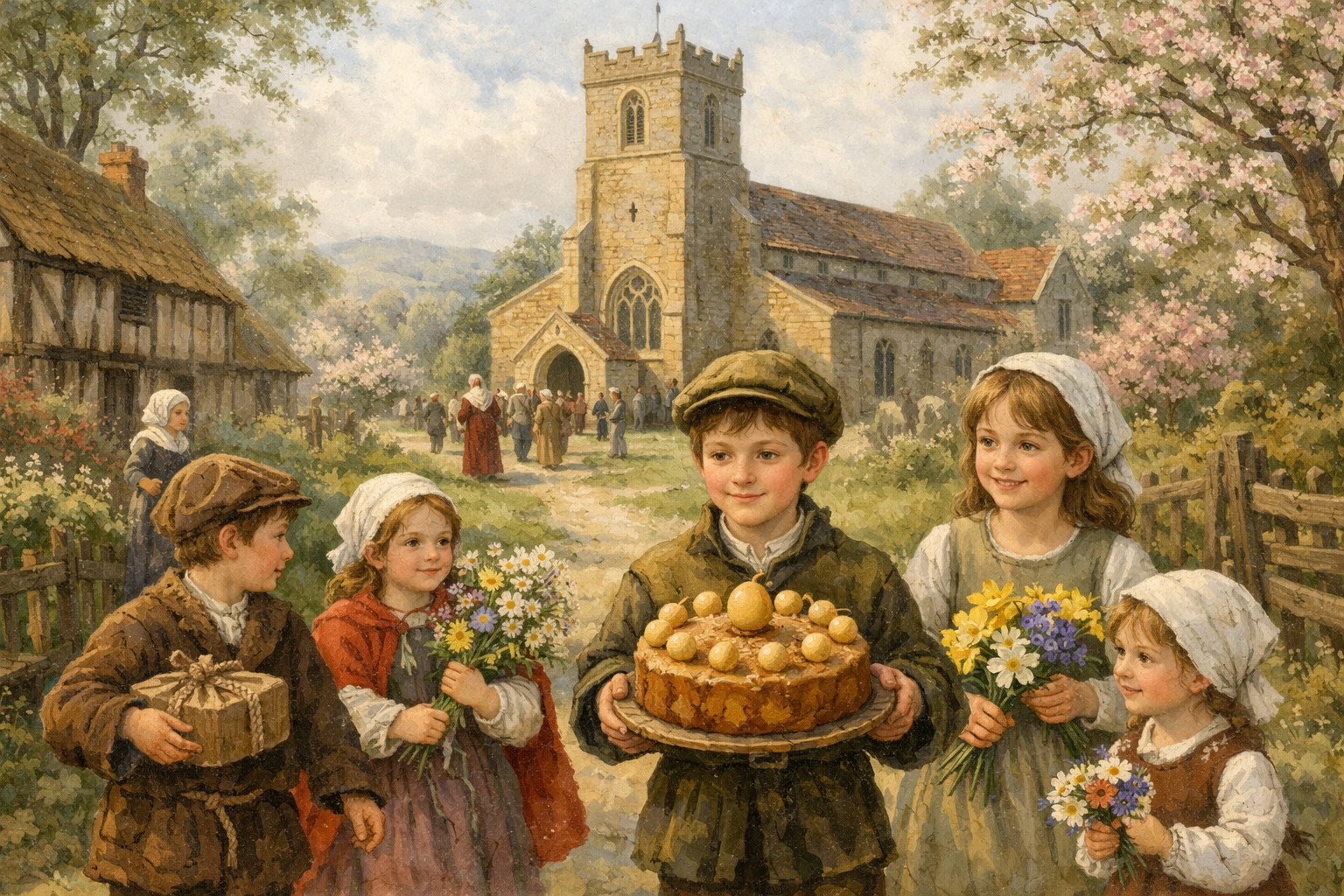
Along these paths young travellers gathered flowers from hedgerows and fields—primroses, violets, and early daffodils—to carry with them as gifts for their mothers. The flowers were simple offerings, yet they were laden with symbolism. Just as the earth itself was awakening from winter’s sleep, so the Christian soul was preparing to emerge from the discipline of Lent into the joy of Easter.
In this way the ecclesiastical and domestic meanings of Mothering Sunday slowly converged. The honour given to the Church as mother naturally extended to the honouring of one’s own mother within the household.
Simnel Cakes and the Taste of Laetare
The culinary emblem of Mothering Sunday was the simnel cake, a rich fruit cake that stood in quiet contrast to the austerity of Lenten fare. The cake was made from fine flour, dried fruits, spices, and almond paste, and it was traditionally decorated with marzipan balls representing the Apostles—usually eleven in number, symbolising the faithful Apostles after the betrayal of Judas.⁷
The presence of this cake on Laetare Sunday reveals something important about the spiritual tone of the day. Although Lent remained a season of fasting, the Church permitted a modest relaxation of austerity at its midpoint. The simnel cake therefore served as a small but meaningful celebration—a reminder that penance is ordered not toward despair but toward joy.
Historical recipes record an intriguing detail: simnel cakes were sometimes boiled before being baked, a technique that helped preserve their moisture during long journeys.⁸ This suggests that many cakes were carried by servants travelling home to their families.
The act of presenting the cake to one’s mother became a gesture of gratitude and affection. It was a tangible expression of the bond between parent and child, and it reflected the deeper nourishment provided by the Church herself.
Flowers and the Renewal of Creation
Another custom closely associated with Mothering Sunday was the gathering of wildflowers. The Fourth Sunday of Lent falls at a moment when the countryside begins to awaken visibly from winter. The first blossoms appear in fields and hedgerows, offering a quiet promise that spring has begun.
Children returning home for the day often gathered these flowers along the way. Primroses, violets, and daffodils were placed in simple bunches and offered either to their mothers or to the church itself.⁹
Within the sanctuary these flowers transformed the austere environment of Lent into a foretaste of Easter joy. Their presence reminded the faithful that the sorrow of penance was already beginning to yield to the beauty of redemption.
In some parishes the flowers were placed before statues of the Blessed Virgin Mary. This gesture connected the honour given to earthly mothers with the deeper maternal symbolism embodied by the Virgin.
Marian Devotion and the Maternal Church
The association between Mothering Sunday and the Blessed Virgin Mary reflects a deeper theological intuition within Christian tradition. Medieval devotion frequently portrayed Mary as the compassionate mother of believers, whose maternal care reflects the nurturing love of the Church herself.
This symbolism was not merely devotional but doctrinal. The Church understood Mary’s motherhood as intimately connected to the mystery of redemption. Just as she gave birth to Christ according to the flesh, she continues to intercede for the faithful as their spiritual mother.
The maternal language used by the Fathers of the Church finds its most natural expression in this context. When St Cyprian speaks of the Church as mother, he articulates a reality that medieval Christians perceived not only intellectually but instinctively.¹⁰
Mothering Sunday therefore became an occasion to contemplate the maternal dimension of the Christian faith itself.
The Parish as a Spiritual Household
The observance of Mothering Sunday extended beyond individual families into the life of the parish community. Churches were decorated with flowers, the liturgy was celebrated with particular solemnity, and neighbours gathered afterward to share modest meals.
Churchwardens’ accounts from the late medieval period occasionally record expenditures for flowers and decorations associated with the Fourth Sunday of Lent.¹¹ These small details reveal how deeply the rhythms of the liturgical year shaped the communal life of medieval England.
The parish functioned as a kind of spiritual household in which the faithful accompanied one another through the seasons of the Christian year.
Echoes Across Europe
Although the term “Mothering Sunday” belonged specifically to England, the themes underlying the celebration resonated throughout medieval Europe.
In Rome the Pope blessed the Golden Rose on Laetare Sunday, a symbolic ornament representing Christ whose Passion blossoms into the glory of the Resurrection.¹² In parts of France and Germany the day was marked by pilgrimages to important shrines or cathedral churches during the midpoint of Lent.
Across the Christian world the same intuition prevailed: the Church, aware of the burdens of the Lenten fast, wished to console and strengthen her children with a glimpse of the joy that awaited them.
A Tradition Remembered
The transformations of modern society inevitably altered many of the customs associated with Mothering Sunday. Industrialisation reshaped patterns of domestic service, and the rural rhythms that had once sustained the tradition gradually faded.
Yet the custom did not disappear. In the early twentieth century Anglican liturgical movements revived Mothering Sunday as part of a broader effort to reconnect English society with the spiritual rhythm of the Christian calendar.¹³ Over time the observance merged with the American celebration of Mother’s Day, producing the form widely recognised today.
Conclusion
Mothering Sunday remains a quiet testament to the sacramental imagination of the medieval Church. What began as a pilgrimage to the mother church blossomed naturally into a celebration of maternal love, family life, and the promise of renewal.
The customs of simnel cake, gathered flowers, and journeys home were not merely quaint traditions. They were outward expressions of a profound theological truth: the Christian life unfolds within the maternal care of the Church.
On Laetare Sunday the Church lifts her voice and sings Laetare Jerusalem. In that song she reminds her children that the desert of Lent is not endless. They walk under the guidance of a mother who nourishes them, consoles them, and leads them—patiently and lovingly—toward the joy of Easter.
¹ Missale Romanum (1962), Fourth Sunday of Lent, Introit: Laetare Jerusalem.
² Galatians 4:26.
³ St Cyprian of Carthage, De Unitate Ecclesiae, 6.
⁴ Eamon Duffy, The Stripping of the Altars (Yale University Press, 1992), pp. 94–97.
⁵ J. Wickham Legg, The Sarum Missal in English (Oxford University Press, 1916), pp. xv–xx.
⁶ Ronald Hutton, Stations of the Sun (Oxford University Press, 1996), p. 147.
⁷ Ivan Day, Simnel Cake and the History of Mothering Sunday (Prospect Books, 2015), pp. 14–22.
⁸ C. Anne Wilson, Food and Drink in Britain (Constable, 1973), pp. 311–312.
⁹ Dorothy Hartley, Food in England (Macdonald, 1954), p. 542.
¹⁰ St Cyprian of Carthage, De Unitate Ecclesiae, 6.
¹¹ C. Harper-Bill, The Pre-Reformation Church in England (Longman, 1989), pp. 121–123.
¹² J. N. D. Kelly, The Oxford Dictionary of Popes (Oxford University Press, 1986), p. 179.
¹³ Ronald Hutton, Stations of the Sun, pp. 148–149.
¹⁴ Josef A. Jungmann, The Mass of the Roman Rite, Vol. I (Benziger, 1951), pp. 344–347.
related articles


Latest articles
- A CUBICLE IS NOT A ROOMKaron Monaghan KC’s new Opinion argues that some mixed-sex and open-plan school toilets may conflict with existing law, raising serious questions about girls’ privacy, safeguarding, religious liberty and Catholic education.
- Today’s homily: St Dennis, Bishop with Rusticus & Eleutherius, MartyrsSt Denis and his companions proclaimed Christ to pagan Paris and sealed their witness in blood. Through Luke 12:1–9, the homily explores the contrast between hypocrisy and authentic confession, the proper fear of God, divine providence and the Christian’s duty to value eternal judgement above worldly approval.
- Today’s Mass: October 09 St Dennis, Bishop with Rusticus & Eleutherius, MartyrsGregory of Tours states that Denis was bishop of the Parisii and was martyred by being beheaded by a sword. The earliest document giving an account of his life and martyrdom, the “Passio SS. Dionysii Rustici et Eleutherii” dates from c. 600, is mistakenly attributed to the poet Venantius Fortunatus, and is legendary.
- Today’s Mass: October 08 St Bridget of SwedenSaint Bridget of Sweden, born around 1302, was a noblewoman renowned for her piety and prophetic revelations. After marrying Prince Ulpho and raising eight children, she led a life of austerity and charity, founding the Order of the Holy Saviour. She died in Rome in 1373 and was canonised in 1391.
- Today’s Mass: October 07 Pope St Mark, ConfessorSt Mark’s brief pontificate teaches that God measures fidelity, not duration or worldly achievement. Christ alone possesses the everlasting priesthood; His servants are stewards of what they have received. With the commemorated martyrs, St Mark reminds us to persevere faithfully, so that when the Lord comes, He finds us “so doing.”




Leave a Reply