
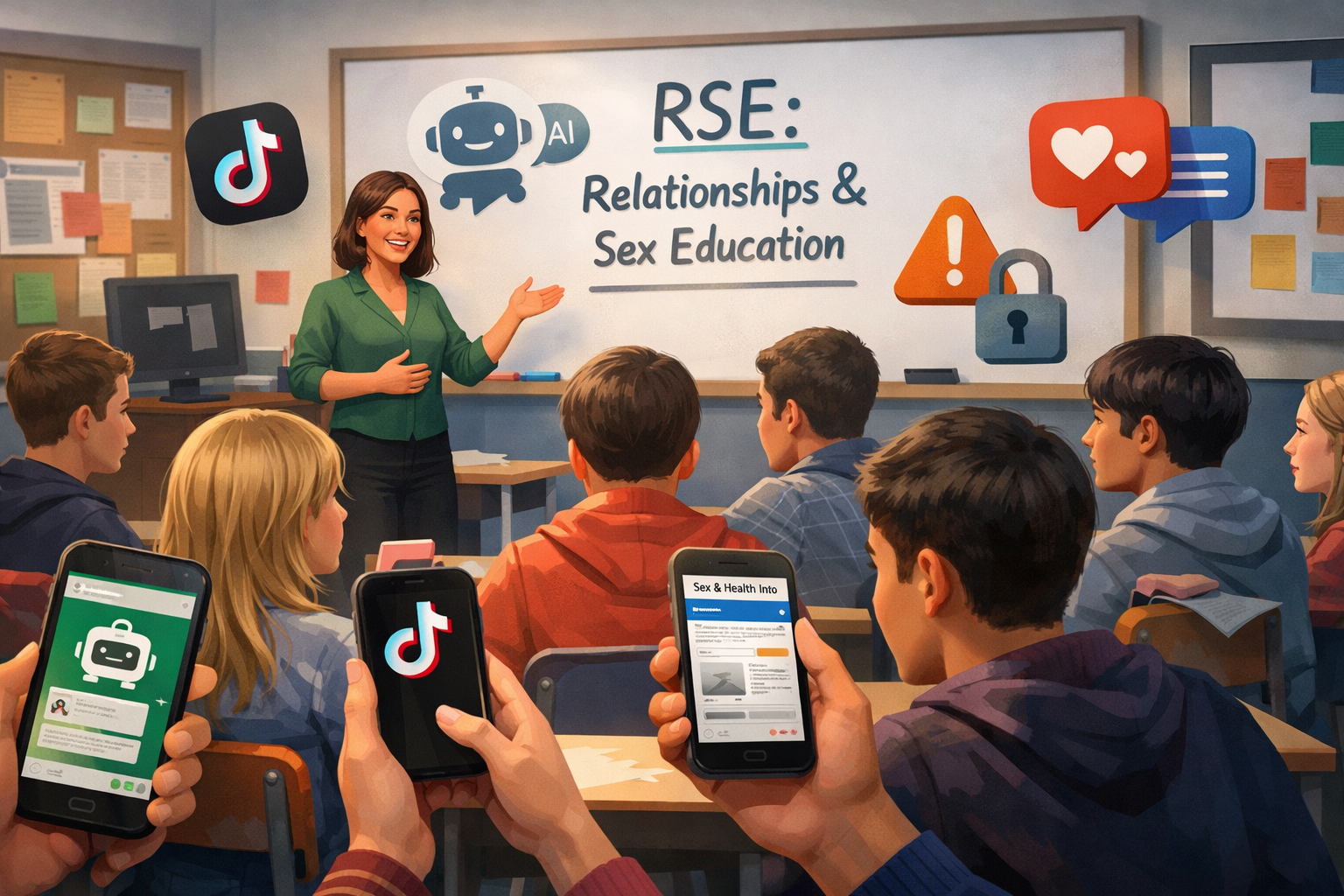
Relationships and Sex Education (RSE) and the State: When the Tail Begins to Wag the Dog
Reflections on the Young People’s RSE Poll 2025
The Young People’s RSE Poll 2025 published by the Sex Education Forum presents itself as a straightforward attempt to measure the quality of Relationships and Sex Education (RSE) in England. Drawing on responses from 1,001 young people aged sixteen and seventeen, the report seeks to evaluate how students experienced the RSE they received at school and what improvements might be required.¹
At first glance the exercise appears entirely reasonable. Policymakers naturally wish to understand how educational programmes are experienced by those who receive them. Yet embedded within the report is a methodological assumption that reveals something far more significant about the direction of modern education policy.
Repeatedly the survey asks young people what topics they would like to see included in RSE and what qualities they believe teachers should possess. Their answers are then used to identify gaps in the curriculum and to guide recommendations for future policy. In effect, pupils are invited not merely to evaluate teaching but to influence the direction of the subject itself. The report explains that the survey questions were partly designed after consultation with sixth-form students and youth organisations in order to explore “what they were curious to understand better through the poll.”²
This approach represents a quiet but profound inversion of the traditional logic of education. For most of human history education operated on a clear and widely accepted principle: the young are taught what the mature generation judges to be necessary for their intellectual and moral formation. Teachers and parents transmit knowledge, wisdom, and experience that students have not yet acquired.
The survey reflects a different model in which the curriculum evolves in response to what pupils believe they need. In other words, the process begins to resemble a situation in which the tail is wagging the dog.
From Pedagogy to Anthropology
At first sight this might appear to be merely a pedagogical preference reflecting contemporary educational fashions. In reality it points to something much deeper. The shift from adult authority to pupil preference is the visible expression of a more fundamental change in how modern society understands the human person.
Traditional education was built upon a particular anthropology. Human beings were understood to possess a given nature and a capacity for flourishing that required cultivation through discipline, moral guidance, and the gradual acquisition of virtue. Childhood and adolescence were stages of formation in which young people were guided toward maturity by parents, teachers, and the inherited wisdom of their communities.
In that framework education was essentially formative. Authority existed not to suppress the individuality of the young but to guide them toward goods they might not yet recognise for themselves.
The educational philosophy reflected in the RSE survey arises from a different anthropology altogether. Here the individual is assumed to be fundamentally self-defining. Identity is not received but constructed. Moral norms are not inherited but negotiated. Education therefore becomes less a process of formation and more a process of facilitating self-exploration.
Once that assumption is adopted it becomes almost inevitable that pupils will be consulted about what they wish to learn and that teachers will be expected to avoid presenting moral frameworks that might appear judgemental.
Indeed, the survey itself highlights the qualities students most desire in an RSE teacher. The highest priorities include “not making students feel judged” (54%), “being comfortable with the topics” (53%), and “giving factual and accurate information” (49%).³ These responses reflect a classroom ethos in which the teacher’s authority lies less in transmitting moral understanding and more in creating a space where students feel able to discuss and explore their views.
The Institutional Machinery
How did such an anthropology come to shape national education policy? The answer lies less in spontaneous social demand than in the gradual work of institutional networks.
Ideas first emerge within academic disciplines such as sociology, psychology, and gender studies. Advocacy organisations translate those ideas into policy language framed around safeguarding, wellbeing, inclusion, and equality. Government departments then draw on those frameworks when drafting statutory guidance. Teacher-training organisations and educational charities subsequently produce resources to help schools implement the guidance in practice.
Over time the ideas move from theory to policy and from policy to classroom routine.
The development of RSE illustrates this process clearly. The Sex Education Forum describes its role as bringing together partners and stakeholders, working with policymakers, and supporting educators with training and resources designed to ensure effective delivery of RSE.⁴ Through such institutional pathways a particular approach to relationships and sexuality becomes embedded in educational practice across the country.
The Expanding Scope of RSE
One consequence of this institutional development has been a dramatic expansion in the scope of RSE itself. The subject once focused primarily on biological knowledge about reproduction, contraception, and disease prevention. Today it encompasses a wide range of psychological, legal, and social themes.
The survey identifies several areas where students believe they learned too little during their schooling. Among the most significant gaps reported were:
• 72% said they had learned either nothing or not enough about deepfakes.
• 72% said the same about the law on strangulation and suffocation.
• 67% said they learned too little about sexual pleasure.
• 65% said they learned too little about skills for ending relationships or friendships.⁵
More than half of respondents also reported learning little or nothing about pornography at school, despite its widespread accessibility online.⁶
These findings highlight how the subject has evolved far beyond the biological explanation of reproduction. RSE now functions as a kind of relational ethics curriculum addressing emotional wellbeing, power dynamics, legal frameworks, and social expectations within intimate relationships.
What Young People Say They Need
When students were asked what additional topics should be taught between the ages of sixteen and eighteen, their responses centred largely on relational risks and safeguarding concerns.
The most requested subjects included:
• recognising signs of domestic abuse in relationships (29%)
• knowing how to seek help after sexual assault (27%)
• identifying healthy relationships (25%)
• understanding manipulation in relationships (25%)
• pregnancy options (24%).⁷
These responses illustrate a generation aware of the complexities and vulnerabilities of modern relationships. Young people clearly recognise the need for guidance in navigating them.
Yet this expectation raises an important question. Can educational institutions realistically provide the kind of moral and relational formation that historically emerged from families, communities, and religious traditions?
A Revealing Paradox
One of the most striking aspects of the survey is the tension it reveals between the ideology of autonomy embedded in modern education and the desires expressed by the students themselves.
Despite the emphasis on non-judgemental teaching and student-led exploration, many respondents emphasised the importance of trusted adults. They valued teachers who could answer questions honestly and who were confident in addressing the subject.
This suggests that young people are searching not merely for information but for authority exercised with integrity.
The ideology of autonomy assumes that adolescents want freedom from judgement and moral guidance. The voices recorded in the survey suggest something rather different: many students are actually seeking adults capable of offering clear and trustworthy direction.
Digital Culture and the New Environment
The report also highlights the radically different environment in which young people now encounter ideas about sexuality.
Students reported turning to a variety of online sources for information about relationships and sex. The most commonly cited were websites run by health organisations (35%), TikTok’s “For You” page (28%), and artificial intelligence tools such as chatbots (20%).⁸
The presence of AI systems among the most common sources of advice is particularly striking. Increasingly young people turn to automated systems for answers to questions they may feel uncomfortable asking adults.
Despite this digital landscape the survey still found that schools ranked as the most helpful source of information on key issues such as understanding consent and recognising controlling behaviour in relationships.⁹
The Political Horizon
When educational institutions begin shaping moral norms in areas historically governed by families and communities the issue rarely remains confined to professional debate. Over time it tends to become a political question.
Parents naturally take a close interest in what their children are taught about relationships, identity, and morality. If families perceive that schools are redefining those subjects without their participation or consent, demands for reform can quickly emerge.
Such debates rarely concern curriculum details alone. They crystallise around a more fundamental question: who holds primary responsibility for the moral formation of children — parents or the state?
Conclusion
The Young People’s RSE Poll 2025 is ostensibly a survey about classroom experience. In reality it reveals something deeper: a transformation in the philosophical assumptions underlying education itself.
Where earlier generations understood education as the transmission of inherited wisdom, contemporary policy increasingly treats it as a process of facilitating individual self-definition. That anthropological shift explains why pupils are invited to shape the curriculum and why teachers are expected to avoid presenting moral frameworks that might appear authoritative.
Yet the survey also reveals that young people themselves continue to seek something more than neutral facilitation. They want adults who are trustworthy, knowledgeable, and willing to guide them through the complexities of modern life.
Whether the educational system will rediscover the value of that kind of authority—or whether it will continue to treat the preferences of pupils as the primary guide to curriculum development—may well become one of the defining educational debates of the coming decade.
- Sex Education Forum, Young People’s RSE Poll 2025, Executive Summary, “Poll methodology,” p. 3.
- Ibid., Executive Summary describing consultation with sixth-form students and youth organisations, p. 3.
- Ibid., Part 2: “Young people’s opinions about how RSE is taught,” pp. 10–11.
- Ibid., “About Us,” p. 29.
- Ibid., Part 4: “Which topics were covered at school? What was missed?” summary, p. 15.
- Ibid., discussion of pornography education coverage, p. 15.
- Ibid., Part 5: “What RSE would be useful for young people aged 16 to 18?” pp. 17–18.
- Ibid., Part 6: “Exploring online sources in more detail,” p. 24.
- Ibid., “Which sources of information are most helpful for key areas of learning,” p. 23.
RELATED ARTICLES


Latest ARTICLES
- The Church Does Not Need Our Denial: Truth, scandal and the false defence of ecclesiastical reputationThe text explores the concept of “spiritual denial” within the Catholic Church regarding serious allegations against church leaders. It argues that this denial, often perceived as loyalty, leads to evasion of uncomfortable truths. The piece emphasises that acknowledging these failures does not undermine the Church’s integrity, urging faithful confrontation of wrongdoing while maintaining justice for all involved.
- The Dossier against the Victim: Bergoglio, Grassi and the Counter-Investigation the Church CommissionedAfter Fr Julio César Grassi was convicted of child sexual abuse, the Argentine Episcopal Conference, under Cardinal Bergoglio, commissioned a counter-investigation claiming his innocence, allegedly costing US$300,000. A new book by Grassi’s victim details intimidation faced by him post-conviction, highlighting the disparity in institutional support between the abuser and the victim.
- What takes priority? Leo XIV, Sexual Morality and the Synodal Reordering of Moral EmphasisPope Leo XIV has not rejected Catholic sexual morality, but his remarks hint at a pastoral shift prioritising issues such as justice and equality over sexual ethics. As the Amoris Laetitia synod approaches, concerns arise about whether moral teachings will remain authoritative as pastoral priorities evolve. The Church’s foundational beliefs may risk being undermined in this reordering.
- After the Mistrial: The Lindsay Clancy Spectacle DeepensThe mistrial concerning Lindsay Clancy’s case revealed a split jury regarding her criminal responsibility for the deaths of her three children. Although eleven jurors seemed to lean towards a lack of guilt due to mental illness, the incident highlights the complex interplay between compassion, public perception, and accountability in tragic cases.
- Today’s homily: Feria II of the Fifteenth Sunday Post PentecostSt Paul urges us not to grow weary in doing good: every prayer, sacrifice, act of charity and fidelity is seed sown for eternity. Our task is to persevere in the sowing and trust God for the harvest.





Leave a Reply