
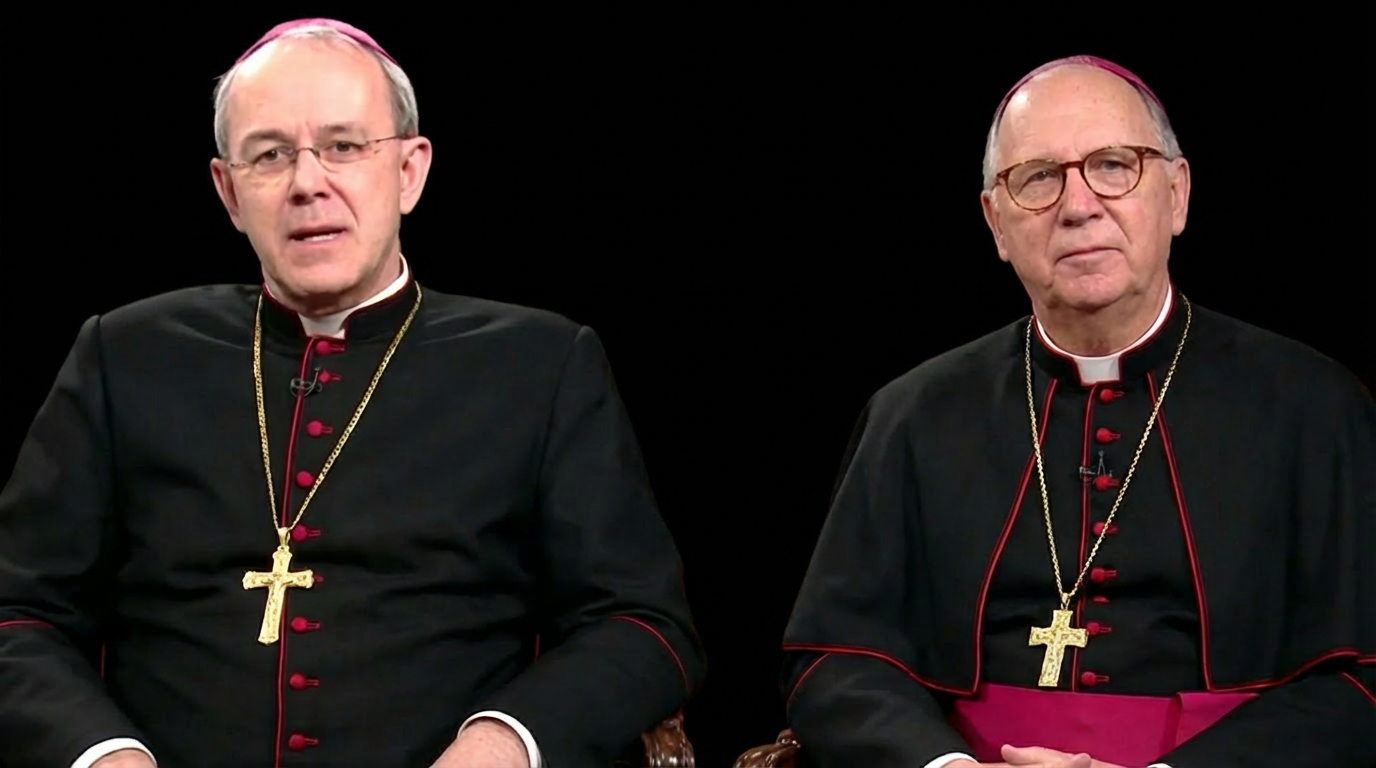
Chur, Canon Law, and the SSPX: The Schneider–Eleganti Debate in Context
The recent disagreement between Bishop Athanasius Schneider and Bishop Marian Eleganti over the canonical consequences of episcopal consecrations carried out without papal mandate has revived a long-standing debate in the life of the Church. At issue is not merely the interpretation of a disciplinary rule, but the broader question of how canonical penalties are to be applied when extraordinary circumstances are claimed.
The personal context of the exchange adds an additional dimension. Bishop Marian Eleganti served from 2010 until 2021 as auxiliary bishop of the Diocese of Chur in Switzerland. He had been appointed by the diocesan bishop, Bishop Vitus Huonder, who governed the diocese from 2007 until his retirement in 2019. Huonder became widely known for his defence of Catholic moral teaching and for his sympathy toward Catholics attached to the traditional Roman liturgy.
After retiring, Huonder made a decision that attracted international attention. In 2019 he took up residence in a house of the Society of Saint Pius X (SSPX) in Wangs, Switzerland, explaining that he wished to live where the traditional liturgy that had nourished his priesthood continued to be celebrated.¹ No disciplinary action followed, and he remained a bishop of the Catholic Church until his death in 2024.
Huonder’s decision highlighted the unusual canonical status of the SSPX itself. The Society does not possess canonical recognition within the Church, yet the Holy See has repeatedly taken steps acknowledging the reality of its sacramental life. In 2009 Pope Benedict XVI lifted the excommunications of the four bishops consecrated by Archbishop Marcel Lefebvre in 1988.² In the years that followed the Holy See granted SSPX priests faculties to validly absolve sins in confession and authorised them to assist at marriages under certain conditions.³
Within this already complex situation the present canonical dispute has emerged.
Bishop Schneider has suggested that if the SSPX were again to consecrate bishops without papal mandate, the automatic excommunication traditionally attached to such acts might not necessarily be incurred if those involved lacked schismatic intent and believed themselves compelled by necessity. Bishop Eleganti has rejected this reasoning, arguing that the objective violation of papal authority suffices to trigger the canonical penalty.
The canonical framework begins with canon 1382 of the 1983 Code of Canon Law, now renumbered canon 1383 following the 2021 reform of Book VI. The canon states that a bishop who consecrates another bishop without pontifical mandate—and the person receiving the consecration—incurs latae sententiae excommunication reserved to the Apostolic See.⁴
Yet the Code itself sets out conditions governing the application of penalties. Canon 1321 establishes the fundamental principle of penal law: no one is punished unless the violation of the law is “gravely imputable by reason of malice or culpability.”⁵ Canonical penalties therefore require not only the external act but also moral responsibility.
Canon 1323 further states that no penalty is incurred when a person violates a law out of necessity or grave inconvenience.⁶ Canon 1324 adds that when such circumstances exist in a lesser degree the penalty may be mitigated or the automatic sanction may not be incurred.⁷
These provisions formed the canonical basis for Archbishop Lefebvre’s justification of the 1988 consecrations. In a declaration issued on the day of the consecrations he argued that a crisis affecting doctrine, liturgy, and priestly formation had created a state of necessity requiring extraordinary action to preserve the traditional priesthood.⁸
Another principle of interpretation reinforces the caution urged by Bishop Schneider. Canon 18 states that laws imposing penalties must be interpreted strictly.⁹ In canonical jurisprudence this means that penalties should not be presumed when doubt exists regarding whether the conditions for their application have been fulfilled.
The debate between Schneider and Eleganti therefore concerns not merely the act of consecration but the interpretation of these broader principles of canonical penal law.
The discussion becomes even more complicated when viewed against the contemporary situation of the Church in China. Since the establishment of the People’s Republic in 1949, Chinese authorities have attempted to organise Catholic life through the Chinese Patriotic Catholic Association, a state-sanctioned body intended to operate independently of the Holy See.¹⁰ Within this system bishops have frequently been appointed and consecrated without prior papal mandate.
Despite these irregular consecrations, the Holy See has often pursued a policy of reconciliation rather than issuing blanket declarations of excommunication. In several cases bishops originally ordained without papal approval were later recognised by Rome as part of efforts to regularise the situation of the Church in China.¹¹
This diplomatic approach culminated in the provisional agreement between the Holy See and the Chinese government on episcopal appointments signed in 2018 and subsequently renewed.¹² The agreement itself has been the subject of intense debate within the Church, including criticism from figures such as Cardinal Joseph Zen of Hong Kong.¹³
The implications of this policy have already been examined in detail in Nuntiatoria, particularly in the article *“A Lion Must Roar: Why Pope Leo XIV Must Break Rome’s China Pact.”*¹⁴ What that analysis demonstrates is that the application of canonical penalties in contemporary practice has sometimes been shaped by diplomatic and pastoral considerations rather than applied as a purely mechanical consequence of the act itself.
Seen in this light, the disagreement between Schneider and Eleganti reflects two distinct instincts within Catholic thought. Eleganti emphasises the objective necessity of hierarchical unity and obedience to the Roman Pontiff. Schneider emphasises the mitigating principles contained within the Church’s own legal tradition and the possibility that extraordinary circumstances may affect culpability.
The irony is that this debate unfolds in the shadow of Chur itself. Bishop Huonder’s quiet decision to spend his retirement among the SSPX demonstrated how complex the Society’s relationship with the wider Church has become. A diocesan bishop of the Roman Catholic Church chose to live peacefully within a community widely described as canonically irregular without breaking communion with Rome.
Huonder’s example did not resolve the canonical controversy surrounding the Society of Saint Pius X. But it did illustrate a reality that legal formulas alone cannot capture: the Church’s pastoral life often unfolds in circumstances far more complicated than the categories of polemic suggest.
- Nuntiatoria, “A Lion Must Roar: Why Pope Leo XIV Must Break Rome’s China Pact,” 3 October 2025.
- Catholic News Agency, “Retired Swiss bishop to live at SSPX house,” 20 January 2019.
- Pope Benedict XVI, Letter to the Bishops of the Catholic Church Concerning the Remission of the Excommunication of the Four Bishops Consecrated by Archbishop Lefebvre, 10 March 2009.
- Pope Francis, Apostolic Letter Misericordia et Misera (20 November 2016), granting SSPX priests faculties to absolve sins; Congregation for the Doctrine of the Faith, “Letter to Ordinaries Regarding Marriages of the Faithful of the SSPX,” 27 March 2017.
- Code of Canon Law (1983), canon 1382; revised as canon 1383 in the reform of Book VI promulgated by Pascite gregem Dei (2021).
- Code of Canon Law (1983), canon 1321 §1.
- Code of Canon Law (1983), canon 1323 §4.
- Code of Canon Law (1983), canon 1324 §§1–3.
- Archbishop Marcel Lefebvre, “Declaration of Archbishop Lefebvre on the Consecrations at Ecône,” 30 June 1988.
- Code of Canon Law (1983), canon 18.
- Richard Madsen, China’s Catholics: Tragedy and Hope in an Emerging Civil Society (Berkeley: University of California Press, 1998), pp. 70–74.
- Anthony E. Clark, China’s Saints: Catholic Martyrdom during the Qing (1644–1911) (Bethlehem: Lehigh University Press, 2011), pp. 201–205; see also Vatican communications recognising previously illicit bishops following reconciliation with the Holy See.
- Holy See Press Office, “Provisional Agreement between the Holy See and the People’s Republic of China on the Appointment of Bishops,” 22 September 2018.
- Cardinal Joseph Zen, public statements criticising the Vatican–China agreement reported in AsiaNews, 2018–2020.
RELATED ARTICLES


Latest ARTICLES
- Today’s Mass: September 04 Feria of Sunday XIV Post PentecostThe Fourteenth Sunday After Pentecost emphasises the importance of serving one master—God—over the flesh. It urges Christians to focus on spiritual over temporal concerns, warning against anxiety. The readings highlight the contrast between the fruit of the spirit and the works of the flesh, encouraging a pursuit of divine life.
- Today’s homily: St Pius X, PopeThe text reflects on the life and legacy of Pope St Pius X, who was chosen from humble beginnings to reform the Church. His pontificate focused on defending the Catholic Faith, restoring liturgical sanctity, and fostering deeper connections between believers and Christ. Pius X exemplified a balance of truth and pastoral charity.
- Today’s Mass: September 03 Pope St Pius X,Pope St Pius X, born Giuseppe Melchiorre Sarto, was a significant reformer who emphasised preserving the Catholic Faith against Modernism. His pontificate (1903-1914) featured reforms in liturgy, frequent Holy Communion, and seminaries, rooted in a pastoral desire to restore everything in Christ. He died in 1914 and was canonised in 1954.
- Today’s homily: St Stephen of HungaryThe homily reflects on the life of Saint Stephen of Hungary, illustrating his transition from a powerful ruler to a saint. He embraced the responsibilities of kingship guided by faith, understanding his authority as stewardship. His legacy teaches that true governance comes with surrender to God, ultimately placing his kingdom under the protection of the Blessed Virgin Mary.
- Today’s Mass: September 02 St. Stephen the GreatSt. Stephen the Great, King of Hungary (977-1038), was a significant Christian ruler who reinforced the faith throughout Hungary. Anointed king in 1000 by Pope Sylvester II, he fought against paganism and promoted the Church. He was canonised in 1083 and is the patron saint of Hungary, symbolising national identity.



Leave a Reply