
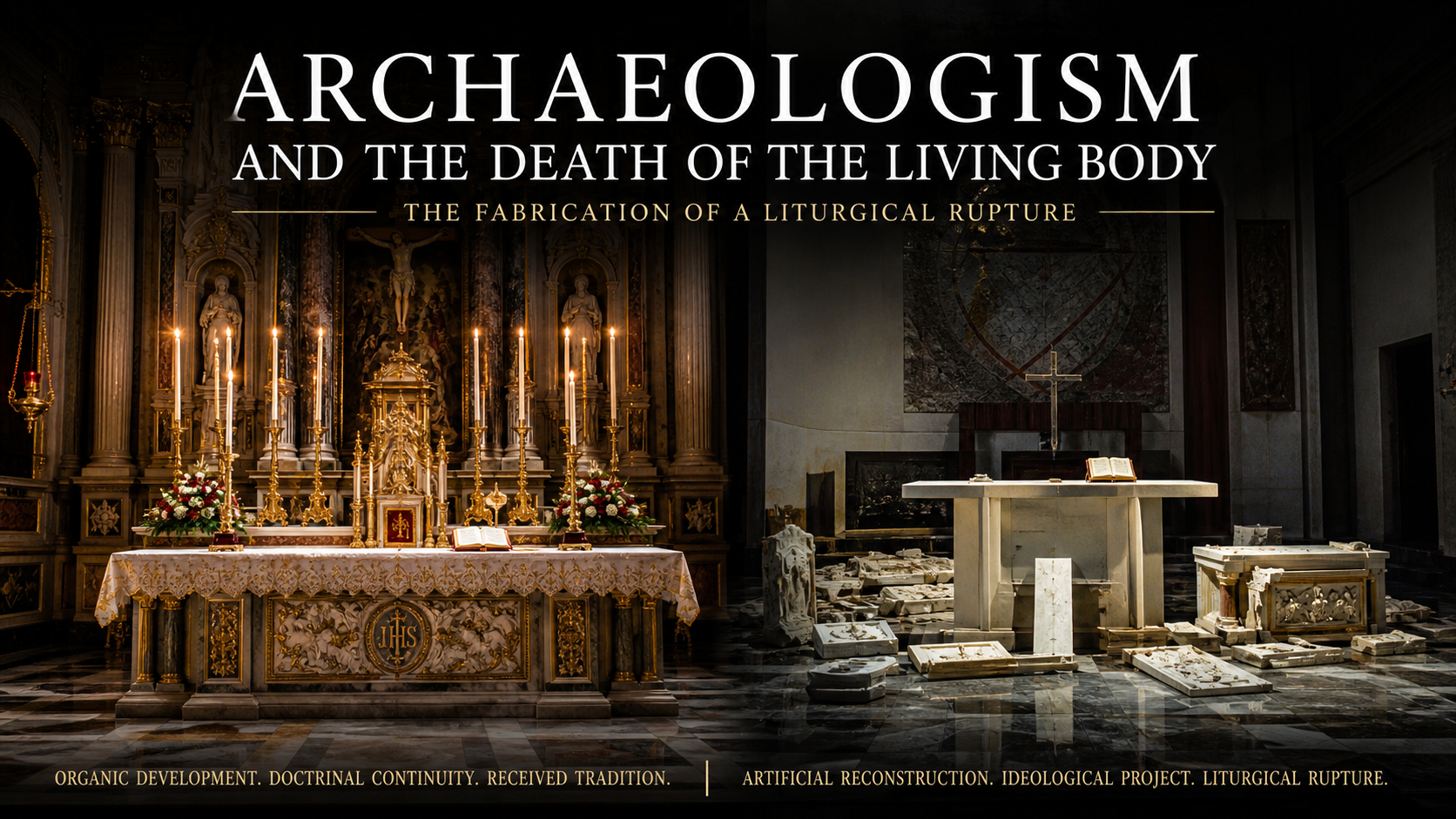
Archaeologism and the Death of the Living Body: The Fabrication of a Liturgical Rupture

The liturgical reform promulgated on 3 April 1969, in the Apostolic Constitution Missale Romanum of Paul VI, was presented to the Catholic world as a restoration: a return to apostolic simplicity, a purification of historical accretions, and a recovery of the Church’s original liturgical form. Yet this claim—repeated with increasing insistence in postconciliar discourse—rests upon a premise that cannot withstand theological scrutiny. What was advanced as renewal reveals itself, upon examination, as a constructed rupture: not the organic development of a living tradition, but the product of an ideological method known as archaeologism.
The governing principle by which such claims must be judged is not modern innovation but the perennial rule articulated by Vincent of Lérins in the fifth century: quod ubique, quod semper, quod ab omnibus creditum est.¹ Authentic development is not excluded; indeed, it is required. But it is strictly conditioned: growth must occur in eodem dogmate, eodem sensu eademque sententia.² Development that alters substance is not development but corruption. This principle has been repeatedly invoked by the Magisterium as the criterion of doctrinal and liturgical continuity.
The Method of Reconstruction: From Pistoia to the Consilium
Archaeologism is not the legitimate study of antiquity. It is the presumption that the Church’s historical development constitutes a deviation from an ideal primitive form, and that modern scholarship possesses the authority to reconstruct that form. This presumption was first systematised in the Synod of Pistoia (1786), whose proposals—simplification of rites, suppression of devotional elements, vernacularisation, and reduction of sacerdotal distinctiveness—anticipated with striking precision the later programme of reform.
These propositions were definitively condemned by Pius VI in Auctorem Fidei (28 August 1794), which rejected as “rash, offensive to pious ears, and injurious to the Church” the claim that liturgical development represented a corruption of evangelical simplicity.³ The doctrinal core of the condemnation is clear: the Church does not degenerate through time; she is guided.
The same error resurfaced in the twentieth century within academic liturgical movements and found institutional expression in the Consilium ad exsequendam Constitutionem de Sacra Liturgia, the body tasked with implementing the reforms mandated by Sacrosanctum Concilium. Under the direction of Archbishop Annibale Bugnini, the Consilium undertook not merely revision but reconstruction. Its method was not the organic pruning of a living rite but the selective dismantling and reassembly of its elements according to historical hypotheses and pastoral criteria—ratified through committee votes and accelerated timelines rather than received continuity.
This method was explicitly warned against by Pius XII in Mediator Dei (20 November 1947):
“The desire to restore everything indiscriminately to its ancient condition is neither wise nor laudable… This attitude revives the excessive and unhealthy archaeologism to which the illegal Synod of Pistoia gave rise.”⁴
The condemnation is not peripheral but central: to privilege antiquity as normative, apart from the living tradition, is to repeat a previously condemned error.
The Vincentian Test and the Roman Rite
When the Vincentian canon is applied to the Roman liturgical tradition, the conclusion is unambiguous. From the earliest Eucharistic formulations to the stabilisation of the Roman Canon, from the sacramentaries to the codification under Pius V in 1570, the rite exhibits organic development: continuity of identity alongside enrichment of expression. The sacrificial character of the Mass, far from being a late addition, is progressively clarified and safeguarded.
The Council of Trent, in its dogmatic definition, leaves no ambiguity:
“In this divine sacrifice which is celebrated in the Mass, the same Christ who offered Himself once in a bloody manner on the altar of the Cross is contained and immolated in an unbloody manner.”⁵
This doctrinal precision is mirrored in the liturgical form that developed around it. The Roman Canon, fixed and universal, functioned as both expression and safeguard of this theology.
The reform of 1969 does not extend this development; it reconfigures it. The introduction of multiple Eucharistic prayers, the reworking of the Offertory, and the expansion of optional elements collectively alter the structural coherence of the rite. What had been stable becomes variable; what had been unified becomes plural. A received inheritance becomes, in practice, a configurable construct.
Fabrication Acknowledged: Contemporary Testimony
The character of the reform was not unnoticed by contemporaries. The Short Critical Study of the New Order of Mass, presented to Paul VI in 1969 by Cardinals Ottaviani and Bacci, stated:
“The Novus Ordo Missae… represents, both as a whole and in its details, a striking departure from the Catholic theology of the Mass as it was formulated in Session XXII of the Council of Trent.”⁶
This was not a rhetorical flourish but a theological judgment grounded in the principle of lex orandi, lex credendi.
Subsequently, Joseph Ratzinger offered a retrospective assessment of the reform’s method:
“In the place of liturgy as the fruit of development came fabricated liturgy. We abandoned the organic, living process of growth and development over centuries and replaced it… with a fabrication, a banal product, made on the spot.”⁷
This judgment is corroborated by the liturgical scholarship of Klaus Gamber, who argued that the postconciliar reform represented not a legitimate evolution of the Roman Rite but “a break in the organic development of the liturgy,” effected through deliberate reconstruction rather than inherited continuity.⁸
The convergence between contemporary critique, later theological reflection, and independent liturgical scholarship is decisive: all identify the same phenomenon—fabrication in place of development.
The Historical Fiction of “Primitive Simplicity”
The appeal to a “primitive apostolic form” rests on a historical fiction. The earliest sources—Justin Martyr, the Didaché, and related liturgical testimonies—do not describe a minimal or purely communal rite but one already marked by hierarchy, sacrificial understanding, and structured prayer. The notion that early Christian worship resembled modern simplified liturgy is not a recovery of history but a projection upon it.
Moreover, the sources themselves are fragmentary and contested. The attribution of the so-called Apostolic Tradition to Hippolytus remains debated among specialists. To elevate such material above the continuous tradition of the Roman Rite is to invert the hierarchy of evidence: conjecture is privileged over continuity.
Stability, Authority, and the Limits of Reform
The Roman Canon’s stability was never regarded as a defect. Its immutability was understood as a guarantee of doctrinal fidelity. Development occurred, but around a stable core, not through its displacement. The shift from a fixed Canon to multiple Eucharistic prayers represents not organic growth but structural redefinition.
The question, therefore, is not whether the Church possesses authority over her liturgy—she does—but how that authority is exercised. Authority that preserves continuity participates in tradition; authority that reconstructs risks severing it.
Conclusion: A Final Judgment
The issue at stake is not preference but principle. A living body grows; it does not need to be disassembled in order to be renewed. A tradition guided by the Holy Spirit develops organically; it does not require reconstruction from fragments.
The method of archaeologism—condemned by Pius VI and again by Pius XII—reappears in the twentieth century not as an incidental excess but as a governing principle of reform. Its application has produced not the restoration of a primitive form, but the substitution of a constructed one.
The consequences extend beyond liturgical form into the life of the Church and the fabric of Christian civilisation itself. Where liturgy ceases to function as a stable and unifying expression of doctrine, doctrinal clarity gives way to interpretive plurality; where the sacred is rendered mutable, reverence yields to familiarity; where continuity is broken, memory is weakened, and with it the transmission of faith across generations. A Church that no longer worships in continuity with her own past risks losing not only her liturgical inheritance but her capacity to speak with a coherent voice to the present age.
The judgment follows directly from the Church’s own criterion: what does not develop in eodem sensu does not remain the same. What does not remain the same cannot claim continuity. And what cannot claim continuity cannot be justified as tradition.
This is not a question left open to preference or pastoral taste. It is a question already answered in principle by the Church herself. The only remaining question is whether that answer will be acknowledged.
¹ Vincent of Lérins, Commonitorium, ch. II.
² Vincent of Lérins, Commonitorium, ch. XXIII.
³ Pius VI, Auctorem Fidei (1794).
⁴ Pius XII, Mediator Dei (1947), §§62–64.
⁵ Council of Trent, Session XXII (1562), ch. 2.
⁶ Ottaviani & Bacci, Short Critical Study (1969).
⁷ Joseph Ratzinger, La mia vita (1997), p.113.
⁸ Klaus Gamber, The Reform of the Roman Liturgy (1993), critique of postconciliar rupture.
Related Articles


Latest Articles
- QUI BENE DISTINGUIT, BENE DOCET ~ He who distinguishes well, teaches well: Spiritual Conference for Nuntiatoria CXXIIIIn a series of Tuesday conferences, the speaker explores themes about recognising reality, receiving divine gifts, and understanding spiritual truths. He highlights the importance of making careful distinctions to maintain sound judgment, especially in an age consumed by distractions and superficial assessments. True wisdom lies in distinguishing truth from perception and nurturing an authentic inner life centred on Christ.
- Today’s homily: Impression of the Stigmata upon St FrancisFrom serving the lepers he once shunned to receiving Christ’s wounds upon Mount Alvernia, Saint Francis shows how grace transforms a soul through obedient love. His stigmata call us to let the Cross shape our lives, beginning with the particular act of mercy or sacrifice we have been reluctant to offer.
- Today’s Mass: September 17 Impression of the Stigmata of St Francis of AssisiSaint Francis received the stigmata because he had first allowed the Cross to transform his soul. His wounds were not a spectacle, but God’s answer to a world growing cold: the visible sign of a life consumed by crucified love. We may never bear Christ’s wounds in our flesh, but we must bear their likeness through penance, fidelity, patience, mercy and sacrificial love.
- Sermon for Stigmata of St. FrancisToday marks the feast of St. Francis’ stigmata, celebrating his transformation from a wealthy merchant’s son to a devoted preacher of poverty and humility. He founded the Franciscan order, emphasising evangelisation and simplicity. His experience of receiving the stigmata exemplifies the Christian doctrine of redemption through suffering, distinguishing it from other faiths.
- Today’s homily: Wednesday Michaelmas EmberThe homily reflects on the significance of fasting and prayer in the Christian faith, emphasising their role in spiritual growth and self-mastery. By juxtaposing scripture from Amos and the Gospel of Mark, it highlights the need for gratitude and humility during abundance, urging believers to recognise their dependence on God. True repentance transforms and restores one’s relationship with Him.



Leave a Reply