
The End of Clinical Deference: Puberty Blockers, Consent, and the Reassertion of Law in Britain

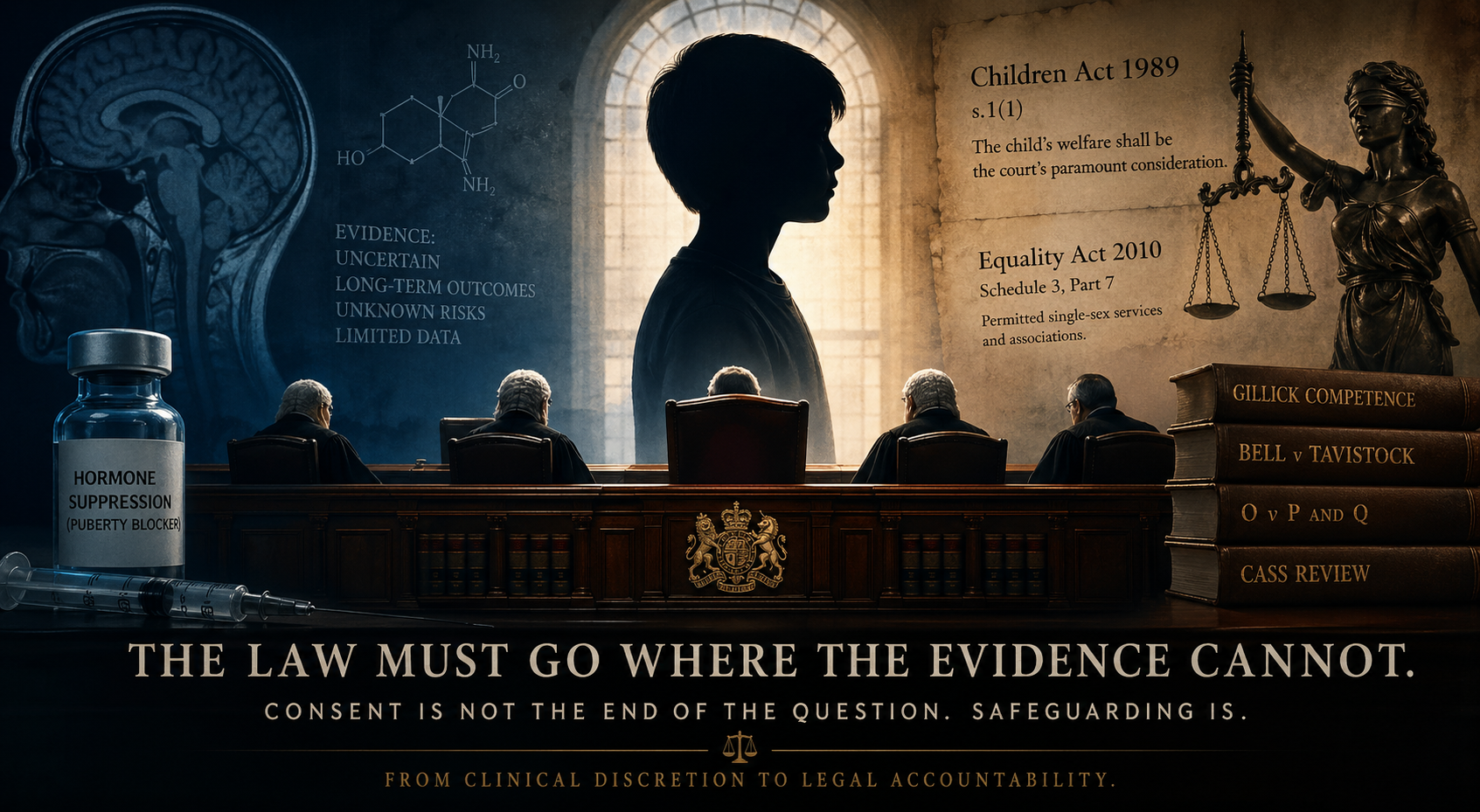
The United Kingdom has entered a decisive phase in the governance of childhood medical intervention. What was once presented as a matter of clinical discretion—whether to prescribe puberty blockers to minors experiencing gender dysphoria—has now been recast as a question of law, evidence, and institutional responsibility. The convergence of judicial scrutiny, regulatory reassessment, and evidentiary uncertainty has altered the terrain fundamentally. The issue is no longer whether such treatments can be offered, but whether they can be justified within the established legal framework governing consent, safeguarding, and the welfare of the child.
The doctrine of Gillick competence, articulated in Gillick v West Norfolk and Wisbech Area Health Authority [1986] AC 112, remains the foundation of minor consent in English law. Lord Scarman held that a child may consent where he or she has “sufficient understanding and intelligence to enable him or her to understand fully what is proposed.”¹ Yet puberty blockers test this principle at its outer boundary. Unlike discrete treatments, puberty suppression is not an isolated intervention but the entry point into a developmental pathway. The evidence indicates that between 95% and 98% of minors who commence puberty blockers proceed to cross-sex hormones²—an empirical reality that reframes the nature of consent. What is being consented to is not merely a reversible pause, but a sequence of decisions with enduring physiological consequences, a pathway whose direction is not neutral and whose destination is not unknown.
This was recognised in Bell v Tavistock [2020] EWHC 3274 (Admin), where the Divisional Court held that “it is highly unlikely that a child aged 13 or under would ever be Gillick competent to give consent to being treated with puberty blockers.”³ The Court further expressed “very considerable doubt”⁴ regarding the capacity of 14–15-year-olds to comprehend implications such as infertility and sexual function. On appeal, the Court of Appeal ([2021] EWCA Civ 1363) rejected the imposition of age-based presumptions but, crucially, did not restore certainty. Instead, it re-centred responsibility on clinicians while acknowledging the complexity of the decision, observing that “the question of whether a child is Gillick competent… is a matter for clinicians exercising their professional judgment.”⁵ This formulation, far from resolving the issue, intensifies it. Where evidence is uncertain, the burden placed upon clinical judgment becomes heavier, not lighter, and the space between discretion and liability correspondingly narrows.
That tension is resolved only by reasserting the court’s ultimate authority. In O v P and Q [2024] EWCA Civ 199, King LJ reaffirmed that “the court’s protective role does not fall away simply because a young person is Gillick competent.”⁶ Consent, therefore, is no longer determinative. It operates within, not beyond, the framework of judicially determined welfare, and where the stakes are high and the evidence unclear, the law does not retreat—it advances.
If Bell exposed the limits of consent, the Cass Review exposed the fragility of the clinical model itself. The Final Report (April 2024) concluded that “the evidence base for puberty blockers… is weak and there is a lack of high-quality research assessing their safety and effectiveness.”⁷ At p. 179, it continues: “There is considerable uncertainty about the long-term outcomes of interventions to manage gender-related distress.”⁸ These are not cautious caveats appended to an otherwise secure body of knowledge; they are structural deficiencies that reach to the core justification for intervention. Hilary Cass herself summarised the position with disarming clarity: “We have no good evidence on the long-term outcomes for this group of young people.”⁹
The empirical picture is therefore defined not by competing certainties, but by acknowledged absence. No robust longitudinal studies track patients into adulthood; psychological outcomes remain inconsistent; and critical domains—fertility, sexual function, neurodevelopment—are insufficiently understood. The policy response has followed directly. NHS England has restricted puberty blockers to research settings, and the Department of Health and Social Care has endorsed an indefinite limitation pending stronger evidence.¹⁰ What was once routine practice has been reclassified, in effect, as experimental.
This shift carries immediate legal consequences. Under Bolam v Friern Hospital Management Committee [1957] 1 WLR 582, clinicians are protected when acting in accordance with a responsible body of medical opinion. Yet where that body of opinion is itself called into question by state-commissioned review, its authority is no longer self-validating. Clinical discretion must now operate within a framework explicitly defined by evidentiary uncertainty. The shield of consensus has thinned; the demand for justification has thickened.
It must be recognised that a substantial body of clinical opinion—historically represented by organisations such as World Professional Association for Transgender Health and the Endocrine Society—has defended puberty blockers as a harm-reduction measure. The argument is that, for a subset of adolescents experiencing severe and persistent dysphoria, suppressing puberty may alleviate acute distress and reduce the need for more invasive interventions later. This position reflects genuine clinical concern and has shaped practice for over two decades. It is neither trivial nor insincere. Yet its coherence depends upon two assumptions: that benefit can be demonstrated and that risk can be assessed. The Cass Review places both in doubt. It found no consistent evidence of psychological improvement attributable to puberty blockers and emphasised the absence of long-term safety data.⁷ The harm-reduction framework, while ethically intelligible, becomes unstable when the harms it seeks to balance cannot yet be measured.
The most consequential shift, however, lies in safeguarding. The Children Act 1989 establishes that the child’s welfare is the court’s “paramount consideration.”¹¹ This principle is not rhetorical; it is operative. It requires institutions to evaluate not only immediate distress but long-term consequence. Where evidence is uncertain, safeguarding doctrine necessarily adjusts. Historically, social and medical affirmation were treated as protective. The assumption was that recognition of a child’s expressed identity would mitigate harm. The emerging evidence base complicates that assumption. The Cass Review identifies high rates of co-occurring mental health conditions, uncertainty in causal pathways between intervention and outcome, and the possibility that early intervention may itself shape developmental trajectory. In such a context, the safeguarding question is no longer whether intervention alleviates distress, but whether it introduces risks that cannot be justified. The logic of precaution replaces the presumption of affirmation.
The next phase of this legal evolution will unfold in schools. Here, statutory duties converge and collide. Institutions must navigate the Equality Act 2010, safeguarding obligations, and parental rights simultaneously. Recent Department for Education draft guidance (2023–2024) signals a shift toward caution in social transition and greater parental involvement, recognising that such decisions may have implications beyond the immediate classroom.¹² The points of conflict are already visible. Social transition—names, pronouns, uniform—is no longer treated as neutral where it may reinforce a pathway toward medical intervention. Parental notification is increasingly framed as necessary where decisions affect welfare. Single-sex spaces, protected in law under Equality Act provisions, are now the subject of active dispute. These are not theoretical tensions. They are generating complaints, legal challenges, and pre-litigation correspondence that will, in due course, demand judicial resolution.
The legal trajectory is already defined by a sequence of cases that together mark the transition from clinical autonomy to judicial oversight: Bell v Tavistock, which exposed the limits of consent; AB v CD [2021] EWHC 741 (Fam), which reaffirmed parental authority; O v P and Q [2024] EWCA Civ 199, which confirmed the primacy of best interests; and R (TransActual CIC) v Secretary of State for Health [2024], which challenged the regulatory framework itself. Further litigation is not speculative but inevitable. Claims grounded in informed consent, judicial review of institutional policy, and equality law disputes concerning sex-based provisions will define the next stage. The courts are no longer peripheral actors; they are the central forum in which the boundaries of permissible practice will be drawn.
The United Kingdom has thus moved from a model of clinical innovation to one of legal accountability. This transformation is not ideological but evidentiary. Where evidence is weak, the law tightens. Where consequences are profound, consent is scrutinised. Where uncertainty persists, safeguarding prevails. The central question now stands in its clearest and most exacting form: can a child meaningfully consent to a treatment whose long-term consequences are not yet understood, and can the State permit such treatment without assuming responsibility for those unknowns? Until that question is answered with evidentiary clarity, puberty blockers will remain not merely a medical controversy but a constitutional one, testing the limits of autonomy, the duties of care, and the authority of law over uncertain science.
¹ Gillick v West Norfolk and Wisbech AHA [1986] AC 112, p.188.
² Dutch puberty suppression studies (~95–98%).
³ Bell v Tavistock [2020] EWHC 3274 (Admin), §145.
⁴ Ibid., §151.
⁵ Bell v Tavistock [2021] EWCA Civ 1363, §89.
⁶ O v P and Q [2024] EWCA Civ 199.
⁷ Cass Review (Final Report, April 2024), pp. 45–47.
⁸ Ibid., p.179.
⁹ Hilary Cass, public statements (2024).
¹⁰ UK Department of Health and Social Care, Policy Statement (2024).
¹¹ Children Act 1989, s.1(1).
¹² UK Department for Education, Draft Guidance (2023–2024).
related articles


Latest articles
- Today’s homily: Our Lady of WalsinghamThe Mass reflects on the significance of Walsingham, Loreto, and the Christian soul as “Holy Houses” that embody the connection between heaven and earth. It highlights Mary’s central role in the Incarnation and emphasises the importance of inner conversion by inviting believers to reflect on their own hearts as dwelling places for God.
- Today’s Mass: September 24 Our Lady of WalsinghamThe Feast of Our Lady of Walsingham commemorates the vision of Mary that inspired Richeldis de Faverches to build a replica of her house in Nazareth in 1061. This shrine became a significant pilgrimage site, attracting royal visits until its destruction in 1538. The revival of pilgrimage in the 20th century reaffirmed its spiritual importance.
- Sermon for Blessed Virgin Mary of RansomToday, we commemorate the feast of the Blessed Virgin Mary of Ransom, which honours the Mercedarians, a religious order founded in 1218 to free Christian captives from the Moors in Spain. Their mission persists today, highlighting the ongoing relevance of ransoming captives amidst contemporary persecution, combining spiritual redemption with social responsibility.
- OUR LADY OF RANSOM: THE MOTHER OF THE REDEEMER AND THE BREAKING OF CHAINSThe Feast of Our Lady of Ransom, celebrated on 24 September, commemorates the Mercedarian Order’s mission to redeem Christian captives, embodying the concept of liberation from sin through Christ’s sacrifice. This day’s significance links historical devotion with England’s Catholic restoration, connecting the feast to both the Incarnation and personal spiritual freedom.
- Today’s Mass: September 23 Pope Saint Linus, MartyrPope Saint Linus, a nobleman from Tuscany, became an early Christian leader, first in Gaul and then as the Pope after Saint Peter. He was martyred for his faith, noted for his role in baptising and appointing bishops. Saint Thecla, inspired by Saint Paul, chose virginity and endured persecution, ultimately receiving martyrdom.






Leave a Reply