
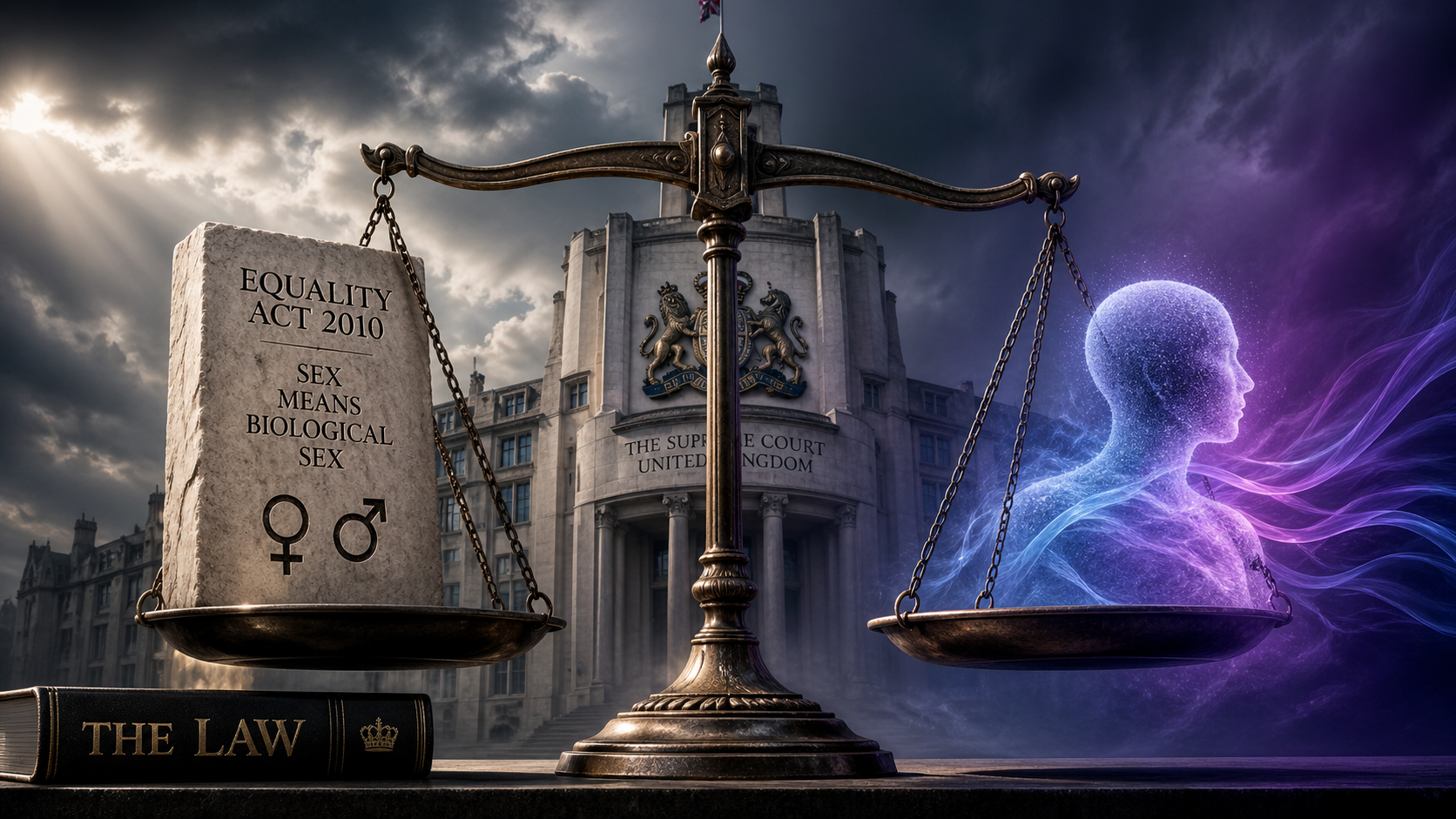
Law, Reality, and the Limits of Reinvention — Britain Re-Anchors Sex in Law and Confronts the Consequences

The United Kingdom has entered a decisive juridical phase in the long-running dispute over sex, identity, and the authority of law. For years, public institutions drifted—sometimes cautiously, often uncritically—toward policies that treated sex as a matter of identity rather than biology. That drift has now encountered a firm correction. The courts have spoken with clarity; regulators have followed; the law has reasserted a foundational premise: that sex, in its legal meaning, refers to biological reality. Yet clarity at the level of definition does not end a conflict—it sharpens it. The question now is not what sex means, but how far that meaning may be applied without colliding with competing legal claims.
The Judicial Settlement — Sex Restored to Meaning
The turning point came with the judgment of the UK Supreme Court in For Women Scotland Ltd v Scottish Ministers. Interpreting the Equality Act 2010, the Court held that the terms “sex,” “man,” and “woman” refer to biological sex.¹ This was not a policy preference but a necessity arising from the structure of the statute itself. As the Court stated:
“The meaning of ‘sex’ must be consistent throughout the Act… A variable definition would render the statutory scheme incoherent.”²
A legal category that shifts its referent ceases to function as law. The Court did not innovate; it restored coherence.
The Court further held that a Gender Recognition Certificate does not alter a person’s sex for the purposes of the Equality Act.³ In doing so, it rejected the administrative tendency to treat identity as determinative of legal classification. The law may recognise status, but it cannot dissolve the categories upon which its protections depend.
Regulatory Consolidation — Distinction, Not Collapse
Following the judgment, the Equality and Human Rights Commission issued guidance aligning public bodies with the Court’s interpretation.⁴ The Commission made the position explicit:
“Where a service is provided on a single-sex basis, it is lawful to restrict access on the basis of biological sex where this is a proportionate means of achieving a legitimate aim.”⁵
At the same time, the Commission reaffirmed that individuals undergoing gender reassignment remain protected under a distinct characteristic.⁶
This is the structural key to the present settlement. The United Kingdom has not resolved the tension by collapsing sex into identity, nor by denying identity legal relevance. It has instead drawn a line between them. Sex defines categories; gender reassignment governs protection. The distinction is juridically elegant—but inherently unstable under pressure.
The Return of Reality — And the Cost of It
For a time, ambiguity allowed institutions to avoid difficult decisions. Policies could be framed in inclusive language while quietly departing from legal precision. That era has ended. The Court has removed the ambiguity; regulators have reinforced the boundary. Institutions must now choose: comply with the law as clarified, or face the consequences of divergence.
Nowhere is this tension more visible than in local authorities such as Brighton & Hove City Council, where identity-led policies were often adopted ahead of legal clarity. Schools, public facilities, and council services must now reconcile those practices with a statutory definition that no longer bends to accommodate them. Where policy lags behind law, litigation follows.
Sport — Where Biology Cannot Be Ignored
In sport, the conflict is immediate and concrete. Governing bodies such as UK Athletics and British Cycling have begun restricting female categories to biological females while creating alternative divisions. These decisions rest on measurable differences in strength, endurance, and performance.
The legal challenge will not be whether such distinctions are permitted—they are—but whether they are proportionate in each context. Claimants will argue exclusion; regulators will argue fairness and safety. The courts will not adjudicate ideology but evidence. The result will be incremental, case-driven clarification. Yet the underlying principle is unlikely to shift: where biological difference determines outcome, biological classification will remain lawful.
Prisons — The Hardest Case of All
If sport tests fairness, prisons test safety. The placement of trans-identified prisoners raises acute conflicts between the rights of individuals and the protection of others. The HM Prison and Probation Service must weigh dignity against risk, privacy against safeguarding.
Litigation is inevitable. Trans prisoners will invoke privacy and non-discrimination; female prisoners will invoke protection from harm. The courts will be forced to confront whether individualised risk assessment can replace categorical safeguards. Early indications suggest a tightening toward biological criteria where risk is significant. The law, when pressed, tends to favour the protection of the vulnerable over the assertion of identity.
Healthcare — Where Error Carries Consequence
In healthcare, the stakes are higher still. Institutions such as NHS England cannot operate on ambiguity. Diagnosis, treatment, and patient safety depend upon accurate classification. The recording of sex is not merely administrative; it is clinical.
Here, the conflict becomes acute. Recording identity as sex risks medical error; refusing identity recognition risks legal complaint. The system must navigate both. The publication of the Cass Review has reinforced the need for evidence-based practice, particularly in relation to children.⁷ Its conclusions have already begun to reshape clinical policy and will likely influence judicial reasoning in future negligence and consent cases.
The Counter-Claim — Law as Social Instrument
Opponents of this re-anchoring argue that legal categories are not fixed reflections of reality but instruments shaped by social need. Scholars such as Agustín Fuentes have advanced precisely this line of reasoning:
“Biological definitions of sex… are themselves interpretive frameworks shaped by cultural and historical context.”⁸
On this view, classification is not descriptive but purposive. Law should therefore evolve toward inclusion, even if that requires redefining its terms.
The Supreme Court’s judgment is, in part, a rejection of that premise. It does not deny complexity; it denies that complexity dissolves classification. The law may respond to social reality, but it cannot abandon the categories that make it intelligible.
Brighton as Microcosm — Policy Meets Law
Brighton provides a revealing case study of what happens when policy outpaces law. Schools that permitted identity-based access to single-sex spaces must now reassess their safeguarding duties. Council facilities must reconcile inclusion policies with statutory compliance. Healthcare providers must ensure that clinical practice aligns with both legal and medical standards.
These are not theoretical adjustments. They expose institutions to legal challenge from multiple directions: from those asserting discrimination, and from those asserting failure to protect. The dual system does not eliminate conflict; it redistributes it.
From Definition to Enforcement
The deeper issue is not merely legal but philosophical. A legal system may extend protection, accommodate difference, and regulate conduct. But it cannot indefinitely sustain categories that detach from the realities they describe. The Supreme Court has reaffirmed that limit. It has insisted that some terms must remain anchored if law itself is to remain coherent.
Yet coherence at the level of definition does not guarantee stability in practice. On the contrary, it often provokes contest. The United Kingdom has chosen a path that separates biological reality from identity-based protection. Whether that separation can endure sustained pressure—from litigation, from policy demands, from cultural expectation—remains uncertain.
Conclusion — The Law Remembers
The era of ambiguity has ended. In its place comes an era of enforcement. The courts have restored the meaning of sex; regulators have marked its boundaries; institutions must now conform to it or contest it.
The law has remembered what reality is. The question now is whether the institutions built upon it will do the same—or be compelled, case by case, to relearn it.
¹ For Women Scotland Ltd v Scottish Ministers [2025] UKSC 16.
² Ibid., para. 175.
³ Ibid., paras. 201–205 (interaction with Gender Recognition Act 2004).
⁴ Equality and Human Rights Commission, Interim Update Following the Supreme Court Judgment on the Meaning of Sex in the Equality Act, 2025.
⁵ Ibid., section on single-sex services and proportionality.
⁶ Equality Act 2010, s. 7 (gender reassignment).
⁷ The Cass Review: Independent Review of Gender Identity Services for Children and Young People, 2024.
⁸ Agustín Fuentes, “There Are More Than Two Sexes: How Biology Helps Explain Gender Diversity,” Scientific American, 30 September 2018.
related articles


Latest articles
- Today’s homily: Our Lady of WalsinghamThe Mass reflects on the significance of Walsingham, Loreto, and the Christian soul as “Holy Houses” that embody the connection between heaven and earth. It highlights Mary’s central role in the Incarnation and emphasises the importance of inner conversion by inviting believers to reflect on their own hearts as dwelling places for God.
- Today’s Mass: September 24 Our Lady of WalsinghamThe Feast of Our Lady of Walsingham commemorates the vision of Mary that inspired Richeldis de Faverches to build a replica of her house in Nazareth in 1061. This shrine became a significant pilgrimage site, attracting royal visits until its destruction in 1538. The revival of pilgrimage in the 20th century reaffirmed its spiritual importance.
- Sermon for Blessed Virgin Mary of RansomToday, we commemorate the feast of the Blessed Virgin Mary of Ransom, which honours the Mercedarians, a religious order founded in 1218 to free Christian captives from the Moors in Spain. Their mission persists today, highlighting the ongoing relevance of ransoming captives amidst contemporary persecution, combining spiritual redemption with social responsibility.
- OUR LADY OF RANSOM: THE MOTHER OF THE REDEEMER AND THE BREAKING OF CHAINSThe Feast of Our Lady of Ransom, celebrated on 24 September, commemorates the Mercedarian Order’s mission to redeem Christian captives, embodying the concept of liberation from sin through Christ’s sacrifice. This day’s significance links historical devotion with England’s Catholic restoration, connecting the feast to both the Incarnation and personal spiritual freedom.
- Today’s Mass: September 23 Pope Saint Linus, MartyrPope Saint Linus, a nobleman from Tuscany, became an early Christian leader, first in Gaul and then as the Pope after Saint Peter. He was martyred for his faith, noted for his role in baptising and appointing bishops. Saint Thecla, inspired by Saint Paul, chose virginity and endured persecution, ultimately receiving martyrdom.






Leave a Reply