
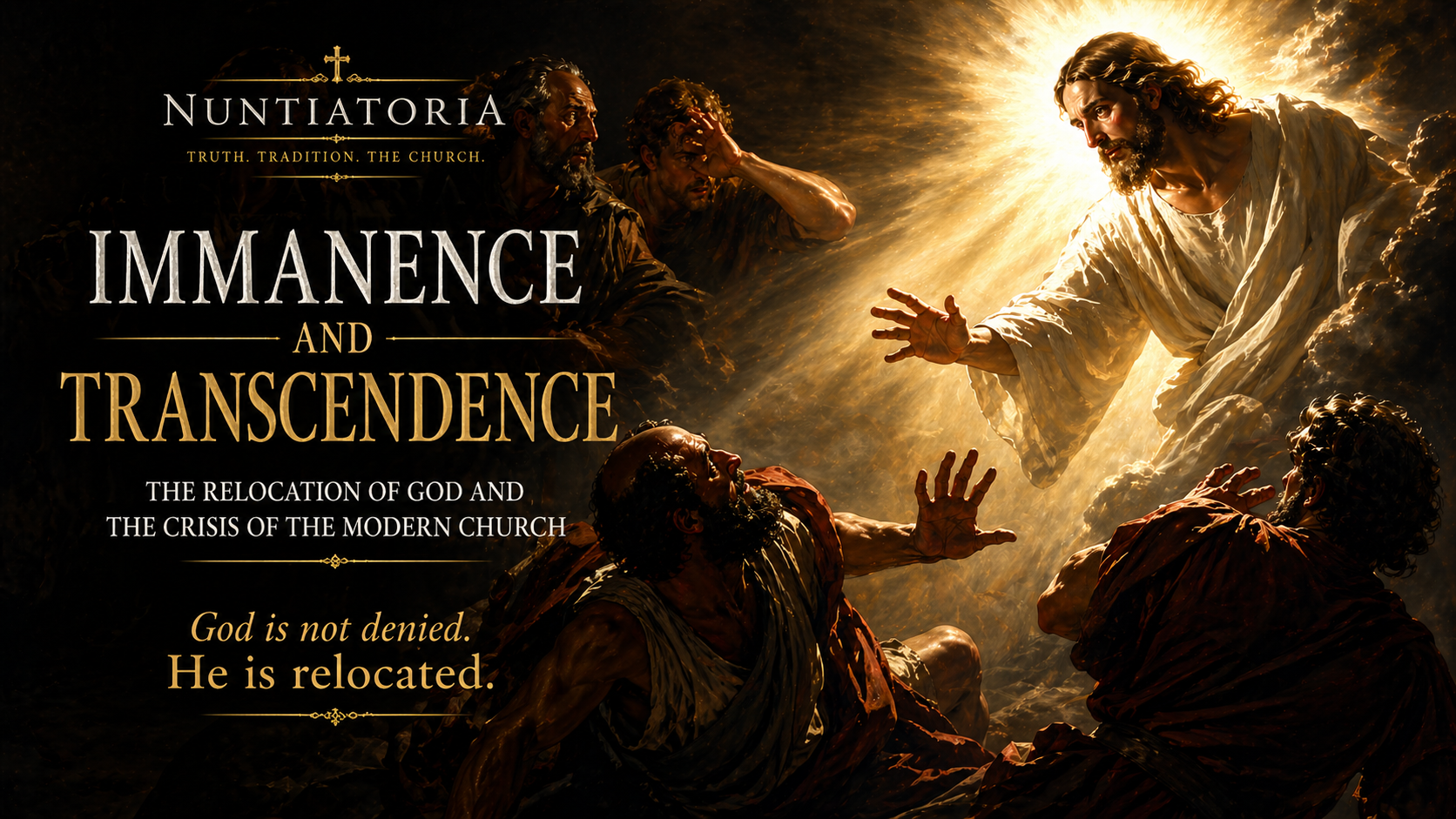
Immanence and Transcendence: The Relocation of God and the Crisis of the Modern Church
A theological commentary by the Titular Archbishop of Selsey
The deepest crisis of the modern Church is not liturgical experimentation, doctrinal ambiguity, or pastoral confusion considered in isolation. These are symptoms. The cause lies beneath them: a displacement at the level of first principles. It is the question of where God is located in theological reasoning. If God is transcendent—Lord, Lawgiver, and Judge—then revelation descends, doctrine binds, worship ascends, and man is summoned out of himself. If God is primarily immanent—encountered within experience, mediated through consciousness, and interpreted through history—then theology begins with man, and God is encountered only within the horizon of human self-awareness. The postconciliar crisis is, at root, this shift of gravity: from God who speaks to man, to man who interprets God.
The classical Catholic synthesis is neither simplistic nor sentimental. It is metaphysically exact. God is not an object within the universe, nor the highest instance within a category of beings. As Thomas Aquinas teaches, He is ipsum esse subsistens—subsistent Being itself, pure act, unconditioned and without limitation.¹ Creation does not contain Him; it participates in Him. The entire order of theology follows from this: revelation is not discovery but disclosure, grace is not development but gift, truth is not constructed but received. The Fathers insist upon the same order. Irenaeus of Lyons rejects the Gnostic tendency to locate divine knowledge within interior speculation, insisting instead that God is known because He reveals Himself in history, supremely in Christ.² Augustine of Hippo captures the paradox with enduring precision: God is “more inward than my inmost self, and higher than my highest.”³ The order is decisive. He is inward because He is higher. Immanence is the fruit of transcendence, not its replacement.
The modern inversion does not begin by denying God; it begins by shifting the starting point of theology. With Friedrich Schleiermacher, religion is defined as the “feeling of absolute dependence.”⁴ With Karl Rahner, God becomes the horizon of human transcendental experience.⁵ In both cases, theology begins not from divine self-disclosure but from human consciousness. The movement is subtle but decisive: from participation to subjectivity, from revelation to experience. Reginald Garrigou-Lagrange recognised the danger, warning that such approaches risk dissolving the distinction between nature and grace and thus between man and God, returning theology, in effect, to the errors of modernism.⁶ Once grace is treated as intrinsic to human structure, it ceases to be supernatural; once revelation arises within consciousness, it ceases to bind.
The Second Vatican Council, read in continuity, does not teach this inversion. Dei Verbum states plainly: “It pleased God… to reveal Himself.”⁷ Revelation remains a divine initiative. Yet the Council’s pastoral orientation, its engagement with modern categories, and its anthropological language created the conditions for a shift in theological method. As Joseph Ratzinger later observed, the decisive issue lies in interpretation: whether the Council is read in continuity with tradition or as a rupture from it.⁸ The rupture, where it occurred, did not manifest in formal dogmatic contradiction, but in the reconfiguration of theology’s point of departure. The question was no longer first what God has revealed, but how man experiences.
This reorientation becomes visible in the governing texts and pastoral practices of the postconciliar Church. In the liturgy, the shift is enacted rather than argued. The traditional Roman Rite, with its eastward orientation, its hieratic language, and its silent Canon, embodies sacrifice offered to a transcendent God. The widespread adoption of versus populum, vernacular immediacy, and dialogical participation subtly but unmistakably reorients the liturgical act toward the assembly. The priest appears less as one who offers sacrifice to God and more as one who presides over a gathered community. The axis of worship tilts. What was once vertical becomes perceptibly horizontal.
In moral theology, the same shift is articulated with greater explicitness. In Amoris Laetitia (2016), Pope Francis writes that “conscience can do more than recognise that a given situation does not correspond objectively to the overall demands of the Gospel.”⁹ This formulation expands conscience beyond recognition into mediation. The transcendent moral law remains affirmed in principle, yet its concrete application is filtered through subjective discernment within particular circumstances. This stands in marked tension with the teaching of Pope John Paul II, who insists in Veritatis Splendor that “circumstances or intentions can never transform an intrinsically evil act into one which is subjectively good.”¹⁰ The divergence is methodological rather than merely pastoral. One begins with immutable truth and applies it to life; the other begins with life and interprets truth through it.
The same logic governs the reconfiguration of sacramental signs in Fiducia Supplicans (2023), issued by the Dicastery for the Doctrine of the Faith under Cardinal Víctor Manuel Fernández. The declaration permits blessings of couples in situations objectively at variance with the moral law, insisting that such blessings do not “legitimise” those situations.¹¹ Yet the act itself occurs precisely within them. Traditionally, a blessing presupposes and signifies an ordering toward God. Here, the sign is reframed through context, its meaning mediated by pastoral intention rather than grounded unequivocally in objective order. The shift is not declared; it is enacted.
In Evangelii Gaudium (2013), the governing maxim is stated succinctly: “Realities are greater than ideas.”¹² Properly understood, this cautions against abstraction. In practice, it has often functioned as a reversal of priority. Doctrine becomes secondary to lived experience; theology begins from the concrete rather than from revelation. The movement is consistent with the broader trajectory: from transcendence to immanence as the operative starting point.
This reorientation is not uncontested. Cardinal Walter Kasper has advanced a pastoral approach grounded in mercy and accompaniment, particularly in relation to irregular unions, while critics such as Cardinal Raymond Burke have warned that such approaches risk introducing doctrinal ambiguity under the guise of pastoral care. Yet the debate, when framed merely as mercy versus rigor, obscures the deeper issue. The true question is metaphysical. Does theology begin from God or from man? If from God, mercy calls man upward into truth; if from man, mercy adapts truth to circumstance.
This inversion was foreseen and named with precision by Pope Pius X, who identified “vital immanence” as the defining principle of modernism: religion arising from an interior need rather than from divine revelation.¹³ Once this principle is admitted, its consequences unfold with internal coherence. Doctrine becomes interpretative, sacraments expressive, morality situational, and the Church therapeutic. God is not denied. He is rendered immanent to the point of dependence upon human consciousness.
The resolution is not found in rejecting immanence, as though Christianity were a form of distant deism. It is found in restoring the proper order of transcendence and immanence as revealed in Jesus Christ. In Him, the transcendent God enters history without ceasing to be transcendent. He does not arise from human experience; He interrupts it. He does not confirm man as he is; He commands him to become what he is not. The Incarnation is not the validation of immanence but the descent of transcendence. It is not man discovering God, but God confronting man.
The contemporary crisis, therefore, is not accidental but coherent. When conscience mediates law, when pastoral practice reframes doctrine, when sacramental signs are detached from objective order, and when lived experience governs theological interpretation, the centre has shifted. God is no longer the starting point. He is the conclusion—drawn, interpreted, and adapted.
God is not denied. He is relocated. And once relocated, He is reduced—from Lord to symbol, from Judge to companion, from Creator to interpreter of human meaning. But a God who is interpreted cannot command; a God who does not command cannot judge; and a God who does not judge cannot save. A Church that no longer begins from the transcendent God will not raise man to heaven. It will leave him where modernity has already placed him—alone, within the confines of his own experience, mistaking its echo for the voice of God.
¹ Thomas Aquinas, Summa Theologiae, I, q.3, a.4.
² Irenaeus of Lyons, Adversus Haereses, IV.6.1.
³ Augustine of Hippo, Confessions, III.6.11.
⁴ Friedrich Schleiermacher, On Religion: Speeches to Its Cultured Despisers (1799).
⁵ Karl Rahner, Foundations of Christian Faith (1976), pp. 21–30.
⁶ Reginald Garrigou-Lagrange, “Where is the New Theology Leading Us?” Angelicum 23 (1946): 126–145.
⁷ Second Vatican Council, Dei Verbum, §2.
⁸ Joseph Ratzinger, Address to the Roman Curia, 22 December 2005.
⁹ Pope Francis, Amoris Laetitia (2016), §303.
¹⁰ Pope John Paul II, Veritatis Splendor (1993), §81.
¹¹ Dicastery for the Doctrine of the Faith, Fiducia Supplicans (2023), §34.
¹² Pope Francis, Evangelii Gaudium (2013), §231.
¹³ Pope Pius X, Pascendi Dominici Gregis (1907), §7.
RELATED ARTICLES


Latest
- Today’s homily: Wednesday Michaelmas EmberThe homily reflects on the significance of fasting and prayer in the Christian faith, emphasising their role in spiritual growth and self-mastery. By juxtaposing scripture from Amos and the Gospel of Mark, it highlights the need for gratitude and humility during abundance, urging believers to recognise their dependence on God. True repentance transforms and restores one’s relationship with Him.
- Today’s Mass: September 16 Wednesday Michaelmas EmberThe post commemorates the Ember Days, originally aligned with Roman agricultural festivals. The Catholic Church adopted these days early in its history to honour true worship and avoid disrupting Roman converts’ practices. The Ember Days promote fasting, prayer, and gratitude towards God for nature’s gifts while assisting the needy.
- SEPTEMBER EMBERTIDEThe September Ember Days, rooted in ancient Roman liturgy, are a time of reflection, fasting, and thanksgiving, coinciding with the autumn harvest. Marked by communal penance and prayers for clergy sanctification, these observances connect biblical themes of creation and sacrifice, urging Christians to evaluate their spiritual fruitfulness.
- Today’s homily: Seven Sorrows of the Blessed Virgin MaryOn the Feast of the Seven Sorrows, the Church contemplates not merely Mary’s grief but her fidelity beneath the Cross. Through the liturgy, St Bernard, St John Damascene and St Thomas Aquinas, the homily shows that Christian resignation does not mean calling suffering good, but remaining faithful to God when suffering cannot be removed or understood. Mary’s stabat becomes the model of a faith which the sword can pierce, but cannot conquer.
- Today’s Mass: September 15 The Seven Sorrows of the Blessed Virgin MaryThe Feast of the Exaltation of the Holy Cross, celebrated on September 14, commemorates the historical finding of the True Cross by Saint Helena, the dedication of churches by Constantine, and its restoration by Heraclius II. It honours the cross as the symbol of salvation, transforming a method of execution into a source of life and hope.




Leave a Reply