
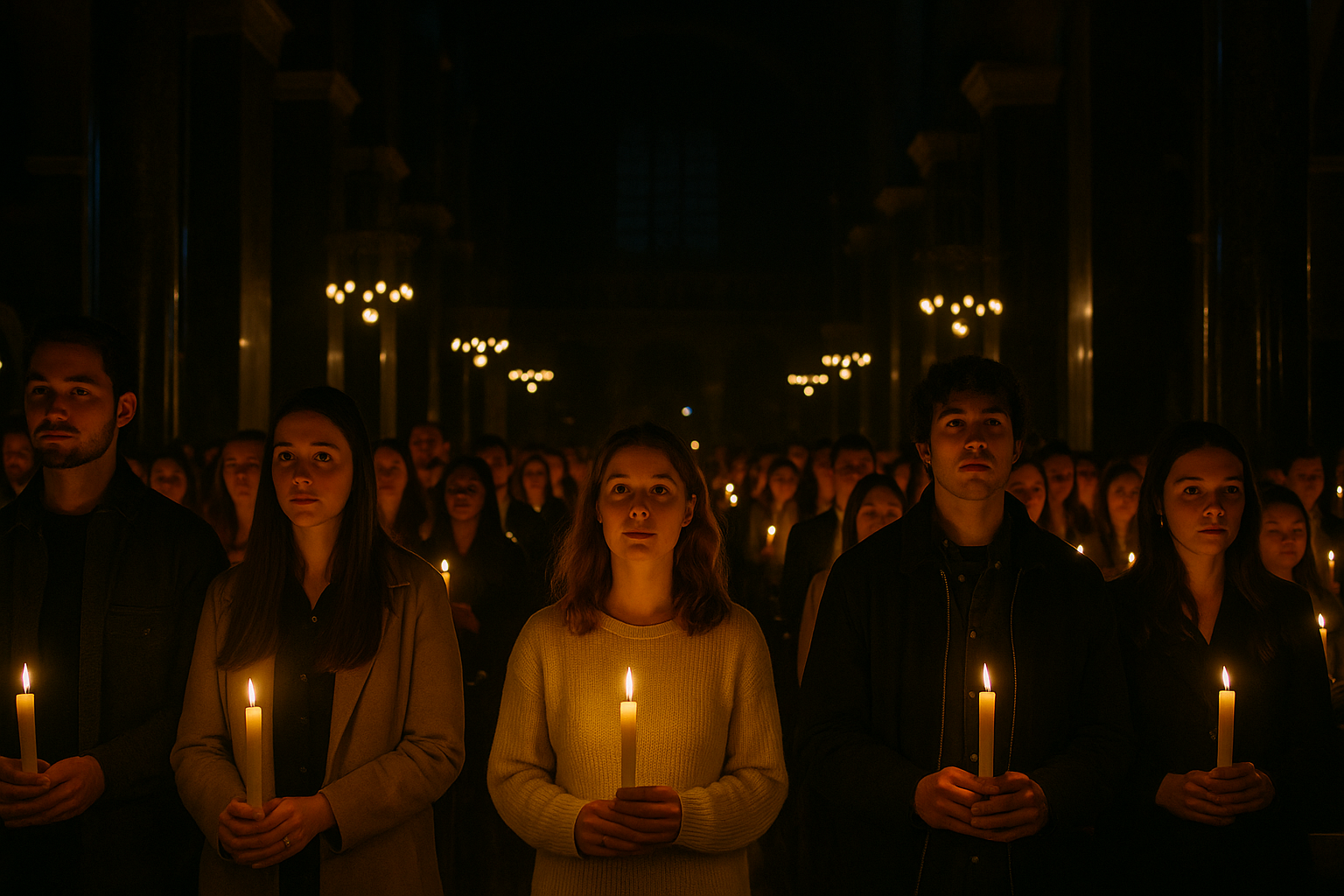
THE QUIET REVIVAL OR THE SEARCH FOR ORDER? BRITAIN’S CATHOLIC RESURGENCE RE-EXAMINED
Opening Context: A Claim Tested Against Evidence
On 13 April 2025, Catherine Pepinster argued that Catholicism in Britain is experiencing a notable resurgence among younger generations, drawing upon the Bible Society report The Quiet Revival.¹ That report makes the striking observation that among regular churchgoers aged 18–34, “Catholics now outnumber Anglicans by more than two to one.”¹ This claim has since shaped contemporary interpretations of religious change in Britain. Yet such a conclusion requires careful examination, both statistically and theologically.
Thesis: A Movement Toward the Church, Not Yet a Renewal Within It
What is presently observable is not a full ecclesial revival in the classical sense of renewed sacramental life, doctrinal unity, and generational transmission. It is a movement toward the Church—particularly among younger adults—motivated by a search for coherence in an increasingly fragmented culture. Catholicism appears resurgent not simply because it is growing, but because it retains a structure and metaphysical seriousness that its principal historical counterpart, the Church of England, has progressively diminished.
Statistical Context: Rebalancing Within Decline
The numerical comparison between Catholicism and Anglicanism must be handled with precision. According to official figures, the Church of England’s usual Sunday attendance stood at 654,000 in 2022, continuing a long-term decline.² By contrast, the Catholic Church in England and Wales reported approximately 1.75 million regular Mass attendees in its most recent consolidated survey.³ While these figures derive from different methodologies, the trajectory is clear: Anglican participation has contracted sharply, while Catholic practice has remained comparatively stable. The resulting impression of Catholic strength is therefore, in part, a relative rebalancing within wider ecclesial contraction.
Conversion: Verified Increase, Limited Conclusions
There is credible and verifiable evidence of increased adult entry into the Church. The Archdiocese of Southwark reports a “record number of adults” being received in recent years, with several hundred entering annually.⁴ Other diocesan and journalistic reports confirm a rise in RCIA participation, with clergy attributing this increase in part to digital engagement.⁵
What can be stated with confidence is therefore measured but significant: adult conversions are increasing in multiple dioceses, and interest among younger adults is demonstrably rising.
The Missing Indicator: Transmission of the Faith
The decisive test of revival lies not in conversion alone but in transmission. The Catechism teaches that catechesis must lead to “communion in Jesus Christ.”⁶ Yet long-term statistical trends in England and Wales show sustained declines in baptisms, marriages, and priestly ordinations.³ Without demonstrable reversal in these areas, the present increase in adult entry cannot yet be considered a self-sustaining renewal.
RCIA: Normative Clarity and Practical Variability
The Rite of Christian Initiation of Adults is governed by the Ordo Initiationis Christianae Adultorum, which requires catechesis to be “complete in its content… and solidly based on the Word of God.”⁷ This is a clear and demanding standard.
At the same time, episcopal guidance in England and Wales emphasises that the process is to be “adapted to local circumstances” and integrated pastorally into parish life.⁸ This principle of adaptation introduces variability in implementation. The extent to which doctrine is presented systematically depends on local catechists and clergy.
The result is a structural tension: the Church mandates completeness, but permits flexibility in delivery.
What Converts Actually Believe: Evidence and Implications
Recent diocesan testimony and early survey work provide important insight into the beliefs and motivations of converts themselves. Reports from the Archdiocese of Southwark indicate that converts are drawn by “authority and uniformity,” the “beauty and reverence” of the Mass, and the “sacramental life… and the catechism.”⁴ A national RCIA survey project has similarly recorded testimonies describing conversion as a movement toward “wholeness” and ecclesial authority, with one convert remarking: “I couldn’t be my own Pope anymore.”⁹
These statements are theologically significant. They indicate that converts are not primarily seeking accommodation, but:
- authority over private judgment
- coherence over fragmentation
- sacramental realism over symbolic religion
Clergy observations corroborate this pattern, noting a strong attraction to clarity, stability, and tradition.⁵
The contemporary convert, therefore, is not seeking a diluted Christianity, but a more defined and demanding one.
Clergy, Catechesis, and the Formation Gap
At this point the analysis must engage the question of clergy attitudes and their practical implications for formation. While comprehensive UK-wide datasets on clerical orthodoxy are limited, converging evidence from sociological research, pastoral studies, and synodal processes reveals a consistent pattern.
Research synthesised by Stephen Bullivant and others indicates that Catholic life in Britain is characterised by low doctrinal literacy among the laity and a pastoral culture that prioritises inclusion and retention.¹⁰ Broader European Values Study data similarly suggests that clergy in Western Europe often hold more permissive views on certain moral questions than official teaching would indicate.¹¹
At the pastoral level, this is reflected in what may be described as a “soft orthodoxy” model:
- formal adherence to doctrine
- flexible application in practice
- emphasis on accompaniment, conscience, and gradualism
Synodal consultation reports across dioceses further reinforce this pattern, consistently prioritising listening, inclusion, and pastoral sensitivity, while placing comparatively less emphasis on strengthening doctrinal catechesis.¹²
The implications for converts are direct and measurable. A typical parish experience in Britain is likely to include:
- strong emphasis on belonging and welcome
- sacramental participation
- pastoral sensitivity
but variable doctrinal depth and precision depending on local circumstances.
This produces a structural tension at the heart of the present resurgence:
- converts are drawn by clarity, authority, and coherence
- they are often received into a pastoral environment shaped by adaptation, discretion, and flexibility
The result is a discernible formation gap:
the faith sought by converts is often more sharply defined than the faith they encounter in ordinary parish life
This is not universal, but it is sufficiently consistent across research and pastoral observation to constitute a real and significant dynamic.
Doctrinal Reception: Evidence of Divergence
Survey data reinforces this concern. The State of Theology UK study indicates that substantial numbers of self-identified Christians—including Catholics—hold views at variance with established doctrine on key moral and ecclesiological questions.¹³ This demonstrates that formal affiliation does not necessarily entail full doctrinal assent.
Digital Evangelisation: A Documented Catalyst
The role of digital media is now well established. Clergy reports attribute increased conversions in part to online apologetics and social media engagement.⁵ The initial encounter with Catholicism frequently occurs in a context that is intellectually structured and doctrinally explicit, further intensifying the contrast with locally variable catechesis.
Immigration and the Demographic Reality
Census data from the Office for National Statistics confirms that a substantial proportion of Catholics in England and Wales were born outside the United Kingdom.¹⁴ Parish vitality in many areas is closely linked to these communities, meaning that Catholic presence is sustained not only by conversion, but by the continuity of global Catholicism expressed locally.
The Masculine Pattern: A Search for Order
The increasing presence of young men among converts reflects a deeper anthropological response to contemporary instability. In a culture marked by relativism and uncertainty, Catholicism offers a structured and intelligible framework: hierarchical, sacramental, and doctrinally ordered.
Conclusion: A Resurgence Under Judgment
The evidence now permits a precise and disciplined conclusion. There is a real and measurable increase in interest in Catholicism among younger adults in Britain. There is credible diocesan evidence of rising conversions. There is a demonstrable shift in the comparative strength of Christian denominations.
Yet the conditions of a true revival have not yet been met.
The Church is gaining entrants, but not yet demonstrably strengthening transmission.
Converts are seeking clarity, but formation is variably delivered.
Clergy uphold doctrine formally, but often apply it pastorally with flexibility.
The present moment must therefore be understood as a movement toward the Church, not yet a renewal fully within it.
Whether it becomes such a renewal will depend on what follows: not merely entry, but formation; not merely interest, but fidelity; not merely growth, but the faithful transmission of the Catholic faith in its fullness.
¹ Bible Society, The Quiet Revival: Gen Z and the Future of Faith in Britain (London, 2025), executive summary.
² Church of England, Statistics for Mission 2022 (London: Archbishops’ Council, 2023), p. 5.
³ Catholic Bishops’ Conference of England and Wales, Catholic Statistics 2018 (London, 2019), pp. 8–12.
⁴ Archdiocese of Southwark, “Record number of adults received into the Catholic Church,” official diocesan release (2026).
⁵ Catholic News Agency, “Surge in adults entering Church in England this Easter prompted by internet and tradition,” 2025.
⁶ Catechism of the Catholic Church, §426.
⁷ Ordo Initiationis Christianae Adultorum (1972), no. 75.
⁸ Catholic Bishops’ Conference of England and Wales, RCIA pastoral guidance documents.
⁹ The Tablet, “National survey explores why people join the Church,” 2025.
¹⁰ Stephen Bullivant, Mass Exodus: Catholic Disaffiliation in Britain since Vatican II (Oxford University Press, 2019).
¹¹ European Values Study, Wave 2017–2020 data (clergy and values subsets).
¹² Synod on Synodality, Diocesan Synthesis Reports (England and Wales, 2022).
¹³ Ligonier Ministries / Evangelical Alliance UK, State of Theology UK Survey (2022).
¹⁴ Office for National Statistics, Census 2021: Religion and Country of Birth dataset.
RELATED ARTICLES


LATEST ARTICLES
- Today’s Mass: September 10 St Nicholas of TolentinoSaint Nicholas of Tolentino, born around 1246 in Italy, became a devout Augustinian hermit known for his piety and dedication to preaching. He spent his later years in Tolentino, promoting virtue, and maintaining his chastity until his death in 1306. Canonised in 1446, his tomb is revered by the faithful.
- Today’s Mass: September 09 Day II in the Octave of The Nativity of the Blessed Virgin MaryThe feast of Our Lady’s Nativity, of ancient Eastern origin and established at Rome by the time of Pope St Sergius I, celebrates Mary as the immaculate New Eve and the dawn of salvation, the chosen tabernacle from whom the Redeemer would take His flesh. Today the Church also commemorates St Gorgonius, an officer of the imperial household at Nicomedia who, with his companion Dorotheus, embraced the Faith and suffered martyrdom under Diocletian in A.D. 303; his relics were later translated to Rome.
- NOMEN MANET, RES DEEST ~ The Name Remains; the Reality Is Lacking: Spiritual Conference for Nuntiatoria CXXIIThe content emphasises the disconnect between the names associated with Catholicism and the actual practices of faith. It highlights the importance of embodying belief through genuine actions, urging self-examination rather than mere external observance. Ultimately, it advocates for a restoration of sincerity in faith, calling individuals to authentically reflect their beliefs through their lives and worship.
- Mary Is Co-Redemptrix: Cardinal Burke Reopens Rome’s Marian ControversyCardinal Raymond Leo Burke has declared the Virgin Mary as “Co-Redemptrix” amidst controversy over the Vatican’s restriction on this title. The debate revolves around the appropriateness of certain theological language and whether terminology historically used can still accurately express Marian cooperation in Redemption without compromising Christ’s unique role.
- When Politics Defines Doctrine: Edmund Waldstein, Integralism and the New Boundary at HeiligenkreuzThe ongoing exclusion of Father Edmund Waldstein from teaching at Heiligenkreuz has sparked debate on the limits of acceptable Catholic thought, particularly regarding integralism and its relationship to Church doctrine. Critics argue that Waldstein and similar positions challenge both Catholic teachings and democratic values, raising questions about the intersection of faith and politics.




Leave a Reply