
Free Speech on Trial: The Crown’s Failure at Glasgow and the Fragility of Britain’s “Buffer Zone” Regime

In a case that should never have reached a courtroom, the attempted prosecution of Rose Docherty has collapsed under the weight of its own legal incoherence. At Glasgow Sheriff Court, Sheriff Stuart Reid dismissed the charges against the 75-year-old grandmother, ruling that the Crown had failed to disclose “an offence known to the law of Scotland.”¹ What ought to have been resolved at the level of basic prosecutorial scrutiny was instead permitted to proceed to arrest, detention, and months of legal uncertainty—an inversion of justice that exposes not merely an isolated error, but a deeper instability within the emerging framework of so-called “buffer zone” enforcement.
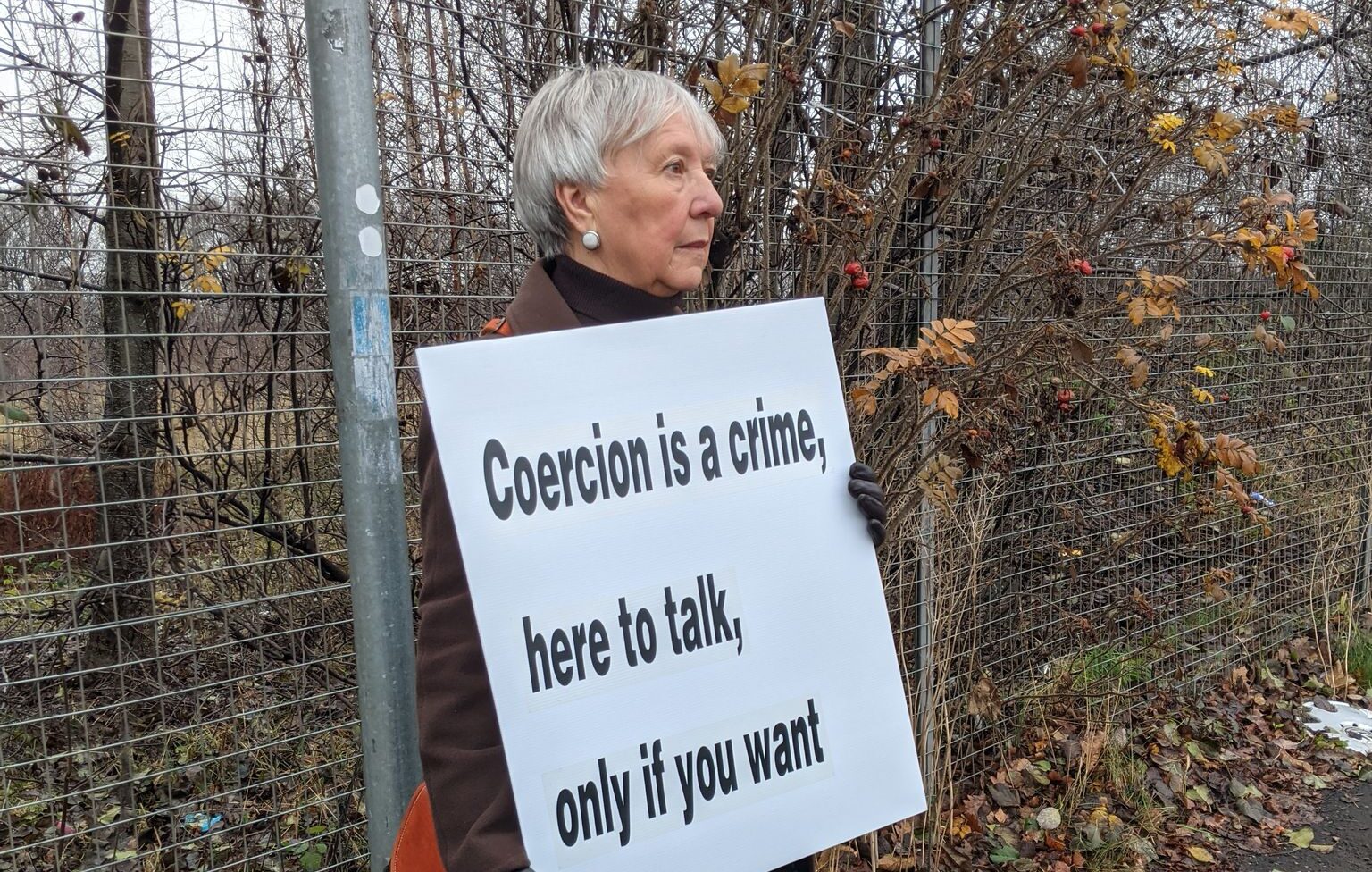
The facts are as stark as they are revealing. Mrs Docherty stood near the Queen Elizabeth University Hospital holding a sign: “Coercion is a crime, here to talk, only if you want.” She did not approach anyone. She did not obstruct, harass, or intimidate. She did not even raise her voice. She offered conversation—conditionally, consensually, and passively. Yet for this she was arrested, handcuffed, transported in a police van, and detained in a cell, despite her age and medical condition, including a double hip replacement.² That such conduct could be construed as criminal at all is remarkable; that it was prosecuted is more so; that it collapsed at the threshold of evidential sufficiency is the clearest indication that the law itself is operating at the outer limits of coherence.
At the heart of the case lay a requirement so elementary that its absence should have precluded proceedings entirely. For the offence of “influencing” to exist under the Abortion Services (Safe Access Zones) (Scotland) Act 2024, there must be an identifiable person within the zone who is accessing—or facilitating access to—abortion services, and evidence that such a person was in fact influenced.³ The Crown could demonstrate neither. During proceedings, the Procurator Fiscal conceded that there was “not at the moment” any evidential basis to show that any person had been influenced, and that enquiries were ongoing to determine whether anyone had been influenced at all.¹ This was not a minor evidential gap; it was the absence of the offence itself. Sheriff Reid’s dismissal pro loco et tempore therefore did more than terminate the case—it revealed that the prosecution had been initiated without the factual substrate required by law.
This failure is not merely procedural; it is conceptual. The Docherty case exposes the extraordinary elasticity of the term “influence” within buffer zone legislation. The architect of the Scottish law, Gillian Mackay, acknowledged publicly that the legislation could extend even to prayer within one’s own home, “depending on who’s passing by the window.”⁴ Such a statement is not incidental. It is an admission that the law’s operative categories are not anchored in objective conduct, but in the perceived effect of that conduct upon an undefined observer. In England and Wales, analogous provisions under the Public Order Act 2023 adopt a similar structure, extending criminal liability to forms of expression that may be neither direct, nor intentional, nor even communicative in the conventional sense.⁵ When legal definitions are stretched to this degree, they cease to function as rules and begin to operate as instruments of discretion.
Where discretion expands, certainty contracts. And where certainty contracts, the process itself becomes punitive. Mrs Docherty endured seven months of legal proceedings for conduct that the Crown ultimately could not substantiate even in principle.² This is not an aberration; it is a foreseeable consequence of legislating in terms so vague that enforcement becomes a matter of interpretation rather than application. One need not secure a conviction if the burden of arrest, investigation, and prosecution is itself sufficient to deter the conduct in question. The chilling effect on lawful expression, long recognised in jurisprudence, emerges here not as a theoretical concern but as an operational reality.
It is precisely this danger that Article 10 of the European Convention on Human Rights seeks to guard against. The right to freedom of expression may be qualified, but only where restrictions are clearly defined, necessary, and proportionate.⁶ As the European Court of Human Rights held in Kokkinakis v. Greece, a restriction is not “prescribed by law” unless it is formulated with sufficient precision to enable the citizen to regulate his conduct; the individual must be able to foresee, to a degree that is reasonable in the circumstances, the consequences of his actions.⁷ That standard is plainly unmet where even the prosecution cannot identify the subject of the alleged offence, nor demonstrate that any prohibited effect has occurred. In such circumstances, the law ceases to guide conduct and instead becomes a mechanism for retrospective interpretation.
The Docherty case does not stand in isolation. In England, Isabel Vaughan-Spruce faces prosecution for silent prayer within a buffer zone—conduct that raises the same fundamental question: how does one criminalise an internal act without collapsing into speculation about intention, perception, and the subjective experience of others?⁸ The trajectory is unmistakable. What begins as a narrowly framed prohibition on harassment risks evolving into a regime that regulates presence, thought, and potential interpretation. Such a trajectory is not merely undesirable; it is incompatible with the principles of legal certainty upon which a free society depends.
What renders the Glasgow proceedings particularly instructive is not simply that the Crown failed, but that it failed in a manner that reverses the proper order of justice. Charges were brought before the existence of an offence had been established; investigation followed prosecution rather than preceding it; evidence was sought to sustain a theory already advanced. Sheriff Reid’s refusal to endorse such an approach is therefore of real significance. It reasserts a principle as old as the common law itself: the state must prove its case before it acts, not construct it as it proceeds.
The dismissal of the case against Rose Docherty is rightly described as a victory, but it is a qualified one. The statutory framework under which she was prosecuted remains in force. The conceptual ambiguities that enabled her arrest remain unresolved. The enforcement mechanisms that subjected her to months of legal jeopardy remain intact. What has been exposed is not merely the failure of a single prosecution, but the fragility of a legal regime that depends for its operation upon vague definitions and discretionary enforcement.
A legal order that cannot identify its own offences before it prosecutes them is not merely strained—it is disordered.
¹ Oral ruling of Sheriff Stuart Reid at Glasgow Sheriff Court, 28 April 2026, dismissing charges pro loco et tempore; Crown concession recorded in court that there was “not at the moment” evidence of influence.
² ADF International, “Free speech victory: Judge dismisses charges against Scottish grandmother arrested for offering consensual conversation in ‘buffer zone’,” Press Release, 28 April 2026.
³ Abortion Services (Safe Access Zones) (Scotland) Act 2024, statutory provisions defining offences of “influencing” within designated zones.
⁴ Gillian Mackay, interview with BBC Scotland, 2024, acknowledging potential scope of enforcement based on perception.
⁵ Public Order Act 2023, Section 9 (safe access zones in England and Wales).
⁶ European Convention on Human Rights, Article 10.
⁷ Kokkinakis v. Greece, European Court of Human Rights, judgment of 25 May 1993, on legal foreseeability and precision.
⁸ Proceedings involving Isabel Vaughan-Spruce, England, ongoing as of 2026.


latest
- QUI BENE DISTINGUIT, BENE DOCET ~ He who distinguishes well, teaches well: Spiritual Conference for Nuntiatoria CXXIIIIn a series of Tuesday conferences, the speaker explores themes about recognising reality, receiving divine gifts, and understanding spiritual truths. He highlights the importance of making careful distinctions to maintain sound judgment, especially in an age consumed by distractions and superficial assessments. True wisdom lies in distinguishing truth from perception and nurturing an authentic inner life centred on Christ.
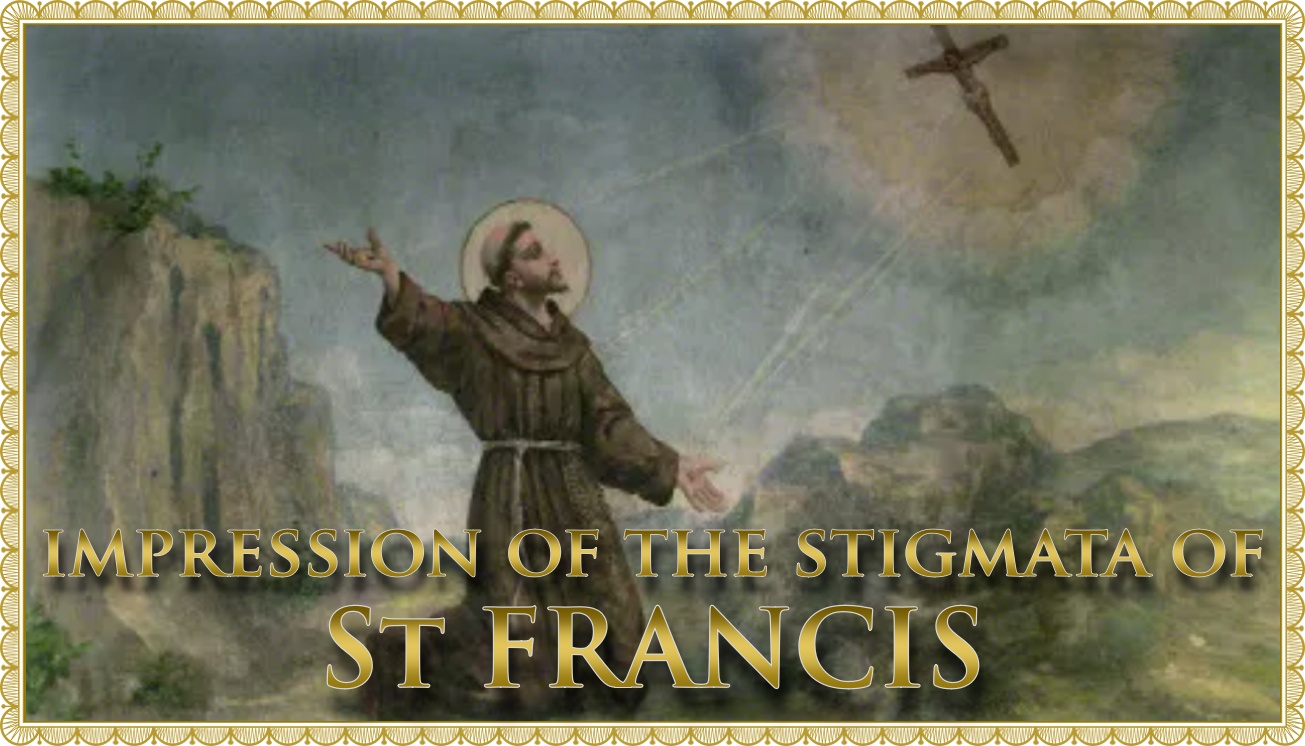
- Today’s homily: Impression of the Stigmata upon St FrancisFrom serving the lepers he once shunned to receiving Christ’s wounds upon Mount Alvernia, Saint Francis shows how grace transforms a soul through obedient love. His stigmata call us to let the Cross shape our lives, beginning with the particular act of mercy or sacrifice we have been reluctant to offer.
- Today’s Mass: September 17 Impression of the Stigmata of St Francis of AssisiSaint Francis received the stigmata because he had first allowed the Cross to transform his soul. His wounds were not a spectacle, but God’s answer to a world growing cold: the visible sign of a life consumed by crucified love. We may never bear Christ’s wounds in our flesh, but we must bear their likeness through penance, fidelity, patience, mercy and sacrificial love.
- Sermon for Stigmata of St. FrancisToday marks the feast of St. Francis’ stigmata, celebrating his transformation from a wealthy merchant’s son to a devoted preacher of poverty and humility. He founded the Franciscan order, emphasising evangelisation and simplicity. His experience of receiving the stigmata exemplifies the Christian doctrine of redemption through suffering, distinguishing it from other faiths.
- Today’s homily: Wednesday Michaelmas EmberThe homily reflects on the significance of fasting and prayer in the Christian faith, emphasising their role in spiritual growth and self-mastery. By juxtaposing scripture from Amos and the Gospel of Mark, it highlights the need for gratitude and humility during abundance, urging believers to recognise their dependence on God. True repentance transforms and restores one’s relationship with Him.



Leave a Reply