
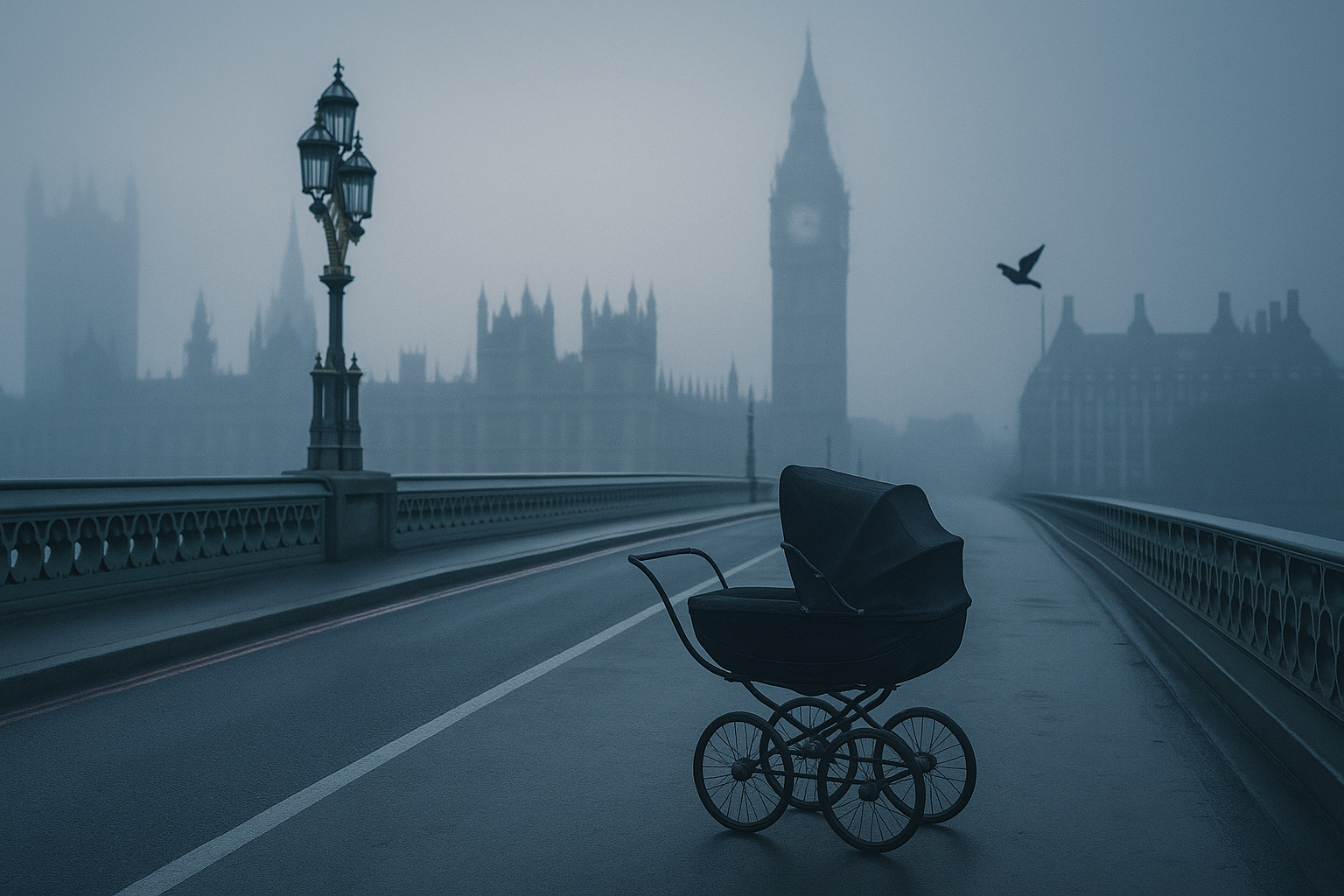
Britain 2063: A Nation Without Children — The Vanishing Majority and the Catholic Call to Renewal
A Vanishing People
The year 2063, according to the latest demographic projections, will mark a turning point without precedent in British history. Professor Matt Goodwin of the University of Buckingham, analysing official data from the Office for National Statistics (ONS), concludes that the White British population will become a minority within the next forty years.¹ Based on census data, birth and death records, and migration trends, Goodwin’s cohort-component model foresees a steady decline: from 73% of the population in 2025 to 57% by 2050, and below 50% by 2063. By the end of the century, only a third of the inhabitants of these islands will identify as White British.
If accurate, this would represent not merely a demographic shift but a civilisational transformation. For the first time since the Anglo-Saxons settled these shores, the majority of the population will neither share a common ancestry nor a continuous cultural memory. The foreign-born and their children are projected to form a majority by 2079, while one in five citizens will identify as Muslim by 2100.²
Such forecasts are not speculation in the abstract. They are grounded in measurable realities: sustained high immigration, differential fertility, and an ageing native population. Beneath the statistics lies a question neither Parliament nor pulpit seems willing to confront — what kind of civilisation will Britain become when the people who built it are no longer its majority?
The Fertility Divide
The crisis of numbers is, before all else, a crisis of birth. Professor Goodwin notes that the fertility rate among UK-born women has fallen to 1.39, far below the replacement level of 2.1. Among foreign-born women, however, it rises to 1.97 — and among Muslim women, 2.35.³
These figures expose the asymmetry of Britain’s future. A society that refuses children — through indifference, materialism, or fear of responsibility — inevitably cedes the future to those who embrace them. As T. S. Eliot warned, “A people that ceases to create its own culture ceases to exist.” When the cradle is empty, the nation withers.
Demographic decline is not only statistical but spiritual. It speaks of a loss of confidence in life, a despair masked as progress. Western societies, including Britain, have built economies on sterile individualism and measured prosperity by the consumption of things rather than the creation of persons. Yet no civilisation can long endure when it prefers pleasure to posterity.
The Culture of Death
Since 2021, Britain has recorded over 700,000 abortions,⁴ a figure that dwarfs the annual birth deficit. In 2023 alone, the Department of Health reported more than 252,000 abortions in England and Wales, the highest since records began — a number greater than the population of Portsmouth.⁵ The rate is now equivalent to one in every three conceptions.
Abortion, contraception, and delayed marriage have converged into a silent triad of extinction. Polling among self-identified Catholics reveals that more than 70% admit to using artificial contraception, and over 40% believe abortion can be morally justified “in some circumstances.”⁶ Only a fraction now marry in the Church; the rate of Catholic marriages has fallen by more than half since 2021.⁷
This collapse in faith and fertility is not merely sociological. It is the visible symptom of a deeper apostasy — a turning away from the law of God written into creation. In Humanae Vitae, Pope St. Paul VI reaffirmed that “each and every marital act must of necessity retain its intrinsic relationship to the procreation of human life.”⁸ The rejection of this truth, he warned, would lead to moral corruption, the exploitation of women, and the degradation of family life. Half a century later, his prophecy stands fulfilled in the broken homes, disposable relationships, and spiritual barrenness of modern Britain.
The Catholic Witness Betrayed
Catholics in Britain were once known for their large families and faithful marriages, living symbols of a culture of life amid secular decline. Yet the numbers now tell another story. The Church has mirrored rather than resisted the moral disintegration of the age. Too many of the faithful have been catechised by the world rather than by the Gospel.
In Casti Connubii, Pope Pius XI taught that “any use whatsoever of marriage exercised in such a way that the act is deliberately frustrated in its natural power to generate life is an offence against the law of God and of nature.”⁹ This teaching, never abrogated, binds all Catholics. Yet it is now neglected even from many pulpits, replaced by a tepid language of “discernment” and “personal conscience” that excuses sin while emptying the pews.
The fruit of compromise is sterility — moral and literal. A Church that ceases to defend life will soon have none to defend. A faith that shrinks from proclaiming truth will vanish with the generation that still remembers it.
Faith and Fertility
In every age, the renewal of nations has begun with the renewal of hearts. The decline of Britain is not inevitable if Catholics recover the courage to live what they profess. The laws of demographic arithmetic bend to those who believe.
The Catholic vocation is not merely to preserve a remnant but to regenerate a civilisation. The family — the domestic Church — is the seedbed of culture and the primary cell of social order. In Gaudium et Spes, the Second Vatican Council affirmed: “Married couples should regard it as their proper mission to transmit human life and to educate their children. They should realise that they are thereby cooperating with the love of God the Creator.”¹⁰
This is no private piety but a public witness. Every child conceived in faith, every marriage lived in fidelity, every home made into a sanctuary of prayer, becomes an act of resistance against the anti-life ethos of the age. To welcome life is to proclaim that God has not abandoned His creation, nor has man lost his dignity as its steward.
A Nation of Strangers
Professor Goodwin warns that “by the end of the century, most of the people on these islands will not be able to trace their roots back more than one or two generations.”¹¹ His concern is not racial but civilisational — the erosion of the shared memory that once made the British a people rather than a population.
This fragmentation will not be healed by economic policy or political slogans. A society that no longer knows what it believes cannot integrate those who arrive upon its shores. Assimilation requires a culture confident in its own truths; integration presupposes something worth integrating into.
The same holds for the Church. A people uncertain of its faith cannot evangelise the nations. A Church that apologises for its moral teaching will soon be apologising for its very existence.
The Catholic Response
The Catholic answer to demographic decline is not panic but conversion — not to lament the loss of numbers but to restore the meaning of life. The future belongs not to those who shout loudest but to those who love deepest.
If Britain’s birth rate collapses because its people no longer believe life is sacred, then the only remedy is a revival of faith. Catholics must again become visible as lovers of life, builders of families, and defenders of the unborn. The family must be restored to its rightful dignity as the domestic Church, a sanctuary of love open to the gift of children.
Genesis commands, “Be fruitful and multiply, and fill the earth.”¹² This is not a suggestion but a vocation. Psalm 127 declares, “Children are a heritage from the Lord; the fruit of the womb a reward.” The Christian family, then, is not a lifestyle choice but a participation in divine creation.
To the faithful, therefore, the call is urgent: rediscover the courage to be Catholic — in marriage, in fertility, in public witness. Resist the culture of sterility with the joy of life. Let the cradles once again outnumber the coffins.
The Choice Before Us
The Britain of 2063 will not be determined by numbers alone but by the faith of those who remain. A nation cannot survive without children; the Church cannot thrive without saints. If Catholics recover fidelity to truth, they may yet become the leaven that renews both.
But if indifference continues, if Catholics live as the world lives, then the demographic winter will only deepen. As Pope Paul VI foresaw, when the transmission of life is severed from love, humanity itself becomes disposable. The land that once gave birth to martyrs and missionaries will become, in the words of the prophet Jeremiah, “a land not sown.”
The question, therefore, is not what Britain will look like in 2063, but whether the faith will still burn in the hearts of her people. Renewal begins not in Parliament but at the altar, not in statistics but in conversion. When the faithful again live as faithful Catholics — open to life, steadfast in marriage, confident in truth — the tide will turn.
The future belongs to the fertile. But more deeply still, it belongs to the faithful.

¹ Matt Goodwin, The Future of Britain: Demographic Projections to 2100 (University of Buckingham, 2025), based on ONS 2021 Census and 2022 Population Projections.
² Ibid., p. 6–8.
³ Ibid., fertility data derived from ONS birth statistics (2022) and comparative religious fertility rates.
⁴ UK Department of Health and Social Care, Abortion Statistics, England and Wales: 2021–2023 (published 2024).
⁵ Ibid., Table 2.
⁶ YouGov, Catholics and Contraception: Attitudes Survey (2023); NatCen British Social Attitudes Survey (2024).
⁷ Office for National Statistics, Marriages in England and Wales, 2021–2023 (released 2024).
⁸ Paul VI, Humanae Vitae (1968), §11.
⁹ Pius XI, Casti Connubii (1930), §54.
¹⁰ Gaudium et Spes (1965), §50.
¹¹ Goodwin, The Future of Britain, p. 12.
¹² Genesis 1:28; cf. Psalm 127:3–5.



Leave a Reply