
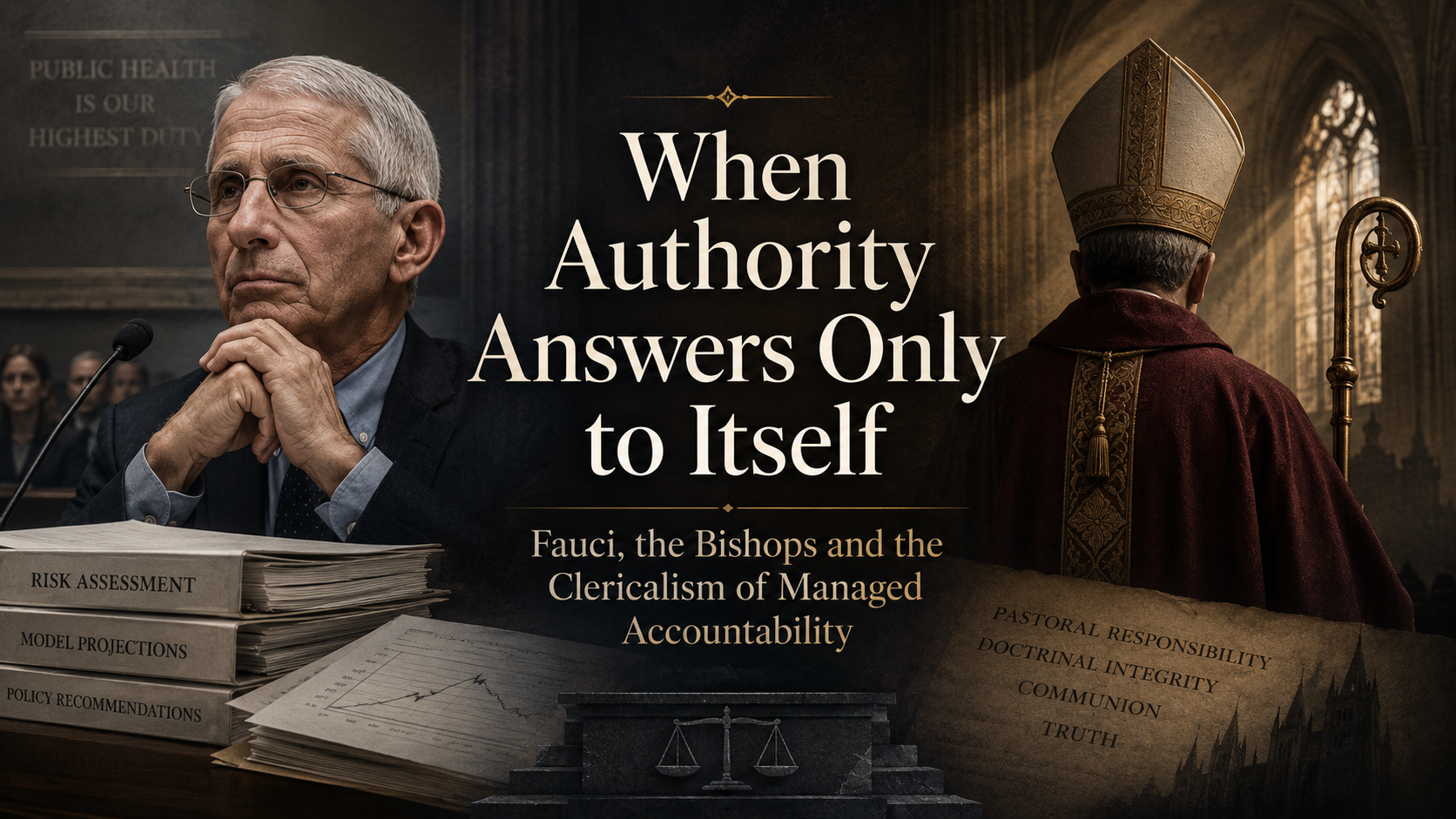
When Authority Answers Only to Itself: Fauci, the Bishops and the Clericalism of Managed Accountability
Christopher Manion’s comparison between Anthony Fauci and the American Catholic hierarchy is rhetorically provocative and, in some particulars, too sweeping. Yet beneath it lies a considerably more important Catholic question. What happens when institutions demand trust and obedience from those beneath them while making meaningful scrutiny of their own conduct increasingly difficult? From the Covid years to the abuse catastrophe, and now even beneath the language of “listening” and “synodality,” the same clericalist temptation repeatedly appears: authority which controls not only the decision, but the questions, the evidence, the consultation and finally the account given of itself.

Christopher Manion’s recent essay, “Fauci and the Bishops,” begins with an analogy which requires qualification but deserves considerably more attention than its rhetorical form might initially suggest.¹ Anthony Fauci was never, juridically speaking, the American “Covid Commando” whose personal decrees closed churches, businesses and schools across the United States. Those coercive powers were exercised principally through federal, state and local governmental mechanisms, while Fauci became the extraordinarily influential public face of the public-health consensus which informed them. Nor can one simply assume that every bishop who restricted public worship during the first bewildering weeks of the pandemic acted from cowardice, political calculation or servility. There was an unfamiliar disease, rapidly changing information, serious concern for the vulnerable and an obligation to make prudential decisions under conditions of genuine uncertainty.
But once those qualifications are made, Manion’s underlying question becomes stronger rather than weaker. The real comparison is not between the legal powers of Anthony Fauci and the canonical jurisdiction of a diocesan bishop. It is between two manifestations of a pathology increasingly characteristic of modern institutions: authority which expects compliance, invokes expertise, demands trust, and yet becomes remarkably resistant when those over whom it exercised power subsequently ask it to account for what it did.
That question has acquired renewed urgency. President Joe Biden’s pardon of Fauci on 19 January 2025 was extraordinarily broad: a “full and unconditional pardon” for any federal offences Fauci might have committed or taken part in from 1 January 2014 until the date of the pardon insofar as they arose from or related to his governmental service.² A pardon is not proof that any offence occurred, still less that Fauci committed one. Yet the breadth of the protection is a matter of record. When Fauci appeared under subpoena before the Senate Homeland Security and Governmental Affairs Committee on 29 July this year, he nevertheless repeatedly invoked the Fifth Amendment rather than answer certain questions. Chairman Rand Paul maintained that the pardon removed the relevant risk of federal prosecution and that Fauci had further weakened his privilege by voluntarily giving opening testimony; Ranking Member Gary Peters disputed that legal interpretation and warned that forcing testimony could imperil constitutional protections. On 6 August the committee nevertheless advanced a contempt resolution by an 8–5 party-line vote.³ The legal dispute is real and should not be caricatured. But so too is the extraordinary public spectacle: after years in which enormous confidence was demanded in governmental expertise, even the attempt retrospectively to establish who knew what, who decided what, and upon what evidence, remains contested.
That context became still more significant on 18 August when David Morens, formerly a senior adviser in the Office of the Director of the National Institute of Allergy and Infectious Diseases, pleaded guilty to conspiracy to commit offences against and defraud the United States. According to the Department of Justice, Morens admitted participating in a scheme designed to evade Freedom of Information Act requests and federal records requirements by moving official communications onto personal email accounts and concealing communications relating to coronavirus research grants.⁴ Nothing in that plea establishes criminal misconduct by Fauci, nor should responsible journalism imply otherwise. What it does establish is that concerns about transparency and record-keeping within the institution Fauci directed were not simply inventions of fevered outsiders. A senior official has now admitted deliberately participating in precisely the kind of evasion which critics had insisted deserved investigation.
But for Catholics the political controversy is ultimately secondary. The more uncomfortable question concerns the Church.
It is often said that “Fauci closed the churches.” Strictly speaking, that is not what happened. The Centers for Disease Control issued public-health guidance; enforceable restrictions depended substantially upon state and local authorities. CDC guidance itself acknowledged both the constitutional significance of religious worship and the right of faith communities to adapt recommendations consistently with their religious traditions.⁵ Nor were churches everywhere legally compelled to close. Pew Research Center found in April 2020 that only ten states then prohibited religious gatherings outright; fifteen permitted them without numerical restriction, while others imposed varying attendance limits or exemptions. Pew also observed that many religious bodies voluntarily suspended services even where government rules would have permitted them to continue.⁶
This makes the Catholic question not less serious but more so.
Because bishops themselves made decisions. Bishops suspended public Masses. Bishops restricted access to churches. Bishops regulated the availability of Confession, Baptism, weddings, funerals and pastoral visitation. Priests were instructed about what they might and might not do. In some dioceses extraordinarily creative measures were employed to maintain sacramental life while observing proportionate precautions; elsewhere ecclesiastical restrictions went beyond what civil law itself required. There were priests who heard Confessions outdoors, distributed Holy Communion with elaborate precautions, arranged private access to churches or found ways to reach the dying. There were other places where the faithful experienced something closer to sacramental abandonment.
The question is not whether every restriction was wrong. That would be facile retrospective judgement. In March 2020 no bishop possessed the knowledge available six years later. A grave infectious disease may justify grave temporary precautions. Catholic prudence is not recklessness baptised with holy water.
The real question comes afterwards.
Where is the ecclesiastical examination of conscience?
Six years have passed. There should by now be a serious Catholic reckoning with those decisions. Not a tribunal conducted with hindsight, but precisely the kind of examination which Christian moral reasoning ordinarily requires after an emergency has passed. What was proportionate? What proved unnecessary? Where did fear overtake prudence? Where did episcopal restrictions exceed civil requirements? Were the particular spiritual dangers of sacramental deprivation adequately weighed against physical danger? Was enough distinction made between closing a cinema and closing a church, between postponing a social gathering and denying a dying Catholic the rites of the Church? Were priests closest to the faithful heard? Were bishops sufficiently alert to the possibility that public-health authorities, however sincere, approached human welfare from assumptions necessarily narrower than the supernatural mission entrusted to the Church?
Most importantly: what would the bishops do differently next time?
That question ought to be uncontroversial. Yet one struggles to identify anything resembling a systematic episcopal examination of the matter proportionate to the magnitude of what occurred. The emergency came; extraordinary decisions were made; the emergency receded; and ecclesiastical life largely moved on. There were statements, defences and occasional reflections, but little of the searching institutional self-examination routinely demanded of others.
And that is where Manion’s analogy reaches the deeper problem. The scandal is not that authority can make mistakes. Every authority does. The scandal begins when authority treats the possibility that it made a mistake as something those beneath it have no standing to investigate.
Catholic theology permits no such conception of episcopal office. A bishop’s authority is not democratic, contractual or delegated by popular sovereignty. It belongs to the divine constitution of the Church. Precisely for that reason it cannot be reduced to arbitrary command. Sacred authority is a stewardship. The shepherd receives authority for the flock; the flock does not exist for the institutional security of the shepherd.
The Code of Canon Law expresses this relationship with remarkable balance. Canon 212 first requires Christian obedience towards what sacred pastors authentically teach or establish as rulers of the Church. The same canon then declares that the faithful are free to make their spiritual needs and desires known to their pastors and that, according to their knowledge, competence and standing, they possess “the right and even at times the duty” to make their views known concerning matters affecting the good of the Church. Canon 213 in turn recognises the faithful’s right to receive assistance from the spiritual goods of the Church, “especially the word of God and the sacraments.”⁷ Obedience therefore does not abolish responsibility; nor does episcopal authority extinguish the legitimate voice of those over whom it is exercised.
That distinction matters because too much contemporary discussion uses the word clericalism in an oddly selective way. Clericalism is frequently imagined as the old-fashioned parish priest who expects everyone to obey him. Certainly it can assume that form. But its deeper essence is the construction of an ecclesiastical caste whose possession of office progressively becomes insulation from scrutiny. It appears wherever those exercising authority determine what questions may be asked, what information may be disclosed, which criticisms are legitimate, who will investigate complaints, what criteria will judge the investigation, and finally whether anything requiring accountability occurred.
The abuse catastrophe revealed that clericalism with devastating clarity. In 2002 the United States bishops adopted their Charter for the Protection of Children and Young People, expressly committing dioceses to openness and transparency concerning clerical sexual abuse and establishing structures intended to improve accountability.⁸ Much has unquestionably improved since then, particularly safeguarding procedures, reporting obligations and awareness of abuse. But Theodore McCarrick demonstrated how long an institutional culture of deference, compartmentalised knowledge, euphemism and reputational management could survive at the highest levels of ecclesiastical life. The Holy See’s own report documented decades of allegations, warnings, denials, incomplete information, disputed assessments and decisions which allowed McCarrick’s advancement and influence to continue.⁹ The scandal was not only the wickedness of one man. It was the ability of an ecclesiastical system repeatedly to possess enough information to be concerned while somehow failing to assemble, test and act upon that information decisively.
The Church should therefore be unusually suspicious of structures in which authority examines itself, reports upon itself and finally pronounces itself satisfied with the result.
Yet here an irony appears. At precisely the moment when Catholics have become increasingly conscious of clericalism, the institutional Church has embraced the rhetoric of “synodality,” “listening,” “discernment,” “participation” and “conversation.” In principle there is nothing objectionable about any of these things. The faithful ought to be heard. Indeed, the Church’s own theological tradition recognises that they possess not merely a passive place beneath the hierarchy but a genuine sensus fidei, and that pastors should listen seriously to the faithful as members of the one Body of Christ. The International Theological Commission has explicitly insisted both that the faithful have a real voice and that there can be no simple identification of the sensus fidelium with public or majority opinion. Authentic participation requires faith, ecclesial communion, attention to the Word of God, adherence to the Magisterium, holiness and concern for the edification of the Church.¹⁰
This makes the manipulation of “synodality” especially serious.
A consultation is not genuinely open merely because microphones are provided. A process does not cease to be clericalist simply because lay people sit around the table. If those who organise the process determine beforehand the conceptual framework, formulate the questions, select the participants, establish the vocabulary, appoint those who synthesise the responses, decide which contributions are representative, exclude conclusions judged unacceptable and then present the resulting synthesis as the “voice” or “discernment” of the People of God, the old clericalism has not disappeared. It has simply acquired facilitators.
Indeed, this can be more insidious than straightforward command. At least an authoritarian bishop who says, “This is my decision,” assumes responsibility for what he has decided. Managed synodality can diffuse responsibility through processes, committees and consultations while ensuring that control never actually leaves the institutional centre. The predetermined conclusion then returns wearing the vestments of participation.
This is not genuine synodality. It is controlled consultation.
And one can recognise its characteristic features. Certain questions are endlessly explored while others rarely reach the agenda. Certain voices are described as “prophetic” while others become “divisive.” Certain demands are treated as evidence that “the Spirit is speaking,” while longstanding Catholic attachment to received doctrine, traditional worship or established moral teaching may be psychologised as fear, rigidity or resistance to change. The process listens—but it also decides beforehand what counts as worth hearing.
That is why the sensus fidelium must never be confused with the product of a managed consultation. The Church’s own theological commission warns explicitly that public opinion and the sensus fidei are not the same thing.¹⁰ A questionnaire does not manufacture the voice of the Holy Ghost. A facilitated discussion cannot transform fashionable opinion into Apostolic Tradition. A majority assembled through a particular methodology does not acquire magisterial authority because the results are described as “discernment.”
Nor does the manipulation run only in a progressive direction. Any ecclesiastical authority can commit the same error. The principle is universal: consultation is meaningful only where those consulted are genuinely permitted to tell authority something it did not already intend to hear.
This brings us back to Covid. It also brings us back to clerical abuse. And it brings us to a much wider pattern visible throughout contemporary ecclesiastical administration. The problem is always substantially the same. Authority creates the mechanism by which its own actions are assessed, determines the admissible evidence, controls publication, describes the outcome, and then invites those affected to regard the resulting process as accountability.
Civil bureaucracies behave similarly. Governments invoke national security. Corporations invoke commercial confidentiality. Universities invoke process. Public-health agencies invoke expertise. Ecclesiastical administrations invoke obedience, prudence, communion, confidentiality or the avoidance of scandal. Sometimes those reasons are entirely legitimate. No serious person proposes that bishops publish confidential personnel records, identify victims, disclose matters protected by conscience, or turn every pastoral judgement into a public referendum. Transparency is not voyeurism, and accountability does not abolish justice, privacy or due process.
But legitimate confidentiality is not the same thing as institutional opacity.
A healthy authority explains what it can explain. It identifies the principles upon which decisions were made. It distinguishes fact from inference and prudential judgement from doctrine. It welcomes competent scrutiny without treating criticism as rebellion. It corrects the record. It acknowledges when circumstances have disproved an earlier assessment. It recognises conflicts of interest. Where serious failure has occurred, it permits examination by persons who are not themselves dependent upon those whose conduct is being examined.
Above all, a healthy authority can say: we were wrong.
Those may be among the hardest words for any institution to pronounce, but in the Church they ought not to be. Christianity begins with repentance. The sacramental economy presupposes acknowledgement of sin. Every Catholic is taught to examine his conscience, accuse himself honestly and amend his life. It is a peculiar ecclesiology which applies that discipline rigorously to individual believers while permitting institutions perpetually to speak in the passive voice.
“Mistakes were made.”
“Lessons have been learned.”
“Processes have been strengthened.”
“Moving forward…”
But who made the mistake? Who failed to act? Who ignored the warning? Who exceeded his authority? Who drafted the policy? Who decided that the churches should close? Who prevented the priest from reaching the dying person? Who promoted the cleric despite the warnings? Who constructed the consultation? Who omitted the inconvenient responses from the synthesis? Who had the power to correct the matter and declined to do so?
Accountability begins when nouns and verbs recover their subjects.
None of this is an argument for weaker bishops. The Church has suffered quite enough from episcopal weakness. What she needs are bishops sufficiently conscious of the divine seriousness of their office that they do not confuse authority with personal infallibility. A bishop who says, “I judged wrongly,” does not diminish the episcopate. A bishop who reverses an unjust decision does not become less authoritative. A bishop who permits independent scrutiny does not surrender governance. A bishop who discovers that the faithful understand a pastoral reality which his bureaucracy has missed is not defeated by the laity.
On the contrary, authority becomes credible when those exercising it demonstrate that truth matters to them more than vindication.
The difficulty is that contemporary institutions increasingly appear to believe the opposite. They demand confidence precisely when confidence has been damaged. They answer criticism by repeating their credentials. They answer questions about process by pointing to another process. They respond to demands for accountability by creating committees whose terms of reference they themselves control. And when distrust inevitably follows, they diagnose the distrust rather than examine the behaviour which caused it.
That is the point at which the comparison with Anthony Fauci becomes genuinely instructive. It does not depend upon proving that Fauci committed a crime. It does not require pretending that he personally ordered every church in America to close. Nor does it require suggesting that every Catholic bishop acted from the same motive. The analogy survives all those qualifications because its real subject is not culpability but institutional authority confronted by retrospective scrutiny.
The question to Fauci is: what happened, what did you know, what did you advise, and why?
The question to the bishops after Covid is: what happened, what principles governed your decisions, what did you learn, and why has there been so little collective reckoning?
The question after the abuse crisis is: who knew, who failed to act, who was protected, and what consequences followed?
The question for contemporary “synodality” is: are you genuinely listening—or are you managing the process by which your preferred answer is returned to you as the voice of those whom you claim to have consulted?
Those are not revolutionary questions. They are questions asked in defence of authority, because legitimate authority cannot indefinitely survive the destruction of trust, and trust cannot survive the perception that those who demand accountability from others are exempt from it themselves.
The Church does not need democratisation. She does not need another Luther, another Henry VIII, or a secular government deciding whether bishops have governed well. Episcopal authority is divinely constituted and must be defended precisely against such reduction.
But divine constitution does not mean divine immunity from human failure.
A bishop remains a man. A conference of bishops remains capable of collective error in prudential affairs. A dicastery remains capable of bureaucracy. A synodal secretariat remains capable of controlling an agenda. A safeguarding office remains capable of institutional self-protection. A consultation remains capable of manipulation. And no number of references to “discernment” can transform an administrative technique into the voice of the Holy Ghost.
The antidote is therefore neither rebellion nor servility. It is something much more demanding: authority exercised as stewardship; obedience ordered to truth; consultation which genuinely risks hearing an unwelcome answer; transparency bounded by justice rather than convenience; responsibility attached to identifiable persons; and repentance where authority has failed.
Anthony Fauci may yet be compelled to answer more questions about his public stewardship. Whether he is eventually vindicated, criticised or implicated in nothing beyond controversial judgement is for competent authorities and evidence to determine.
The bishops confront a different and ultimately more serious standard.
Their office concerns not merely public policy but the salvation of souls. They possess authority not because they are members of an ecclesiastical managerial class, but because they are successors of the Apostles. That should make them less afraid of accountability, not more. An Apostle does not protect the prestige of his office by concealing his weakness. St Peter’s failure was recorded in the Gospel itself.
There is, then, a better way than the pattern Manion describes.
It is not anti-authoritarianism.
It is Catholic authority purified of clericalism.
And its first principle is very simple:
however exalted the office, however impressive the expertise, however elaborate the consultation, no Christian authority answers only to itself.
- Christopher Manion, “Fauci and the Bishops: A Catholic Reflection,” Shenandoah Sodbuster, 18 August 2026. Source
- United States Department of Justice, Executive Grant of Clemency: Dr Anthony S. Fauci, 19 January 2025.
- United States Senate Committee on Homeland Security and Governmental Affairs, Chairman Paul’s Contempt Resolution Against Anthony Fauci Advances Out of Committee, 6 August 2026; Ranking Member Gary Peters, Ahead of Pending Contempt Vote, Peters Warns Colleagues Resolution Lacks Legal Basis and Would Weaken Congressional Oversight and Constitutional Rights, 5 August 2026.
- United States Department of Justice, U.S. Attorney’s Office, District of Maryland, Former Senior NIAID Official Pleads Guilty to Charges Connected to Concealing Federal Records During COVID-19 Pandemic, 18 August 2026.
- Centers for Disease Control and Prevention, COVID-19 Considerations for Communities of Faith.
- Virginia Villa, Most States Have Religious Exemptions to COVID-19 Social Distancing Rules, Pew Research Center, 27 April 2020. Source
- Code of Canon Law, cann. 212–213.
- United States Conference of Catholic Bishops, Charter for the Protection of Children and Young People.
- Secretariat of State of the Holy See, Report on the Holy See’s Institutional Knowledge and Decision-Making Related to Former Cardinal Theodore Edgar McCarrick, 10 November 2020.
- International Theological Commission, Sensus Fidei in the Life of the Church, 2014, especially §§74–80, 113–124.


latest
- Today’s Mass: October 07 Pope St Mark, ConfessorSt Mark’s brief pontificate teaches that God measures fidelity, not duration or worldly achievement. Christ alone possesses the everlasting priesthood; His servants are stewards of what they have received. With the commemorated martyrs, St Mark reminds us to persevere faithfully, so that when the Lord comes, He finds us “so doing.”
- Omnia autem probate: quod bonum est tenete ~ Prove all things; hold fast that which is good: Spiritual Conference for Nuntiatoria CXXVIThe conference reflects on St Paul’s assertion to “prove all things” in relation to self-judgement and the Church. It explores themes of synodality, ecumenism, and the importance of discernment, emphasising the need for humility in understanding truth and the challenge of maintaining genuine holiness in the midst of contemporary ecclesiastical crises.
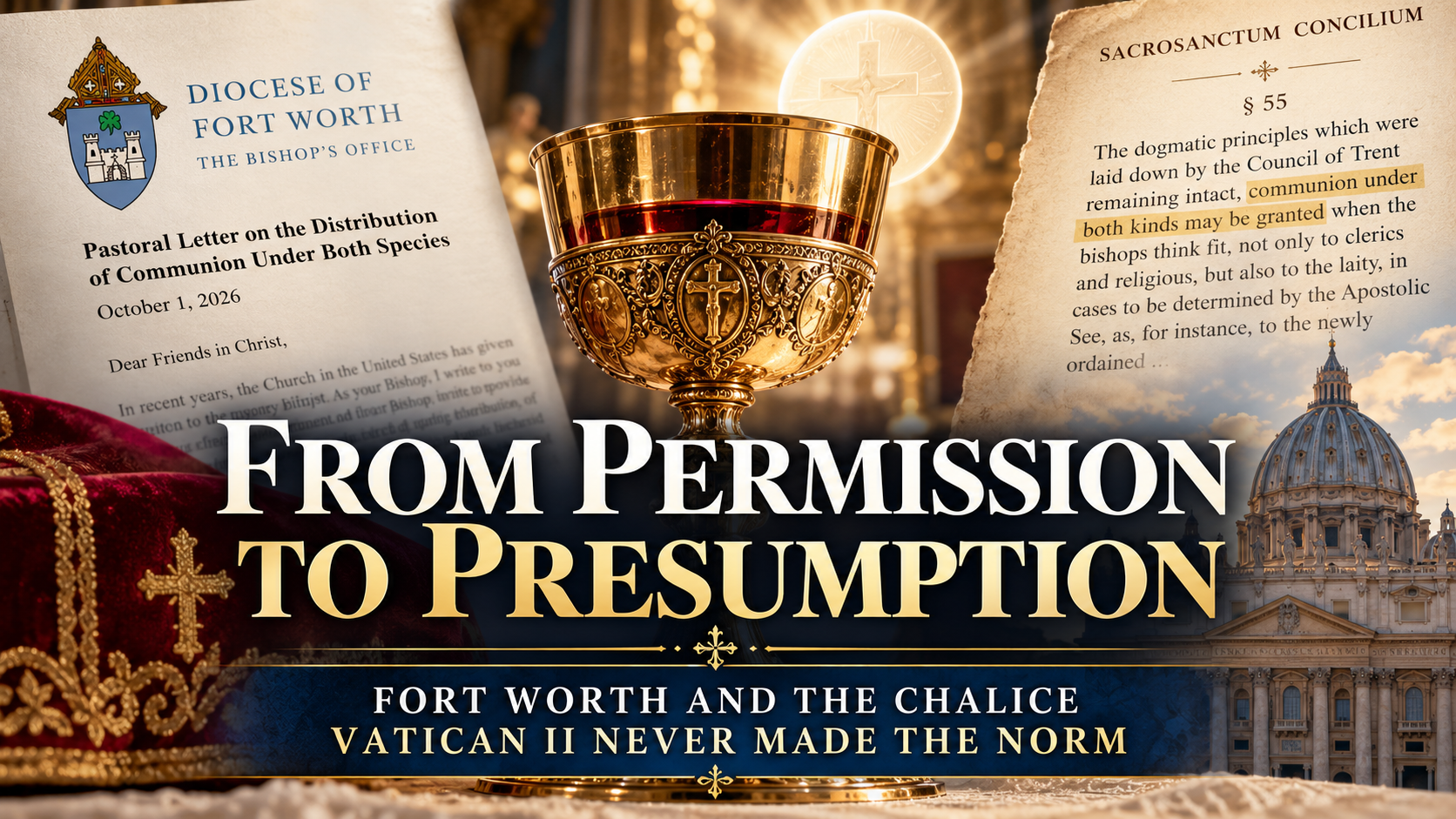
- FROM PERMISSION TO PRESUMPTION: Fort Worth and the Chalice Vatican II never made the NormBishop Michael Olson has implemented strict limitations on the distribution of Communion under both species in the Diocese of Fort Worth, prompting a discussion on the historical evolution of liturgical practices following Vatican II. This decision aims to reaffirm the doctrine of the Eucharist, emphasising that Christ is fully present under either species, while addressing misconceptions surrounding modern practices.
- AUGSBURG 2030: Can Rome commemorate a Confession it once confuted?Pope Leo XIV aims to revitalise the ecumenical spirit of the Augsburg Confession for its 2030 anniversary. However, historical responses from Rome highlight significant doctrinal differences between Catholics and Lutherans. True reconciliation must acknowledge these unresolved issues, as merely celebrating commonality risks glossing over critical theological distinctions that led to the Reformation.
- Today’s homily: St BrunoThe text reflects on Saint Bruno’s journey towards a life of solitude, prayer, and contemplation, emphasising the importance of genuine pursuit of God amidst distractions. It highlights that true spiritual growth requires silence and self-examination, urging believers to reclaim quiet moments for reflection, repentance, and devotion in daily life.



Leave a Reply