
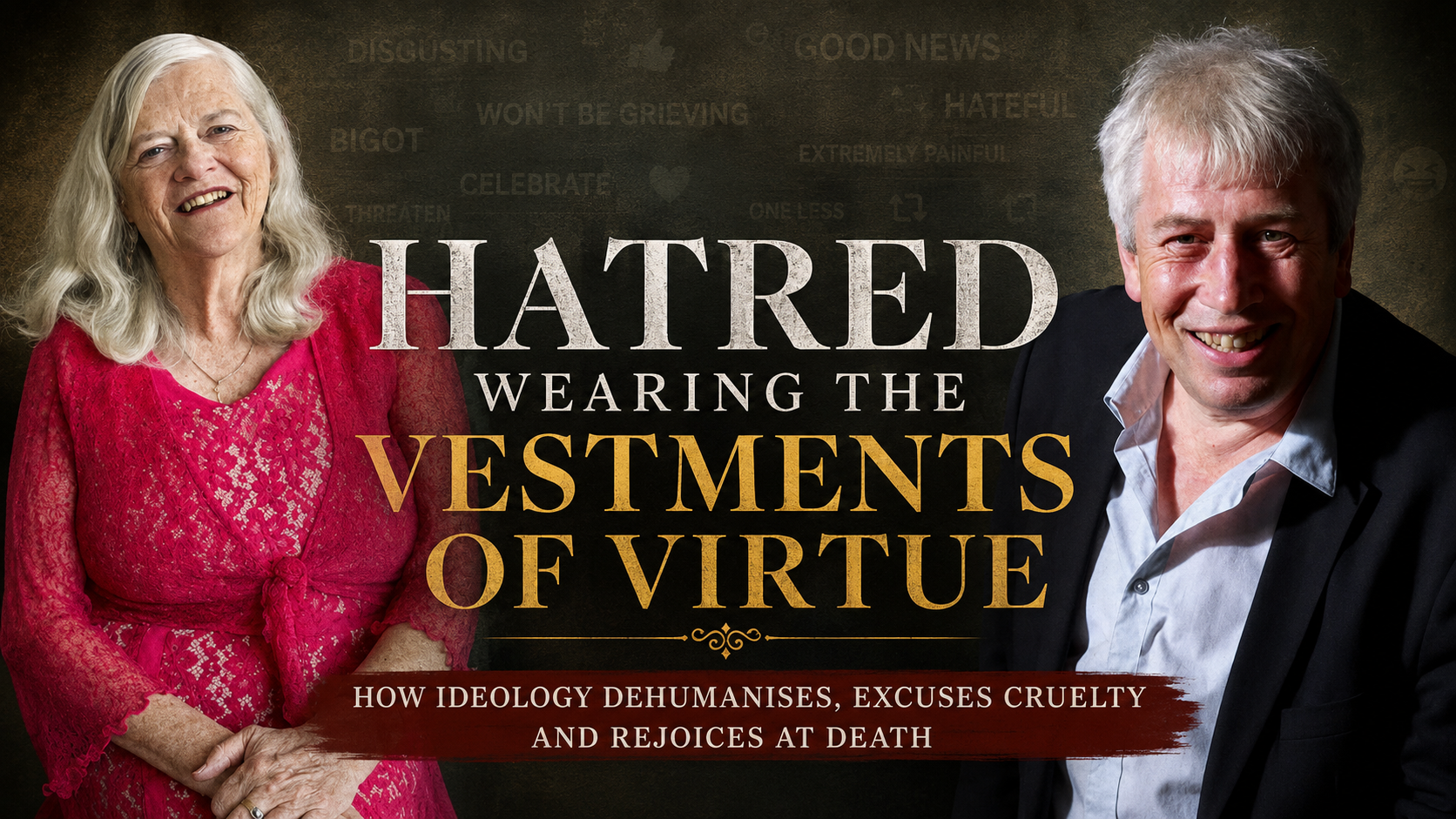
HATRED WEARING THE VESTMENTS OF VIRTUE
When ideology abolishes the person, cruelty becomes righteousness — and even the grave no longer commands mercy

There are moments when a civilisation reveals more about itself through its reflexes than through its manifestos. The reactions to the deaths of Ann Widdecombe and Rod Liddle have provided just such a moment. Neither was universally admired. Both held opinions which provoked fierce disagreement. Rod Liddle made a career of irreverence and provocation; Ann Widdecombe never disguised convictions which placed her increasingly at odds with the progressive moral consensus. That is precisely why what followed their deaths matters. Civilisation is not tested by whether men can speak charitably of those with whom they agree. It is tested by whether profound disagreement can remain human.
Rod Liddle died on 2 August 2026, aged sixty-six, after a short illness. He had edited BBC Radio 4’s Today programme, written for The Sunday Times, The Sun and The Spectator, and spent decades irritating almost every political tribe in Britain. He was provocative, frequently offensive and deliberately contrarian. He was also a husband, a father of three and a man considerably more complicated than the collection of political accusations eventually attached to his name. Yet almost immediately after his death was announced, parts of social media filled with mockery, denunciation and celebration. The obituary had scarcely been written before the political prosecution of the corpse had begun.¹
The treatment of Ann Widdecombe was more disturbing still. She was found dead at her home in Devon on 9 July, aged seventy-eight, having suffered serious injuries. Joshua Kerry, twenty-eight, has been charged with her murder. Those proceedings remain active, and nothing written here concerns his guilt or innocence, which is a matter for the court. The relevant fact for present purposes is simpler: an elderly woman had been violently killed. Yet even murder proved insufficient to suspend the ideological arraignment.²
Within hours of the news, Heather Herbert, an employee of the University of Aberdeen, responded on Bluesky by describing Widdecombe’s death as “some good news for once” and writing, “I hope it was an extremely painful death.” Another post wished that she had been “handcuffed to the bed as she screamed in agony”. These remarks were made before it was publicly confirmed that Widdecombe’s death was being treated as murder, but Herbert subsequently remained unapologetic about the hostility expressed. The University of Aberdeen opened an investigation and publicly distanced itself from the comments.³
One may search for sociological explanations, political provocations or grievances against Widdecombe’s public record, but the words themselves ought to stop us. This was not robust criticism of a politician. It was the expressed hope that another human being had suffered terribly while dying. Whatever ideology requires us to qualify our condemnation of that sentiment has already begun to corrupt the moral imagination.
The phenomenon did not remain confined to the more fevered corners of social media. It entered the BBC studio. Appearing on Politics Live after Widdecombe’s death, environmental activist Daze Aghaji acknowledged that what had happened was “absolutely awful”, but immediately insisted that it would “go amiss” not to mention Widdecombe’s opposition to LGBTQ+ political causes, her comments regarding victims of Harvey Weinstein and the fact that she had been “vehemently anti-abortion”. She concluded that “there are a lot of people who won’t be grieving this”. Conservative MP Nigel Huddleston, sitting beside her, replied that he was “quite uncomfortable” after hearing what she had said. The programme subsequently attracted 124 Stage 1 complaints during the relevant reporting period. The BBC nevertheless declared itself “satisfied” that Aghaji’s views had been “handled appropriately”.⁴
There, almost perfectly distilled, is the pathology. A murdered woman could not simply be permitted to occupy the moral category of murdered woman. Before the body had been buried, the ideological charge-sheet had to be produced. Her violent death might be regrettable, certainly, but she had opposed LGBTQ+ political demands. She had been anti-abortion. She had expressed unfashionable opinions. Therefore the claims of those allegedly injured by her beliefs had to be restored to the centre before the ordinary human instinct of compassion could take possession of the scene.
The corpse remained guilty.
This is not merely tastelessness. Nor is it adequately explained by saying that social media has made public discourse coarser. Something deeper is occurring. Identitarian politics teaches people increasingly to encounter one another not first as persons, but as representatives of moral categories: victim or oppressor, ally or enemy, marginalised or privileged, affirming or hateful. The person is no longer merely judged for what he believes; he is progressively identified with the judgement made upon those beliefs.
A man does not merely express an opinion classified as transphobic: he becomes “a transphobe”. A woman does not simply oppose abortion: she becomes “anti-choice”. A critic of Islamic doctrine becomes “an Islamophobe”. A dissenter from progressive orthodoxy becomes “far-right”, “fascist”, “bigot” or “hater”. What begins as an adjective becomes a noun; the noun consumes the biography; the category replaces the person.
Once that substitution occurs, cruelty becomes remarkably easy. His family counts for less. His private virtues are irrelevant or dismissed as hypocrisy. His suffering can be discounted because acknowledging it would disturb the moral narrative. His fear becomes funny, his humiliation deserved, his dismissal “accountability”, his exclusion “safety”, his destruction “consequence”, and eventually even his death “good news”.
Cruelty has not disappeared. It has been baptised with the vocabulary of virtue.
This explains the otherwise extraordinary spectacle of people who speak incessantly of kindness, inclusion, safety, dignity and compassion behaving with conspicuous viciousness while retaining an immaculate opinion of their own moral character. There is no contradiction once compassion has ceased to be universal. Compassion is distributed according to identity. The designated victim must be protected, affirmed and believed; the designated oppressor is subject to another moral code. Hostility towards him may be excused as resistance because his classification has already determined the part he plays in the drama.
He cannot easily become a victim himself. The script does not permit it.
That asymmetry was displayed with remarkable clarity during the recent Oxford Union debate on whether the West was right to be suspicious of Islam. Outside the chamber, protesters opposed the presence of Tommy Robinson and other speakers supporting the motion. Inside, speakers opposing the proposition argued that Muslims were wrongly regarded as threatening and sought to demonstrate the peacefulness, tolerance and civic contribution of Islam. Yet twice the rhetoric of opposition speakers invoked the possibility of violence towards those seated across from them.
Aisha Khan Aziz told Robinson that there was a crowd outside “rioting against” him and that, without the protection and generosity of the Union’s Muslim Palestinian president and largely South Asian executive, he would be “literally cooked”. Later, Michael Daward told those on the proposition bench, “I don’t mind taking out the lot of you.” The chairman intervened, asked whether a threat had been made and required the remark to be withdrawn. Daward maintained that he meant defeating them within the debate, but the words had plainly been sufficiently ambiguous to require formal clarification.⁵
The point is emphatically not that these incidents demonstrate Muslims collectively to be violent. Such a conclusion would repeat precisely the identitarian error under examination by making individuals manifestations of a collective identity. Nor does it follow that every protester outside intended violence. The point is the moral asymmetry. The vulnerability of one side was treated as real, urgent and morally decisive; the vulnerability of the opposing side could become the material of rhetoric and humour.
The identity of the target determined whether the threat counted.
This is exactly the mechanism visible in the treatment of Liddle and Widdecombe. Long before either died, each had been assigned to a condemned category. Their suffering therefore possessed less moral weight. To mourn them without immediately qualifying that mourning risked appearing sympathetic to the supposedly harmful beliefs attached to them. Even the elementary decencies traditionally shown to the dead became ideologically suspect.
The BBC episode is revealing for precisely this reason. The corporation did not endorse Widdecombe’s murder, and no serious critic should pretend otherwise. Nor is a broadcaster responsible for every opinion uttered by a guest. The disturbing feature was rather the apparent inability to recognise that something more fundamental than “a range of views” was at stake. The question was not whether Aghaji was entitled to dislike Widdecombe’s politics. The question was whether the immediate aftermath of a woman’s violent death was the proper occasion to explain why her political offences rendered her undeserving of universal grief.
Whether a murdered woman’s ideological transgressions ought immediately to be rehearsed over her body is not simply another legitimate point somewhere along the political spectrum.
It is a test of moral proportion.
One need not canonise Ann Widdecombe to recognise this. Death does not make every opinion correct. Murder does not sanctify its victim. Public figures remain subject to historical judgement, and Catholics of all people know that judgement is inescapable. But there remains an abyss between judgement and gloating, between truthful criticism and the withholding of elementary human sympathy.
There is a difference between saying that a dead woman held positions one considered profoundly wrong and using her murder as an occasion to explain why she need not be mourned. There is a difference between criticising Rod Liddle’s journalism and metaphorically uncorking the champagne because he has ceased to breathe. There is a difference between refuting Tommy Robinson and treating the prospect of an angry crowd harming him as rhetorical amusement.
Only after the person has been reduced to the category do these distinctions become difficult to perceive.
From a Catholic perspective, the inversion is more profound still, because many of those most readily accused of causing “harm” are resisting developments which Catholic moral reasoning identifies as grave harms to precisely the vulnerable whom progressive politics claims uniquely to defend.
Consider abortion. The Catholic who opposes it is routinely characterised as cruel towards women, yet the person whose life is certainly ended by abortion is the unborn child: the smallest, weakest and most voiceless member of the human family. In England and Wales there were 277,970 abortions among residents in 2023, the highest annual number recorded since the Abortion Act was introduced and eleven per cent higher than in 2022. The Office for National Statistics records that 32.1 per cent of conceptions in 2023 ended in abortion, the highest proportion on record.⁶ Whatever language one employs politically, those figures describe an immense human reality.
Yet it is the person objecting to that destruction who may be denounced as the cruel one.
The Christian defending marriage as the lifelong union of one man and one woman is described as hateful, while a culture which has progressively detached sexual intimacy from permanence, procreation from responsibility and marriage from the natural complementarity of the sexes describes itself as compassionate. The parent objecting to ideological instruction concerning sex and gender may be accused of endangering children, while children themselves have sometimes been encouraged to interpret puberty, distress, homosexuality, autism, trauma or discomfort with sexual stereotypes through highly contested theories of identity.
The clinician or parent urging great caution before medicalising a child’s rejection of his or her sex may be accused of withholding care. Yet NHS England itself states that the NHS and Government have curtailed medical interventions for under-eighteens because of a “lack of evidence about safety, risks, benefits and outcomes”. From 9 March 2026, NHS England paused the initiation of new prescriptions for masculinising or feminising hormones in its children and young people’s gender services after an evidence review found “very limited and weak evidence” supporting continued access for under-eighteens.⁷
This is not mentioned to turn the present editorial into a catalogue of progressive errors. The point is the moral inversion that follows from them. The destruction of unborn life is called healthcare; the weakening of permanent marriage becomes liberation; interventions upon healthy puberty become affirmation; parental caution becomes abuse; moral disagreement becomes harm. The language does more than describe a policy. It determines who is permitted to claim compassion.
Once disagreement itself has been classified as harm, the dissenter is no longer merely mistaken.
He is dangerous.
That distinction is everything. A person who is mistaken may be debated. A person defined as dangerous must be contained.
This is why identitarian progressivism so readily moves from argument to denunciation. Its moral self-understanding depends heavily upon the conviction that it represents compassion itself. If a political programme becomes identified not merely with certain policies but with compassion as such, then resistance to those policies cannot easily be recognised as another moral judgement honestly held. Resistance must itself be cruelty.
The Catholic opposing abortion must hate women. The Christian defending marriage must hate homosexuals. The parent questioning gender ideology must hate his child. The critic of Islam must hate Muslims. The journalist ridiculing progressive orthodoxies must hate whichever communities those orthodoxies claim to protect.
Argument disappears. Motive replaces evidence.
The dissenter presents an intolerable possibility: that the supposedly compassionate may themselves have harmed the vulnerable; that the alleged bigot may have defended a child; that the supposed reactionary may have foreseen consequences which the reformer refused to contemplate; that moral restraint may sometimes prove more humane than ideological affirmation.
It is easier to condemn the dissenter’s character than to confront that possibility.
Once malign motives have been assigned, his humanity can progressively be discounted. His argument need not be answered because it is merely an expression of prejudice. His evidence can be dismissed as a pretext. His refusal to affirm becomes violence. His presence becomes unsafe. Then almost anything done to him may be morally redescribed. Censorship protects the vulnerable; dismissal becomes accountability; humiliation becomes consequence; hostility becomes resistance.
And if he dies, one source of “harm” has disappeared.
That is how a politics which speaks incessantly of compassion can arrive at the celebration of death without recognising its own contradiction.
The concept of “harm” is indispensable to this process. Harm once principally denoted some objective injury. Increasingly it can encompass emotional discomfort, disagreement, refusal of affirmation, exposure to criticism or sometimes merely the presence of an unwanted speaker. An opinion becomes violence, a debate becomes unsafe, and a disagreement over anthropology becomes an attack upon another’s existence. Yet actual hostility towards the designated ideological enemy is simultaneously downgraded. A threat is rhetoric, a mob is protest, career destruction is accountability, public humiliation is justice, and rejoicing at death becomes honesty about the deceased.
The word no longer simply describes injury. It distributes moral permission.
This is why the spectacle surrounding Widdecombe matters. The woman had to be ideologically classified before sympathy could be uncomplicated. The same was true of Liddle. Many of those celebrating his death did not know the man. They knew the category assigned to him, the controversial columns, the accusations and the approved political judgement. Nothing more was required.
The label had replaced the man before the man had died.
His biological death merely exposed what ideology had already done to the moral imagination.
Catholic anthropology begins at exactly the opposite point. Human dignity does not derive from correct politics, approved identity, social usefulness, victim status or moral innocence. It derives from God. Man is made ad imaginem et similitudinem Dei — in the image and likeness of God. Sin may disfigure that image in us morally; it cannot abolish the dignity founded upon our nature as creatures of God.
A human being may profess wicked opinions. He may promote unjust laws. He may commit terrible sins. He may deserve contradiction, resistance, punishment and public condemnation. Yet he never ceases to belong to the human family.
This permits Catholicism to condemn error more seriously without hating the erring person more completely. The Church can condemn abortion as a grave moral evil without denying the dignity of the woman who has undergone one. She can reject gender ideology without despising the child suffering confusion or distress. She can uphold marriage without denying charity to those living contrary to her teaching. She can criticise Islam without denying the dignity of Muslims. She can condemn the ideology of her enemies without pretending that they cease to be neighbours.
The command of Christ is not to love our enemies once they cease being enemies. It is: “Love your enemies: do good to them that hate you: and pray for them that persecute and calumniate you.”⁸ Christianity therefore does not require us to pretend that falsehood is truth, wickedness virtue or aggression innocence. It requires something far more demanding: that even when another person is genuinely wrong, genuinely hostile or genuinely dangerous, we refuse to erase the image of God in him.
Identitarian politics crosses that line when the opponent becomes identical with the accusation made against him. The “bigot” ceases to be a man accused of bigotry and becomes bigotry embodied. The “transphobe” ceases to be a person holding an argument about sex and becomes an existential threat. The “Islamophobe” ceases to be a critic whose propositions may be examined and becomes hatred incarnate.
If the person is identical with the evil attributed to him, his removal logically becomes a good.
This is why death can provoke celebration. The enemy has not merely died; an alleged piece of evil has vanished from the world.
At this point identitarian politics begins to resemble a secular religion, complete with its elect and reprobate, its saints and heretics, its doctrines of purity and contamination. Approved identities confer presumptive innocence. Condemned identities confer presumptive guilt. Redemption requires ideological recantation; mercy follows submission; forgiveness demands conformity.
When one of the condemned dies, some among the faithful celebrate.
The laughing emoji says: I am not one of them. The champagne bottle says: I know who the righteous are. The denunciation of the newly dead says: My allegiance remains pure. The corpse becomes an altar upon which the living perform their ideological virtue.
That is why ordinary appeals to decency can fail. The cruelty is not experienced as a departure from morality. It is experienced as morality fulfilled.
And that is what makes the phenomenon dangerous.
History teaches us to be wary whenever societies cease to see persons and begin principally to see categories. The twentieth century generated an appalling vocabulary of abstraction: class enemy, bourgeois exploiter, counter-revolutionary, racial contaminant, enemy of the people. The political systems which employed those terms differed profoundly, but their dehumanising mechanism had something in common. Before people could be treated differently, they first had to be perceived differently. Individual humanity disappeared behind collective designation.
No hysterical equivalence is necessary. A malicious post on Bluesky is not a gulag, and an ugly television remark is not totalitarian government. But the moral habit deserves recognition wherever it appears: the habit of replacing the person with a category and permitting the category to determine how much sympathy that person deserves.
Political brutality does not begin with brutality.
It begins with permission.
It begins when cruelty towards certain people stops feeling cruel; when their fear becomes amusing, their humiliation satisfying, their suffering irrelevant and their death convenient.
That is why the reaction to Rod Liddle matters. That is why the reaction to Ann Widdecombe matters. That is why the words spoken at the Oxford Union matter. And that is why the response of institutions such as the BBC matters. Each offers, at a different level, a glimpse of what happens when the political identity assigned to a person begins to outweigh his common humanity.
The grave ought to remind us of equality in the most elemental sense. Rich and poor, celebrated and despised, Left and Right, righteous and sinful: memento, homo, quia pulvis es, et in pulverem reverteris. Remember, man, that thou art dust, and unto dust thou shalt return. Death strips away the pretensions by which politics persuades us that our faction is eternal.
The Christian therefore cannot join the grave-dancers, even when the dead spent their lives attacking everything he holds sacred. This must be said with equal force to Catholics and conservatives tempted to imitate the behaviour they condemn. Progressive dehumanisation cannot be answered by conservative dehumanisation. Those promoting abortion, gender ideology, sexual libertinism, attacks upon the family or hostility towards Christianity remain human beings made in the image of God. Their ideas may be destructive. Their arguments may deserve severe refutation. Their hypocrisy may warrant exposure. Their responsibility may be grave. But their dignity is not ours to withdraw.
That is where Catholicism finally and decisively parts company with identitarian politics. The ideologue divides humanity into approved and disapproved identities and apportions sympathy accordingly. The Catholic sees a hierarchy of truths and moral duties, but only one human race: fallen, sinful, capable of repentance and redeemed at an immeasurable price.
Calvary leaves us no permission to invent a category of people beneath mercy.
The Catholic may say that Ann Widdecombe was wrong about this or that without rejoicing that she was murdered. He may say that Rod Liddle wrote something reprehensible without celebrating the death of the man who wrote it. He may believe Tommy Robinson profoundly mistaken without accepting that threats against him somehow matter less.
These distinctions are not weakness.
They are civilisation.
More importantly, they are Christianity.
The reaction to Widdecombe’s murder therefore exposed something more serious than the existence of unpleasant people online. When someone can hope publicly that an elderly woman endured an agonising death; when another activist can appear on the national broadcaster and explain, in the immediate aftermath of her killing, why many people will not mourn her; and when the broadcaster answers complaints by saying itself satisfied that the exchange was appropriately handled, we are looking at something more settled than occasional bad taste.
We are looking at a moral culture in which some have learned that the ordinary obligations of mercy do not extend equally to everybody.
Rod Liddle suffered the same posthumous reduction. His detractors knew the controversial columns, the accusations and the approved judgement. For some of them that was sufficient. The human being disappeared behind the ideological dossier.
That is the real scandal.
A person can suffer a kind of civil death before biological death arrives: the moment when society ceases to encounter him as a person and knows him only as an abstraction. Identitarian politics performs that reduction whenever it converts disagreement into identity, identity into guilt, guilt into diminished moral status and diminished status into permission for cruelty.
Then, when biological death finally comes, there appears to be nothing left to mourn. The human being had already been edited out.
The test of civilisation is not whether we can extend kindness to those whose opinions flatter our own. Any tribe can manage that. The test is whether we can still recognise the humanity of those whose convictions we detest.
Christianity goes further. It commands us to recognise in them something politics can neither confer nor revoke: the image of God.
When that image disappears from our sight, disagreement becomes dehumanisation. When dehumanisation becomes habitual, cruelty becomes permissible. When cruelty is reclassified as virtue, even death can become an occasion for celebration.
And when the grave itself cannot silence political hatred, the problem is no longer merely incivility.
It is spiritual.
It is the corruption of the moral imagination: ideology substituted for anthropology, faction for fraternity, identity for personhood, vengeance for justice, and self-righteousness for charity.
It is hatred wearing the vestments of virtue.
¹ The Guardian, “Rod Liddle obituary”, 4 August 2026; The Times, “Rod Liddle obituary: irreverent but brilliant columnist and broadcaster”, 4 August 2026.
² Crown Prosecution Service, “CPS charges man with murder following death of Ann Widdecombe”, 20 July 2026.
³ Hannah Fortune, “Outrage as Aberdeen University employee hoped Ann Widdecombe suffered ‘painful death’ in Bluesky post”, The Gaudie, 11 July 2026; “Aberdeen University investigates ‘painful death’ wish for Ann Widdecombe”, The Times, July 2026.
⁴ Ekin Karasin, “BBC faces complaints storm over ‘disgusting’ Ann Widdecombe remark about her death”, Evening Standard, 7 August 2026.
⁵ Oxford Union Society, This House Believes the West Is Right to Be Suspicious of Islam, debate transcript, 17 June 2026.
⁶ Department of Health and Social Care, Abortion Statistics Commentary, England and Wales: 2023, 15 January 2026, updated 19 March 2026; Office for National Statistics, Conceptions in England and Wales: 2023, 26 June 2026.
⁷ NHS England, “Updated guidance to primary care about unregulated providers who supply hormone medications to children and young people for gender incongruence”, 12 March 2026; NHS England, “Clinical policy: Prescribing of masculinising and feminising hormones for children and adolescents who have gender incongruence or dysphoria — public consultation guide”, 9 March 2026.
⁸ Matthew 5:44, Douay-Rheims Bible.
RELATED ARTICLES


Latest ARTICLES
- Today’s Mass: October 30 The Blessed Martyrs of DouaiA group of 158 priests trained at the English College of Douai, in France. They were martyred in England and Wales during the century following the foundation of the famed college by Cardinal William Allen in 1568. All perished at the hands of English protestant authorities while labouring to reconvert the island. Simply being a Catholic priest was high treason in England at this time, with the penalty of hanging, drawing and quartering. Eighty alumni of Douai were beatified in 1929.
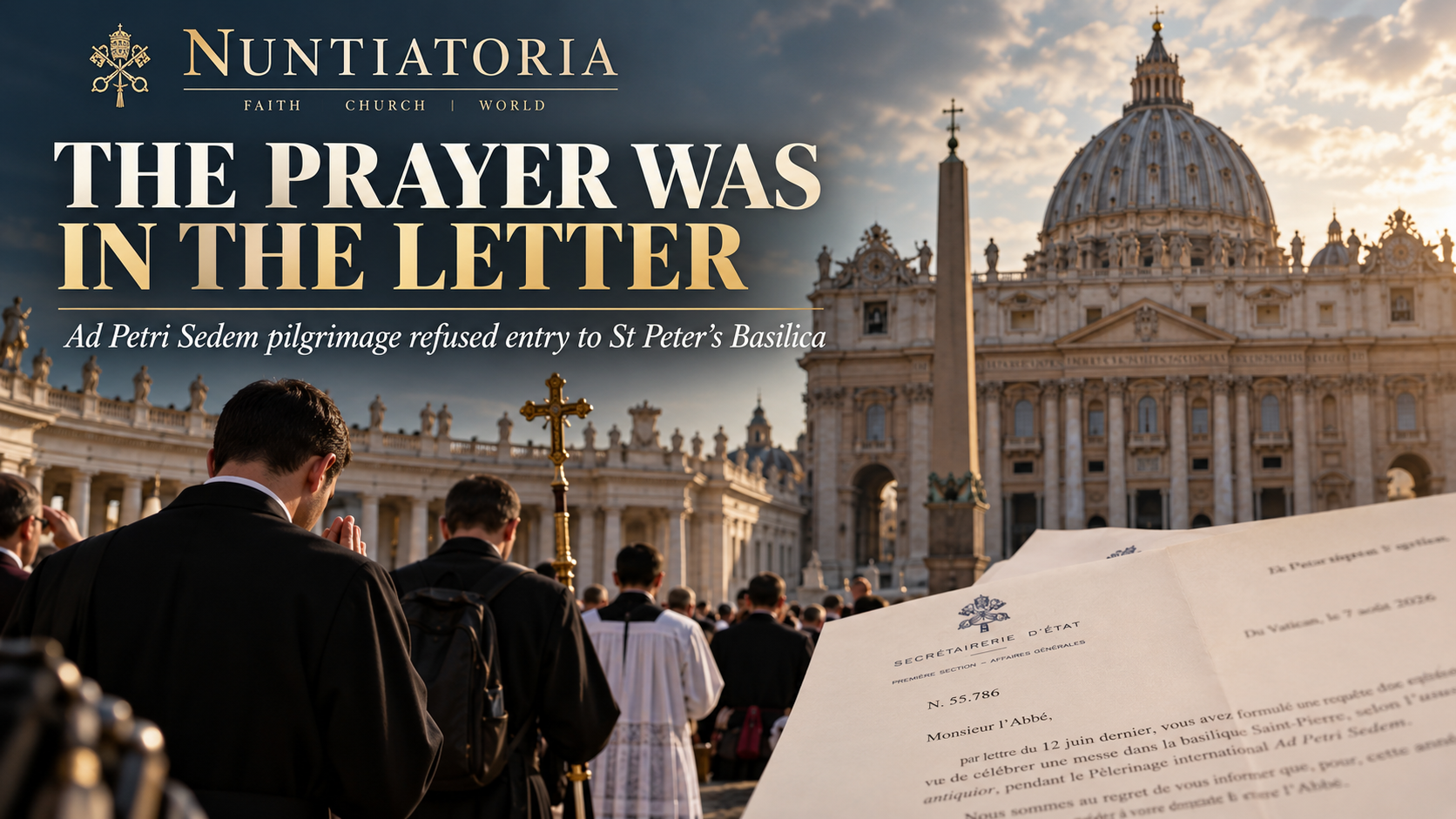
- THE PRAYER WAS IN THE LETTERNewly released Vatican correspondence contradicts claims regarding the refusal of Ad Petri Sedem pilgrims’ request to pray for Pope Leo XIV in St Peter’s Basilica. Bishop Athanasius Schneider’s homily at St Mary Major emphasised the Church as Mother of all Catholics and the importance of the traditional Roman liturgy, highlighting ongoing tensions surrounding ecclesiastical authority and traditional worship.
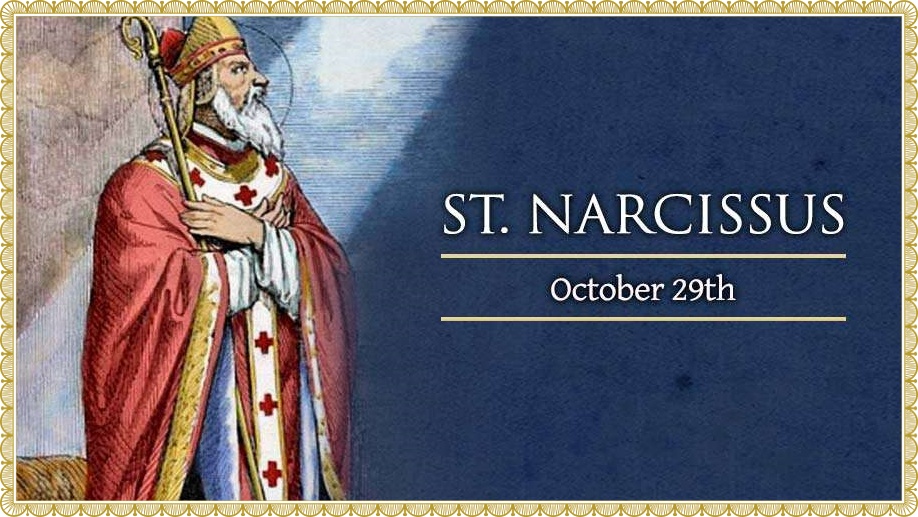
- Today’s homily: St Narcissus of JerusalemThe homily reflects on the role of St Narcissus as Bishop of Jerusalem, highlighting his dedication to preserving faith amidst adversity. By turning water into oil for the Paschal Vigil, he exemplifies the importance of stewardship in worship. It calls Christians to actively nurture their faith and responsibilities within their communities.
- Today’s Mass: October 29 St Narcissus, Bishop of JerusalemSaint Narcissus, Bishop of Jerusalem, was renowned for his piety and dedication to the church. Consecrated at an advanced age, he displayed unwavering vitality in governance. He presided over the Easter council, performed miracles, and faced wrongful accusations. Ultimately, he returned to serve until his death, exemplifying true Christian virtue.
- Today’s Mass: October 28 SS Simon & Jude, ApostlesToday, we honour Apostles Simon and Jude, believed to have been martyred together. Simon, known for his zeal, preached in various regions and is recognised as the patron saint of tanners. Jude, a relative of Jesus, authored an epistle urging faith and perseverance amidst challenges. Their joint feast is celebrated on October 28.



Leave a Reply