
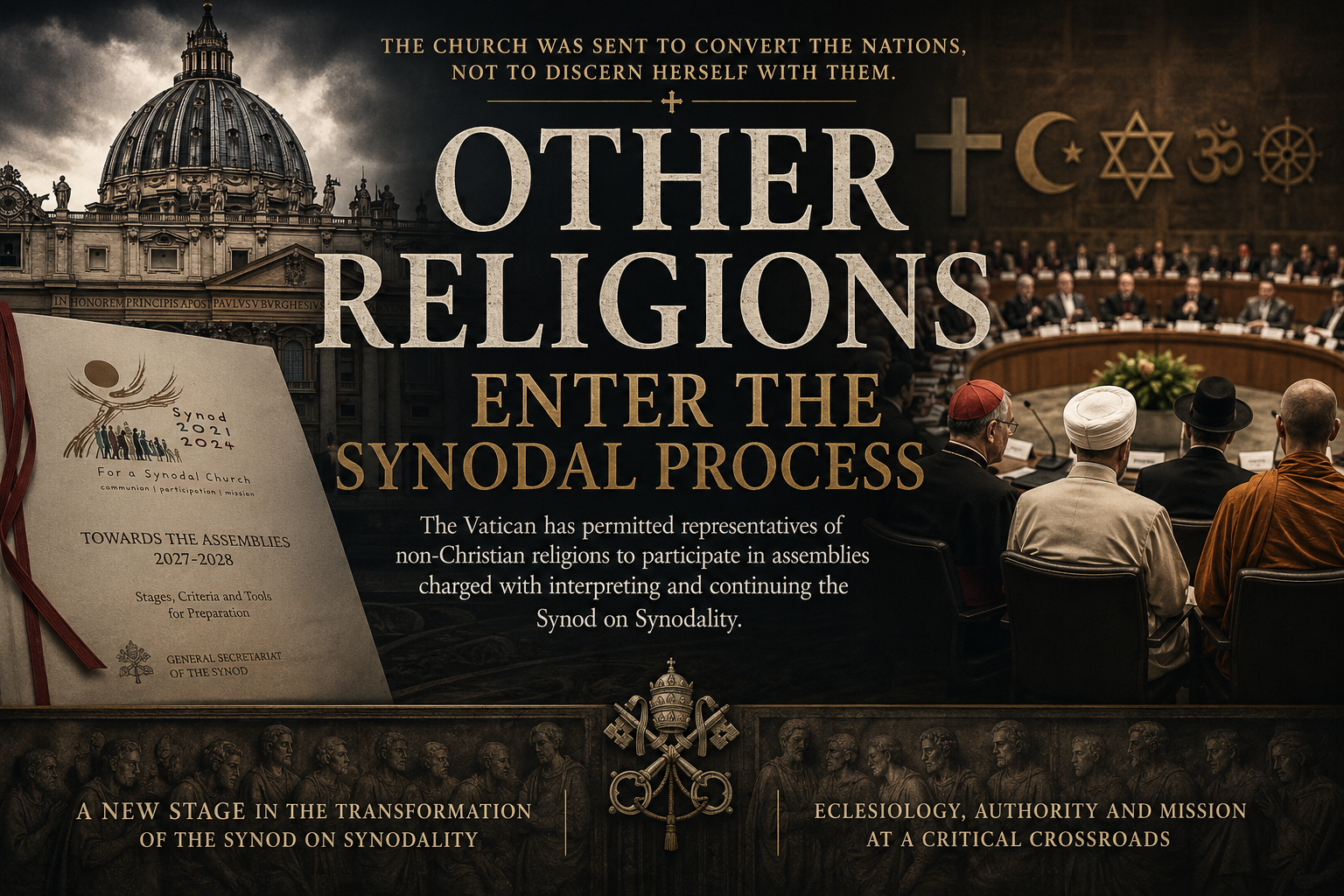
Other Religions Enter the Synodal Process
The Vatican has permitted representatives of non-Christian religions to participate in assemblies charged with interpreting and continuing the Synod on Synodality. The provision is another stage in the transformation of an episcopal institution into a permanent process whose widening participation increasingly obscures the Church’s sacramental constitution and missionary purpose.

On 20 May 2026, the General Secretariat of the Synod published the instructions that will carry the Synod on Synodality through diocesan, national and continental assemblies to an Ecclesial Assembly in Rome in October 2028. Most of the document concerns timetables, methods and the composition of the gatherings. One sentence, placed quietly among these practical arrangements, reveals how far the process has travelled from the Synod of Bishops established by Paul VI:
“Where appropriate, representatives of other Churches and Christian Communities or of other religions may also participate.”¹
The guidelines do not identify particular religions, name any prospective delegates or grant non-Christian representatives a vote. They envisage different forms and degrees of participation, to be determined by those organising the assemblies. The persons selected should also be prepared to accompany the process beyond 2028 and help to secure its continuity.¹
That final detail matters. These are not guests invited to offer ceremonial greetings at an interreligious gathering. They may be admitted to assemblies which the Vatican itself calls ecclesial, whose purpose is to interpret the synodal experience, discern its implications and guide its implementation throughout the Church.
The distinction between observation and participation is left undefined.
Those who have followed the Synod since 2021 will recognise the pattern. The process first expanded beyond bishops to include selected priests, religious and laymen and women as voting members of the Roman assembly. It then ceased to be an occasional gathering and became a permanent sequence of consultations, syntheses, continental stages, expert groups and implementation structures. It now proposes that representatives of non-Christian religions may participate in assemblies concerned with the Church’s future direction.
Each enlargement has been presented as a modest development in method. Taken together, they disclose a substantial alteration in the practical understanding of ecclesiastical authority.
Consultation once assisted those who possessed authority. Under the synodal system, participation increasingly acquires an authority of its own. A conclusion appears credible because sufficient categories of person were represented; a process appears spiritual because participants were invited to speak of their experiences; an assembly appears ecclesial because its organisers have called it so.
The question raised by the new guidelines is therefore larger than the presence of a Muslim, Jew, Hindu or Buddhist at a Catholic meeting. It concerns the nature of the meeting itself. Who constitutes the Church, and who may properly participate in her act of spiritual discernment?
The Catholic Church has every reason to maintain courteous and constructive relations with other religions. Her pastors may receive their representatives, defend them against persecution, cooperate with them in relieving poverty and discuss matters affecting civil peace. Catholics may listen to criticism from outside the Church and sometimes discover failures which familiarity has concealed.
None of this makes an interreligious consultation an ecclesial assembly.
The Church may ask a non-Christian how Catholic institutions are perceived by his community. She may hear how a decision affects those outside her communion. She may receive evidence concerning persecution, social conflict or public policy. Such testimony may be useful, intelligent and morally serious.
It remains external testimony. It does not become participation in the Church’s supernatural judgement concerning her doctrine, worship, government or mission.
Saint Robert Bellarmine defined the Church as the assembly of men united by profession of the same Christian faith and communion in the same sacraments under the government of legitimate pastors, especially the Roman Pontiff.² His definition identifies visible bonds, not a mood of openness or an aspiration towards fraternity. The Church is a determinate society founded by Christ. She does not expand or contract according to the composition of a facilitated conversation.
Leo XIII made the same point in Satis Cognitum. The Church is one because Christ constituted her with one faith, one government and one sacramental communion. Her unity is not produced by the convergence of religious experiences. It is received from her divine Founder and preserved through the bonds He established.³
Pius XII later described this same visible and supernatural reality as the Mystical Body of Christ. The Church is animated by the Holy Ghost, governed through the hierarchy and entrusted with sacraments and doctrine which she did not manufacture. Men enter her by the means appointed by Christ; they do not acquire an ecclesial role because an administrative process has invited them to participate.⁴
This is not a judgement upon the personal sincerity of non-Christians. A Muslim may display courage and devotion; a Jew may possess remarkable learning; a Hindu or Buddhist may practise natural virtues which put many nominal Catholics to shame. The question is not whether they are estimable persons. It is whether those who deny the Christian revelation can share in an act described as the Church’s discernment of what the Holy Ghost is asking of her.
They cannot do so in the same sense as the faithful, because they do not profess the Faith according to which the discernment must be made.
The sensus fidei fidelium is not the religious instinct of mankind. It belongs to the faithful precisely insofar as they receive the theological virtue of faith, adhere to apostolic doctrine and live within the communion of the Church. It cannot be created by consultation, still less by the inclusion of those who reject the truths which give it form.
A Muslim does not confess the Most Holy Trinity or the divinity of Jesus Christ. A practising Jew does not recognise Him as the promised Messias and incarnate Son of God. Hindus and Buddhists do not profess the apostolic Creed, receive Christian Baptism or acknowledge the sacramental constitution of the Catholic Church. Their opinions may assist an external consultation. They cannot become internal witnesses to the Faith they do not hold.
The guidelines would have created far less difficulty had they used the word “observers”. Catholic institutions have admitted separated Christians in that clearly delimited capacity. A baptised non-Catholic possesses an imperfect but real relationship with the Church through Baptism and through those elements of revealed truth and sanctification retained outside visible Catholic unity. His presence may therefore be understood within an ecumenical framework, provided that no authority belonging to Catholic office is attributed to him.
Non-Christian religions stand in another relation to the Church. Ecumenism concerns divisions among those who profess Christ. Interreligious dialogue concerns those who do not profess Him. Combining both within the same clause as potential participants conceals a theological difference which no amount of cordiality can remove.
The Secretariat’s imprecision is especially serious because synodality assigns spiritual significance to participation. These assemblies are not described merely as administrative conferences. Their members are to listen for what the Holy Ghost is saying and recognise the paths along which He is leading the Church.
The Holy Ghost is not the presiding sentiment of an inclusive meeting. He is the Spirit of the Father and the Son, sent to bring to remembrance what Christ taught and to preserve His Church in truth. He does not guide the Church by treating the confession of Christ and the denial of Christ as complementary contributions to a common religious judgement.
He may use the criticism of an outsider to expose Catholic hypocrisy. He does not use the denial of Christian revelation to complete the revelation entrusted to the Apostles.
This necessary distinction has become difficult to express because synodality habitually relies upon language broad enough to carry incompatible meanings. Listening, participation, accompaniment and discernment all have an authentic place in Catholic life. A bishop who refuses counsel will govern badly; a pastor who does not know his people cannot shepherd them wisely.
The problem begins when consultation ceases to assist authority and begins to replace its proper exercise.
The Synod of Bishops established by Paul VI was a body of bishops assisting the Roman Pontiff. Canon law still defines it as an assembly of bishops who foster union with the Pope and offer him counsel concerning faith, morals, discipline and the Church’s activity in the world.⁵ Its theological intelligibility rested upon the episcopal character of its members. Bishops advised the Pope because they were successors of the Apostles, not because they had been selected to represent categories of experience.
The contemporary process operates differently. Parish contributions pass into diocesan reports; diocesan reports are reduced into national syntheses; national syntheses enter continental documents; selected participants then carry the supposed memory of those consultations into Roman assemblies. Drafting committees decide which themes have emerged, facilitators determine how discussion proceeds, and the resulting conclusions are presented as the fruit of listening to the Spirit.
Nuntiatoria has previously described this development as the conversion of collegiality into permanent process. The description is now difficult to dispute. The General Secretariat itself says that the Synod has been transformed from an event into a process, with preparatory, celebratory and implementative stages. The Ecclesial Assembly of 2028 will not conclude that process: the new guidelines expressly look beyond it.
Permanent process alters the place of authority. A bishop no longer appears chiefly as one who teaches, judges and governs after receiving counsel. He becomes the guardian of a conversational space in which judgement is repeatedly postponed so that participation may continue. Questions already answered by doctrine remain institutionally open because closure is treated as a failure of listening.
Cardinal Joseph Zen has repeatedly warned that this method risks producing a constitutional change beneath the language of pastoral consultation. His objection is not that bishops should refuse advice. It is that carefully chosen participants, facilitators and drafting committees may acquire practical influence while the divinely constituted authority of bishops becomes less visible. An assembly may appear universal while every stage through which experience acquires official meaning remains tightly controlled.⁶
The admission of non-Christian representatives carries that development beyond the distinction between episcopal and lay participation. The process first ceased to be unambiguously episcopal. It now approaches the point at which it is no longer unambiguously Christian.
Defenders of the proposal may reply that non-Christians will not decide Catholic doctrine. That may be true. The document does not say that they will vote upon the Creed or propose amendments to the sacraments. The pressure created by their participation is likely to be quieter.
Catholic claims which ought to govern an ecclesial gathering will be expressed in the presence of invited participants who reject them. The Church’s missionary teaching will become socially awkward. The unique mediation of Christ, the necessity of conversion and the obligation to call all nations to Baptism may be treated as inhospitable within a process whose success depends upon maintaining the participation of those who deny those very truths.
No decree suppressing Catholic doctrine will be required. Embarrassment will do much of the work.
Evangelisation will be softened into encounter. Conversion will become mutual enrichment. Mission will remain in the vocabulary while its direction is reversed. The Church, sent to teach the nations, will increasingly present herself as one religious community among others, learning through their participation what she should become.
Pius XI warned against precisely the assumption that religious unity might be constructed by bringing contrary professions into a common enterprise. In Mortalium Animos, he rejected the idea that religions should meet as though each possessed only a portion of a larger truth which must be recovered through cooperation. The Church does not enter dialogue as one seeker among many. She possesses, through no merit of her own, the revelation entrusted to her by Jesus Christ.⁷
The circumstances differ, but the theological order remains. Catholics may cooperate with those who do not share the Faith. They may not behave as though Christian revelation is one religious perspective awaiting completion by others.
The Great Commission is plain:
“Going therefore, teach ye all nations; baptizing them in the name of the Father, and of the Son, and of the Holy Ghost: teaching them to observe all things whatsoever I have commanded you.”
The Apostles first listened to Christ. They were then sent to teach what they had received. They did not ask the nations to assist them in discerning the future identity of the Church.
That missionary direction has already been weakened by the growth of synodal process. Vast ecclesiastical resources have produced consultations, reports, syntheses, continental documents, expert groups and further assemblies. The more obvious measures of Catholic renewal—conversions, vocations, confessions, restored marriages, doctrinal clarity and reverent worship—appear less frequently as the criteria by which the process is judged.
The omission is revealing. A process can always justify another stage. Mission must produce fruit.
The new guidelines should be clarified before the diocesan assemblies begin. Representatives of non-Christian religions may properly be received as guests, observers or witnesses concerning defined external matters. Their legitimate concerns should be heard and their dignity respected. They should not be presented as participants in the Church’s internal discernment of her faith, government or missionary purpose.
Such precision would not insult anyone. A Catholic invited to observe a Muslim council would not expect his opinions to assist in the authoritative interpretation of Islam. A Jewish guest at a Christian assembly should not be placed in the false position of appearing to share in a specifically Christian judgement. Honest dialogue requires the parties to know who they are and why they have met.
The present wording does not provide that honesty. It permits participation in an ecclesial process, attaches spiritual significance to the process, and leaves the meaning of participation to local discretion.
That is not a minor drafting defect. It exposes the unresolved contradiction at the centre of synodality. The process continually widens the circle of those invited to speak while becoming less precise about the authority by which the Church listens, judges and teaches.
The Church may hear the world, cooperate with it and invite it to receive the Gospel. She cannot ask the world to assist in determining what the Church is. Christ entrusted the Faith to the Apostles for the conversion of the nations, not to the nations for the continuing revision of the Faith.
¹ General Secretariat of the Synod, Towards the Assemblies 2027–2028: Stages, Criteria and Tools for Preparation, 20 May 2026; General Secretariat of the Synod, “Towards the Ecclesial Assembly in October 2028”, 20 May 2026.
² St Robert Bellarmine, De Ecclesia Militante, chapter 2, in De Controversiis Christianae Fidei.
³ Leo XIII, Encyclical Satis Cognitum, 29 June 1896.
⁴ Pius XII, Encyclical Mystici Corporis Christi, 29 June 1943.
⁵ Paul VI, Apostolic Letter Apostolica Sollicitudo, 15 September 1965; Code of Canon Law, canon 342; General Secretariat of the Synod, provisions governing the 2023 Synodal Assembly.
⁶ Cardinal Joseph Zen, public interventions concerning the Synod on Synodality; see also Nuntiatoria, “Cardinal Zen and the Crisis of Synodality: Authority, Manipulation and the Future of the Church”, 10 January 2026, and “Cardinal Zen, Synodality and the Constitutional Crisis of the Church”, 22 May 2026.
⁷ Pius XI, Encyclical Mortalium Animos, 6 January 1928.
RELATED ARTiCLES


LATEST ARTICLES
- Today’s Mass: November 3 St Winefride of HolywellThe spring attached to her legend has given its name to Holywell (Tre Ffynnon), Clwyd, and down the centuries, and right up to the present day, pilgrims have travelled there in the hope of finding healing for their illnesses. Such pilgrimages even continued throughout the Reformation with 14,000 people and 150 priests gathered there on St Winefride’s feast day in 1629 – a time when Catholics were still dying as martyrs.
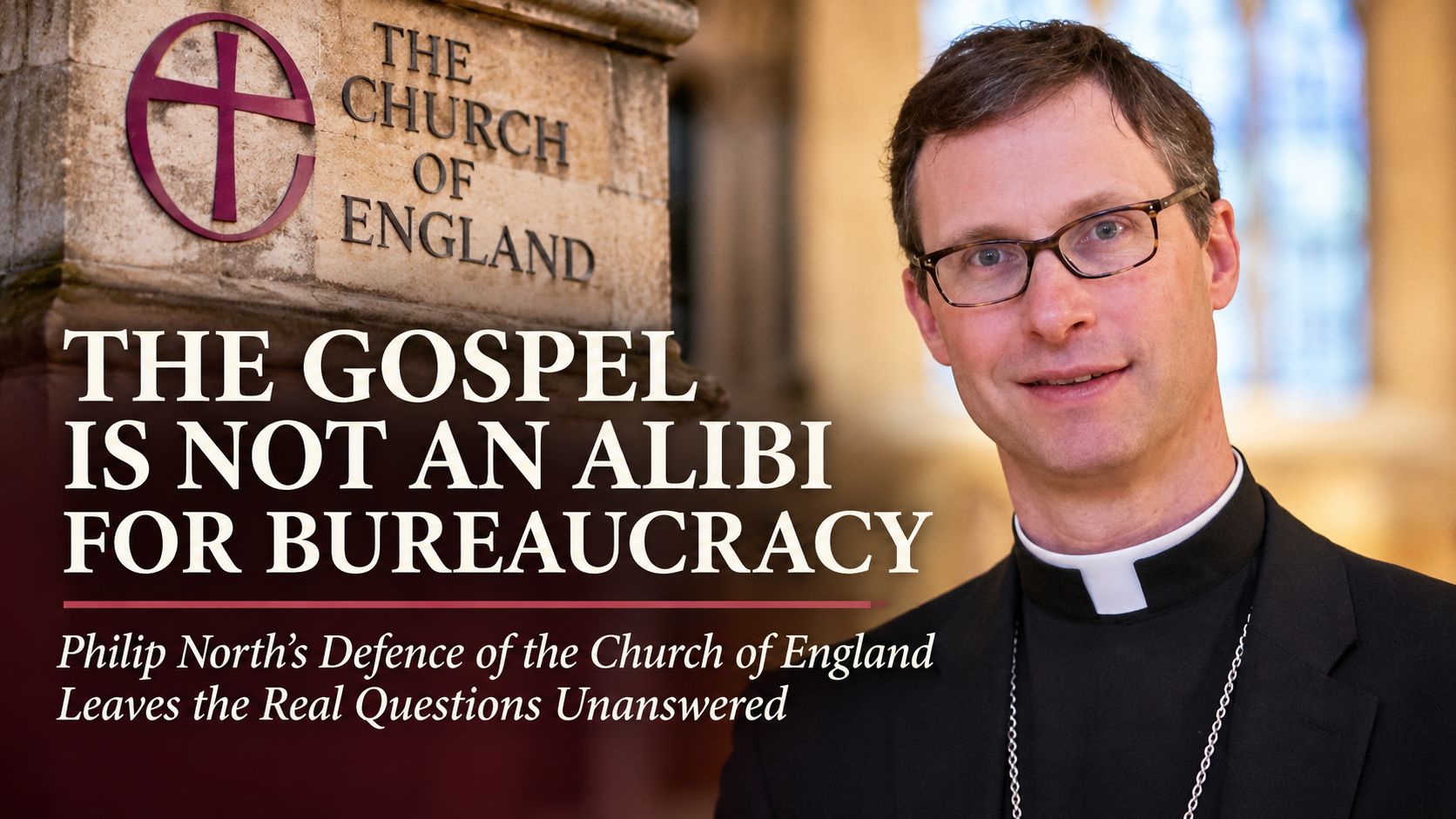
- THE GOSPEL IS NOT AN ALIBI FOR BUREAUCRACYBishop Philip North contends that spiritual renewal is paramount for the Church of England, sidelining organisational reform. He defends diocesan administration despite concerns over rising costs and declining clergy and congregations. This editorial emphasises the need for both faithful evangelisation and responsible financial stewardship as interconnected necessities for the Church’s survival.
- Today’s Mass: November 2 All SoulsAll Souls’ Day is observed on 2 November, commemorating the faithful departed. The Church encourages prayers, alms, and Masses of Requiem to aid souls in need of cleansing from sins. Originating in the early Christian practices, it aims to provide spiritual support for the deceased, ensuring their journey towards eternal rest.
- DE PROFUNDIS: THE PRAYER THAT WILL NOT LEAVE THE DEAD BEHINDThe De Profundis serves as a profound prayer for the dying and the deceased, urging honesty in facing sin and reliance on Christ’s mercy. Through its historical context and traditions, it encourages ongoing remembrance of the departed within the family, emphasising the importance of intercession and maintaining a connection with faith.
- EVERY VOICE — EXCEPT THE OLD MASS?Pope Leo XIV has appointed Father Giacomo Costa and Sister Elena Massimi to oversee synodal implementation. Massimi’s prior support for Traditionis Custodes raises concerns about the Church’s authenticity in listening. As synodality takes a more central role in governance, it remains uncertain if traditional Catholics’ voices will be genuinely considered, questioning the credibility of the process.
CURRENT EDITION


Today’s Mass Propers
- Today’s Mass: November 3 St Winefride of Holywell
 The spring attached to her legend has given its name to Holywell (Tre Ffynnon), Clwyd, and down the centuries, and right up to the present day, pilgrims have travelled there in the hope of finding healing for their illnesses. Such pilgrimages even continued throughout the Reformation with 14,000 people and 150 priests gathered there on St Winefride’s feast day in 1629 – a time when Catholics were still dying as martyrs.



Leave a Reply