
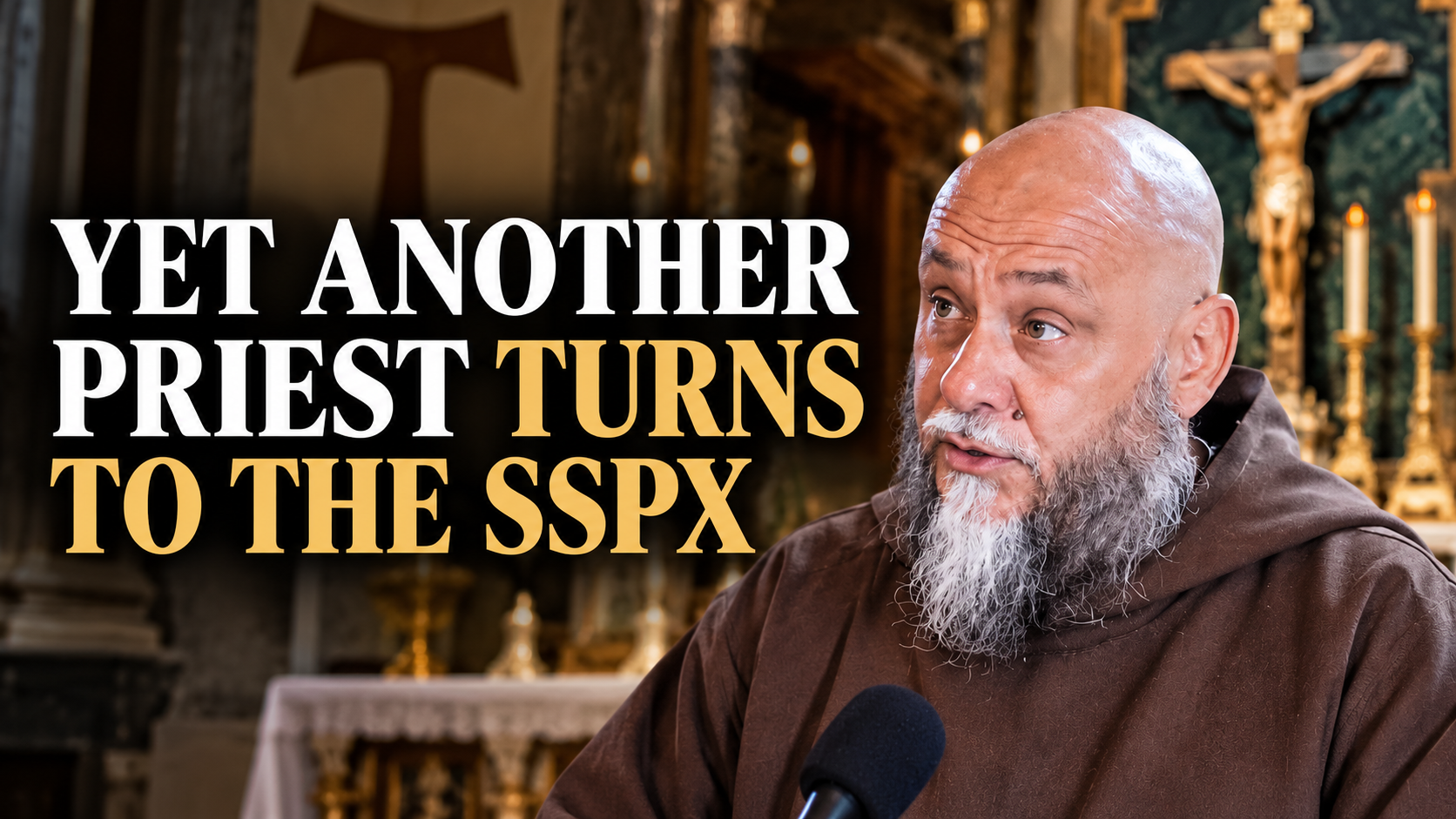
Only months ago the Diocese of Knoxville was publicly promoting Fr David Mary Engo’s ministry. Now it has withdrawn his faculties over an apostolate associated with the SSPX. His extraordinary trajectory raises the question Rome cannot indefinitely avoid: why are priests turning towards Écône?
On 1 January 2026, the Diocese of Knoxville ended every authorised celebration of the Traditional Latin Mass within its territory. Nine months later, the same diocese withdrew all faculties, permissions and authorisations previously granted to Fr David Mary Engo after he became involved in ministry “associated with and supportive of” the Society of Saint Pius X. The diocese has warned Catholics not to attend Masses, retreats, conferences or other activities connected with the proposed ministry and has emphasised that no SSPX priory, mission, chapel, foundation or apostolate has been authorised in Knoxville.¹
That chronology was already striking. A closer examination of Fr Engo’s history makes it considerably more so.
Nuntiatoria observed only days ago, in considering the case of Fr Philip Conklin in Minnesota, that Rome had spent decades creating canonical routes away from Écône only to find some priests apparently beginning to move in the opposite direction.² Knoxville now provides a second case almost immediately, but Fr Engo is particularly revealing because he cannot easily be dismissed as a priest who had always inhabited the traditionalist margins of ecclesiastical life.
Born Michael Anthony Engo in New York in 1967, he entered Franciscan religious life as a young man. His published biography records periods with the Capuchins, the Franciscan Friars of the Renewal and the Franciscans of Primitive Observance. He was ordained priest on 19 July 1997 by the future Cardinal Sean O’Malley, then Bishop of Fall River. In 2009, with the approval and oversight of Bishop Kevin Rhoades, he founded the Franciscan Brothers Minor; the following year he moved the community to Fort Wayne when Rhoades became bishop there, and his biography records his incardination into the Diocese of Fort Wayne-South Bend on 8 December 2010. The Franciscan Brothers Minor were subsequently erected as a Public Association of the Faithful in 2011.³
This was not a project founded in defiance of episcopal government. Quite the reverse. The constitutions associated with Engo’s Franciscan foundation profess “complete and unswerving loyalty” to the Magisterium, the Pope and the local Ordinaries. They expressly renounce exemption from diocesan bishops and insist that the friars obey the bishops in whose dioceses they live and work, as well as the Roman Pontiff.⁴ The significance of that language today is impossible to miss. The priest whom Catholics in Knoxville are now being warned against because of an SSPX-associated ministry founded a Franciscan community whose governing documents made submission to papal and episcopal authority an explicit feature of its identity.
His previous record is equally difficult to fit into the caricature of a lifelong ecclesiastical rebel. During the immediate aftermath of the terrorist attacks of 11 September 2001, diocesan reporting later recalled that Fr Engo spent the first four days at Ground Zero blessing bodies recovered from the wreckage.⁵ He became known as a retreat preacher, evangelist and pro-life activist; he spoke at diocesan conferences and Catholic events, defended religious liberty before legislators, and for years exercised ministry with the approval and involvement of bishops.
After resigning leadership of the Franciscan Brothers Minor in 2017, he devoted himself more fully to eremitical life and preaching. By late 2023 he was serving in Knoxville as parochial administrator pro tempore of Holy Cross Parish in Pigeon Forge. In 2024, diocesan reporting showed him baptising and receiving converts there and described a parish in which former Baptists, Methodists, an atheist and a Jewish convert were among those entering more deeply into Catholic life.⁶ Whatever conclusions one reaches about his present decisions, this was not a priest standing idle at the edge of the Church.
The contrast becomes sharper still when one looks at the immediate chronology. In May 2025, Bishop Mark Beckman appointed Fr Engo chaplain to the Handmaids of the Precious Blood, the contemplative community whose particular apostolate is prayer and sacrifice for priests. The official diocesan announcement recorded his service as parish administrator, chaplain, lecturer and retreat leader.⁷ As recently as 16 May 2026 — less than five months before the withdrawal of his faculties — the Diocese of Knoxville itself advertised him as the guest speaker at its Franciscan Jubilee celebration at St Francis of Assisi Church in Fairfield Glade, inviting the faithful to hear him speak on the life and continuing relevance of St Francis.⁸
That is what makes the present development so difficult to reduce to the familiar vocabulary of fringe traditionalism. This is a priest bishops ordained, received, entrusted with communities, permitted to preach, assigned to parochial ministry, appointed to a contemplative community and publicly presented by the Diocese of Knoxville itself as a Catholic teacher scarcely five months before it warned the faithful against his ministry.
Something happened between there and here. The serious ecclesiastical question is what.
Only days earlier, Archbishop Bernard Hebda of Saint Paul and Minneapolis confirmed that canonical proceedings had begun after Fr Philip Conklin, ordained in 2024, affiliated himself with the SSPX and indicated that he did not intend to end that association.⁹ Fr Conklin is a diocesan priest barely two years ordained. Fr Engo, by contrast, has nearly three decades of priestly life behind him. Two cases do not constitute an exodus and should not be represented as one, but they do constitute a small and notable succession involving priests at radically different stages of clerical life. That alone ought to encourage bishops to ask what is drawing them towards Écône.
Knoxville sharpens the question because its recent liturgical history supplies such an obvious context. In October 2025, Bishop Beckman announced that from 1 January 2026 celebrations according to the older Roman Missal would cease in the diocese. Communities previously attached to the Traditional Latin Mass could continue only according to the 2002 Missal, albeit with Latin and traditional ceremonial where permitted.¹⁰ It would be improper to assert without evidence that this decision caused Fr Engo’s present course; his motives are his own, and until he explains them they should not be invented for him. But it would be equally artificial to pretend that the suppression of authorised traditional worship and the emergence within months of an unauthorised traditional ministry associated with the SSPX belong to entirely separate pastoral realities.
A diocese removes the traditional Roman liturgy from its authorised life. Within nine months, a priest whom that diocese had recently entrusted with public ministry becomes involved in establishing an apostolate aligned with the SSPX. The same diocese then warns Catholics not to attend it. The sequence does not prove causation, but the pastoral contradiction is difficult to miss.
The post-Traditionis Custodes strategy has depended upon an assumption that becomes less persuasive every time something like this occurs: restrict access to the older liturgy within ordinary canonical structures and attachment to it will gradually diminish. Yet attachment to the traditional liturgy is not created by episcopal permission and therefore cannot simply be extinguished by withdrawing that permission. It is transmitted through conviction, worship, families, friendships, priests, religious communities and younger Catholics who never experienced the Church before the liturgical reforms. Suppressing a Mass does not suppress the reasons Catholics came to love it; it changes where they must look for it.
That is precisely why Knoxville matters. Where Catholics attached to the traditional Roman rite can live their faith peacefully within diocesan structures, the bishop retains a pastoral relationship with them. Their priests remain within ordinary ecclesiastical life, and questions of obedience, doctrine and discipline can be handled within an existing relationship of communion and trust. Remove that provision and the attachment does not necessarily disappear. What may disappear instead is the diocesan relationship through which that attachment could have remained securely within regular ecclesiastical structures. Outside those structures stands the SSPX, offering precisely what has just been withdrawn.
That fact cannot be legislated away.
The events following the SSPX episcopal consecrations of 1 July have undoubtedly made the canonical situation more serious. The Dicastery for the Doctrine of the Faith judged the consecrations undertaken without pontifical mandate to constitute a schismatic act and set out the canonical consequences it believes to follow from them. It also urged Catholics to abstain from SSPX celebrations and activities.¹¹ Bishops cannot simply disregard that judgement, and no serious Traditionalist analysis should pretend that formal affiliation with the Society is canonically insignificant.
Precision nevertheless remains essential. The DDF’s own explanatory material retains the earlier canonical distinction between attendance and formal adherence. The 1996 note of the Pontifical Council for Legislative Texts made clear that occasional participation in SSPX liturgical functions is not, by itself, sufficient to establish formal adherence to schism. Such adherence requires an interior choice corresponding to the schismatic position together with an external manifestation of that choice, judged according to individual intention and circumstances.¹²
The Diocese of Knoxville may therefore strongly urge Catholics not to attend Fr Engo’s ministry. What cannot legitimately follow is the simplistic assertion that a Catholic becomes excommunicated merely by walking through the door of an SSPX chapel. Canonical exaggeration solves nothing. Still less does it answer the more uncomfortable question presented by Engo himself: how does a Franciscan priest whose own constitutions proclaim loyalty to the Pope and bishops, and whom a diocese was publicly promoting only months ago, reach a point at which an SSPX-associated apostolate appears to him a viable course?
That question cannot be answered by decree.
Rome once understood the wider problem rather better. After Archbishop Lefebvre’s 1988 episcopal consecrations, Ecclesia Dei did not merely condemn the act. John Paul II simultaneously called for respect for the aspirations of Catholics attached to earlier liturgical and disciplinary forms and established structures through which priests, seminarians, religious communities and faithful associated with Archbishop Lefebvre could remain in or return to full canonical communion while preserving their spiritual and liturgical traditions.¹³ The pastoral logic was obvious: if Rome wished Catholics not to go to Écône, it needed to ensure that attachment to the traditional Catholic liturgy did not require going there.
Traditionis Custodes reversed much of that logic. Instead of treating the traditional liturgy as part of the remedy for the Lefebvrist rupture, it increasingly treated attachment to that liturgy as a problem requiring restriction and eventual disappearance. Knoxville now supplies the contradiction in miniature. The authorised traditional Mass ended on 1 January. By October, a priest publicly entrusted with Catholic ministry only months earlier was organising activity supportive of the SSPX.
Again, this chronology does not establish Fr Engo’s private motives. What it establishes is the strategic problem. A policy designed to prevent Catholics from drifting towards irregular structures cannot be judged successful simply because it removes the authorised alternatives that previously helped keep them within regular ones.
This is the point Rome must confront: the response to Écône cannot consist indefinitely of making Écône forbidden while making the alternative less recognisably traditional. No Catholic should desire rupture with the Roman See. No priest should treat obedience lightly, and the consecration of bishops without papal mandate is a grave act. The preservation of the traditional liturgy does not make every canonical difficulty disappear, nor can loyalty to Tradition be reduced to loyalty to one priestly society. But authority possesses obligations as well as rights. A father who repeatedly removes what nourishes his children cannot profess permanent astonishment when they begin seeking nourishment elsewhere.
Fr Engo makes that point more forcefully precisely because of where he has come from. He was not an SSPX priest knocking on Knoxville’s door. He was already inside the ordinary life of the Church: ordained by a diocesan bishop who became a cardinal, founder of a community created with episcopal approval, an incardinated priest, retreat preacher, parish administrator, chaplain and, until only months ago, a man whom the Diocese of Knoxville itself publicly placed before its faithful as a teacher of Franciscan spirituality.
The significance of Engo and Conklin therefore lies not principally in their number but in what their trajectories may represent. If these remain isolated cases, they may eventually be remembered as individual decisions made in unusual circumstances. If another priest follows, and another after him, the explanation will become progressively harder to dismiss as personal eccentricity or simple disobedience. At some point Rome will have to distinguish the symptom from the disease.
The SSPX did not create the crisis of Catholic liturgy, the collapse of priestly and religious vocations, the erosion of doctrinal confidence or the alienation of traditional Catholics. It arose within that crisis and survived because substantial numbers of Catholics became convinced that it preserved things which ordinary ecclesiastical structures were relinquishing. The answer to that phenomenon cannot simply be to increase the cost of association with Écône while diminishing the possibility of living an authentically traditional Catholic life elsewhere.
For that is where the policy becomes not merely unsuccessful but self-defeating. Suppressing legitimate expressions of Tradition may help manufacture the very canonical alienation that the suppression is supposed to prevent.
Knoxville should therefore be read as more than another disciplinary notice. Five months ago its own website was advertising Fr David Mary Engo as a guest speaker for the faithful. Today those same faithful are being strongly urged to stay away from the ministry he is organising. That extraordinary reversal deserves something more serious than another invocation of obedience. It deserves an examination of what changed, why it changed, and whether the Church’s present treatment of its traditional inheritance is helping to produce the very outcomes it is intended to prevent.
Close the authorised doors to Tradition, and bishops should not be surprised when priests and faithful begin looking for doors they cannot close.
- Notice to the Faithful of the Diocese of Knoxville, Diocese of Knoxville, 2 October 2026.
- Rome Built a Door Out of Écône ~ Priests Are Walking the Other Way, Nuntiatoria, 2 October 2026.
- Who is Fr. David Mary?, Porziuncola Project / Franciscan Brothers Minor.
- A Life of Minority, Porziuncola Project / Franciscan Brothers Minor.
- Knights’ Faith Family Fatherhood Festival scheduled Aug. 17–19, Today’s Catholic, 12 August 2012.
- Evangelization new and old, East Tennessee Catholic, September 2024.
- Bishop Beckman announces new priest assignments, Diocese of Knoxville, 16 May 2025.
- Franciscan Jubilee: Day of Learning and Fellowship, Diocese of Knoxville, 16 May 2026.
- Priest of archdiocese on leave of absence affiliates with schismatic movement, The Catholic Spirit, 30 September 2026.
- Letter to the Faithful regarding implementation of Traditionis Custodes, Diocese of Knoxville, 14 October 2025.
- Nota esplicativa del Dicastero per la Dottrina della Fede, Dicastery for the Doctrine of the Faith, 2 July 2026.
- Nota esplicativa sulla scomunica per scisma in cui incorrono gli aderenti al movimento del Vescovo Marcel Lefebvre, Pontifical Council for Legislative Texts, 24 August 1996.
- Ecclesia Dei, Pope John Paul II, 2 July 1988.





Leave a Reply