
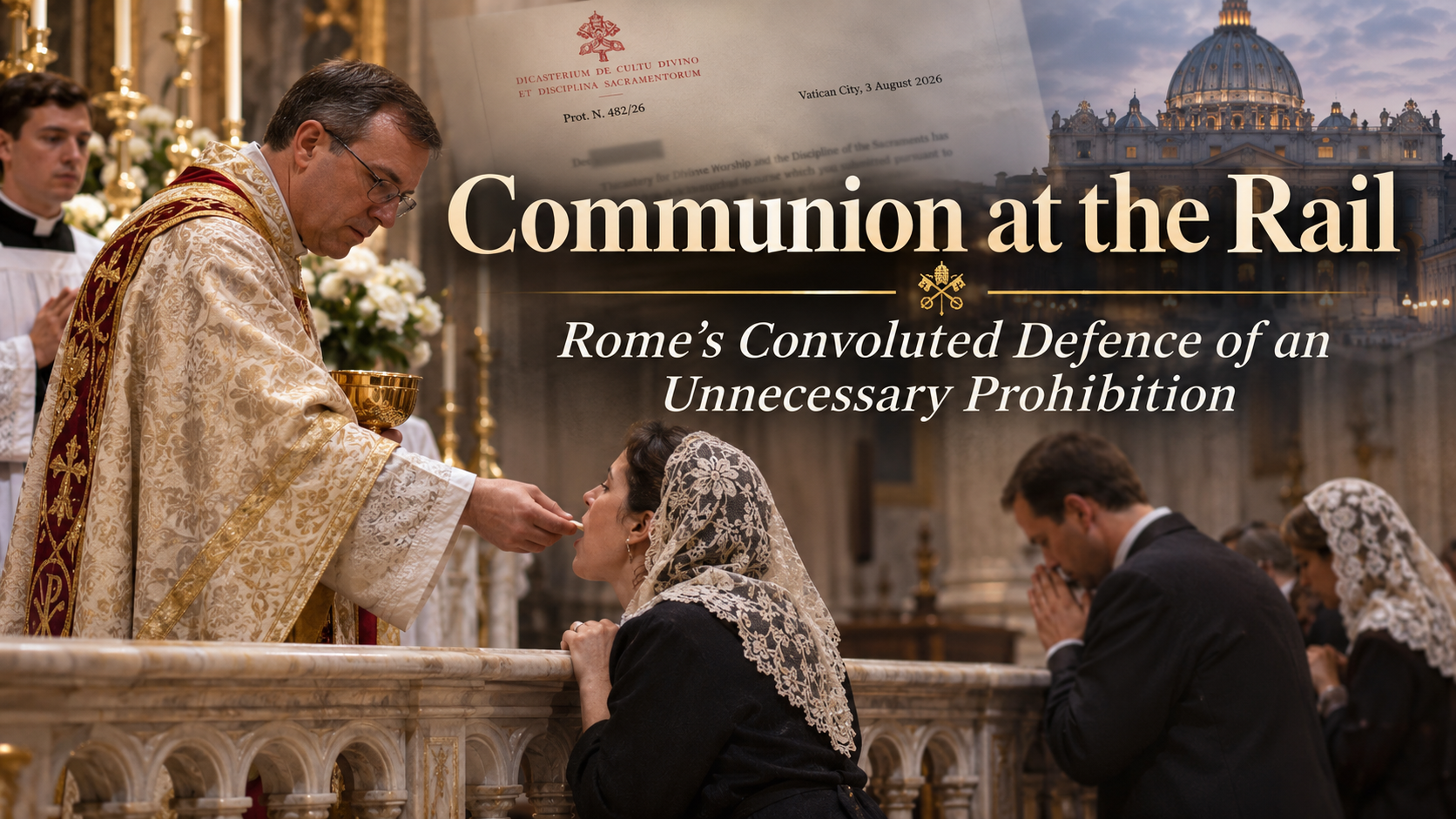
The Vatican’s rejection of a family’s appeal against Bishop Michael Martin’s restrictions on altar rails in Charlotte brings to a troubling conclusion one stage of a controversy which Nuntiatoria has investigated since 2025. Rome has explained why the bishop possesses authority to regulate Communion arrangements. It has been considerably less persuasive in explaining why an established Catholic practice needed to be prohibited, or why a family kneeling at the rail could be passed over without any unlawful denial of the Sacrament.
When Nuntiatoria first examined the restrictions upon altar rails in the Diocese of Charlotte in September 2025, the controversy had scarcely begun to assume its eventual juridical proportions. The immediate question concerned the cessation of a familiar practice in school liturgies. By December, Bishop Michael Martin had extended the prohibition throughout public celebrations in his diocese. Thirty-one priests subsequently sought clarification from Rome concerning the limits of his authority. In April 2026, this publication reported that the Dicastery for Divine Worship had formally acknowledged a recourse concerning the bishop’s handling of liturgical requests. Days later, video footage from a Confirmation Mass at Our Lady of Grace in Greensboro raised a more immediate question: what happens when Catholics present themselves for Holy Communion at the altar rail and the ministers simply pass them by?¹
Rome has now provided an answer. It is an answer whose implications deserve rather more attention than the apparent modesty of the dispute might suggest.
In a three-page decision dated 3 August 2026, bearing Protocol 482/26 and disclosed by Niwa Limbu of AdVaticanum on 18 November, the Dicastery for Divine Worship and the Discipline of the Sacraments rejected a hierarchical recourse submitted by a father whose family had reportedly been passed over on several occasions when kneeling at the altar rail. Signed by Archbishop Vittorio Francesco Viola, OFM, then Secretary of the Dicastery, the letter concludes that the circumstances do not constitute an unlawful denial of Holy Communion. The bishop possesses authority to regulate the places and arrangements for distributing the Sacrament; the family’s decision to approach at a prohibited location therefore did not oblige the ministers to administer Communion there.²
This conclusion bears directly upon the argument developed in our investigation of 1 May, Refusal Without Words? Communion, Posture, and the Quiet Mechanics of Exclusion in Charlotte. That article examined footage showing a family remaining at the altar rail whilst Communion was distributed elsewhere. It distinguished an explicit verbal refusal from an arrangement capable of producing the same practical outcome. The faithful approached, remained kneeling and departed without receiving. The question was whether the law’s protection of sacramental access could be frustrated through the arrangements for distribution without anyone actually pronouncing a refusal.³
The Dicastery has now rejected that interpretation for the circumstances presented in this family’s recourse. Its reasoning merits examination against both the canonical provisions and the factual history of the dispute.
The history is important because the policy did not emerge in December 2025 without warning. Indeed, an illuminating piece of evidence predates the general prohibition by nearly eleven months.
In the parish bulletin of St Mark’s, Huntersville, dated 26 January 2025, the pastor described Bishop Martin’s visit on the Feast of the Baptism of the Lord. During the celebration, the bishop had elected not to distribute Communion at the altar rail, although the parish had maintained that practice for almost a decade. The pastor acknowledged that parishioners were upset and explained the Church’s disciplinary provisions concerning the reception of the Eucharist. He also made the important observation that altar rails remained lawful within the Catholic Church.⁴
This contemporaneous pastoral testimony establishes several things. The established practice was known to the bishop. Its discontinuation had already occasioned distress. The pastor recognised that the Church had not prohibited altar rails, and the issue was therefore understood locally as concerning the bishop’s preferred arrangements rather than compliance with an existing universal prohibition.
Our reporting of September, October and November 2025 followed the extension of this controversy, including restrictions affecting school liturgies, the treatment of the Traditional Latin Mass, and the testimony of a diocesan priest whose concerns reflected wider unease about the direction of liturgical governance in Charlotte. The December intervention made explicit what had increasingly become apparent: the bishop intended to establish a diocesan discipline under which altar rails and kneeling supports would no longer be used for receiving Holy Communion.⁵
His pastoral letter of 17 December directed that altar rails, kneelers and prie-dieux should cease to be used for this purpose by 16 January 2026. Temporary or movable supports were to be removed, although existing permanent rails were not generally required to be physically dismantled. The distinction matters. It is principally their liturgical use which has been prohibited, not their continued existence as architectural furnishings.⁶
The bishop acknowledged that individual Catholics retained the right to receive Holy Communion kneeling. Nevertheless, he argued that the American episcopal norm of standing did not envisage reception at altar rails and that such arrangements visibly contradicted the common posture and processional character of Communion.
Our December editorial, Kneeling Without Rails: How Charlotte Preserves a Right by Destroying Its Practice, examined the weakness of that interpretation. The American adaptation of the General Instruction of the Roman Missal expressly permits an individual communicant to kneel. It does not prohibit altar rails. To infer that an arrangement is unlawful simply because it is not expressly described in modern liturgical legislation is a precarious method of interpretation. The absence of a prescription does not necessarily establish a prohibition.⁷
That remains the essential difficulty.
A Catholic may receive kneeling. An altar rail provides a customary means of doing so. The bishop has prohibited the means whilst continuing to acknowledge the right. Rome has now sustained that distinction, treating the place of reception as a matter capable of being regulated independently of the communicant’s posture.
Before examining the decision further, however, the Roman proceedings themselves require clarification.
On 28 April, Nuntiatoria reported a letter dated 16 February 2026, signed by Fr Pierre Paul, O.M.V., Head of Office at the Dicastery for Divine Worship, under Protocol 369/25. That letter acknowledged a hierarchical recourse concerning the apparent failure of the diocesan bishop to respond to requests about liturgical matters. It was procedural rather than determinative, confirming that the Dicastery would examine the relevant acts.⁸
The August decision disclosed by AdVaticanum bears a different protocol number, 482/26, and concerns the family’s complaint of repeated non-distribution of Communion. The published documents therefore identify distinct proceedings. The rejection of the family’s recourse must not be casually presented as the final disposition of the earlier matter, still less as a definitive answer to the separate dubia submitted by the diocesan priests.
That distinction is important to the integrity of the reporting. Rome’s decision is significant enough without assigning to it conclusions which the document does not contain.
The family’s petition concerned events at Our Lady of Grace in Greensboro, where Communion at the altar rail had reportedly been an established practice for more than five years. The father described several incidents during April and May 2026 when members of his family were passed over after kneeling at the rail. He also explained that his pregnant wife required its physical support when kneeling and rising.
The events of the Confirmation Mass on 29 April received particular attention because video footage showed the family remaining at the rail whilst Communion was distributed elsewhere. Bishop Martin was present in the sanctuary. Our May analysis recognised that no verbal refusal was audible and that the footage did not establish the minister’s motive. It nevertheless identified the visible consequence: communicants presenting themselves at the rail departed without receiving.³
Subsequent evidence has clarified an important factual dispute.
A statement attributed to Fr Christopher Coleman, pastor of Our Lady of Grace, maintained that Bishop Martin had not personally distributed Communion during the Confirmation Mass and consequently had not personally refused the family. According to the statement, Communion was administered at designated stations by the pastor and other priests, including to Catholics who chose to kneel. The family instead approached the altar rail, where the Sacrament was not being distributed.⁹
The statement has been publicly reproduced, although its original provenance has not been independently authenticated. It should therefore be treated as the account attributed to the pastor, rather than an independently verified parish document.
Nevertheless, the distinction is material. The evidence does not justify describing Bishop Martin as having personally refused Communion during that Mass. Nor does it establish that Catholics were refused solely because they knelt, since the parish maintains that other kneeling communicants received at the authorised stations.
What remains undisputed in the competing accounts is the essential circumstance underlying the recourse: the family approached the rail and did not receive Communion there.
This is precisely the distinction upon which the Dicastery relies.
Archbishop Viola begins by characterising the family’s principal argument as an assumption that the right to receive Holy Communion necessarily includes the right to determine individually the place and manner of reception. That proposition is rejected. Canons 843 §1 and 912 protect access to the sacraments, but they do not confer unrestricted freedom to disregard legitimate liturgical arrangements.¹⁰
The general principle is unobjectionable. The faithful cannot insist upon receiving Communion wherever they choose, regardless of the circumstances of the celebration. Ecclesiastical authority possesses legitimate responsibilities concerning good order, the conduct of public worship and the proper administration of the sacraments.
Yet the argument becomes less persuasive when applied to the particular circumstances in Charlotte.
The family did not select an arbitrary place within the church. It approached an established liturgical furnishing at which Communion had customarily been administered. Its use had become impermissible because the bishop had subsequently prohibited it.
There is a substantial difference between claiming an unrestricted right to determine one’s preferred place of reception and questioning whether an ecclesiastical authority possesses sufficient grounds to prohibit an existing, otherwise lawful arrangement.
The Dicastery’s characterisation tends to obscure that distinction.
The letter recognises the protections established by canons 843 §1 and 912, but then invokes canon 843 §2, concerning the obligation of pastors to prepare the faithful for the sacraments through evangelisation and catechetical instruction according to ecclesiastical norms.
This provision has a particular purpose. It concerns preparation for sacramental reception, rather than the extent to which a diocesan bishop may prohibit an existing means of distributing Communion. Its relevance to the present complaint depends upon a broader argument about adherence to legitimate liturgical discipline, an argument which requires rather more explanation than the letter supplies.
The Dicastery concludes that Communion remained available to the family elsewhere, according to the arrangements established by the diocese. The failure to administer Communion at the prohibited rail therefore did not constitute an unlawful denial.
The reasoning is intelligible. Its weakness lies in the assumption upon which its practical application depends.
The very regulation whose justification is contested becomes the decisive ground for determining the lawfulness of its enforcement.
The fact that a communicant has acted contrary to an ecclesiastical regulation may establish a relevant circumstance in judging the conduct of the minister. It does not, by itself, establish that the regulation was properly conceived, proportionate or enacted with the necessary juridical force.
Indeed, this latter question had already been raised publicly.
In January, Dominican canon lawyer Fr Pius Pietrzyk OP questioned whether Bishop Martin’s December pastoral letter possessed the juridical characteristics ordinarily associated with binding legislation. His comments, reported by Religion News Service, also raised the question whether the bishop could withdraw liturgical options which universal law entrusted to the celebrant.¹¹
These observations do not establish the invalidity of the bishop’s instructions. The Dicastery has since affirmed episcopal competence over the arrangements for distributing Communion, citing canons 381 §1 and 838 §4. Yet competence and the proper juridical exercise of that competence are different matters.
A bishop possesses ordinary, proper and immediate authority within his particular Church. He also governs within the limits established by universal law, and his legislative and administrative acts must conform to the relevant canonical requirements. A pastoral letter may convey binding prescriptions, but their juridical effect depends upon their substance and the applicable law, rather than their title alone.
The Dicastery describes the diocesan regulations as legitimate without offering a detailed examination of the formal objection raised by Fr Pietrzyk. This does not prove that Rome neglected a necessary legal step. It does limit the extent to which the published decision supplies a comprehensive answer to that objection.
There is a further difficulty in the authorities invoked to justify liturgical uniformity.
The Dicastery cites Eucharisticum Mysterium §34, which encourages the faithful to adopt the manner of receiving Communion indicated by their pastors so that the unity of the community may be visibly manifested. It also invokes paragraph 42 of the General Instruction of the Roman Missal, concerning common bodily posture as an expression of ecclesial unity.¹²
Neither text establishes a universal prohibition of altar rails.
More importantly, paragraph 42 also requires attention to the traditional practice of the Roman Rite and the common spiritual good of the faithful. Those considerations are directly relevant to an existing altar rail which has long been employed for Communion.
The provision therefore cannot be reduced to an instruction that visible uniformity must prevail regardless of other circumstances.
Nor does Eucharisticum Mysterium establish that every communicant must receive standing. The instruction expressly recognises reception kneeling or standing, whilst encouraging observance of the arrangements indicated by competent pastors. The American adaptation of GIRM §160 similarly establishes standing as the norm whilst preserving the individual communicant’s choice to kneel.
The law therefore expressly accommodates a visible difference of posture. That difference cannot automatically be treated as incompatible with ecclesial unity merely because it occurs at Communion.
The Dicastery’s reasoning leaves the impression that the desirability of common bodily posture is sufficient to justify the withdrawal of a traditional arrangement, without demonstrating why that arrangement’s continued use would compromise the celebration of the Eucharist.
The historical question should not be overlooked. The Second Vatican Council did not order the abolition of altar rails. The subsequent reform of the Roman liturgy and changes in church furnishings cannot all be attributed directly to the Council’s decrees. As Nuntiatoria has argued in its wider examination of postconciliar liturgical history, the distinction between what the Council actually prescribed and what later authorities implemented is essential to any serious discussion of continuity.
Sacrosanctum Concilium §23 expressly required careful investigation before introducing innovations, and stated that new forms should grow organically from those already existing. It cannot be employed as an automatic prohibition of subsequent disciplinary changes, but it does expose the inadequacy of assuming that a longstanding Catholic practice must disappear simply because a later arrangement has become more common.¹³
There is also the question of pastoral accommodation.
The family’s petition referred to the pregnant mother’s need for physical support. Independently, The Catholic Herald reported testimony from a parishioner of St Ann’s who said she could not kneel without an altar rail and had previously fallen when attempting to receive Communion kneeling. The testimony does not establish how widespread such difficulties were throughout the diocese, but it demonstrates that the practical consequences of removing kneeling supports were raised outside the particular family’s complaint.¹⁴
This is where the distinction between retaining a right and making its exercise practicable becomes particularly important.
The bishop’s instructions preserve the individual Catholic’s freedom to kneel, yet prohibit the use of existing furnishings which may enable some communicants to do so safely. Permanent rails may remain physically present, but their use for Communion is forbidden. Movable kneeling supports are to be removed.
A Catholic who wishes to kneel must therefore do so at an authorised station, potentially without the assistance previously available.
That may present no problem for many communicants. It may impose a genuine burden upon others.
The Dicastery gives little attention to that practical consideration. The family could receive elsewhere, it reasons, and consequently no unlawful denial occurred.
Yet the pastoral question remains whether the restriction served a sufficient purpose to justify the inconvenience or difficulty imposed upon those who had previously been accommodated.
There is no evidence in the published Roman decision that use of the altar rail at Our Lady of Grace had produced an identified liturgical abuse, disorder or practical impediment requiring its suppression. Nor does the decision explain why the continued availability of the rail would have compromised the congregation’s unity.
The bishop’s general concern for common liturgical arrangements is apparent. The necessity of this particular prohibition is considerably less so.
This was already the question which Nuntiatoria placed before its readers in December 2025. Our subsequent April and May investigations developed it through the canonical proceedings and the practical events at Greensboro. Rome’s August decision now establishes that the Dicastery has answered it in favour of the bishop’s authority.
The fact that the decision is authoritative within its proper juridical scope must be acknowledged. Equally, it must not be confused with a universally binding declaration that altar rails are unlawful, that the faithful possess no legitimate interest in their continued use, or that all diocesan restrictions of this kind are beyond further juridical examination.
The separate proceedings remain important.
On 5 January 2026, thirty-one Charlotte priests submitted formal dubia to the Dicastery for Legislative Texts, questioning the limits of episcopal authority over liturgical arrangements permitted by universal law. Their questions specifically concerned the prohibition of altar rails and kneeling supports. The intervention was substantial, representing priests entrusted with the pastoral care of Catholics throughout the diocese.¹⁵
In April, Bishop Juan Ignacio Arrieta, then Secretary of that Dicastery, declined to discuss the particular questions publicly, citing confidentiality. No definitive public response to those dubia has been verified in the material examined. That does not establish that no private answer exists.
Nor should the acknowledgement of recourse under Protocol 369/25 be treated as identical with the family’s subsequent recourse under Protocol 482/26.
These distinctions are particularly important because the legal character of a general diocesan regulation is not necessarily the same as that of a singular administrative decision or a minister’s conduct in the distribution of Communion.
Article 181 of Praedicate Evangelium provides for the examination by the Dicastery for Legislative Texts of the conformity of certain laws and general decrees issued by authorities below the supreme authority with universal law. Separately, the Apostolic Signatura possesses jurisdiction over certain alleged violations of law arising from decisions of Roman Curial institutions.¹⁶
The possibility of further recourse against the August decision was identified in AdVaticanum‘s reporting. The applicable procedural rules ordinarily prescribe sixty useful days from notification. The date printed upon Archbishop Viola’s letter does not itself establish when the family received it, and the public record does not verify whether further proceedings have been instituted.
A challenge before the Apostolic Signatura would require an allegation of violation of law, not merely disagreement with a pastoral judgement. Its possible availability must not be mistaken for a prediction of success.
Nevertheless, the broader point remains that ecclesiastical administrative decisions may be subject to juridical examination according to their nature and the remedies established by law.
There is something rather revealing about the tendency to present disputes of this sort as though the recognition of episcopal authority were sufficient to dispose of every objection.
Catholic ecclesiology has never taught that the possession of jurisdiction makes every exercise of jurisdiction pastorally prudent. A diocesan bishop is entrusted with governing a particular Church as a successor of the Apostles. His authority is genuine, and the faithful owe obedience to lawful ecclesiastical governance. He is also bound to exercise that authority for their sanctification and spiritual good, respecting the Church’s universal discipline and the rights recognised by canon law.
The distinction is particularly relevant where the bishop seeks to suppress a longstanding practice which the Church has neither condemned nor universally forbidden.
It is also relevant to the language of synodality and pastoral listening. For several years, the faithful have been encouraged to regard consultation, participation and attention to their experience as important features of ecclesial life. Yet the experience of traditional Catholics in Charlotte presents a more difficult picture. Established practices have been withdrawn, substantial objections have been raised by diocesan clergy, and individual faithful have sought recourse to Rome.
The bishop is not required to accept every objection. The Holy See is not obliged to grant every recourse. But serious objections deserve serious answers, especially where they concern the lawful exercise of sacramental rights.
Our reporting on the implementation of Traditionis Custodes has repeatedly examined the difficulty of reconciling appeals to listening with the withdrawal of liturgical arrangements valued by stable communities of faithful.
Charlotte brings the same difficulty into the ordinary celebration of the postconciliar Roman Rite.
The family was not demanding Mass according to the 1962 Missal. It sought to receive Holy Communion at an established altar rail. The practice is part of the historical liturgical inheritance of the Roman Church and remains lawful in places where competent authority permits it.
It is therefore inadequate to dismiss the dispute as another manifestation of disagreement over the older liturgy. The underlying issue concerns the authority of bishops to suppress existing practices, the limits of that authority and the adequacy of the reasons offered when it is exercised.
A Catholic may acknowledge the bishop’s responsibility for liturgical order whilst questioning whether the prohibition of an altar rail serves that order. One may accept the Dicastery’s competence to decide a recourse whilst finding its reasons insufficiently persuasive. Neither position amounts to the rejection of ecclesiastical authority.
The Roman decision has, in fact, clarified the precise nature of the disagreement.
The Dicastery does not deny the right to kneel. It does not declare altar rails intrinsically incompatible with the reformed Roman liturgy. It concludes that the faithful possess no protected subjective right to require distribution at a particular furnishing where competent authority has established different arrangements.
That may be sufficient to dispose of the individual recourse in the judgement of the Dicastery. It does not answer every question concerning the original prohibition.
The family could receive elsewhere. That is the principal practical consideration advanced by Rome. But the possibility of receiving elsewhere does not establish that the existing rail needed to be taken out of use, nor that accommodating those who required its support would have undermined the good order of the celebration.
The decision supplies a legal explanation of the bishop’s competence, an appeal to common liturgical posture and a conclusion concerning the family’s rights. It offers remarkably little examination of the actual need for the restriction.
The further history now before us makes that omission more significant.
In January 2025, a parish pastor acknowledged distress arising from the bishop’s decision not to use an altar rail which parishioners had employed for nearly a decade. In December, the bishop imposed a general prohibition. Thirty-one priests subsequently sought clarification from Rome. Families and parishioners described both spiritual distress and practical difficulty. The May footage illustrated how the arrangements could result in communicants departing without receiving the Eucharist. In August, the Dicastery rejected the family’s recourse on the ground that Communion remained available according to the diocesan arrangements.
The chronology is instructive because the pastoral objections did not arise after the Roman decision. They preceded the general prohibition, accompanied its implementation and eventually became the subject of formal canonical proceedings.
The prohibition has been upheld. Its necessity remains unproven.
Nuntiatoria argued in December 2025 that the acknowledgment of a right means little if its customary exercise is subsequently made impracticable without sufficient justification. The August decision does not eliminate that concern. It demonstrates that the Dicastery has accepted a distinction between the right to receive kneeling and the use of particular furnishings, whilst declining to find an unlawful denial in the circumstances presented.
That distinction may be capable of juridical defence. Whether it represents wise and proportionate pastoral governance is another question.
An ecclesiastical administration which invokes unity to suppress an established Catholic practice ought to explain what genuine injury to unity would result from its continued observance. In Charlotte, neither the bishop’s pastoral letter nor the Dicastery’s subsequent decision has supplied a convincing answer.
The faithful have been told who possesses authority to regulate the altar rail. They are still entitled to ask why that authority needed to be exercised against them.
- Nuntiatoria, “Reverence Restricted: Charlotte Bishop Bans Altar Rails in School Liturgies,” 12 September 2025; A Priest’s Testimony from the Edge: The Charlotte Letter in Ecclesial Context, 3 October 2025; “The Vanishing of the Altar Rail: Bishop Martin’s Decree and the Battle for Eucharistic Reverence in Charlotte,” 14 November 2025; Kneeling Without Rails: How Charlotte Preserves a Right by Destroying Its Practice, 19 December 2025.
- Niwa Limbu, Exclusive: Vatican Upholds Bishop Martin’s Ban on Communion at Altar Rails, AdVaticanum, 18 November 2026; Dicastery for Divine Worship and the Discipline of the Sacraments, Protocol 482/26, 3 August 2026.
- Nuntiatoria, Refusal Without Words? Communion, Posture, and the Quiet Mechanics of Exclusion in Charlotte, 1 May 2026.
- St Mark Catholic Church, Huntersville, Parish Bulletin, 26 January 2025, “Pastoral Pondering”.
- Nuntiatoria, A Priest’s Testimony from the Edge, 3 October 2025; Rome Opens the File on Charlotte, 28 April 2026.
- Diocese of Charlotte, Bishop Martin Issues Pastoral Letter on Norms for Holy Communion, 17 December 2025.
- Nuntiatoria, Kneeling Without Rails, 19 December 2025; United States Conference of Catholic Bishops, General Instruction of the Roman Missal, §160.
- Nuntiatoria, Rome Opens the File on Charlotte: A Test Case for Liturgical Authority, 28 April 2026; Dicastery for Divine Worship and the Discipline of the Sacraments, Protocol 369/25, 16 February 2026.
- Fr Christopher Coleman, statement attributed to the pastor of Our Lady of Grace, reproduced in I Am the Good Shepherd, 30 April 2026.
- Code of Canon Law, canons 843 §§1–2 and 912.
- Fiona Murphy, New Communion Rules Spark Debate over Bishop’s Authority in Charlotte Diocese, Religion News Service, 9 January 2026.
- Sacred Congregation of Rites, Eucharisticum Mysterium, 25 May 1967, §34; General Instruction of the Roman Missal, §42.
- Second Vatican Council, Sacrosanctum Concilium, 4 December 1963, §23.
- Niwa Limbu, Exclusive: Diocese of Charlotte Reacts to First Sunday after Altar Rail Ban, The Catholic Herald, 19 January 2026.
- The Pillar, Charlotte Priests Submit Dubia to Vatican over Liturgical Changes, January 2026; EWTN News, Dozens of Charlotte Priests Question Vatican over Bishop’s Move to Abolish Altar Rails, Kneelers.
- Francis, Praedicate Evangelium, 19 March 2022, arts. 181 and 197; Supreme Tribunal of the Apostolic Signatura, Lex propria, art. 34 §1.





Leave a Reply